
The Sutton Selective Eligibility Test Explained
A source-led parent playbook for the Sutton SET: the six schools that use it, the two very different outcomes a pass can produce, the 2027-entry dates, and why stage two is nothing like stage one.
 Elspeth Marlow
- 14 min read

If you have spent an evening reading about the Sutton Selective Eligibility Test, you have probably noticed that the pages disagree with each other about the single most basic fact: how many schools actually use it. Some say five. Some say six. The London Borough of Sutton, which runs the admissions round, lists six, and the sixth school changes the strategy for a lot of families.
The second problem is fragmentation. The dates live on one school's site. The exam-day rules live on another school's FAQs. The list of participating schools lives on the council's site. The stage two arrangements live on a third school's admissions page. Nobody assembles them, so parents end up with a half-picture and fill the gaps with generic 11+ advice that does not match what Sutton actually sets.
This guide is a playbook rather than an overview. It walks through the decisions in the order you have to make them, uses the official sources for every factual claim, and is explicit about the one thing nobody can tell you in advance: the pass mark. All dates below are for September 2027 entry, which means testing happens in autumn 2026.
Step 1: Understand what the SET is, and what it is not
The Selective Eligibility Test, usually shortened to the SET, is a single shared screening test sat on one September morning. It is not an entrance exam in itself for the grammar schools. It is a filter that decides who is allowed to sit the real entrance exam a fortnight later.
The test is two papers: a multiple-choice maths paper and a multiple-choice English paper, each taking between 40 and 50 minutes, with a break in between, and content that is broadly based on the Key Stage 2 curriculum (Sutton Grammar admissions FAQs).
Notice what is absent from that description. There is no separately timetabled verbal reasoning paper and no separately timetabled non-verbal reasoning paper in the way families expect from other selective areas. This matters because 11+ formats vary enormously by region, and advice written for Kent, Buckinghamshire or a London consortium will not transfer cleanly. If you want the wider regional picture, our guide to grammar schools near me sets out how different areas structure their tests, and our piece on London consortium tests covers how Sutton sits alongside the capital's other selective routes.
Step 2: Count the schools properly, because there are six
This is where most commercial pages get it wrong. The council names six schools that share the Selective Eligibility Test: Greenshaw High School, Sutton Grammar, Wallington County Grammar, Wallington High School for Girls, Nonsuch High School for Girls, and Wilson's School (Sutton Council selection tests page).
Five of those are grammar schools. The sixth, Greenshaw High School, is a comprehensive that reserves a proportion of places for high-attaining candidates. And the council is explicit that passing means two materially different things depending on which school you are being considered for:
- Pass in respect of one of the five grammar schools, and your child becomes eligible to sit second stage entrance examinations. You are through a gate, not through the door.
- Pass in respect of Greenshaw, and your child becomes eligible to be considered for an ability place. There is no second stage at all.
Read that twice, because it is the most useful sentence in this article. One September test can produce a selective outcome on its own. A family whose child does well on 15 September but would struggle with a long extended-writing paper two weeks later still has a route worth having, provided Greenshaw was part of the plan from the beginning.
Why this changes what you register for
Registration is per school, not a single blanket entry. So the practical question is not just "is my child grammar material?" but "which combination of outcomes am I giving this child access to?" Three sensible shapes:
- Grammar-focused. Register for the two or three grammars that are genuinely commutable, and accept that everything hinges on a strong stage two performance.
- Two-outcome. Register for grammars plus Greenshaw, so the September test can produce a result even if stage two does not go well. This costs you nothing extra on test day because it is the same test.
- Ability-place-led. Register for Greenshaw plus one grammar, treating the grammar as the stretch and the ability place as the realistic target.
Option 2 is the one families most often discover too late, usually in October when the stage two email arrives.
Step 3: Put the 2027-entry dates in your calendar now
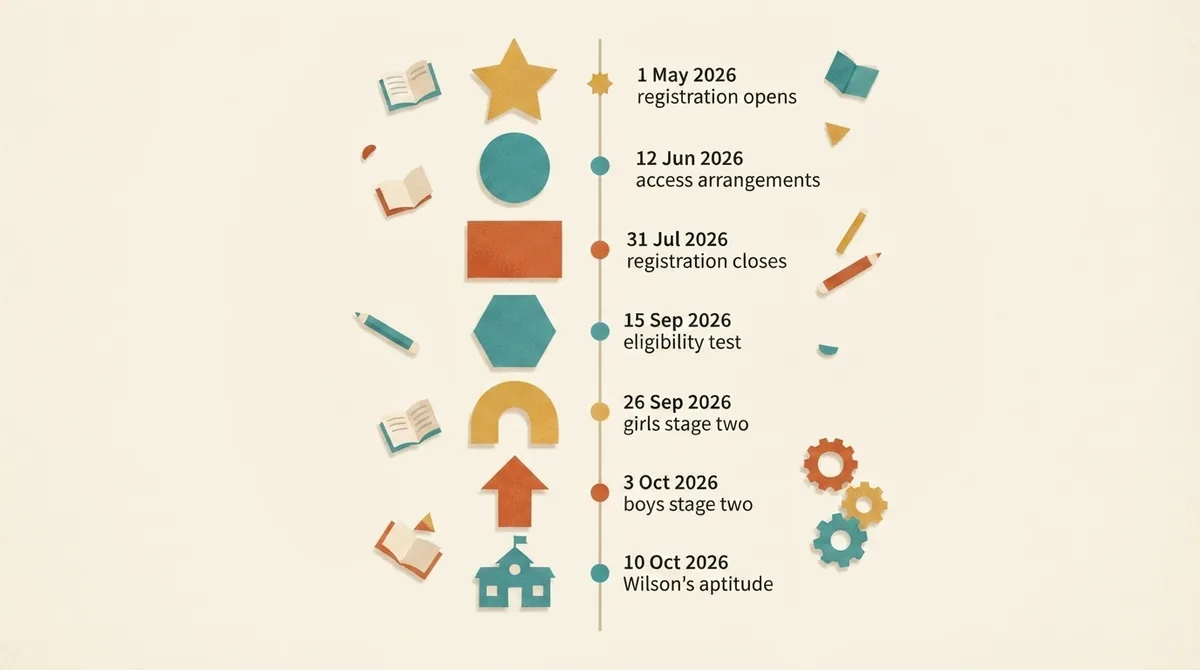
For Year 7 entry in September 2027, the sequence published by Sutton Grammar runs as follows (Sutton Grammar SET page):
- Friday 1 May 2026: registration opens.
- Tuesday 12 June 2026: deadline for access arrangements requests.
- Thursday 31 July 2026: registration closes. This is a hard deadline in the middle of the summer holidays, which is exactly why people miss it.
- Tuesday 15 September 2026: the Selective Eligibility Test is sat, for all six schools.
- Saturday 26 September 2026: stage two for Nonsuch and Wallington High School for Girls.
- Saturday 3 October 2026: stage two for Wilson's, Wallington County Grammar and Sutton Grammar.
- Saturday 10 October 2026: Wilson's aptitude assessments for football and music places.
- Saturday 31 October 2026: deadline for supplementary forms, and also the national deadline for the common application form.
Two warnings on that last date. First, a supplementary or additional form on its own is not an application. The council states plainly that a child "will not be considered for a place at the school unless it has also been named as a preference in your application" (Sutton Council secondary tests and forms). Second, the access arrangements deadline in June sits before most parents have started thinking about autumn at all. If your child has a diagnosed need, that June date is the one to protect.
The lookup below keeps the checked Sutton dates in one place, with the registration link.
This part of the guide looks up which 11+ test your area uses. It works in your browser.
Step 4: Register, and register for the right schools
Registration runs through a shared online portal at suttonset.applicaa.com. You complete one form and indicate which of the participating schools you want your child considered for.
A short checklist before you submit:
- Have you included Greenshaw if a non-grammar selective outcome would be useful to you? Adding it does not change the test your child sits.
- Have you flagged access arrangements, with evidence, before the June deadline?
- Do you understand that you cannot choose the venue? The schools state that "in view of the number of candidates, it is not possible to manage requests for a specific venue." Boys are allocated to Sutton Grammar, Wallington County or Wilson's; girls to Nonsuch or Wallington Girls.
- Is your child going to be physically in the country? There is no overseas provision. To sit the test, the child must be present at one of the participating schools.
Step 5: Prepare for the stage one format, precisely
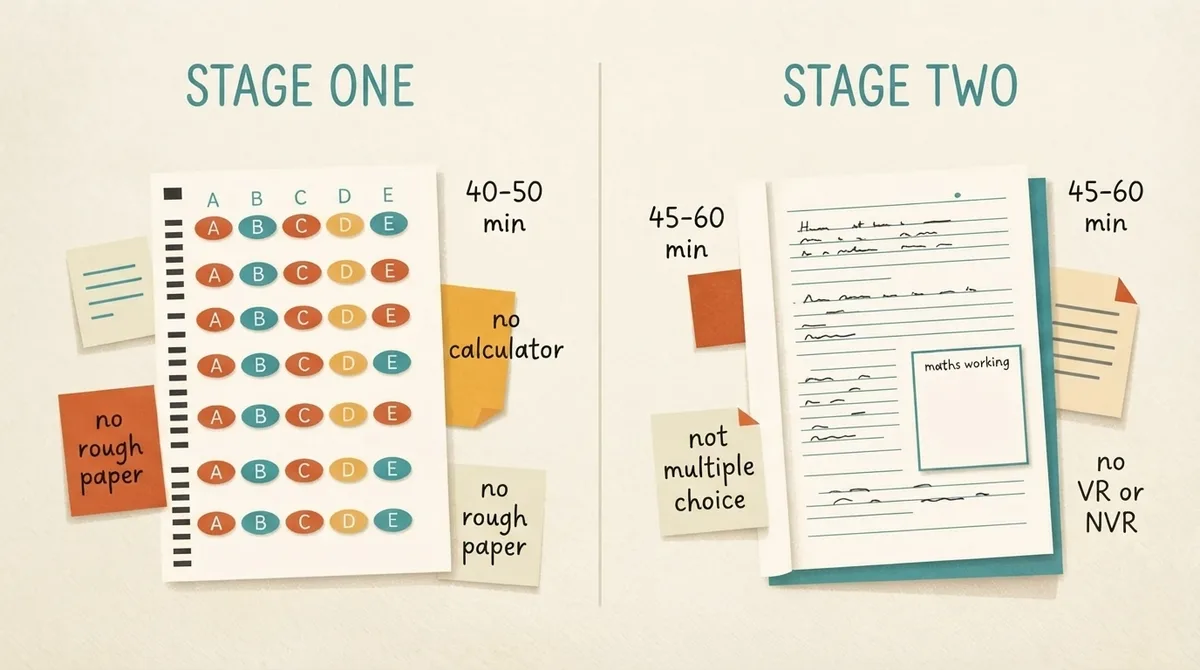
Stage one is a lozenge test. Candidates record answers on a separate answer sheet by filling in lozenges for options A to E (Wallington High School for Girls SET page). The practical consequences are worth drilling explicitly, because they are the things children lose marks to:
- There is no negative marking. A blank is worth exactly the same as a wrong answer, so an unanswered question is a wasted lottery ticket. Every question gets a lozenge, even if it is a guess in the last thirty seconds.
- Some English questions require two answers, and candidates must select both correct answers to gain marks. Half right scores nothing. Children who are used to picking one answer and moving on need to be taught to read the instruction line.
- No rough paper is supplied. Workings go in the space on the question paper. If your child has been practising maths in an exercise book with unlimited space, that habit needs adjusting.
- No calculator or calculator watch may be brought in.
- Sample questions are published, but specimen papers are not. There is no official past paper set to work through.
A worked example of the lozenge risk, using an original question of our own. Suppose a maths item reads: a bag holds 3 red counters, 5 blue and 4 green; one counter is drawn at random, what is the probability it is not blue? Options might run A 5/12, B 7/12, C 1/2, D 4/12, E 3/12. A child who computes 7/12 correctly but shades B on the wrong row of the answer sheet scores zero, and because there is no rough paper they have no scratch trail to catch the slip. The fix is mechanical, not mathematical: answer in blocks of five, then check the row numbers before starting the next block.
Because no specimen papers exist, the useful preparation is timed multiple-choice practice at the real constraint of 40 to 50 minutes per paper. Our free 11 plus practice papers are a reasonable starting point, and our mock test tools let you run the sitting under a clock so the pacing becomes automatic rather than something your child has to think about on the day.
Step 6: Understand that stage two is a different exam entirely
This is the wedge that catches the most families. Almost every generic 11+ resource on this topic pushes multiple-choice verbal and non-verbal reasoning drilling. That is defensible for stage one. It is close to useless for stage two.
Stage two papers cover mathematics and English, each running around 45 minutes to an hour, and the schools state that the tests "will not include verbal or non-verbal reasoning, and are not multiple choice." In practice that means extended writing plus a conventional written maths paper where a child has to produce and present a full answer.
So a child who has spent a year on timed lozenge drills arrives at stage two having practised almost none of the skills being assessed: planning a piece of writing, sustaining it for 45 minutes, showing method in maths, and writing legibly under pressure. Our guides to 11 plus English papers and 11 plus maths papers cover that written work directly.
The three stage two tracks
Competitor pages treat stage two as one event. It is three, on three separate dates.
- Girls' track, Saturday 26 September 2026. Nonsuch High School for Girls and Wallington High School for Girls. Note this falls only eleven days after the eligibility test, which is a very short window for any meaningful change of approach.
- Boys' track, Saturday 3 October 2026. Wilson's School, Wallington County Grammar and Sutton Grammar sit a shared second-stage examination. Wilson's is explicit, though, that the three schools "have different Admissions Criteria" (Wilson's School Year 7 admissions). The same paper, the same performance, three different scoring treatments and three different outcomes.
- Wilson's aptitude assessments, Saturday 10 October 2026. A separate sitting for football and music places, distinct from the academic route.
That second point deserves emphasis. Parents often assume a shared paper means a shared result. It does not. A score that clears one school's bar may sit below another's, because each school weights and ranks according to its own published criteria.
Stage two outcomes are emailed to parents and carers before the October half term break, which gives you a little time before the 31 October application deadline, though not much.
Step 7: Learn how the scoring actually works
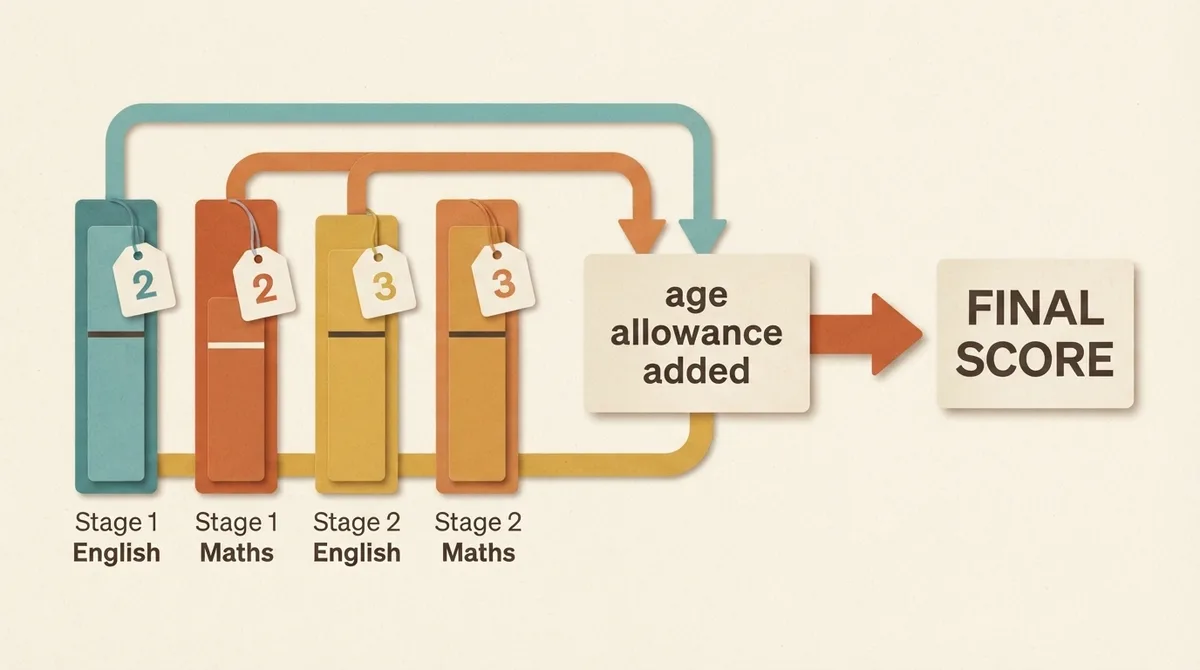
Three mechanics matter here.
Age standardisation. A standardisation for age mechanism is applied to the SET, with adjustments calculated separately for each test. A September-born child and an August-born child are not compared raw.
No published pass mark, ever. Each school sets its pass mark after the test has been sat and marked. The schools state directly that "it is not possible to state a pass mark in advance." Any page or tutor implying they can tell you the cutoff is guessing. Parents receive an outcome email during the week after the test. If your child passes, you are not given a score, only confirmation that the required standard was met. If your child does not pass, you receive standardised scores in both papers, including any age adjustment.
Stage one is not discarded. At Sutton Grammar, four standardised scores are calculated, two from stage one and two from stage two. Those four scores "will be weighted in the ratio 2:2:3:3, an age allowance will be added, and the total rounded to the nearest four marks to give the final score."
Work through what that ratio implies. Stage one contributes four parts out of ten to the final ranking; stage two contributes six. A child who scrapes through stage one and then performs superbly at stage two is carrying a deficit into the final calculation. So treating the September test as a mere gate to be squeaked through is a scoring error, not just a mindset one. Aim to pass it well.
Step 8: Slot the SET into your council application
The test and the application are separate processes, and the test does not apply for anything on your behalf. Sequence it like this:
- Register for the SET by 31 July 2026, naming every school you want your child considered for.
- Sit the test on 15 September 2026 and receive the outcome the following week.
- Sit any applicable stage two paper on 26 September, 3 October or 10 October 2026.
- Complete the Sutton common application form by 31 October 2026, naming the schools as preferences.
- Complete any supplementary or additional forms by the same date, remembering these do not count as an application on their own.
The most common failure here is a family who did everything right in the exam hall and then assumed a strong result carried them into the admissions round automatically. It does not. The preference form is what places your child.
Step 9: Build a preparation plan that respects both formats
A plan that works for both stages splits roughly like this:
- Spring and early summer 2026. Curriculum consolidation across Key Stage 2 maths and English. No exam technique yet. This is also when access arrangements evidence needs gathering.
- Summer 2026. Introduce the stage one format specifically: lozenge answer sheets, no rough paper, no calculator, a 45-minute clock. Track accuracy per topic rather than overall percentage, so you can see what is genuinely weak. A revision timetable helps here more than extra hours do.
- From late August 2026. Run full timed sittings weekly, and start light extended-writing work in parallel. Do not wait for the 15 September result to begin stage two preparation, because the girls' track leaves only eleven days.
- 16 to 25 September 2026. Shift almost entirely to written work: one planned piece of writing and one full written maths paper per week, marked for method and presentation as well as answers.
What is not knowable in advance
Be honest with yourself about the limits of the information. Nobody publishes the pass mark before the test. Nobody publishes the number of candidates in advance. Nobody can tell you your child's chances at a specific school from a mock score, because standardisation, age allowance and each school's own criteria all sit between raw performance and outcome. Anyone selling certainty on those points is selling something else.
What you can control is straightforward: register on time, register for the right combination of schools including a considered decision about Greenshaw, practise stage one under the real constraints, and start stage two written work before you know whether you need it. If you want the practice organised for you rather than assembled by hand, you can create a free account and run timed sittings from there.
Always check the current-year details against the council and school pages before acting, since dates and arrangements are confirmed annually and this guide reflects the position for September 2027 entry.
Topics
- sutton
- set
- grammar schools
- surrey
- 11 plus
- admissions