
Practice Papers and Mock Tests
11 Plus English Papers: Comprehension, SPaG and Writing Tasks
Finding an 11 plus English paper takes thirty seconds; marking one honestly is the hard part. This is a walkthrough of running a full paper at home, from choosing the right format to awarding each comprehension mark and grading the writing task.
 Elspeth Marlow
- 16 min read
Finding an 11 plus English paper is not difficult. Type the phrase into a search engine and you get a page of download directories, several hundred PDFs deep between them, most of them free. The finding problem was solved years ago. What nobody solves is the problem you hit about twenty minutes later: your child has written four lines about why the author chose a particular word, and you have no idea whether it is worth three marks, one mark or none.
That gap is structural rather than lazy. A maths paper marks itself, because the answer is 47 or it is not. English does not work that way. A comprehension answer can quote exactly the right line and still score zero because it never explains the effect of that line. A writing task has no answer key at all, and in some areas it is not even scored by the test. Sutton Grammar states plainly that it does not provide specimen papers. GL Assessment's practice books include answer sheets and general guidance for parents on the test experience, not marking criteria. In Kent, the writing exercise is not marked as part of the test, so there is literally no score for a parent to compare against.
So this article is not another list of links. It is a walkthrough of one full English paper from start to finish: choosing the right format, finding a paper that actually comes with a mark scheme, sitting it under real conditions, awarding each comprehension mark yourself, grading the writing against a five-criterion rubric, and then doing something useful with the result seven days later. Formats vary considerably by region and by school, so treat every timing below as a starting point to check against your own admissions authority.
Milestone one: work out which English paper your child will actually sit
This is the step most families skip, and it quietly wastes months. "11 plus English" is not one exam. It is at least five different things depending on your postcode, and the differences change what you should practise.
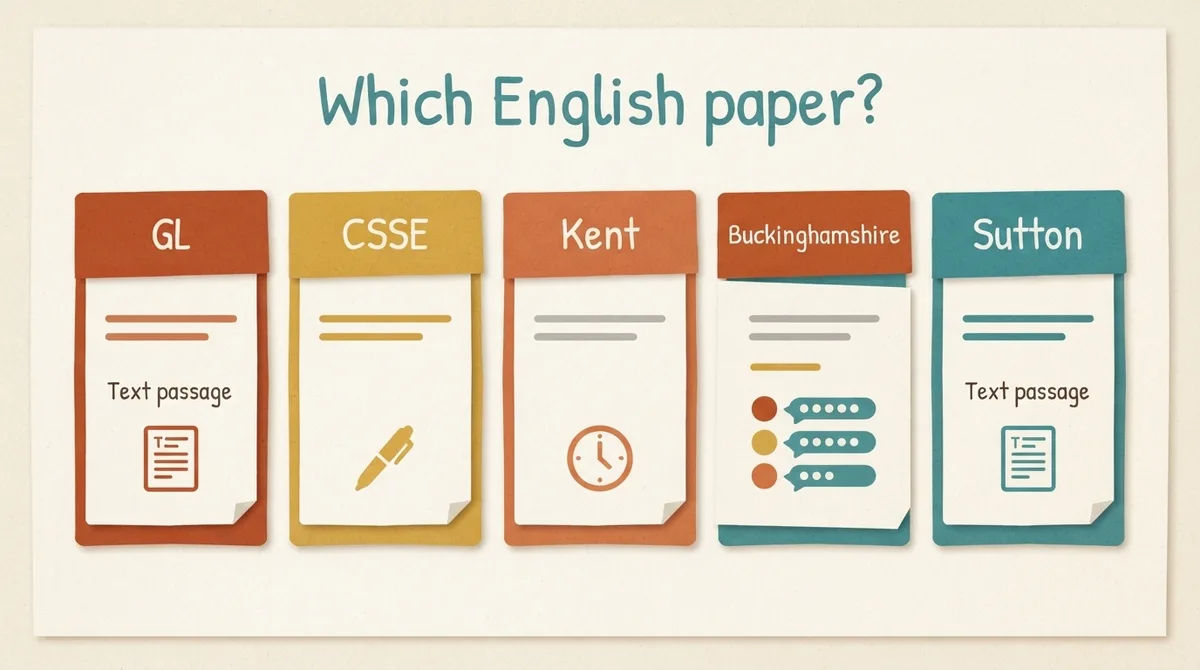
GL Assessment style. The most widely used commercial format. GL's own English practice materials cover comprehension exercises where children read a passage and answer questions on it, use of capital letters and punctuation, spelling questions where children spot mistakes, and word choice and grammar questions. Crucially, GL itself warns that the exact timings and number of questions in your local test may differ from its familiarisation and practice materials, and advises parents to check with their local admissions authority. Treat GL papers as a style, not a specification.
CSSE (Essex). A genuine outlier in a good way. CSSE publishes past materials that include a separate English Continuous Writing Paper alongside the main English paper, plus mark schemes for English and maths. It also publishes a standalone English Continuous Writing sample mark scheme as guidance. If your child sits any writing task anywhere in the country, that document is worth reading.
Kent. The Kent Test opens with a one hour paper covering English and maths, where each section involves a five minute practice exercise followed by a 25 minute test. The English section includes a comprehension exercise plus additional questions drawn from a set designed to test literacy skills. The papers are multiple choice with a separate answer sheet and are marked by computer. There is also a writing exercise with 40 minutes allowed including 10 minutes of planning time, but it is not marked as part of the test. It may be read later by a local headteacher panel as part of the headteacher assessment stage.
Buckinghamshire. There is no standalone English comprehension paper at all. Buckinghamshire Council explains that one paper tests verbal skills including comprehension, technical English and verbal reasoning, while the other tests mathematics and non-verbal skills including spatial reasoning. Each paper is about 45 minutes long, or 60 minutes including the introduction and examples. Practice papers sat in school are shorter, around 40 minutes, and are neither marked nor sent home. A score of at least 121 is considered qualifying for a Buckinghamshire grammar school. You can confirm the current arrangements on the council's secondary transfer testing pages.
Sutton. The Sutton Selective Eligibility Test is two papers, a multiple choice maths paper and a multiple choice English paper, with no verbal or non-verbal reasoning. Each takes between 40 and 50 minutes with a rest and toilet break between them, and content is broadly based on the Key Stage 2 curriculum. Sutton Grammar's admissions FAQs state that it does not provide specimen papers, only downloadable examples of question types.
Independent and single-school formats. These move. The Latymer School, for example, states that its September 2027 assessment will consist of three sections, mathematics, English comprehension and English writing, administered from that year by Quest Assessments. If you are targeting a specific school, check its admissions page every autumn rather than relying on a directory's cached description.
If you want the wider picture of how these regional systems interlock, our guide to 11 plus past papers covers which boards publish what.
Milestone two: find a paper that comes with a mark scheme
Here is the filter that matters. Most free 11 plus English practice papers give you an answer key: a letter for each multiple choice question, and for written answers, at best a one-line "accept any reasonable answer". That is useless for the part of the paper you cannot mark yourself.
Sources that give you real marking information are rare, so prioritise them:
- CSSE publishes English mark schemes alongside its past papers, and separately an English Continuous Writing sample mark scheme. Start at the CSSE practice material page. Note that all CSSE examination papers are protected by copyright, so use them at home rather than redistributing them.
- The Latymer School publishes specimen comprehension sets, including extracts with questions and answers, plus a separate downloadable Writing Mark Scheme on its sample papers page. Two of these worked in parallel will teach you more about marking than fifty answer keys.
- GL Assessment's free familiarisation materials are the official starting point for a GL-style test, with the caveat above about local variation. They familiarise; they do not train you to mark.
- Local authority familiarisation booklets for Kent and Buckinghamshire tell you the test conditions, which is what you need for milestone three.
Our own hub of free 11 plus practice papers is organised the same way, by what each source actually includes rather than by how many links we can fit on a page. If a page offers you thirty 11 plus English test papers and not one mark scheme, it has handed you the easy half of the job.
Milestone three: sit the paper properly, once
A paper sat in fragments over a week tells you nothing about pacing, and pacing is where most marks are lost. Set aside one block. A realistic home setup for a full English paper looks like this:
- Comprehension, 30 to 40 minutes. One passage, one set of questions, no dictionary, no discussion. Match the format your child will actually sit: if it is multiple choice, use a separate answer sheet so the transfer step is practised too.
- SPaG section, 10 to 15 minutes if your target format includes discrete spelling, punctuation and grammar questions.
- Short break. Sutton builds one in between papers; do the same at home.
- Writing task, 30 to 40 minutes including planning. Kent allows 40 minutes with 10 minutes of planning. Enforce the planning time rather than letting your child start writing at minute one.
Write the finish time on the top of the page before your child starts, and let them run over if they need to, but mark where they were when the clock ran out. That single pencil line is often more informative than the total score.
Milestone four: mark the comprehension yourself
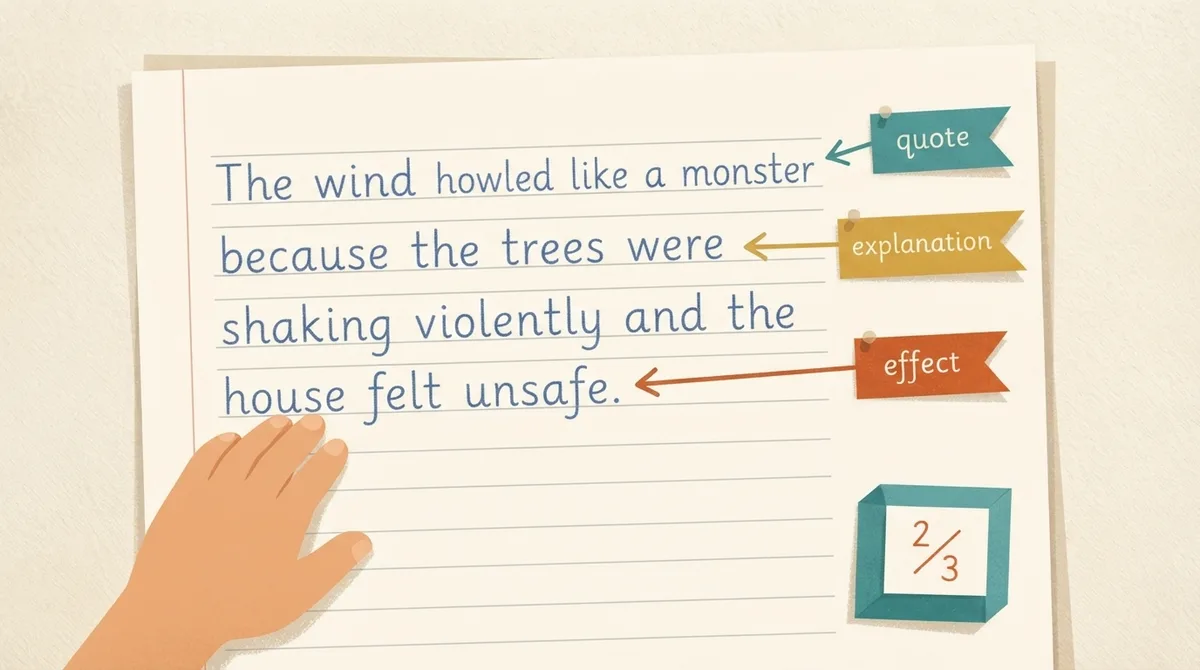
This is the part no directory teaches. The rule underneath almost every 11 plus comprehension mark scheme is simple: marks are awarded for separate pieces of evidence and separate pieces of reasoning, and the mark allocation tells you how many of each are wanted.
Take an original worked example. Suppose the passage contains this line:
The gate had not been opened in forty years, and the ivy had stitched it shut so thoroughly that it looked less like a gate than a green wall with a memory of hinges.
A question might read: How does the writer make the gate seem permanently closed? (3 marks)
Mark it in three separate acts:
- One mark for a relevant quotation or precise reference. "The ivy had stitched it shut" earns it. "It says the gate was closed" does not, because it is a summary rather than a reference.
- One mark for explaining what the language means. "Stitched" suggests the ivy has sewn the gate to its frame, as though it has been deliberately fastened rather than simply overgrown.
- One mark for the effect on the reader, or the inference beyond the literal. The phrase "a memory of hinges" implies the gate has stopped being a gate at all, so the reader understands nobody expects it to open again.
That is the shape: evidence, explanation, effect. A one-mark question usually wants only the first of those. A two-mark question usually wants two distinct points, not one point expressed twice. Our breakdown of 11 plus comprehension question types maps this onto retrieval, inference, language and structure questions individually.
The five near-miss answers
When you mark, most lost marks fall into five recognisable categories. Naming them to your child is far more useful than a score.
- Right quote, no explanation. The child copies the correct line and stops. They have earned the evidence mark and nothing else. Fix: after every quotation, require the words "this suggests" or "this makes the reader".
- Retells instead of infers. The answer paraphrases the passage accurately but never goes beyond it. "He walked away and did not look back" is a retell; "he does not look back, which suggests he has already decided not to return" is an inference.
- Answers from general knowledge. The child explains what usually happens in gardens, or what they think a character would feel, without reference to this text. Nothing outside the passage can earn a mark.
- One-word answer to a three-mark question. Common under time pressure, and the most expensive habit on the paper. The mark allocation is an instruction about length.
- Ignores the actual question verb. "Explain" and "how does the writer" want analysis; "find" and "give" want retrieval. Answering an analysis question with a retrieval answer caps the score no matter how neat the handwriting.
Milestone five: mark the writing task with a rubric you can actually apply
You are not a teacher and you do not need to be. Use five criteria worth five marks each, out of 25. Score each one honestly and independently.
- Task and shape (5). Does it answer the prompt, and does it have a beginning, a middle and a deliberate ending rather than simply stopping?
- Vocabulary and imagery (5). Are word choices precise and occasionally surprising, or general and repeated?
- Sentence variety (5). Is there a mix of short and long sentences, and at least some varied openings rather than a run of "Then I" and "After that".
- Technical accuracy (5). Spelling, punctuation including speech punctuation, paragraphing, consistent tense.
- Reader effect (5). Does any of it land? Tension, atmosphere, humour, a character you can picture.
Two graded model responses to the same task
Task: Write the opening of a story that begins with a locked gate. (30 minutes)
Response A
There was a gate. It was locked and it had been locked for a long time. I wanted to see what was on the other side so I went up to it and pulled it but it did not open. Then I got a stick and tried to move the lock but the stick broke. Then I went home and had my dinner and thought about the gate. The next day I went back to the gate again and it was still locked. I was annoyed about it.
Marks: task and shape 2 (it is on topic but is a list of events with no ending), vocabulary 1, sentence variety 1 (repeated "Then I"), technical accuracy 3 (accurate but very simple), reader effect 1. Total 8 out of 25. Nothing here is wrong. It is simply unshaped.
Response B
The gate had been locked for as long as anyone in our road could remember, and ivy had grown across it until it looked like a green wall. Mum said it led to the old orchard. Dad said it led nowhere at all, which is the sort of thing adults say when they know exactly where something leads.
On the Tuesday after my birthday, I found the key in the pocket of a coat that had never been mine. It was small, cold and unreasonably heavy.
I did not open the gate that afternoon. I stood in front of it for eleven minutes, holding the key, listening to something on the other side that sounded very much like someone waiting.
Marks: task and shape 4 (a clear arc, and it ends on a deliberate hook), vocabulary 4 ("unreasonably heavy", the ivy image), sentence variety 4 (short sentences used for effect), technical accuracy 5, reader effect 4. Total 21 out of 25.
The gap between them is not talent or vocabulary lists. It is three teachable habits: withhold something from the reader, vary sentence length deliberately, and decide the last line before you start writing. Our guide to 11 plus creative writing breaks those down into practice drills.
Milestone six: the seven days after the paper
This is where a downloaded PDF normally ends and where the actual improvement starts. Directories are terminal: you download, you print, you leave. A marked paper is only worth the week that follows it.
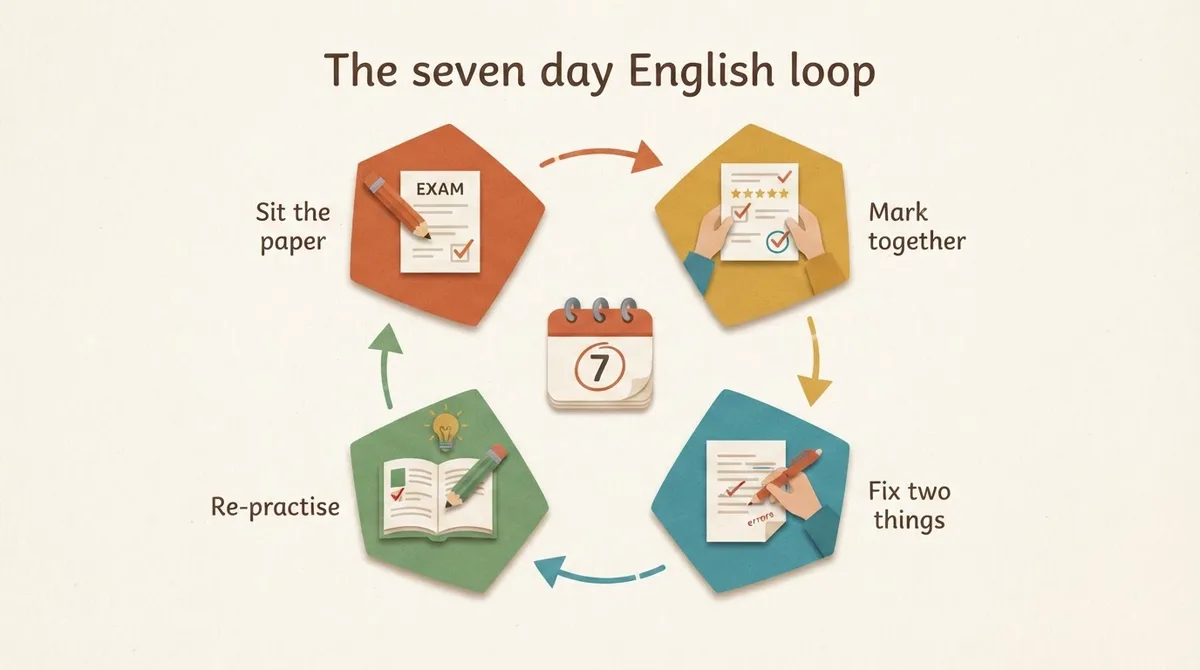
- Day one, mark together. Sit beside your child and mark aloud, saying which of the five near-miss categories each lost mark belongs to. Do not rewrite their answers for them.
- Day two, pick exactly two targets. For example: "always add a sentence beginning this suggests" and "plan the ending before writing". Two, not eight.
- Days three to five, short focused reps. Ten minutes a day on one target: three inference questions, or three story openings of four sentences each. Volume is not the point; repetition of one habit is.
- Day six, rest. English improvement is largely reading, so read something enjoyable and unrelated.
- Day seven, re-practise the same skill, not the same paper. A new comprehension passage, the same question type. If the target has stuck, retire it and pick a new one next week.
One paper per week, marked properly and followed by targeted practice, will move a child further than three unmarked papers a week. If you want the tracking handled automatically, our paper tests run full-length papers, mark the objective sections instantly and log which comprehension question types your child keeps losing marks on, so the two weekly targets choose themselves.
Between full papers, the shorter English practice test below is timed and marks itself, with a worked answer for every question. It is multiple choice, so it does not replace marking comprehension and writing yourself.
This part of the guide is a free timed practice test. It works in your browser.
Frequently asked questions
How many 11 plus English papers should my child do? Fewer than most families think, marked far more carefully. One full paper a week from roughly six months out, each followed by a week of targeted practice, is a sustainable rhythm. Papers sat and never marked teach almost nothing.
My child's 11 plus English exam papers are multiple choice. Does the writing rubric still matter? Usually yes. Several multiple choice areas still require a writing exercise, even where it is not scored by the test itself. In Kent the writing may be read later by a headteacher panel, and many independent schools set a writing task at interview stage. It also builds the vocabulary and sentence control that comprehension questions reward.
Should I use commercial 11 plus English practice papers or school past papers? Both, for different jobs. Commercial packs give volume and consistent difficulty. School and board past papers give you the genuine question style and, in the best cases, the mark scheme. Do the commercial ones midweek and the real ones as your weekly full paper.
How do I mark an answer that is not in the mark scheme? Ask two questions: is it supported by something actually in the passage, and does it answer the question that was asked? If both are yes, credit it. Mark schemes list expected answers, not the only permitted ones.
What score should my child be getting? There is no universal figure, because scores are usually age standardised and thresholds vary by area. Buckinghamshire, for example, treats 121 as its qualifying score, but that is a standardised score from its own tests, not a raw percentage on a practice paper. Track the trend in your child's raw marks and the pattern of lost marks rather than chasing a number.
Where do I start if I have never marked an English paper before? Download one paper with a published mark scheme, mark it yourself first without looking at the scheme, then compare. The places you disagreed with the examiner are the whole lesson. Do that once and every paper afterwards is easier to mark. When you are ready to hand the admin over, you can set up a free account and let the platform handle scoring and tracking while you keep the conversation about the writing.
Topics
- 11 plus english
- comprehension
- creative writing
- practice papers
- marking