
11 Plus Creative Writing: Tasks, Marking Criteria and Model Answers
The official assessment statements markers of KS2 writing work from, what each 11+ exam board actually asks for, and annotated model scripts showing why one answer outscores another.
 Elspeth Marlow
- 15 min read
Almost every guide to 11 plus creative writing tells you the same three things: use ambitious vocabulary, vary your sentence openers, and plan for five minutes. None of them shows you the document a marker of eleven-year-old writing actually works from, and almost none of them tells you whether your child's target school even sets a writing task.
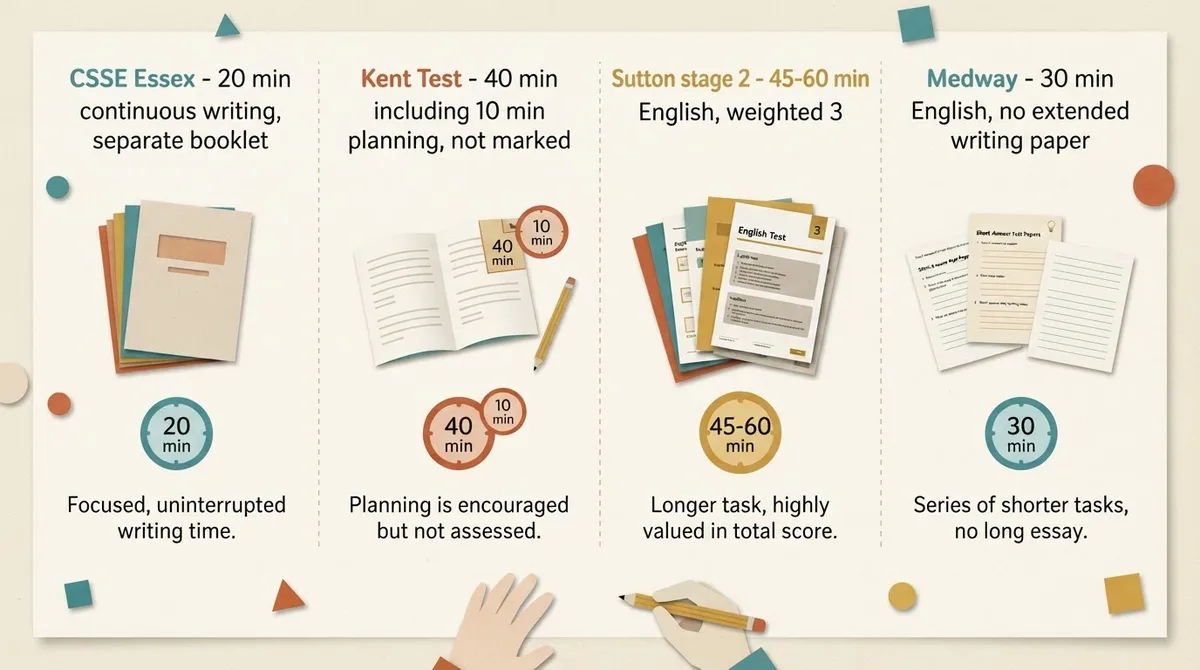
Both omissions matter. The assessment statements used to judge writing at the end of key stage 2 are published in full by the Department for Education and the Standards and Testing Agency, and they are a checkable list, not a mood. And the phrase "the 11 plus creative writing exam" describes at least four different things depending on where you live: a twenty-minute section answered in a separate booklet in Essex, a forty-minute task in Kent that is not marked at all, a heavily weighted written English paper in Sutton, and, in Medway, no extended writing paper on the official list of papers.
This guide starts with what the task is, sorts out which exams include it and how much it counts, publishes the criteria verbatim, then works through annotated model answers, a planning framework sized to your child's real time window, a prompt bank and a home-marking checklist. Formats change, so always confirm details against your own admissions authority before you build a plan around them.
What the 11 plus creative writing task actually is
An 11 plus creative writing task asks a child to produce one continuous piece of writing, usually between 250 and 500 words, in a fixed time window, from a short prompt. There are four common task types:
- Story writing, from a title ("The Locked Door") or an opening line.
- Descriptive writing, where nothing much needs to happen: a place, a person, a moment.
- Extract continuation, where the child reads a passage in the comprehension section and continues or responds to it.
- Non-fiction and personal writing, such as a letter, a speech, a diary entry or a persuasive argument.
The skill being tested is not imagination in the abstract. It is controlled, accurate, purposeful writing produced quickly and by hand. That distinction explains most of the marks: a wildly inventive script with dropped punctuation and a collapsed ending scores below a modest story that is shaped, varied and correct.
Which 11 plus exams include a writing task, and how much it really counts
This is the decision that should shape your preparation, and it is regional. Work out which of these four situations you are in before you buy anything.
If your child sits CSSE (Essex). The official CSSE English familiarisation paper allows ten minutes' reading time and sixty minutes to complete the test, with suggested candidate timings of thirty minutes for comprehension, ten minutes for applied reasoning and twenty minutes for continuous writing. Candidates are instructed to go to a separate booklet on the desk to answer the continuous writing questions. CSSE also states that from September 2024 (2025 entry) the English paper does not contain applied reasoning questions, so the practical time available for writing may differ from the familiarisation paper. See the CSSE familiarisation English paper and the CSSE site. Our guide to what makes the CSSE exam different covers the rest of the paper.
If your child sits the Kent Test. The writing exercise will not be marked, but may be used by a local headteacher panel as part of the headteacher assessment stage. Forty minutes are allowed for the writing task, including ten minutes' planning time. So the writing matters only if your child goes to panel, and it matters a great deal then, because it is one of the few pieces of your child's own work the panel sees.
If your child sits for Sutton. Sutton Grammar School states that the shared second stage test comprises a maths paper and an English paper, that these are not multiple choice and contain no reasoning, and that each runs around 45 minutes to 1 hour. The four standardised scores (SET English and maths multiple-choice items, plus second-stage English and maths papers) are weighted in the ratio 2:2:3:3, with an age allowance added. The written papers therefore outweigh the stage-one multiple-choice items. The detail is on the Sutton Grammar admissions FAQs, and the arithmetic of weighting is explained in our piece on standardised scores and age weighting.
If your child sits the Medway Test. Medway Council's official page states the test is made up of three papers: English, mathematics and reasoning, with the English paper lasting 30 minutes and covering comprehension, punctuation and grammar. No extended writing paper is listed. Several tuition sites still advertise Medway extended-writing preparation; check the Medway Council page before you pay for it.
If you are outside these areas, independent and consortium schools vary widely, and many set a writing task at interview or as a separate paper. Ask the registrar directly.
The marking criteria: the official standards behind 11 plus writing
Grammar schools do not publish mark schemes for writing. What they do have is markers trained on the same national reference point as every state primary teacher: the teacher assessment framework for English writing at the end of key stage 2, published by the DfE and the Standards and Testing Agency.
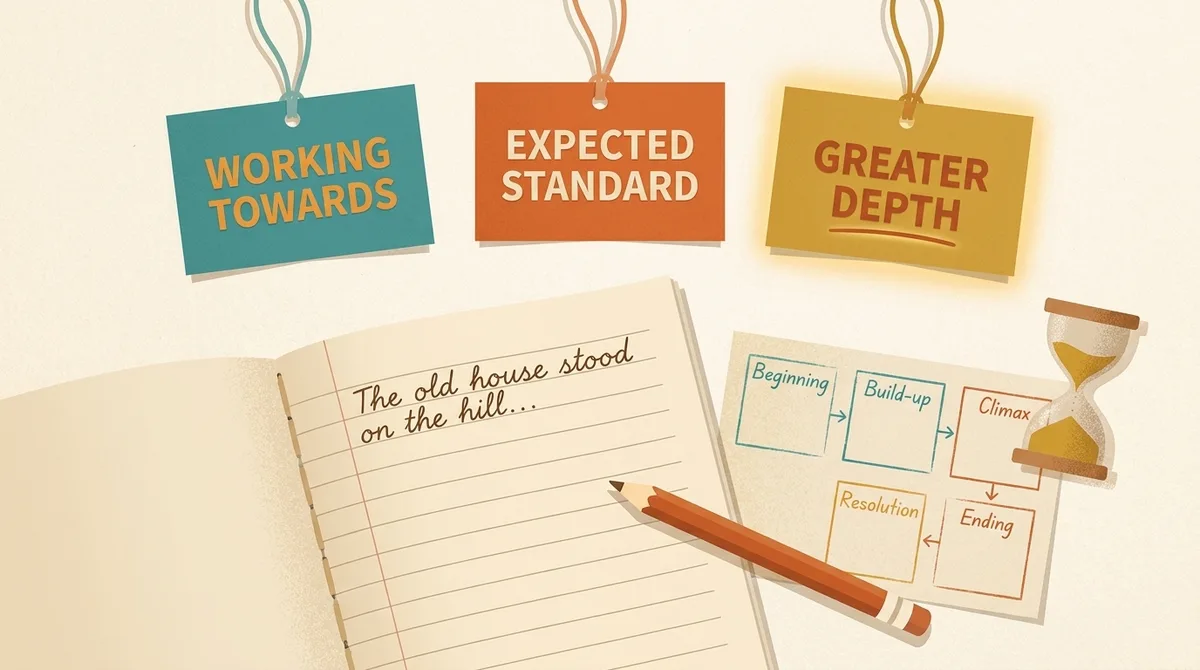
It sets out three standards of attainment: "working towards the expected standard", "working at the expected standard" and "working at greater depth". Each contains "pupil can" statements on which teachers base their judgements. The framework says a pupil's writing "should meet all of the statements within the standard at which they are judged", though teachers may use discretion so a particular weakness does not prevent an accurate judgement overall, an approach that "applies to English writing only".
The framework also defines its qualifiers precisely, which is useful when you mark at home:
- "most": the statement is generally met with only occasional errors.
- "many": met frequently, but not yet consistently.
- "some": the skill is starting to be acquired, demonstrated correctly on occasion, but not yet consistent or frequent.
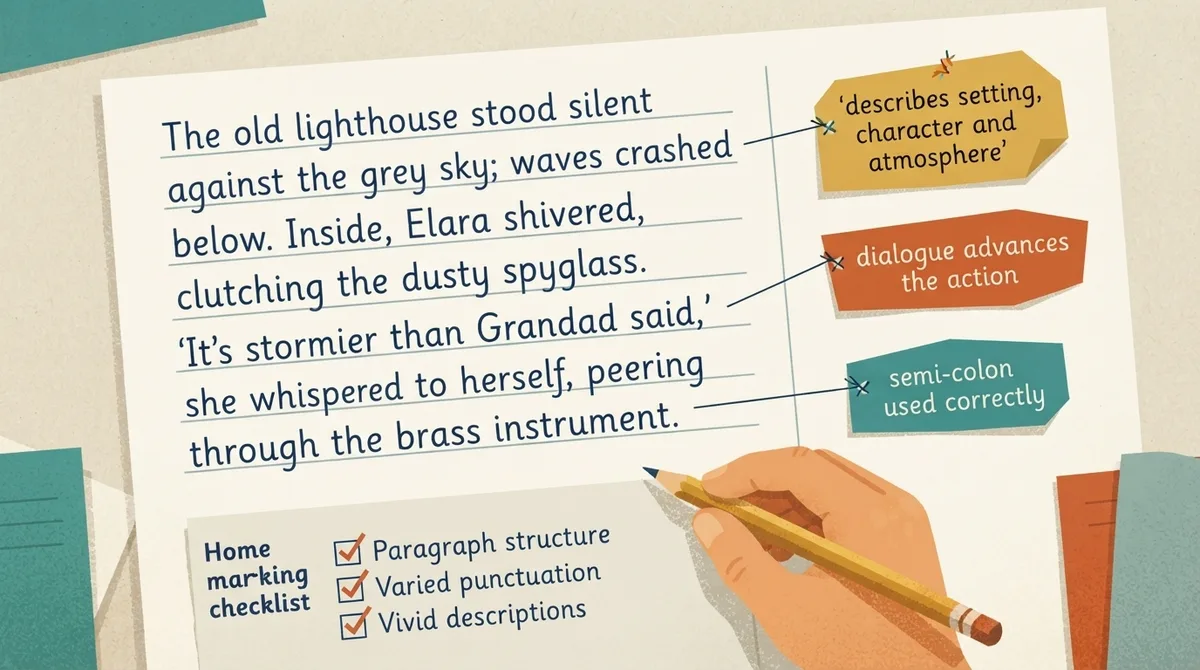
At the expected standard, the pupil can, among other things, "in narratives, describe settings, characters and atmosphere" and "integrate dialogue in narratives to convey character and advance the action". That second statement alone kills the most common weak habit in practice scripts: dialogue that fills space without moving anything.
What "working at greater depth" looks like in an exam script
Treat greater depth as the working definition of a top 11 plus script. The framework states that at this standard the pupil can:
- "write effectively for a range of purposes and audiences, selecting the appropriate form and drawing independently on what they have read as models for their own writing"
- "distinguish between the language of speech and writing and choose the appropriate register"
- "exercise an assured and conscious control over levels of formality"
- "use the range of punctuation taught at key stage 2 correctly (e.g. semi-colons, dashes, colons, hyphens)"
Note what is absent. The framework states explicitly that there are no additional statements for spelling or handwriting at greater depth. The gap between a solid script and a top script is control of form, register, formality and punctuation, not harder spellings. Families who spend months on vocabulary lists and none on register are optimising the wrong variable. Vocabulary still matters for precision, and our 11 plus vocabulary list is worth working through, but it is not what separates the bands.
Story and descriptive writing: model answers, marked and annotated
All examples below are original, written for this guide.
Prompt: "The Last Bus"
Script A (secure expected standard):
The bus stop was cold and empty. Maya looked at her watch again. It was ten past eleven and the last bus was late. "Where is it?" she said to herself. A fox crossed the road and stared at her. She felt scared so she pulled her coat tighter and waited.
What it does: settings and character are described, and there is a controlled attempt at atmosphere. What holds it at expected: "She felt scared" states the emotion rather than building it, the dialogue conveys nothing the narration has not already told us, and the punctuation range stops at full stops and speech marks.
Script B (greater depth):
The shelter smelled of wet metal and old chip paper; beyond it, the road ran black and empty towards the roundabout. Maya checked her watch for the fourth time: eleven minutes past. "You could always walk it," she told herself, in her mother's voice, which was not encouraging. A fox slid out of the hedge, looked at her with complete indifference, and carried on.
Annotations, statement by statement:
- "smelled of wet metal and old chip paper; beyond it, the road ran black and empty": describes settings, characters and atmosphere, and uses the range of punctuation taught at key stage 2 correctly (semi-colon joining two related clauses, colon introducing the time).
- "in her mother's voice, which was not encouraging": distinguishes between the language of speech and writing and chooses the appropriate register. The spoken line is casual; the narrating voice around it is dry and controlled.
- "looked at her with complete indifference": character-through-detail rather than "she felt scared", which is what drawing independently on what they have read as models looks like in practice.
Prompt: describe a market at closing time
Script C (expected): lists sights and sounds in sequence, each sentence beginning with a noun phrase, accurate but flat.
Script D (greater depth): organises the description around one moving observer, shifts formality once (a stallholder's shouted half-sentence against a measured narrator), and uses a dash for an aside. The task is descriptive, so there is no plot; the marks come from selecting the appropriate form and sustaining a register, not from inventing an incident.
Extract continuation and non-fiction: model answers, marked and annotated
Extract continuation. Where a paper asks a child to continue a passage, the hidden criterion is drawing independently on what they have read as models. The continuation must inherit the extract's tense, narrative person and register.
Script E (expected): continues the plot sensibly but slips from past to present tense twice and from a formal Victorian narrator into modern idiom ("the man was really annoyed").
Script F (greater depth): holds the tense, keeps the elevated register, and uses one line of dialogue that both reveals the speaker's class anxiety and pushes the scene forward, satisfying integrate dialogue in narratives to convey character and advance the action.
Non-fiction. For a letter, speech or diary entry, formality is the whole game.
Script G (expected): a persuasive letter to a headteacher with good arguments, but a wobble in tone ("it would be well annoying if"), which fails conscious control over levels of formality.
Script H (greater depth): opens with a concession ("I understand the timetable is already crowded"), holds a courteous register throughout, uses a colon to introduce a three-part list, and closes by naming a specific, costed request. Same idea, controlled delivery, higher band.
The general rule to teach: for every script, ask who is this addressed to, and what does that let me sound like? before writing a word.
The planning framework that fits your child's real time window
Generic advice says "plan for five minutes". That is wrong in most regions. Size the plan to the actual task.
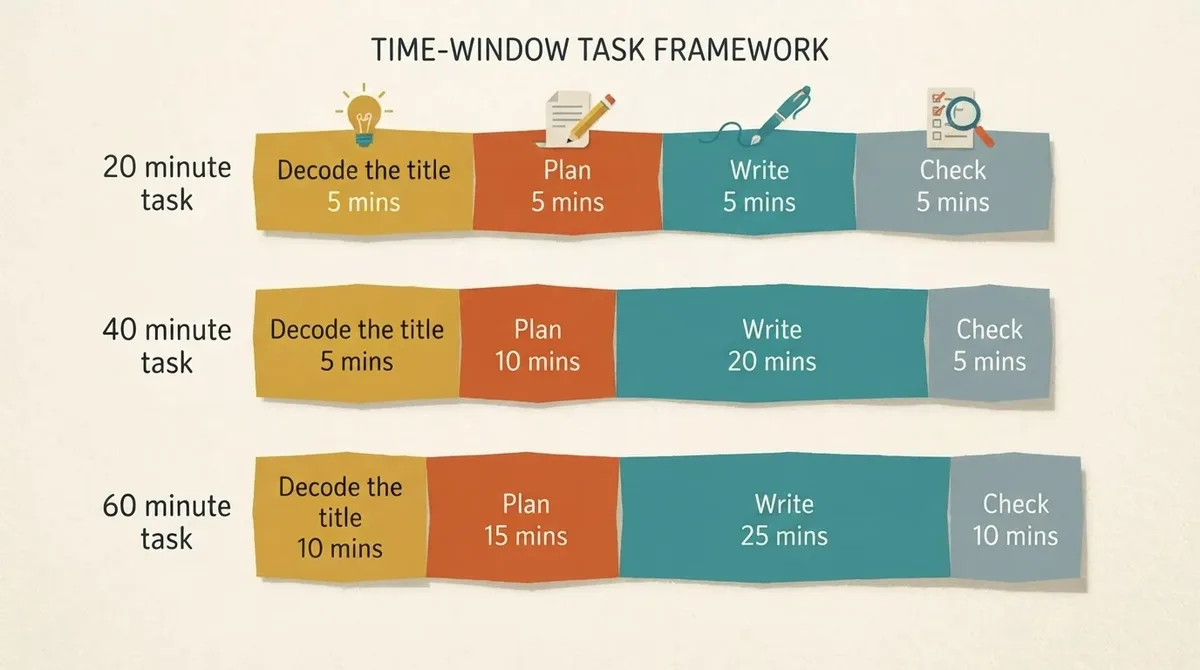
Twenty-minute task (CSSE-style continuous writing): 1 minute decoding the title, 2 minutes planning, 15 minutes writing, 2 minutes checking. The plan is five bullets: opening image, character want, complication, turn, last line. Write the last line first. Children who know their ending do not run out of paper mid-climax.
Forty-minute task with ten minutes' planning built in (Kent-style): use the full ten minutes properly. Two minutes generating three possible angles, one minute choosing, five minutes building a paragraph-by-paragraph plan with one planned punctuation move per paragraph, two minutes listing five precise nouns and verbs you intend to use. Then 25 minutes writing and 5 minutes checking.
Forty-five to sixty-minute English paper (Sutton-style stage two): the writing sits alongside comprehension, so budget backwards from the paper, not the task. Decide your split before the exam and rehearse it under a timer.
In every version, the check phase is non-negotiable: read for missed capitals and full stops first, then for one sentence you can upgrade with a semi-colon, colon or dash. Two minutes of that reliably moves a script.
25 practice prompts by task type
Story titles (1-8): The Last Bus; The Locked Door; A Promise I Could Not Keep; The Day the River Froze; Found in the Attic; The Wrong Address; Three Minutes Early; The Visitor Nobody Saw.
Opening lines to continue (9-13): "By the time I noticed, the tide had already reached the steps."; "He had not spoken since Tuesday."; "The letter was addressed to someone who had never lived here."; "We agreed never to mention the fire again."; "The lights in the hall went out one row at a time."
Descriptive (14-18): a market at closing time; a hospital waiting room at 3am; the moment before a storm breaks; an empty school in the holidays; a station platform in fog.
Personal and diary (19-21): a day you changed your mind about someone; the diary entry of someone who has just moved country; a moment you were braver than you expected.
Non-fiction and persuasive (22-25): a letter to your headteacher arguing for a change to the school day; a speech to your year group about a cause you care about; an article advising younger children about starting secondary school; a balanced piece on whether homework should be set at weekends.
Work through these under a timer that matches your region. If you want them delivered in exam conditions with timing data, our mock tests run the full paper rather than the task in isolation.
How to mark your child's writing at home
Use this checklist, built from the official statements. Score each line "most", "many" or "some", using the framework's own definitions above.
- Is the form right for the purpose and audience, and sustained to the end?
- In narrative, are setting, character and atmosphere described rather than announced?
- Does every line of dialogue either reveal character or advance the action? Delete any that does neither.
- Is the register consistent, and is any shift in formality clearly deliberate?
- Is there correct use of semi-colons, colons, dashes or hyphens at least once, and no misuse?
- Are paragraphs used to mark shifts in time, place or focus?
- Is spelling of common and taught words secure, and is handwriting legible at speed?
The mistakes that cost the most marks, in order of frequency: an ending that stops rather than resolves, because the child overspent on the opening; dialogue used as filler; "showing off" vocabulary used slightly wrongly, which reads worse than a plain accurate word; and a story so ambitious that it cannot close in 400 words. A single scene, closely observed, outscores a saga every time.
Mark one piece a week, not five. Rewriting one paragraph in response to one specific statement teaches more than a fresh script with ticks on it. Tracking which statements keep recurring is exactly the kind of pattern our progress tracking is designed to surface, our broader 11 plus English guide shows how writing fits alongside comprehension and grammar, and its companion guide to every 11 plus maths topic and question type does the same job for the other half of the exam.
11 plus creative writing FAQs
How long should the piece be? Long enough to be shaped and finished in the time allowed. For a twenty-minute task that is often 250 to 350 words; for a forty-minute task, 400 to 500. A finished shorter piece beats an unfinished longer one.
Does handwriting count? Legibility at speed matters, and an unreadable script cannot be credited. But the framework adds no extra handwriting requirement at greater depth, so beyond legible-and-fast, further effort is better spent elsewhere.
Should my child memorise a story to adapt? No. Prepared stories bent to fit an unrelated title read as exactly that, and they undercut the requirement to select the appropriate form for the task. Prepare flexible ingredients instead: two settings you can describe well, a handful of precise verbs, one reliable structure.
Is creative writing worth preparing for if our region does not mark it? In Kent, yes, but proportionately. The task is unmarked at the test stage yet may be seen by a headteacher panel, so a competent, complete, legible piece protects a borderline application without needing months of drilling.
Where do we start if we are new to all this? Confirm your admissions authority's format first, then build the rest of the plan around it. Our what is the 11+ parent guide covers the sequence, and you can start a free account to try timed writing tasks alongside the other papers.
Check every regional detail above against your own admissions authority and the exam body's current materials before you plan, including the Kent County Council Kent Test pages, because arrangements are reviewed annually.
Topics
- 11 plus
- creative writing
- english
- marking
- model answers