
11 Plus Vocabulary: Word List and How to Learn It
A tiered 11 plus vocabulary list with definitions and example sentences, built from what real GL and CSSE papers actually ask. Includes a day 1, 3, 7 and 21 revision schedule and free printable flashcards.
 Elspeth Marlow
- 13 min read
Search for an 11 plus vocabulary list and you will be handed 300 words, 500 words, or 1,800 words, with the same implicit promise attached: learn these and your child is covered. Almost none of those pages show you a single real exam question. That matters, because when you read the official sample papers, the list model quietly falls apart.
The Buckinghamshire Secondary Transfer Test Familiarisation Booklet, produced by GL Assessment, includes a worked English vocabulary question against a rainforest passage: it asks which of five options is closest in meaning to rely, and the answer is depend. Both are ordinary words. Neither appears on anybody's "tricky words" list. Meanwhile the Consortium of Selective Schools in Essex (CSSE) familiarisation English paper devotes its single largest question, worth 12 of the paper's 45 marks (about 27%), to finding a word in the passage that matches a given phrase such as "wild/natural", "bit by bit" or "tiny amount". You cannot revise for that from a list, because the text supplies the answer.
So this guide does two things differently. First, it starts from what the papers actually ask and tiers the words on that evidence, giving every word a definition and an example sentence. Second, it gives you a dated schedule (day 1, 3, 7, 21) and a way to test the words rather than skim them. Formats vary by region, so check your own admissions authority, but the underlying skill is the same everywhere.
What "11 plus vocabulary" really means
A vocabulary list is a memory aid. The 11+ is a retrieval test. Those are not the same thing, and the gap between them is where most revision time is wasted.
Consider the conditions. In Buckinghamshire, children sit two papers of roughly 60 minutes each; the Verbal Skills paper splits into English (25 minutes plus 5 minutes practice) and Verbal Reasoning (20 minutes plus 5 minutes practice). Every question is multiple choice and marked by computer. No dictionary, no watch, no calculator, no scrap paper, no electronic device is allowed in the room. That is roughly 45 working minutes in which a word must surface unaided or not at all.
Now consider proportion. The Department for Education's Key Stage 2 English reading test framework, which shapes the reading diet these children arrive with, allocates the content domain "give / explain the meaning of words in context" 5 to 10 marks, or 10 to 20% of a 50-mark paper. A related domain about how meaning is enhanced through word choice gets 0 to 6%. Vocabulary is important. It is not the paper.
And the statutory baseline is far smaller than the internet suggests. The national curriculum's English Appendix 1 states that the word lists for Years 3 and 4 and Years 5 and 6 are statutory, and that the 100 words in each list can comfortably be taught across Key Stage 2. One hundred words, not eighteen hundred.
How vocabulary is actually tested: four question types
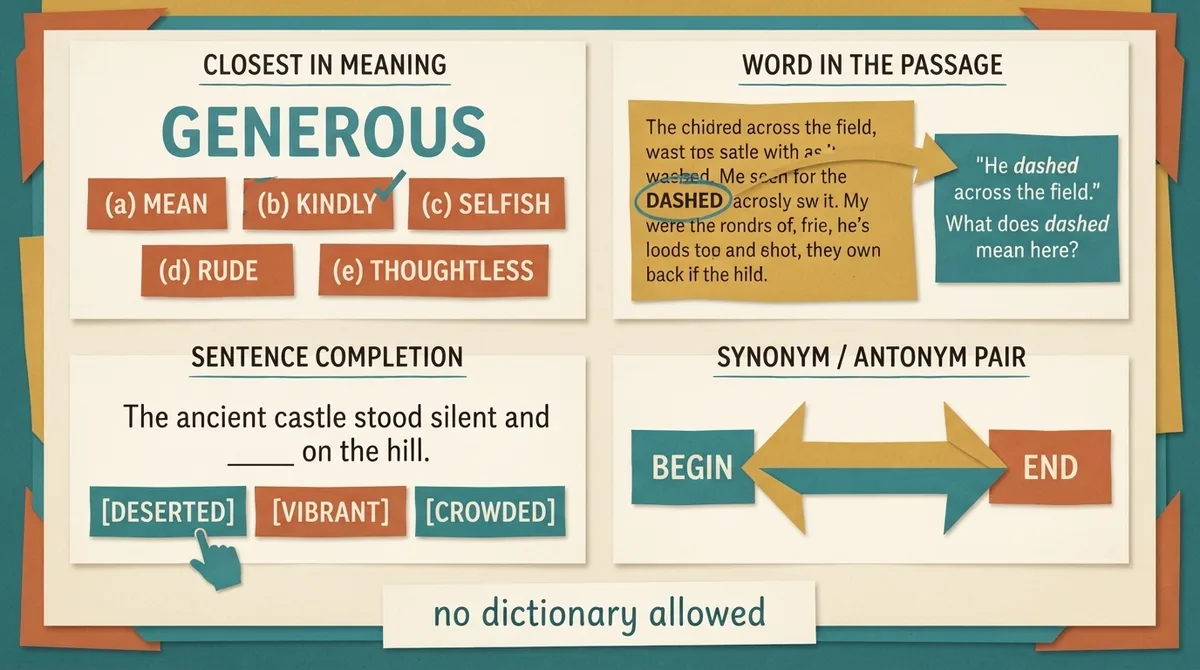
1. Closest in meaning. A word is quoted from a passage with a line reference, and five options follow. The GL-produced Buckinghamshire booklet's worked example targets rely and answers depend. The difficulty is not rarity, it is discrimination: the distractors are plausible neighbours, so your child needs the precise sense, not a fuzzy association.
Original worked example. The passage says the villagers had to rely on the river for water. Options: protect, depend, respond, help, develop. Help feels close because rivers help people. But swap each option into the sentence and only depend on works grammatically and in sense. Substitution is the technique, not recognition.
2. Find the word in the passage. The CSSE familiarisation paper's Question 12 asks pupils to select from the passage one word most closely corresponding to a word or phrase on the left, with prompts including "wild/natural", "skilful", "disbelieving" and "tiny amount". Twelve marks. There is no list on earth that prepares this; the skill is scanning a text for a synonym you have been shown in paraphrase.
3. Shades of meaning within a text. The same CSSE paper asks which four words in a short span suggest a lot of noise (4 marks) and which two suggest silence (2 marks). This rewards a child who notices clamour, din and hush as belonging to families.
4. Sentence completion and word relationships. The Buckinghamshire booklet confirms children may be shown a sentence with words missing and asked to pick the best word to complete it. In verbal reasoning, GL Assessment describes its tests as assessing similarities and differences between words and understanding of the rules and meaning of language, which is where synonym and antonym pairs live. Our 11+ verbal reasoning guide breaks those question families down further.
Why we tiered this list instead of publishing 1,800 words
Three of those four question types are won by high-frequency Tier-2 vocabulary: the words that appear across subjects and text types but rarely in casual speech. Rely, gradually, reluctant, conceal. Only the fourth type rewards the exotic. So the list below is tiered by the job each word does.
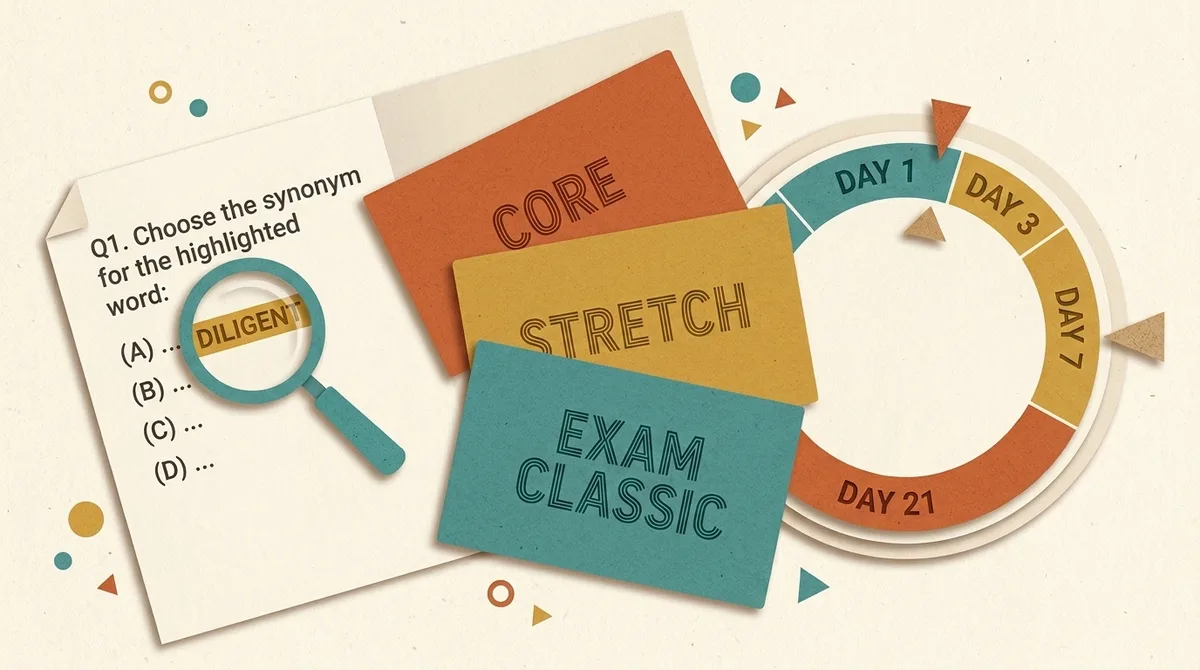
- Core tier: high-frequency words that plausibly appear in a Year 6 passage and carry closest-in-meaning and sentence-completion marks.
- Stretch tier: less common but still passage-realistic words that separate a solid score from a competitive one.
- Exam-classic tier: synonym and antonym pairs that recur in verbal reasoning because they pair cleanly.
Every entry gets a meaning and a sentence, because a word learned without a context sentence fails the substitution test above.
The core tier: 11 plus vocabulary words to learn first
- Abundant - existing in large quantities. Rainfall was abundant, so the crops needed no watering.
- Adjacent - next to or adjoining. Their tent stood adjacent to the boathouse.
- Anxious - worried or uneasy. She grew anxious as the coach failed to arrive.
- Conceal - to hide deliberately. He tried to conceal the letter beneath a book.
- Deliberate - done on purpose. The delay was deliberate, not an accident.
- Diminish - to become or make smaller. The noise diminished as the crowd left.
- Elaborate - detailed and complicated. The cake had an elaborate pattern of icing.
- Feeble - weak, lacking strength. A feeble light showed at the far window.
- Fragile - easily broken. The fragile glass jar cracked in the frost.
- Gradually - slowly, bit by bit. The mist gradually cleared from the valley.
- Hesitate - to pause before acting through doubt. She hesitated before answering the question.
- Immense - extremely large. An immense oak dominated the field.
- Isolated - far from others, alone. The cottage was isolated on the moor.
- Peculiar - strange or unusual. There was a peculiar smell in the corridor.
- Persuade - to convince someone to do something. He persuaded his sister to help.
- Reluctant - unwilling, hesitant. The dog was reluctant to enter the water.
- Rely - to depend on for support. Villagers rely on the river for water.
- Scarce - hard to find, in short supply. Fresh fruit was scarce that winter.
- Vast - very great in size or extent. A vast plain stretched to the horizon.
- Vivid - producing strong, clear images. She gave a vivid account of the storm.
Twenty words is one sensible batch. Learn these to automatic recall before opening the stretch tier.
If you want the full list rather than a starter batch, the free 11 plus vocabulary word list has 254 words in its own three tiers (foundation, strong and stretch) across fourteen themed sections, each with a meaning, an example sentence, similar and opposite words and its word family, and a link to the exercise that practises it. You can search it online or download the printable colour PDF (there is also a printer-friendly black-and-white edition); both have a tick box beside every word.
The stretch tier: words for a competitive score
Qualifying standards vary by area, and some are published openly: Buckinghamshire, for example, states that a Secondary Transfer Test Score of 121 or more qualifies a child for grammar school. We cover regional variation in our guide to 11+ pass marks and qualifying scores. Where places are tight, the stretch tier is where marks are found.
- Apprehensive - nervous about something ahead. He felt apprehensive before the interview.
- Bewildered - completely confused. The bewildered traveller studied the map again.
- Candid - honest and direct. Her candid answer surprised everyone.
- Diligent - hard-working and careful. A diligent search uncovered the missing key.
- Formidable - impressive and rather intimidating. They faced a formidable opponent.
- Meticulous - extremely careful about detail. His notes were meticulous.
- Monotonous - dull through lack of variety. The monotonous drip kept her awake.
- Obscure - unclear or little known. The origin of the custom is obscure.
- Perilous - dangerous. The perilous path ran beside a cliff.
- Resilient - able to recover quickly. Resilient plants survived the frost.
- Sceptical - doubting, not easily convinced. She was sceptical of his excuse.
- Tranquil - calm and peaceful. The tranquil lake mirrored the hills.
Exam-classic synonyms and antonyms for 11 plus verbal reasoning
These pair reliably, which is exactly why they recur. Learn them as pairs, not singly.
Synonym pairs:
- ancient and antique
- brave and valiant
- silent and mute
- begin and commence
- angry and irate
- wealthy and affluent
- odd and peculiar
- plenty and ample
Antonym pairs:
- expand and contract
- praise and criticise
- generous and miserly
- ascend and descend
- transparent and opaque
- ancient and modern
- temporary and permanent
- artificial and natural
Roots, prefixes and suffixes that unlock hundreds of words
The national curriculum makes the point directly: pupils need to understand the role of morphology and etymology, giving the example that seeing the link between medical and medicine helps with spelling. The same link helps with meaning, and it scales in a way that memorising does not.
- aud (hear): audible, audience, auditorium
- spec / spect (look): inspect, spectator, conspicuous
- port (carry): transport, portable, export
- dict (say): predict, dictate, contradict
- bene (good): benefit, benevolent, beneficial
- mal (bad): malice, malnutrition, malfunction
- circum (around): circumference, circumnavigate
- -ible / -able (capable of): legible, sustainable
A child who knows bene and mal can make a sensible guess at benevolent in a passage without ever having met it. That is the retrieval skill the exam is testing.
The spaced-repetition schedule: day 1, 3, 7 and 21
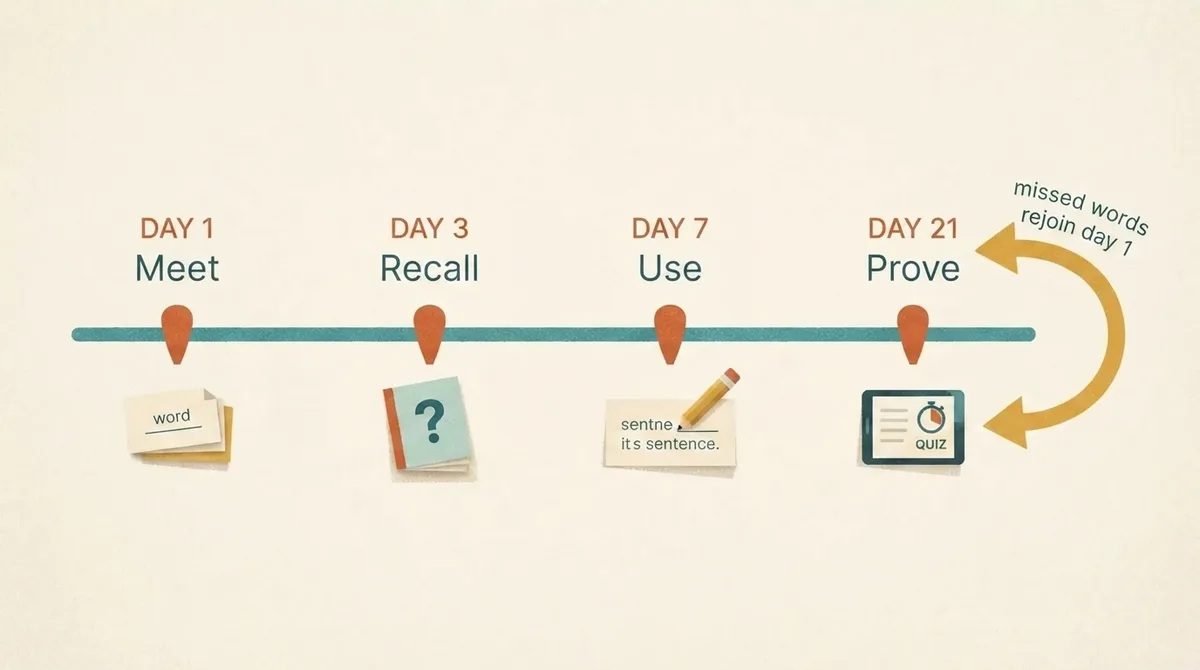
Most advice says "work through part of the list each week". That is not a plan. Here is one. Take ten words per batch, start a new batch every Monday, and run each batch through four dated touches. Total time is about 40 minutes per batch, spread over three weeks.
- Day 1 (10 minutes): meet the word. Read word, meaning and example sentence aloud. Your child then writes one new sentence of their own for each word. No copying the example.
- Day 3 (8 minutes): recall cold. Cover the meanings. Show only the words. Your child says the meaning aloud. Mark each one right or wrong. Wrong ones go straight back into tomorrow's list, not to day 7.
- Day 7 (10 minutes): use it under substitution. Read a short paragraph from any book. For each batch word, ask: could this word replace a word in that paragraph, and would the sentence still make sense? This trains the exact skill in the closest-in-meaning question.
- Day 21 (12 minutes): prove it against the clock. Ten mixed questions, roughly 60 seconds each, matching the exam formats: five closest-in-meaning, three sentence completions, two odd-one-out. Anything missed rejoins day 1 in a new batch.
At ten words a week from January, a child covers the core and stretch tiers here with room to spare, and covers them properly. If you want the batches slotted into a wider week, our 11 plus revision timetable guide shows how to fit them around comprehension and the maths topics and question types your child also has to cover.
Test the words, do not skim them
Skimming a list produces recognition. The exam demands recall. The difference shows up the first time a child sees four plausible options and cannot separate them.
So test rather than read. Three ways to do it without buying anything:
- Ungated printable flashcards. Print the core and stretch tiers double-sided, word one side, meaning and sentence the other. No email address required, no trial to start.
- The three-pile sort. Confident, shaky, unknown. Only the shaky pile gets time. The confident pile is finished; the unknown pile gets five words a week, not twenty.
- Timed online drills. Answering under a clock is a separate skill from knowing the word. Trace Learn's progress tracking records which words a child misses repeatedly, which is the data a paper list cannot give you.
As for the common question of which vocabulary app is best: the app matters much less than whether the practice is timed, in the exam's multiple-choice format, and revisited on a schedule. GL Assessment publishes around 10 hours of free familiarisation material as PDF downloads across six areas, and it is worth working through those before paying for anything.
Which words to skip
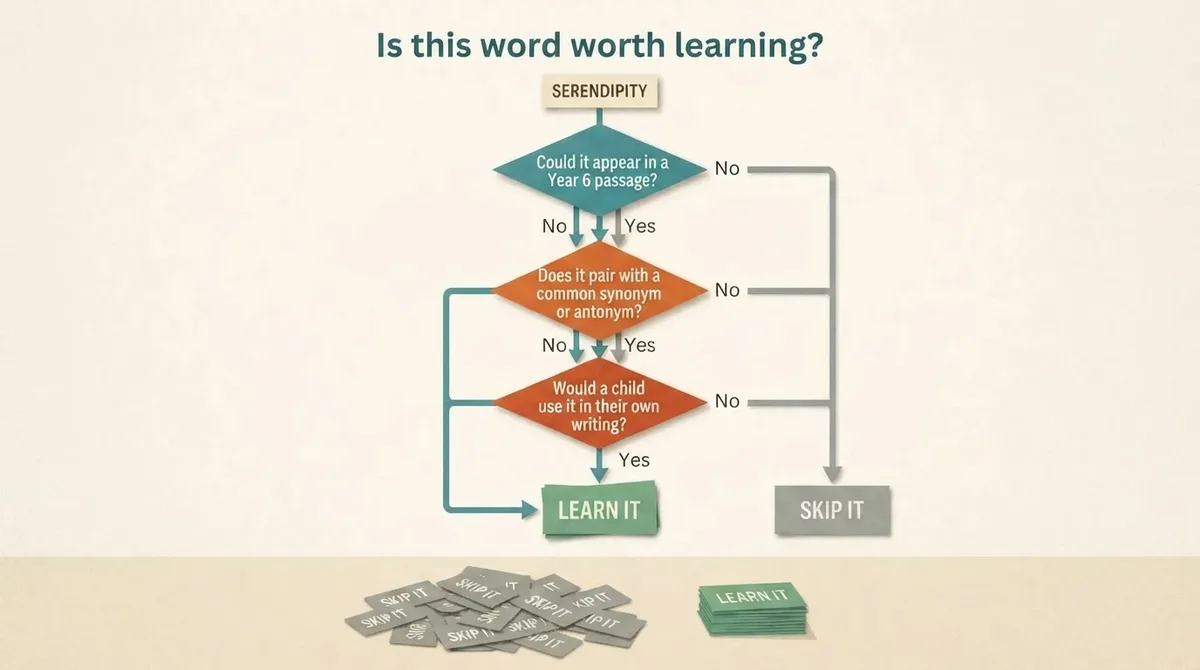
No other page will tell you this, so here it is plainly: if a word is unlikely to appear in a Year 6 passage and does not pair with a common synonym or antonym, it is not worth the revision minutes. Run any long list through three questions:
- Could this word plausibly appear in a story, article or poem written for eleven-year-olds?
- Does it have an obvious partner word (synonym or antonym) that verbal reasoning could pair it with?
- Would your child ever choose it in their own writing?
Two yeses means learn it. Fewer means skip it. Applied to a typical 1,800-word list, this filter usually cuts it by more than half, and the half you keep is the half the paper rewards.
Three further mistakes to avoid. Learning words without sentences, which fails substitution. Ignoring context questions, which are the highest-value vocabulary marks on papers like CSSE's and are better trained through comprehension practice than word lists. And chasing obscure words while everyday precision stays shaky, when the official worked example targets rely.
Frequently asked questions
How many words does my child need? Fewer than the lists imply. Around 200 to 400 well-learned Tier-2 words, plus roots and prefixes, plus regular reading, outperforms 1,800 skimmed ones.
How long before the exam should we start? A year of ten words a week is comfortable. Six months at fifteen a week still works. Cramming in the final month does not, because the day 21 consolidation never happens.
Do all 11+ papers test vocabulary the same way? No. Formats differ by consortium and county: some use multiple-choice papers produced by GL Assessment, others use their own papers with written answers, as CSSE does. Check your admissions authority's own familiarisation material before assuming.
Does reading replace vocabulary revision? It does most of the work, but not all. Reading builds breadth; targeted drilling builds the speed of recall the clock demands.
Where should we start today? Print the core tier, run day 1 on the first ten words, and put day 3 in the calendar. If you want the drills marked automatically, you can start a free account and let the schedule run itself.
Sources: the Buckinghamshire Secondary Transfer Test Familiarisation Booklet, the CSSE familiarisation English paper, GL Assessment's free familiarisation materials and the DfE Key Stage 2 English reading test framework.
Topics
- vocabulary
- english
- verbal reasoning
- word lists
- revision