
Building an 11 Plus Revision Timetable That Your Child Will Keep To
Three complete 11 plus revision timetables (12 months, 6 months and 6 weeks), counted backwards from the real test date rather than forwards from today. Free, ungated and built around spacing, interleaving and a recovery plan for the weeks you miss.
 Elspeth Marlow
- 15 min read

Most 11 plus revision timetables are built the wrong way round. A parent sits down on a Sunday evening, opens a blank grid, and fills it forwards from today: maths on Monday, English on Tuesday, verbal reasoning on Wednesday, a full paper at the weekend. It looks orderly. It survives about three weeks.
The reason is not laziness on anybody's part. It is that the timetable has no anchor. In most selective areas the 11 plus is not sat at the end of Year 6 the way GCSEs are sat at the end of Year 11. It is sat in the first week of September, days after the summer holiday ends. Buckinghamshire has confirmed that the Secondary Transfer Test papers for children moving up in September 2027 will be sat on 8 and 10 September 2026. That single fact rearranges everything. The summer holiday is not a warm-up before the real work starts in the autumn term. It is the last block of preparation you will get. And "twelve months out" does not mean September of Year 6. It means September of Year 5.
This page gives you three complete timetables (12 months, 6 months and 6 weeks), the two learning rules that make them work, and a recovery protocol for the weeks you inevitably miss. Everything is on the page. There is no form, no login and no email capture, because a plan you cannot see before you commit to it is not a plan.
Why 11 plus revision timetables are abandoned by week three
Timetables do not collapse because families stop caring. They collapse for four predictable reasons, and each has a design fix.
- They are built at maximum enthusiasm. The Sunday-night plan reflects the energy of the parent making it, not the reality of a Wednesday in November after swimming club. If your plan only works on a perfect week, it works roughly one week in five.
- They have no slack. A plan with seven scheduled sessions and seven available slots has zero tolerance. One ill child, one birthday party, and you are behind. Behind quickly becomes abandoned, because catching up means redoing the whole schedule.
- The child never agreed to it. A timetable handed down as a fait accompli is a rota. A timetable a ten-year-old helped shape (which afternoons are protected, which day is completely free) is a commitment.
- Nothing visible improves. Doing papers without seeing a trend line is demoralising. If week eight feels identical to week two, motivation drains away regardless of the actual progress being made.
Every timetable below is built with six working days and one deliberately empty day, sessions short enough to finish, and a tracking step so improvement is visible.
Start with your test date, not today's date
Before you write anything into a grid, find two dates: the day your child sits the test, and the day secondary applications close. Then count backwards.
Regional variation here is real and unavoidable. Buckinghamshire tests in early September of Year 6. Other authorities and individual grammar schools test later in the autumn term, and independent schools using pre-tests run on their own timetables entirely. The Admissions Code requires each admission authority to publish its entry requirements and selection process in its admission arrangements, so the authoritative date is always on your council's or school's own page, never on a revision blog. If you are still working out which test applies to you, our comparison of GL Assessment, CEM and ISEB is the quickest way to orient yourself.
The Buckinghamshire calendar shows why the tail matters as much as the run-up. The test is sat on 8 and 10 September 2026, with a shorter practice test usually taken two days before the main papers so children know what to expect. Applications for a secondary place open on 7 September 2026 and the deadline to submit is 31 October 2026. Results reach most parents by email after 4pm on 9 October 2026, roughly four weeks after the papers and three weeks before applications close. That gap is not an accident: paragraph 1.32(c) of the School Admissions Code 2021 requires admission authorities to take all reasonable steps to inform parents of selection test outcomes before the 31 October closing date, so parents can make an informed choice of school, while making clear this does not equate to a guarantee of a selective place.
So the real shape of the year is: revise, sit the papers in early September, wait about four weeks, then spend three weeks making a school-choice decision with the result in hand. National offer day follows on 1 March. Build the timetable so that October is free for the decision, not for panicked extra practice.

How much revision is realistic, and how long a session should be
For a Year 5 child a year out, three to four short sessions a week is a sustainable baseline. In the final term, five or six. Sessions of 20 to 30 minutes work far better than an hour, because the test itself is made of short, high-concentration bursts: the Buckinghamshire test is two papers of roughly 60 minutes each with a break between them, measuring verbal, non-verbal and mathematical skills.
A useful rule: the total weekly load in the 12-month plan should sit around two to three hours, rising to four or five in the final six weeks, including full papers. Anything approaching "hours a day" is a sign the plan has replaced learning with volume. GL Assessment publishes around 10 hours of free familiarisation materials and frames their purpose as helping children familiarise themselves with the multiple-choice layout, the content and examples of question types they will face. That is format familiarity, not endurance training. GL also cautions that exact timings, the combination of topics and the number of questions in your local test may differ from its own materials, which is another reason to check your area's specification rather than assume.
Buckinghamshire's own preparation advice is similarly modest: let your child work through the online familiarisation guide, make sure they can work quietly without distractions, support homework, develop comprehension through discussion, and encourage independent problem-solving. Nothing in there requires a wall chart with a session in every square.
The two rules that make a timetable work: spacing and interleaving
Almost every 11 plus timetable you will find online prescribes the same thing: one full paper per subject per week, plus daily core skills. The hidden flaw is that topics are covered once. Angles appear in week two and never return. By the time the test arrives in September, week two was ten months ago.
Two adjustments fix this without adding a single minute.
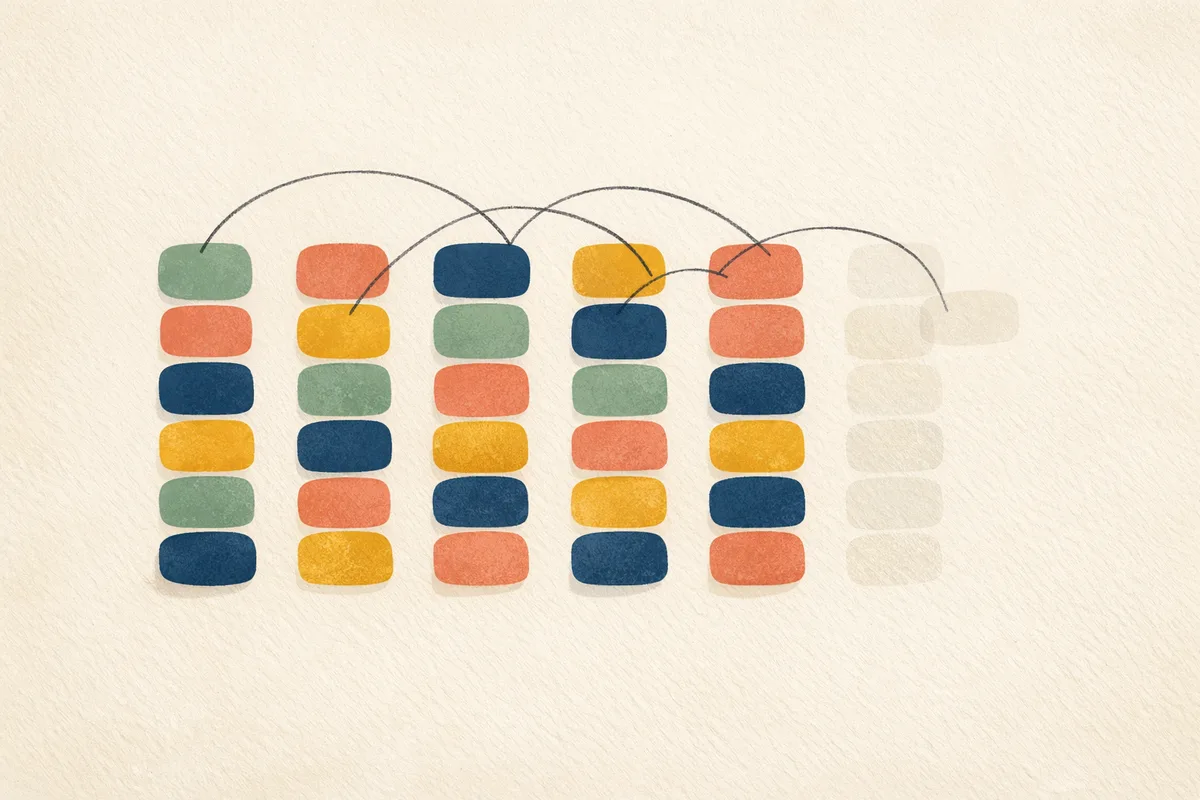
Spacing. Every topic gets three deliberate revisits, not one pass. Cover it, then return at roughly one week, roughly three weeks and roughly eight weeks. A revisit is short: five or six questions, ten minutes, no marking ceremony. If the revisit is comfortable, the topic retires to the long list. If it is shaky, it re-enters the cycle at one week.
Interleaving. Do not give a subject a whole day. Mix disciplines within the same session and within the same week, so a session might be six mixed maths questions followed by five non-verbal reasoning items. This feels harder and produces better transfer, because the real test does not tell your child which method to reach for. Practising in blocks trains recognition of the block; interleaving trains recognition of the question.
A sample interleaved week, used in all three plans below:
- Monday: 20 minutes maths core skills, 10 minutes verbal reasoning revisit
- Tuesday: 25 minutes English (comprehension or writing), 5 minutes spelling and vocabulary
- Wednesday: 20 minutes non-verbal reasoning, 10 minutes maths revisit from three weeks ago
- Thursday: free day, reading only
- Friday: 25 minutes mixed reasoning (verbal and non-verbal in one set)
- Saturday: timed section or full paper, depending on the phase
- Sunday: 15 minutes reviewing Saturday's errors, then stop
The 12-month 11 plus revision timetable (from September of Year 5)
Twelve months out means the September your child starts Year 5. Total load: two to three hours a week, six days on, one day off.
- Block 1, September to October half-term (Year 5 autumn). Establish the habit, not the content. Three sessions a week. Daily reading of 15 minutes with two minutes of discussion. Introduce verbal reasoning question types slowly. Milestone: your child completes four consecutive weeks without a missed session.
- Block 2, November to Christmas. Add non-verbal reasoning. Four sessions a week. Begin the revisit cycle: everything covered in Block 1 returns once. Milestone: one untimed short paper before the holidays, purely to see the format.
- Block 3, January to February half-term. Maths topic coverage begins in earnest (fractions, ratio, percentages, area and perimeter). Interleave with reasoning every session. Milestone: a written list of your child's five weakest topics.
- Block 4, February half-term to Easter. Attack those five topics, one per fortnight, each with its one-week revisit built in. Introduce timing gently: sections, not full papers. Milestone: first timed section completed calmly.
- Block 5, Easter to May half-term. First full mock under quiet conditions. Use it to diagnose, not to score. Milestone: a fresh weakness list that replaces the January one.
- Block 6, May half-term to end of Year 5. Five sessions a week. One full paper per fortnight, alternating disciplines. Eight-week revisits now start landing on Block 1 material. Milestone: schedule the summer before the holidays begin.
- Block 7, the summer holiday. Switch to the 6-week plan below. This is the final block, not a break in the middle.
The 6-month 11 plus revision timetable (from spring of Year 5)
Starting in March of Year 5 is common and entirely workable. Compress the plan by cutting coverage breadth, not the revisit cycle.
- Month 1 (March). Diagnose first. One untimed short paper per discipline across two weekends, then write the weakness list before scheduling anything. Four sessions a week.
- Month 2 (April). Maths and English core skills, interleaved with reasoning in every session. One-week revisits active. Milestone: mental arithmetic fluency drills two mornings a week, five minutes each.
- Month 3 (May). Non-verbal reasoning intensive, because it is the fastest discipline to improve from a standing start and the one schools rarely teach. Add three-week revisits. Milestone: first timed section.
- Month 4 (June). Five sessions a week. One full paper per fortnight. Eight-week revisits now begin. Milestone: paper two shows fewer unfinished questions than paper one.
- Month 5 (July). Exam technique block: question triage, when to move on, how to guess sensibly on a multiple-choice paper, how to transfer answers accurately. One full paper a week.
- Month 6 (the summer holiday). Run the 6-week plan below.
The 6-week 11 plus revision timetable (the summer before the test)
This is the block everyone gets wrong, either by doing nothing or by doing a paper a day. Six weeks, five sessions a week, mornings only, one completely free week built in.
- Week 1. Restart gently after term ends. Three sessions, no full papers. Re-run the weakest topic from the last mock. Goal: re-enter the habit without resentment.
- Week 2. Full paper on one morning, mixed practice on three others. Mark together, and log error types rather than scores (careless, misread, method unknown, ran out of time).
- Week 3. Attack the two dominant error types. If "ran out of time" leads, practise sections at 90 percent of the real time limit. Eight-week revisits land here.
- Week 4. The free week. No scheduled sessions at all. Reading continues. This week is what makes weeks 5 and 6 possible, and it is why the plan survives a family holiday instead of being destroyed by one.
- Week 5. Two full papers, spaced three days apart, both at the actual time of day the test will be sat. Mixed short sets in between.
- Week 6 (test week). Taper. Two short sessions of familiar question types only, no new material, no full papers after Tuesday. Confirm the practice test date, the venue and the equipment. Early nights beat extra questions.
If you would like the topic-level detail behind these blocks, our year-by-year preparation plan sets out what to cover when, and when to start 11 plus preparation helps if your starting point is earlier or later than Year 5.
Print or copy the timetables, with nothing to sign up for
Everything above is the artefact. There is no gated version with the good bits withheld. To use it:
- Print this page. The three plans and the sample week print cleanly on two sides.
- Copy the sample week into a paper planner or a spreadsheet, one row per day and one column per week, and pencil in the block milestones as you reach them.
- Write your test date at the top of the first page, in large letters, and the application deadline beneath it.
The editable version is deliberately low-tech, because the plans that survive are the ones a family can amend in thirty seconds. If you want practice material to slot into the Saturday sessions, our list of free 11 plus practice papers is a reasonable place to start, alongside the free familiarisation materials published by GL Assessment.
Tracking progress, recovering slipped weeks and keeping your child on side
A timetable needs three supports to survive contact with real life.
A weekly tracking sheet. One line per week with four entries: sessions completed out of sessions planned, the topic that felt hardest, the topic that felt easiest, and one thing that improved. Four lines, ninety seconds, done by the child, not the parent. Scores alone are a poor signal at this age because paper difficulty varies wildly; error types are far more informative. If you would rather not keep the paper sheet going, Trace Learn's progress tracking records question-level accuracy and topic trends automatically and schedules the revisits for you, which is the part parents most often drop first.
A recovery protocol. Decide now, in advance, what happens when you fall behind, because deciding in the moment is how plans die. Cut in this order: first the full paper (it is the most expensive session and the least diagnostic when rushed), then the writing task, then one core-skills session. Never cut the revisit sessions, because they are the entire mechanism by which earlier work is retained. Then restart on the next scheduled day at the point you reached, and do not rebuild the timetable. A missed week is a missed week, not a reason to redesign.
Child buy-in. Before week one, agree three things together: which afternoon is untouchable and free, what happens at the end of each completed block (something small, immediate and unrelated to results), and the child's right to call one "swap" per fortnight, moving a session rather than cancelling it. Children who hold a swap card use it far less than you expect, because the control matters more than the escape.
11 plus revision timetable: frequently asked questions
How many hours a day should my child do? Not hours. Twenty to thirty focused minutes on a school day, with one longer weekend session for a paper in the final months, is the shape that holds. Seven hours a day is a GCSE-revision myth applied to a ten-year-old and it will damage motivation long before September.
What is a good timetable for revision? One with fewer sessions than you think, a genuinely free day, revisits of old topics built in, and disciplines mixed within the week rather than one subject per day.
Is 70 percent enough to pass? Raw percentages do not map onto outcomes. Buckinghamshire, for example, standardises each child's score to account for age at the time of testing and then weights the sections (verbal, mathematical and non-verbal) differently, with a standardised score of at least 121 making a child eligible to be considered for a grammar school place. Other areas use different thresholds and different weightings, and eligibility is not the same as an offer. Track error types, not percentages.
What are the most common mistakes? Starting with a plan built for a perfect week; covering topics once; leaving non-verbal reasoning until last; treating the summer holiday as downtime when it is the final block; and filling October with more practice when it should be reserved for the school-choice decision.
Should we do a full paper every week from the start? No. Full papers a year out mostly measure what has not been taught yet. Use short timed sections from spring of Year 5, and full papers from about eight weeks out.
The timetable that works is rarely the most impressive one. It is the one still on the fridge in February, with a few gaps pencilled through and a test date circled at the top.
Topics
- 11 plus revision
- timetable
- study plan
- progress tracking
- planning