
Practice Papers and Mock Tests
Free 11 Plus Practice Papers with Answers
A curated library of free 11 plus papers where every entry tells you its duration, question count, whether answers are included and whether it matches your local board before you download it.
 Elspeth Marlow
- 13 min read
Most 11+ paper pages compete on a number. One promises 1,300 papers, another 107, a third calls itself the largest collection on the internet. None of them answers the question you actually typed the search for, which is not "where are the papers" but "which paper should my child sit next, and does it look anything like the test they will face in September?"
That second question has a real answer, and the answer changes depending on where you live. A child in Essex sits two 60 minute papers in English and Maths only. A child in Bexley sits two multiple-choice booklets of roughly 50 minutes each. A child in Buckinghamshire sits two papers of about 60 minutes covering verbal, non-verbal and mathematical skills. GL Assessment says so itself, in print, on its own free materials page: "The exact timings for, and number of questions in, your local 11+ test may differ from those in our familiarisation and practice materials." Against that backdrop, a pile of 1,300 undifferentiated PDFs is not generosity. It is a filing problem passed to you.
So this page is built the other way round. Every paper in our library carries four facts on its face before you click: how long it takes, how many questions it holds, whether answers are included, and whether it can be sat online with automatic marking. Each also carries an honest board-fit label, either GL-style, CSSE-style or generic practice, not board-matched. Below is the playbook for using that library properly, in six steps, with worked examples you can copy tonight.
Step 1: Name the test before you name the paper
Before downloading anything, write one sentence on a sticky note and put it on the fridge. It should read like this: "Amara sits the Buckinghamshire Secondary Transfer Test in September, two papers of about 60 minutes, verbal, non-verbal and maths." Or: "Joe sits the CSSE test, two 60 minute papers, English and Maths only, no reasoning paper."
That sentence does more work than any download. It immediately tells you which of the four subjects matter, roughly how long a full practice sit should last, and whether an unlabelled paper you found is relevant or a distraction. GL Assessment reinforces the point in its own guidance: local authorities or individual schools decide which subjects to test, and may add their own questions to those from a test provider, which is why two GL-based areas can set materially different papers.
If you cannot write that sentence yet, that is your first task, not paper selection. Our parent guide to what the 11+ actually is walks through how to find your area's arrangements, and the section below gives you the current published structure for several major areas.
Step 2: Read the four facts before you download
Every row in the library shows the same four fields. Here is how to read them, and what a parent should do with each.
- Duration. Match this to your real test, not to convenience. If your local paper runs 60 minutes and you keep giving 20 minute worksheets, your child never rehearses the hardest skill in the exam, which is holding concentration in minute 48.
- Question count. Duration alone is meaningless without it. Forty questions in 50 minutes is a thinking test. Eighty questions in 50 minutes is a pace test, and it demands a completely different strategy: move fast, mark and return, never stall.
- Answers included. A paper without a mark scheme is a homework sheet, not an assessment. If the answer key is missing, do not use it for a timed sit. Use it for teaching instead.
- Can be sat online. This decides who does the marking. Printable is right for handwriting stamina, working out in the margin and exam-hall realism. Online is right for instant feedback on a school night when nobody has the energy to mark 50 answers.
The fifth field, board fit, is the one nobody else publishes, and it is the one that prevents wasted evenings. "GL-style" means the question families and answer format follow GL conventions. "CSSE-style" means English and Maths only, extended writing, no reasoning section. "Generic practice, not board-matched" is an honest admission: the content is good, the format may not mirror your test.
Step 3: Check your area's real format
This is the part almost no ranking page does, because it means reading council and consortium pages rather than re-listing PDFs. Here is what the official sources currently publish. Treat it as a starting point and always confirm against your own admissions authority, because arrangements change year to year.
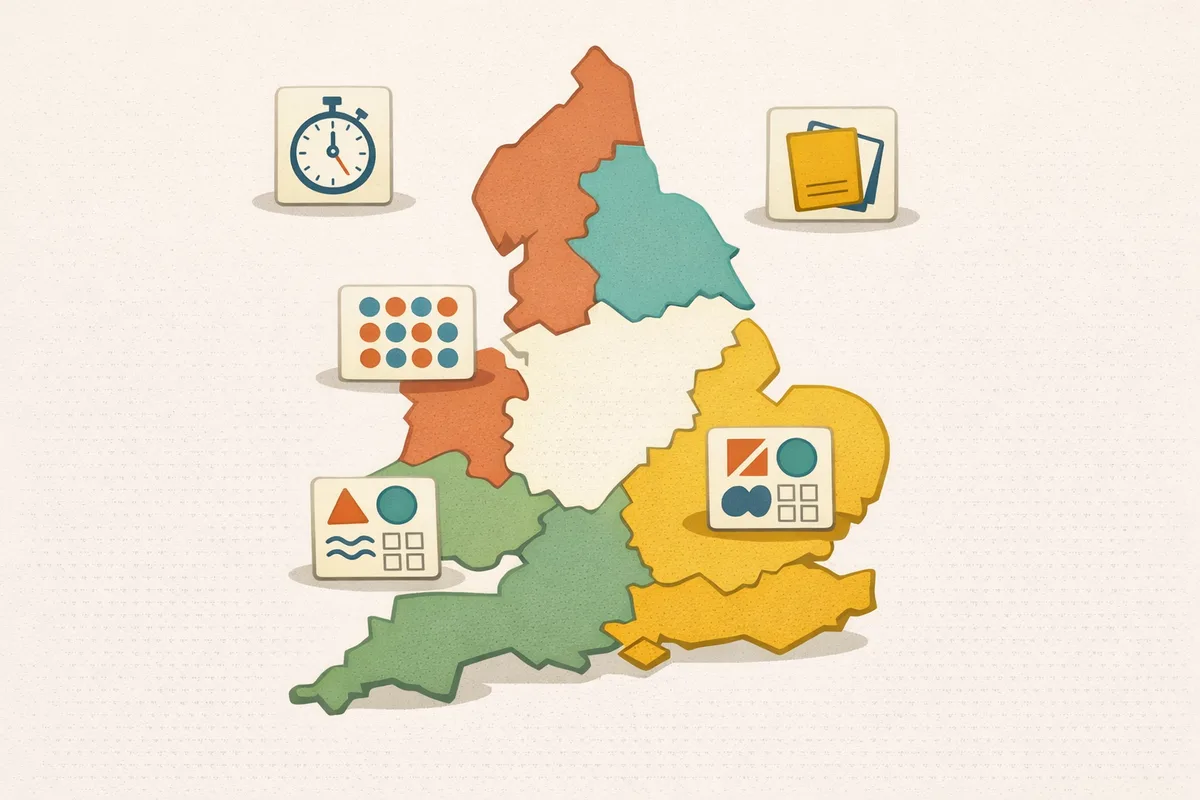
- Essex (CSSE). Candidates sit two tests, one in English and one in Mathematics. The English paper lasts sixty minutes with ten minutes additional reading time, and the Mathematics paper lasts sixty minutes. Crucially, CSSE confirms that with effect from September 2024 (2025 entry) the English paper does not contain Applied Reasoning questions, so older CSSE past papers no longer match the current format. The examination for 2027 entry is scheduled for Saturday 19th September 2026. CSSE publishes free downloadable familiarisation papers, with fuller practice packs available to buy.
- Buckinghamshire. Buckinghamshire Council states that children sit two test papers, each about 60 minutes long, with a break between, and that the Secondary Transfer Test measures verbal, non-verbal and mathematical skills. There is also a shorter practice test, usually taken two days before the main test, to help children learn what to expect.
- Bexley. The London Borough of Bexley states that Quest Assessments is the Bexley Selection Test provider, and that the assessment comprises two separate booklets testing verbal ability and English comprehension, numerical reasoning, and non-verbal reasoning. The tests are timed and consist of multiple-choice questions. Each paper lasts approximately 50 minutes plus additional time for instructions, with each full session running two and a half to three hours, and testing takes place between Monday 7 and Thursday 10 September 2026 at grammar school centres.
- Independent schools using the ISEB Common Pre-Test. ISEB describes its Common Pre-Test as four online, adaptive and shared entrance assessments covering mathematics, English (reading comprehension and grammar), verbal reasoning and non-verbal reasoning, often taken in Year 6 or Year 7. The four assessments can be taken together on the same day or split across multiple days.
- Sutton and Kent. Both run their own published arrangements, and both have consortium or school-level variations that a summary line would misrepresent. Check your area's current admissions page directly before choosing papers, and confirm the paper structure for the specific schools on your list.
Read that list twice and one thing becomes obvious. "11 plus papers" is not one product. A Bexley child drilling extended creative writing and an Essex child drilling non-verbal reasoning are both preparing sincerely for a test they are not sitting.
To check your area's real format before you print anything, pick your area below.
This part of the guide looks up which 11+ test your area uses. It works in your browser.
Step 4: Print it or sit it online, from the same row
Google's own related searches for this term include both "11 plus papers pdf free download" and "11+ practice papers online free". Those are two different parents, or often the same parent on two different evenings. So every paper here exists in both forms from one row: a printable PDF with the mark scheme, and an auto-marked online version. No email wall, no account required to download.
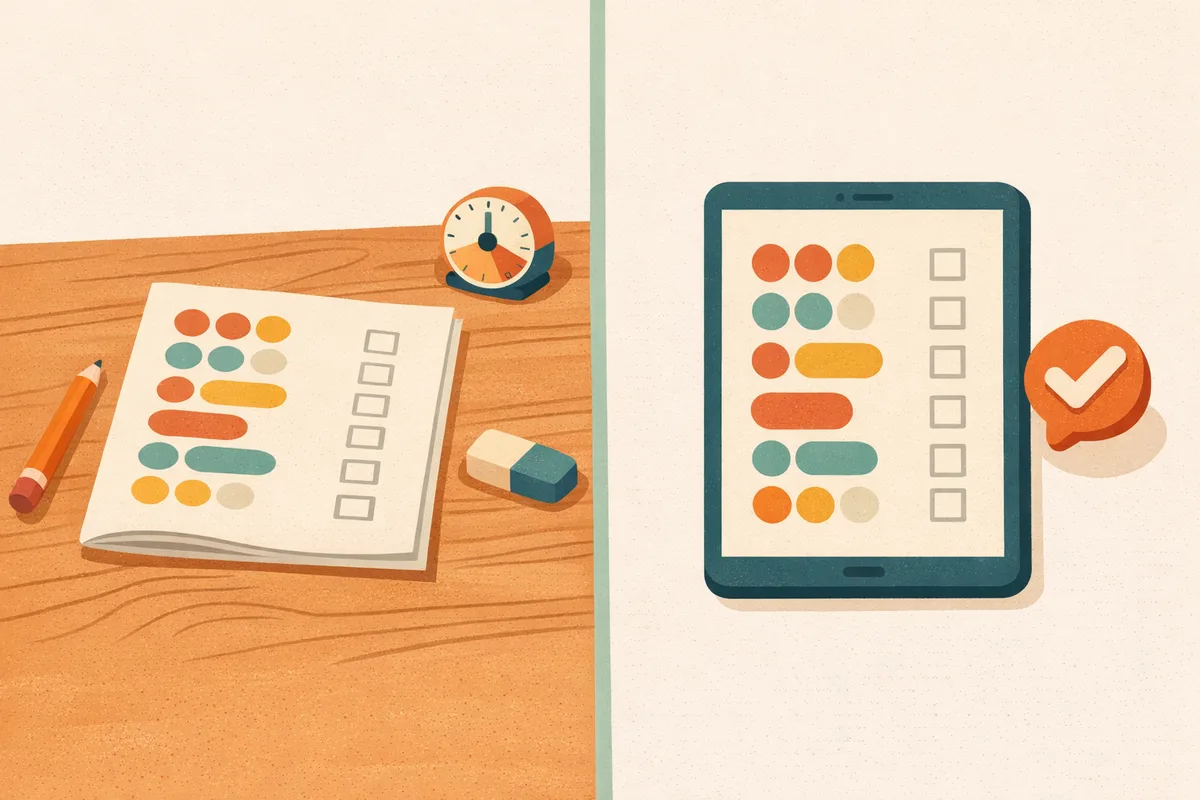
A simple rule for choosing between them:
- Use print for full mock sits, for anything involving written English, and for the two or three rehearsals closest to the real date. Paper builds the physical stamina that a screen does not.
- Use online for midweek maintenance, for reasoning drills where speed matters, and for any session where marking would otherwise get skipped. Our online mock tests mark automatically, which means the feedback conversation happens on the same evening rather than three days later.
To time a paper at home, enter its length and number of questions below. It gives the seconds each question can take, the checkpoints, and a practice clock.
This part of the guide works out seconds per question and checkpoints for a timed paper. It works in your browser.
Step 5: Mark for diagnosis, not for a score
A score out of 50 tells you almost nothing. What tells you something is a two column tally. Take a blank sheet, write "could not" on the left and "did not" on the right, and place every wrong answer in one of them.
Worked example. Priya sits a 50 question maths paper in 50 minutes and scores 38. Her father marks it and finds nine of the twelve errors sit in the last eleven questions, and that six of those nine are arithmetic slips on methods she demonstrably knows. That is not a maths problem. That is a pacing problem: she is spending too long early and then rushing. The fix is a timing drill, not more topic work. She practises the first fifteen questions in twelve minutes for a week, and the tail of the paper stops collapsing.
Second worked example. Tom scores 31 on a verbal reasoning paper with 60 questions. His errors cluster: eleven of them are in letter-sequence and code questions, and he is nearly perfect on vocabulary. Again this is not "do more verbal reasoning". It is one question family, and it is teachable in an afternoon. Our verbal reasoning question families guide breaks those types down, and the non-verbal reasoning guide does the same for rotations and pattern series.
GL Assessment makes the case for timing plainly: "Tackling a practice paper under timed conditions gives children valuable experience of managing their time effectively." Timed sits are not about pressure for its own sake. They are the only way the pacing signal above becomes visible.
Step 6: A twelve week schedule you can actually keep
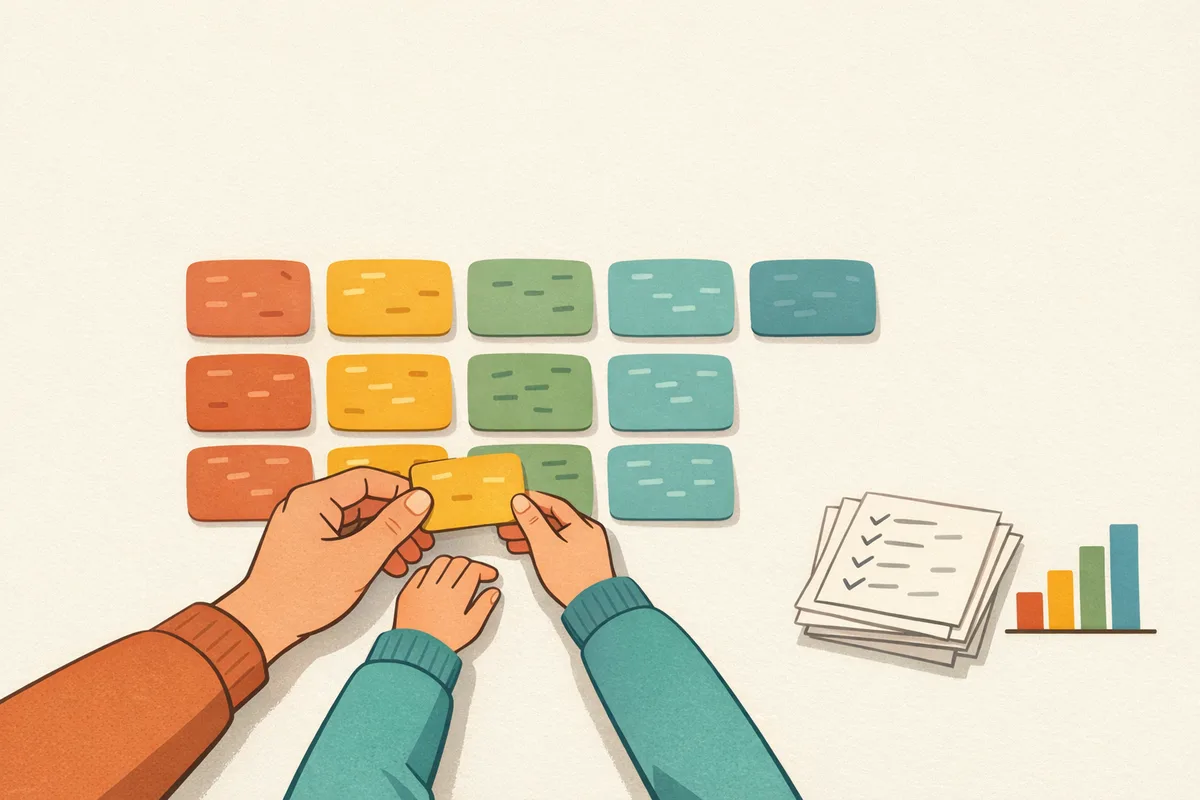
Twelve weeks, three phases, two sessions a week plus one weekend sit. Adjust downward if your child is tired. Nothing here requires more than about three hours a week.
- Weeks 1 to 2, diagnose. One full-length paper per subject that your area actually tests, under real timing, marked with the two column tally. No teaching yet. You are gathering evidence.
- Weeks 3 to 6, build. Short online sessions targeting the two or three weakest question families identified in weeks 1 and 2. Keep these to 20 minutes. One mixed paper each weekend to check that the fix is holding.
- Weeks 7 to 10, integrate. Full papers under exact local timing, including the reading time if your area grants it. Alternate printed and online. Introduce the back-to-back structure your area uses, for example two papers with a break between them if that mirrors your test.
- Weeks 11 to 12, rehearse. Two or three full rehearsals only, on paper, at roughly the time of day the real test starts. Then stop. The last week should get lighter, not heavier.
If you would rather not build this by hand, our exam plan generates the same shape automatically from your child's board and start date, and progress tracking keeps the question-family tally for you.
What we left out, and why
We could triple the library tomorrow by adding every historic paper we can lawfully host. We have not, for three reasons.
- Superseded formats. A pre-2024 CSSE English paper containing Applied Reasoning, handed to an Essex child preparing for 2026, teaches a skill the current paper does not test and burns an evening doing it. Where we hold such papers we label them clearly as historic, or we leave them out.
- Papers without mark schemes. If we cannot supply answers, we do not list it as a practice paper. It becomes teaching material instead, labelled as such.
- Unattributable PDFs. If we cannot establish what a paper is, who wrote it and what it was designed to test, we cannot label it honestly, so it does not go in.
Fewer papers, each one described accurately, beats a thousand rows you have to audit yourself.
Where to get official papers direct
Always go upstream where you can. Our directory of official 11+ past papers and sample papers lists every free paper we have verified on its publisher's own site, labelled by subject, board, year and whether answers are published, with nothing re-hosted.
- GL Assessment's free familiarisation materials are downloadable PDFs covering verbal reasoning, non-verbal reasoning, English and maths, with no email signup required. Read the caveat on that page carefully: 11+ tests vary from area to area, and GL recommends contacting your admissions authority for specifics.
- CSSE publishes free downloadable familiarisation papers alongside practice packs that must be purchased.
- Your council's admissions pages carry the arrangements that actually govern your child's test, including registration deadlines. Those deadlines are usually earlier in the summer than parents expect.
Questions parents ask most
Where can I find free 11+ practice papers with answers? Start with the official familiarisation materials from your test provider or consortium, then use a curated library like this one for volume. Insist on a mark scheme every time.
What papers are in the 11+? It depends entirely on your area. English and maths only in Essex under CSSE. Verbal, non-verbal and mathematical skills in Buckinghamshire. Verbal ability and English comprehension, numerical reasoning and non-verbal reasoning in Bexley. Four adaptive online assessments for ISEB Common Pre-Test schools.
Is 70 percent enough to pass? There is no fixed pass mark. Most areas use standardised scores adjusted for age, and the qualifying threshold moves with the cohort and the number of places. Treat raw percentages as a progress signal for you, not a prediction.
Where can I find comprehension papers with answers? Filter this library to English, then to your board label. Comprehension is the section where board fit matters most, because passage length, question style and the presence of extended writing vary sharply between areas.
When you are ready to run the plan rather than assemble it, create a free account and the library filters itself to your board, your subjects and your test date. If you are earlier in the journey, our year-by-year preparation plan is the better place to begin.
Topics
- 11 plus papers
- practice papers
- mock tests
- gl assessment
- csse
- free resources