
11 Plus Maths: Every Topic and Question Type Explained
A complete 11 plus maths topic list, organised as a decision guide rather than a directory. Includes the four areas school teaches after the exam is over, the classic traps per topic, and how pace differs by board.
 Elspeth Marlow
- 13 min read
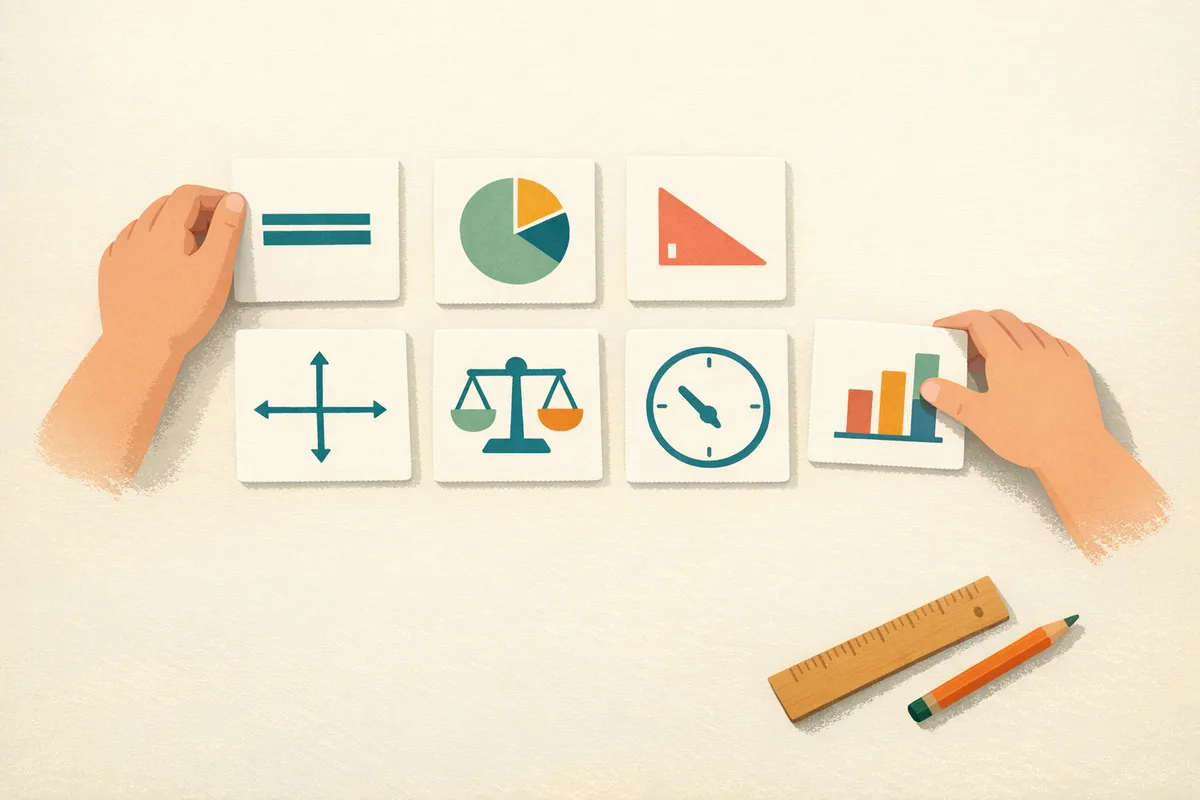
Every guide to 11 plus maths answers the same question: what topics are on the paper? That question is genuinely easy to answer, because the content is drawn almost entirely from the national curriculum your child is already following. The list has been public for years. Copying it out is not the hard part.
Two questions help turn the list into a practice plan. Which of these topics has my child not actually been taught yet? And which of them are quietly losing marks on questions we assumed were fine? A topic list treats fractions, probability and timetables as three equal boxes to tick. In a real exam room they are nothing of the sort.
So this guide does give you the full taxonomy, because you need it. But it is arranged as a decision guide: four different starting points, each suited to a different child, so you can work out what to do this week rather than staring at seventeen topics at once.
11 plus maths in one minute
The subject content comes from the upper key stage 2 programme of study, which covers Years 5 and 6. The Department for Education organises it into eight statutory domains: number and place value; addition and subtraction; multiplication and division; fractions (including decimals and percentages); measurement; geometry and properties of shapes; geometry and position and direction; and statistics. Year 6 adds two further statutory sections of its own, ratio and proportion, and algebra.
Who sets the paper depends entirely on where you live, and this matters more than most families expect. Some areas use GL Assessment materials, some use consortium papers written locally, and many independent schools write their own. GL Assessment says plainly that "the exact timings, the combination of topics covered ... and the number of questions in your local 11+ test may differ from those in our familiarisation and practice materials", which is an unusually honest warning worth taking seriously.
Time allowances vary enormously. The Consortium of Selective Schools in Essex states that its Mathematics paper "will last sixty minutes". In the Kent Test, maths sits inside a combined paper where "each section will involve a 5-minute practice exercise followed by a 25-minute test". Same syllabus, less than half the time. If you want the wider picture of formats and providers first, our guide to what the 11 plus is and how it works covers that ground.
The complete 11 plus maths topic list
Seventeen topics cover essentially everything you will meet. Use this as your master inventory, then pick a route below rather than working straight down it.
- Place value and rounding - reading, ordering and rounding numbers, including negatives.
- The four operations - written methods for addition, subtraction, multiplication and division, including remainders.
- Factors, multiples and primes - factor pairs, common factors, prime numbers, square and cube numbers.
- Order of operations - deciding which part of a calculation to do first.
- Fractions - equivalence, comparing, adding, subtracting, multiplying and dividing.
- Decimals - place value to three decimal places, calculation and rounding.
- Percentages - percentages of amounts, increase and decrease, and simple reverse problems.
- Converting between fractions, decimals and percentages - fluent movement between all three forms.
- Ratio and proportion - sharing in a ratio, scaling recipes, unequal sharing and best value.
- Sequences and number patterns - finding the rule and continuing or reversing it.
- Algebra - simple formulae, missing number equations, and expressing relationships with letters.
- Measurement and units - metric conversions, and converting between metric and imperial approximately.
- Money - costs, change, multi-item totals and value comparisons.
- Time and timetables - the 24-hour clock, durations, and reading bus or train timetables.
- Perimeter, area and volume - rectilinear shapes, triangles, parallelograms, cubes and cuboids.
- Shape, angles, symmetry and coordinates - 2D and 3D properties, missing angles, reflection, translation and the full coordinate grid.
- Statistics, averages and probability - bar charts, line graphs, pie charts, tables, the mean, and simple likelihood.
Most question types you will see are combinations of these applied to a word problem. That is why multi-step word problems are not really an eighteenth topic: they are the wrapper around all seventeen.
Which route should you take?
Here is the decision most parents are actually facing. Read the four descriptions and pick the one that sounds like your child right now. You can change route later, and most families do.
- Route 1, frequency first. Choose this if your child is broadly competent but you have limited weeks and want marks per hour of effort.
- Route 2, curriculum gaps first. Choose this if you have not yet checked what school has covered, or if your child is sitting an early autumn paper.
- Route 3, traps first. Choose this if practice scores are decent but inconsistent, and mistakes feel careless rather than conceptual.
- Route 4, pace first. Choose this if your child gets things right at home but runs out of time under test conditions.
If you genuinely cannot tell, do Route 2 first. It is the only one where the cost of skipping it is a topic your child has never seen.
Route 1: start with what appears most often
Topic lists imply equal weighting. Real papers do not. Analyses of current GL-style practice material consistently find that charts, tables and graphs, money, and measurement together account for a large slice of the paper, in the region of a tenth each, while averages, probability and ratio can appear barely at all in some GL sets.
The practical consequence is uncomfortable but useful: probability, which feels satisfyingly exam-like to revise, may be worth less to your child than confidently reading a bus timetable. Families routinely spend three sessions on probability trees and none on interpreting a compound bar chart.
A sensible frequency-weighted order for a short run-up looks like this: charts, tables and graphs; money; measurement and unit conversion; the four operations; fractions, decimals and percentages; shape and area; then everything else. Treat that as a default, not a law, and correct it against real papers from your own board.
Route 2: start with what school has not taught yet
This is the section that changes how most parents plan, and it is not the usual claim that the 11+ goes "beyond the national curriculum". It generally does not. The problem is not the curriculum. It is the calendar.

Four heavily tested areas are statutory Year 6 content:
- Ratio and proportion is a Year 6 section of the programme of study. It does not appear in Year 5 at all.
- Algebra is likewise a Year 6-only section.
- The mean as an average is Year 6: pupils are taught to "calculate and interpret the mean as an average", and it is absent from Year 5.
- Coordinates in all four quadrants is Year 6: pupils "describe positions on the full coordinate grid (all 4 quadrants)" and reflect and translate shapes on it. Year 5 covers the first quadrant only.
Order of operations sits in the same bracket. It is stated in Year 6 and not explicitly in Year 5.
Now put that against the exam date. CSSE's 11+ for 2027 entry is sat on Saturday 19 September 2026, within days of children starting Year 6. Autumn-term testing is the norm across much of England. Your child will be examined on ratio, algebra, the mean and negative coordinates before a single lesson on them has been timetabled.
That is not a criticism of schools, which are teaching the curriculum in the order they are meant to. It is simply a scheduling mismatch, and it converts directly into an action list. These five areas are the ones you must cover at home, because school will not reach them in time. Several other topics also step up between Year 5 and Year 6: prime numbers, calculating volume of cuboids in standard units, and finding missing angles at a point, on a line or vertically opposite. Check those next.
A quick way to audit this is to ask your child to attempt one question from each of the five areas above. If the response is "we have not done that", you have found your first month of work. Our year-by-year preparation plan shows how to fit that around school without overloading the term.
Route 3: start with the traps
Most guides show how a question is done correctly. Almost none shows how it is got wrong, which is a shame, because the classic error per topic is the single most useful thing a parent can carry in their head while marking.
- Subtraction across the decimal point. Asked for 8 minus 3.45, children write 5.45 or 4.45. The fix is to write it as 8.00 and align the points before starting.
- Treating a ratio as a fraction of the total. Share 60 sweets in the ratio 2:3 and the common answer is 24 and 36 arrived at correctly, but 40 and 20 arrived at by reading 2:3 as two-thirds. Teach parts first: 2 plus 3 is 5 parts, so one part is 12.
- Misreading minor gridlines. On a scale where five small squares span 10 units, each square is 2, not 1. Children count squares rather than reading the interval. Always ask "what is one small square worth?" before reading any value.
- Volume and capacity units. Forgetting that 1 litre equals 1,000 cm³ turns a correct calculation into a wrong answer. A tank 20 cm by 10 cm by 25 cm holds 5,000 cm³, which is 5 litres, not 5,000.
- Percentage decrease then increase. A price cut by 20% then raised by 20% does not return to the original. Work each step from the new amount.
- Timetable durations. Crossing the hour by subtracting digits gives 14:50 to 15:20 as 70 minutes. Count up to the hour, then on.
- Mean with a missing value. Children average the numbers they can see instead of using total equals mean times count.
- Negative coordinates. Reflecting in the y-axis, the sign of the x-coordinate changes, not the y. This one is almost universal because it is untaught in Year 5.
Mark a practice paper against that list and you will usually find the same two or three repeating. Fix those two, not all eight.
To check a mean, or to see the median, mode and range of a list, type the numbers below. In the quiz-scores example, a mean of 15 from five scores means a total of 75: total equals mean times count, the fix for the missing-value trap above.
This part of the guide works out the mean, median, mode and range of a list of numbers, with the working. It works in your browser.
Route 4: start with pace
Topic knowledge at the wrong speed is worth very little, and the speed required varies wildly by board. Sixty minutes for a CSSE maths paper is a different exercise from a 25-minute Kent maths section that follows a five-minute practice exercise. Work out your own seconds-per-question figure by dividing the stated time by the number of questions, then practise at that rate rather than at a comfortable one.
One mechanical detail deserves its own sentence. Kent Test papers are "multiple-choice with a separate answer sheet" and "are marked by an automated marking machine". Answers that stay in the booklet score nothing. If your child's board uses separate answer sheets, rehearse the transfer, including what happens when a question is skipped and the numbering slips.
Building this into practice is more effective than telling a child to hurry up. Timed sections under realistic mock conditions surface pace problems that untimed homework hides completely, and repeated sittings show whether speed is improving or whether accuracy is being traded away for it.
To turn a maths paper's timing into a pace your child can follow, enter its minutes and questions below.
This part of the guide works out seconds per question and checkpoints for a timed paper. It works in your browser.
Board variation, briefly
Formats differ by region and by school, and the differences are real: multiple choice or standard format, one combined paper or separate subject papers, calculator never permitted, and quite different time allowances. Always confirm the arrangements published by your own consortium or school for your child's entry year. GL Assessment's own familiarisation guidance makes the same point about local variation, and it applies to every provider.
Your printable coverage checklist
Print or copy the seventeen-topic list above and put three columns beside it: Not yet taught, Taught but shaky, and Secure. Then work through it in one sitting with your child rather than alone, because their view of what is secure is often more accurate than yours.
Rules for using it well:
- Mark the five Year 6 areas from Route 2 as "not yet taught" by default unless you have evidence otherwise.
- A topic only becomes "secure" after two correct attempts under time, on different days.
- Rewrite the sheet monthly. A checklist that never changes is not being used.
- Keep at most three topics in active revision at once.
If you would rather not track this on paper, a progress view that scores by topic does the same job automatically and is harder to fool. Either way, pair the checklist with real papers: our roundup of free 11 plus practice papers is a reasonable place to source them.
To see where your child is across the topics, the timed maths practice test below gives a score for each question type and a worked answer for every question.
This part of the guide is a free timed practice test. It works in your browser.
Frequently asked questions
What maths topics are in the 11 plus?
The seventeen topics listed above, drawn from the upper key stage 2 curriculum, plus the Year 6 sections on ratio and proportion and algebra. Multi-step word problems combine several of them in a single question.
Does 11 plus maths go beyond the national curriculum?
Rarely in content. The difficulty comes from combining topics, applying them in unfamiliar wording, and doing so at speed. The more common problem is timing: several tested areas are Year 6 content examined at the start of Year 6.
How much of the 11 plus maths syllabus should be covered before the exam?
All of it, but not equally. Aim for full coverage of the seventeen topics with deep fluency in the highest-frequency ones and specific attention to the Year 6 gaps.
Is 70% enough to pass?
There is no fixed pass mark. Outcomes depend on standardised scores, local admission rules and the number of applicants in a given year, so no percentage can be treated as a threshold.
Start with one route, not four. If you want the topic checklist turned into a dated weekly plan, you can set one up in a few minutes.
Topics
- 11 plus maths
- syllabus
- topics
- revision
- parents