
The 11 Plus Exam: What It Is, Who Sits It and How It Works
The 11 plus is not one exam. It is roughly fifteen different tests sharing a name, and which one your child sits depends entirely on your postcode. Here is how to find yours.
 Elspeth Marlow
- 13 min read

Ask what the 11 plus exam is and you will get a tidy answer: a selective test taken in Year 6 for entry to grammar and independent schools, covering English, maths, verbal reasoning and non-verbal reasoning. That answer is true, and it is also close to useless, because the moment you try to act on it you hit the real question. Which test? Set by whom? Sat on what date? Registered by when?
That is not a gap in your understanding. It is a gap in almost every guide written on the subject. The 11 plus is not a single national examination. It is roughly fifteen different assessment regimes wearing the same name, run by different local authorities, consortiums and school groups, with different papers, different timings, different weightings and different deadlines that fall months apart. A parent in Chelmsford and a parent in Coleraine are both "doing the 11 plus" and almost nothing they need to know overlaps.
So this guide is built as a decision path rather than a definition dump. You start with which of the three systems you are in, narrow to your authority or consortium, find out who sets your test, and finish knowing what your papers actually look like. Along the way we explain how marking genuinely works, because the most common questions parents ask (is 70% enough? what is a good score?) are built on an assumption about percentages that does not hold.
The 11 plus exam, in 40 words
The 11 plus is a selective entrance test sat in Year 6 (or Primary 7 in Northern Ireland) for places at academically selective secondary schools. It assesses English, maths, verbal reasoning and non-verbal reasoning. Format, board and dates vary by local authority.
Keep that as your working definition, then throw away the idea that it describes one exam. Everything useful lives one level down.
Step one: which of the three systems are you in?
Before anything else, work out which of these three describes your family. They barely interact.
- State grammar schools in England. Free, non-fee-paying, selective by test. Testing is run by a local authority or a consortium of schools, usually in September of Year 6, with results out before the national application deadline of 31 October. This is where most people mean when they say "the 11 plus".
- Independent (fee-paying) senior schools. Many use the ISEB Common Pre-Test, taken online and adaptively, often in Year 6 or Year 7, with school-specific papers and interviews following. Timelines run later, typically into the winter, and registration is with each school directly.
- Northern Ireland. A separate system entirely. The Schools' Entrance Assessment Group (SEAG) runs a standardised assessment for post-primary schools using academic selection, sat in Primary 7 in November.
If you are in system one, your postcode decides your exam. If you are in system two, your school shortlist decides it. If you are in system three, there is one assessment and one timetable.

Step two: who sets the test where you live
Almost all state grammar testing in England now runs through GL Assessment, with a significant exception in Essex. This matters more than it sounds, and we will come back to why in a moment. Here is what the picture looks like in several of the largest selective areas, with dates for 2026 testing (2027 entry).
Buckinghamshire
The Secondary Transfer Test is produced by GL Assessment and measures verbal, non-verbal and mathematical skills. Children sit two papers of approximately 60 minutes each with a break between them, and normally take a shorter familiarisation practice test two days beforehand. Results are emailed to most parents after 4pm on 9 October 2026, comfortably before the national application deadline. The qualifying score is 121.
Warwickshire and the West Midlands
The West Midlands Grammar Schools Entrance Tests contain four sections: English, verbal reasoning, non-verbal reasoning and mathematics, all in multiple-choice format. Each of the two tests takes around 60 minutes including spoken instructions and explanations of practice items. Raw data is standardised and weighted into a total score. Eligibility to sit is based solely on date of birth, and parents who miss the 30 June registration deadline cannot have results shared between all authorities. Details are on the Warwickshire County Council 11+ test page.
Redbridge (north east London)
Covering Ilford County High School for Boys and Woodford County High School for Girls, Redbridge uses GL Assessment across two papers: English and verbal reasoning, then mathematics and non-verbal reasoning. Registration opens 1 May 2026 and closes at 5pm on Monday 15 June 2026. The test is on Friday 18 September 2026, with results mid-October. No access adjustments are considered after 15 June, and applicants must live in the common catchment area.
Essex (CSSE)
The Consortium of Selective Schools in Essex sets its own papers rather than buying in a board, for ten member schools including Colchester Royal Grammar School, King Edward VI Grammar School, Southend High School for Boys and for Girls, and Westcliff High School for Boys and for Girls. There are two papers: English, lasting 60 minutes plus a 10-minute reading period, and mathematics, lasting 60 minutes. The 2027-entry examination is on Saturday 19 September 2026. Note that CSSE administers only the examination and has no involvement in applications, admissions or appeals, which surprises a lot of families.
Gloucestershire and other school-run areas
In some counties the grammar schools themselves organise testing rather than the council, with test dates in early to mid September. Always confirm the date and registration route on the individual school's admissions page, because school-run arrangements change more often than authority-run ones.
Northern Ireland (SEAG)
SEAG is a not-for-profit company serving 63 post-primary schools that use academic selection. Primary 7 pupils sit two papers: Paper 1 on 14 November 2026 and Paper 2 on 21 November 2026. Registration closes at 11:59pm on Friday 18 September 2026, and Statements of Outcomes are released online on 23 January 2027. The SEAG website is the authoritative source.
The correction most parents still need: CEM is gone
A large amount of advice still circulating online tells parents to prepare for a "CEM-style" test, often described as less coachable, with mixed-format papers. In many areas that advice is simply out of date. Warwickshire moved its 11+ from CEM to GL Assessment for September 2023 entry after the previous contract with CEM came to an end and a joint procurement exercise was run with The Schools of King Edward VI Foundation. The GL test assesses the same four competencies, and GL was already in use by other authorities including Buckinghamshire, Kent and Lincolnshire.
If you have bought CEM-branded practice material for an area that has moved to GL, you are preparing for a paper your child will not sit. Check your authority's current page before you spend anything else.
To see who sets the test where you live, pick your area below. It shows the test, its subjects and the dates we have checked.
This part of the guide looks up which 11+ test your area uses. It works in your browser.
What the four subjects actually contain
Whatever the board, the content pool is broadly the same, though not every area tests all four.
- English. Comprehension of an unseen passage, vocabulary in context, spelling, punctuation and grammar. Some areas (Essex being the notable one) include extended writing; most GL areas do not.
- Maths. Key Stage 2 curriculum content under time pressure: four operations, fractions, decimals, percentages, ratio, measure, time, area and perimeter, and multi-step word problems.
- Verbal reasoning. Language logic rather than knowledge: codes, letter sequences, hidden words, analogies, odd ones out. Our verbal reasoning guide breaks these into question families, which is by far the fastest route to improvement.
- Non-verbal reasoning. Visual pattern work: rotations, reflections, series completion, matrices, nets and cubes. See the non-verbal reasoning guide for a solving method rather than a taxonomy.
The balance between them varies. Some areas weight verbal skills heavily, others give all four sections roughly equal footing. Find your weighting before you decide where to spend practice time.
How the 11 plus is marked, and why there is no pass percentage
This is where nearly every guide waves its hands, so here is the mechanism in order.
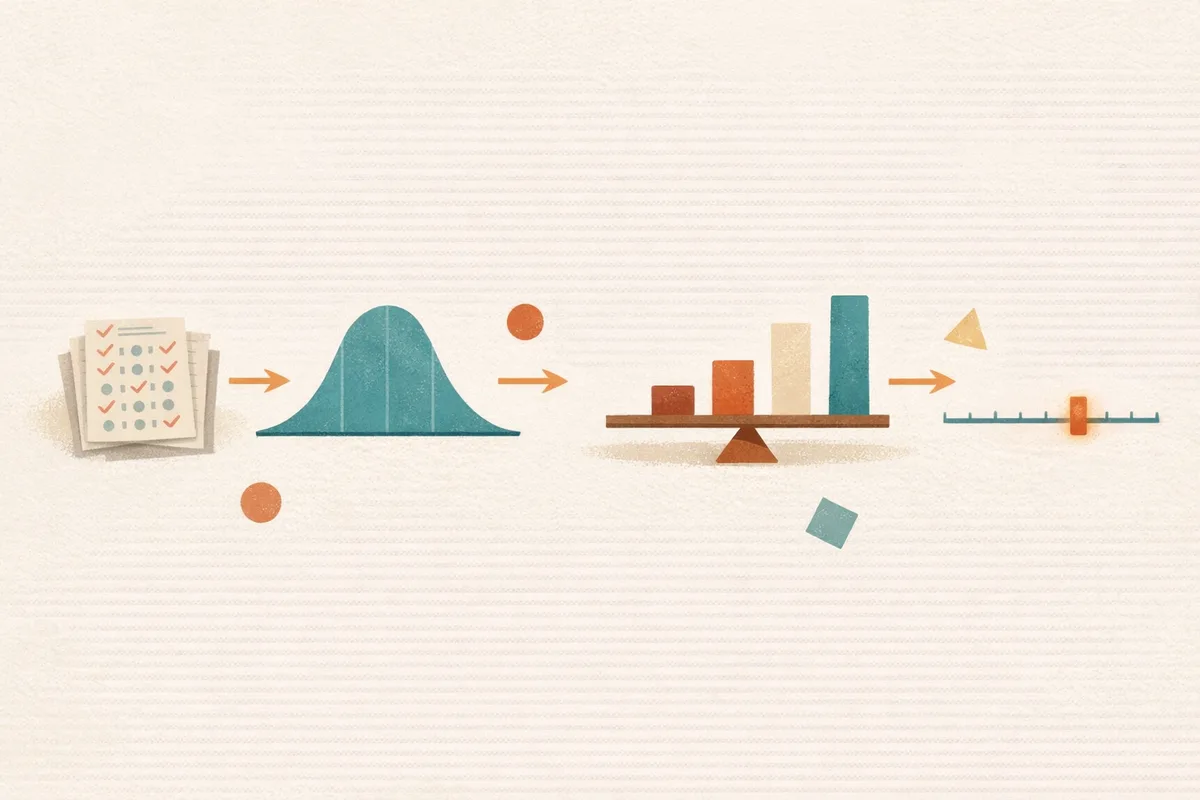
- Raw score. Your child's number of correct answers on each paper. Nobody outside the marking process ever sees this as a meaningful figure.
- Age standardisation. Each raw score is adjusted for the child's age in years and months on the day of the test, so a child born in August is not penalised against a child born the previous September. This is not a rounding tweak, it is a genuine statistical correction.
- Standardised scores. The adjusted result is expressed on a scale, in Buckinghamshire from 60 to 170, where the score describes performance relative to the cohort rather than relative to a curriculum.
- Weighted composite. Standardised scores are combined by area-specific weights. In Buckinghamshire the Secondary Transfer Test Score is 50% verbal skills, 25% mathematical skills and 25% non-verbal skills.
- Threshold. The composite is compared to a qualifying standard. In Buckinghamshire a score of 121 or above qualifies, which around 37% of children are expected to achieve. A score above 121 gives no additional priority, because Buckinghamshire grammar schools do not use score as an admission rule. All of this is set out on the council's marking the Secondary Transfer Test page.
Two consequences follow. First, "is 70% enough to pass?" has no answer, because percentages are not what is compared and there is no fixed national pass mark. Second, the 11 plus is not "harder than SATs" in the way people mean. SATs are criterion-referenced: they measure a child against the curriculum, and everyone can in principle do well. The 11 plus is norm-referenced: it measures a child against the other children competing for the same places. That is a different kind of difficulty, not simply more of it.
Use the 11+ score calculator by area to check a reported result against its published method and qualification rule. A selective-test score is not automatically a national percentile, and qualification does not guarantee a school place.
The admissions calendar

The sequence for state grammar entry, in the order it happens:
- Spring and early summer of Year 5. Registration for your local test opens and closes. Warwickshire's deadline is 30 June; Redbridge closes at 5pm on 15 June 2026. This is the deadline families miss, because it falls a full academic term before the exam.
- September of Year 6. Testing. Redbridge sits 18 September 2026, Essex CSSE 19 September 2026, and school-run areas cluster in the same fortnight.
- Early to mid October. Results. Buckinghamshire emails most parents after 4pm on 9 October 2026.
- 31 October. The national deadline to apply for a secondary school place. Applications usually open on 1 September.
- 1 March. National Offer Day, when secondary school offers are sent, moving to the next working day if it falls on a weekend or bank holiday. The process is set out on GOV.UK.
Crucially, you list grammar schools on your normal application whether or not your child qualified. If they did not reach the standard, routes remain: a Selection Review, an admission appeal, or in some authorities Pupil Premium eligibility. Not qualifying closes one door, not the corridor.
If you are working out when to begin, our year-by-year preparation plan maps backwards from these dates.
Independent schools and the ISEB Common Pre-Test
If your list includes fee-paying senior schools, the mechanics change. The ISEB Common Pre-Test is a set of four online, adaptive assessments covering mathematics, English (reading comprehension and grammar), verbal reasoning and non-verbal reasoning. Pupils typically sit it in Year 6 or Year 7. The four assessments can be taken on one day or across several sessions, and a pupil sits once then shares results with multiple schools. The 2026-27 testing window runs from September 2026 to late May 2027, per ISEB's own published guidance.
Adaptive means question difficulty responds to performance, so children rarely finish feeling they aced it. That is by design and worth saying out loud to an eleven-year-old beforehand.
What preparation actually costs
The honest range is wide. GL Assessment publishes free familiarisation materials as printable PDFs across six areas in multiple-choice layout, and states plainly that 11+ tests vary from area to area, so timings and question counts in a local test may differ from its samples. Its official practice paper packs cost £11.99 each, with three-book subject bundles at £31.99, each book containing three question papers plus parent guidance. Pack numbering does not indicate difficulty.
Weekly private tuition is the other end, commonly running into four figures across a year. Online platforms sit between the two; you can compare what that looks like on our pricing page. What actually moves a score is not spend but diagnosis: knowing which question families your child loses marks on, then practising those rather than everything.
Three original 11 plus questions to try right now
No sign-up, no PDF. Try these, then check yourself.
- Verbal reasoning. A four-letter word is hidden across the end of one word and the start of the next: Sarah's coach opened the gate. Find it.
- Maths. A minibus leaves school at 08:50. The journey takes 1 hour 45 minutes, and on the way it stops for 25 minutes. What time does it arrive?
- Non-verbal reasoning. A square tile has a small black dot in its top-left corner and a short line along its bottom edge. The tile rotates 90 degrees clockwise at each step. After three steps, where are the dot and the line?
Answers: (1) CHOP, spanning "coach opened". (2) 11:00. (3) The dot is in the bottom-left corner and the line is along the right edge, which is the same as rotating the original tile 90 degrees anticlockwise once.
If your child solved all three quickly, the useful next step is a timed, mixed set rather than more of the same. A free diagnostic that marks instantly will tell you which of the four subjects to work on first.
Questions parents ask most
How hard is the 11 plus exam? Hard relative to the cohort, not relative to the curriculum. Most content sits within Key Stage 2; the difficulty comes from pace, reasoning question types not taught at primary school, and competition for a limited number of places.
What is a good 11+ score? Whatever your authority's qualifying standard is, and no more. In Buckinghamshire that is 121 on a 60 to 170 scale, and exceeding it confers no advantage there. Other areas rank by score. Check yours.
Is 70% enough to pass? The question does not map onto how the test is scored. Percentages are not compared, standardised composites are.
Can my child sit tests in more than one area? Often yes, but dates clash and each area registers separately. Check both calendars before committing.
For a broader orientation to the whole process, start with our practical parent guide to the 11+.
Last refreshed August 2026. Dates given are for 2026 testing and 2027 entry. Formats, deadlines and qualifying standards vary by area and change year to year, so always confirm against your own local authority, consortium or school before acting.
Topics
- 11 plus
- grammar schools
- admissions
- exam boards
- parent guide