
Practice Papers and Mock Tests
11 Plus Maths Papers and Topic Tests with Answers
Download full 11 plus maths papers labelled by board style, timing and difficulty, then reslice the same library into short topic tests so one weak area maps to one download.
 Elspeth Marlow
- 15 min read
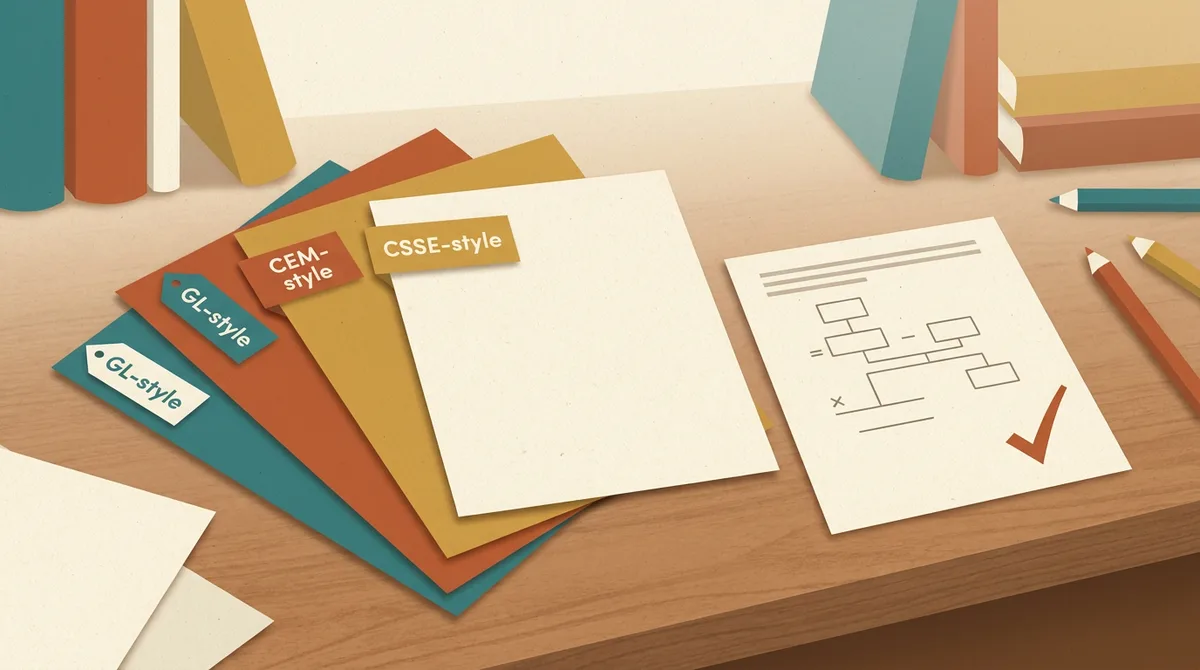
Most 11 plus maths libraries are filed one way only: by school, by board, or by publisher. That is genuinely useful for about a week, while you work out which papers your child should sit. After that it stops helping. Once your child has done two full papers and dropped every ratio question and every reverse percentage, what you need is twenty minutes of ratio practice tonight, not another sixty minute paper on Saturday.
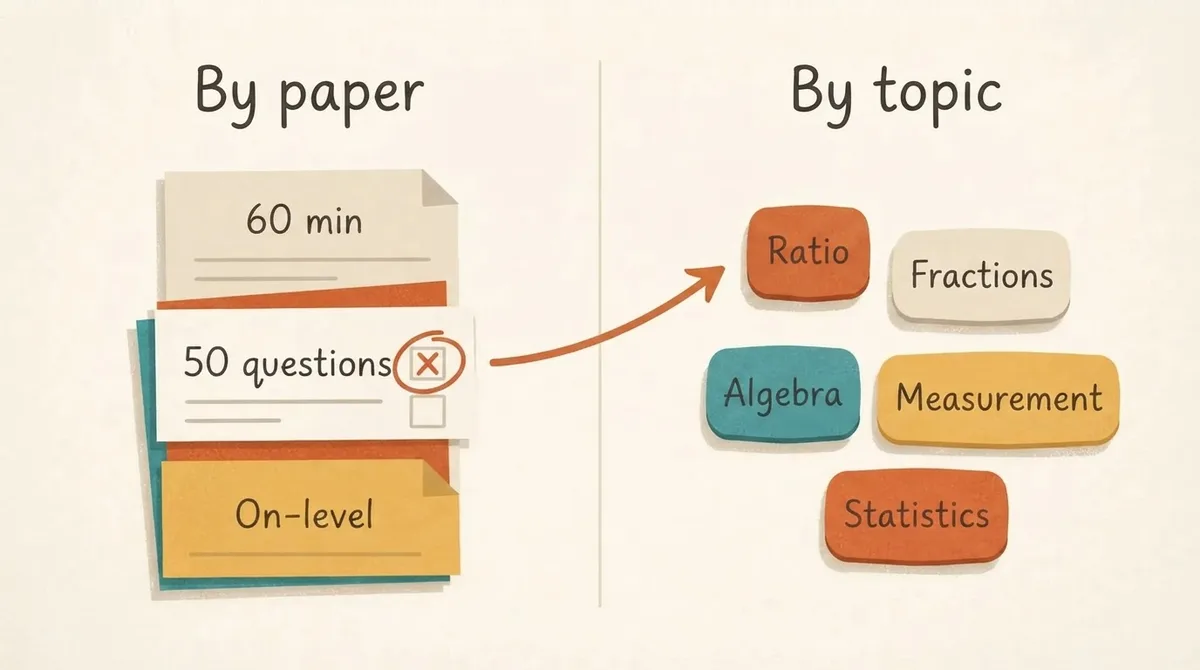
So this page indexes the same library twice. The first index lists full maths papers, each labelled with the board style it imitates, the time allowed, the question count and an approximate difficulty band. The second index reslices that same content into short topic tests mapped to the Year 5 and 6 national curriculum domains, so a weakness turns into a download in one click rather than a search.
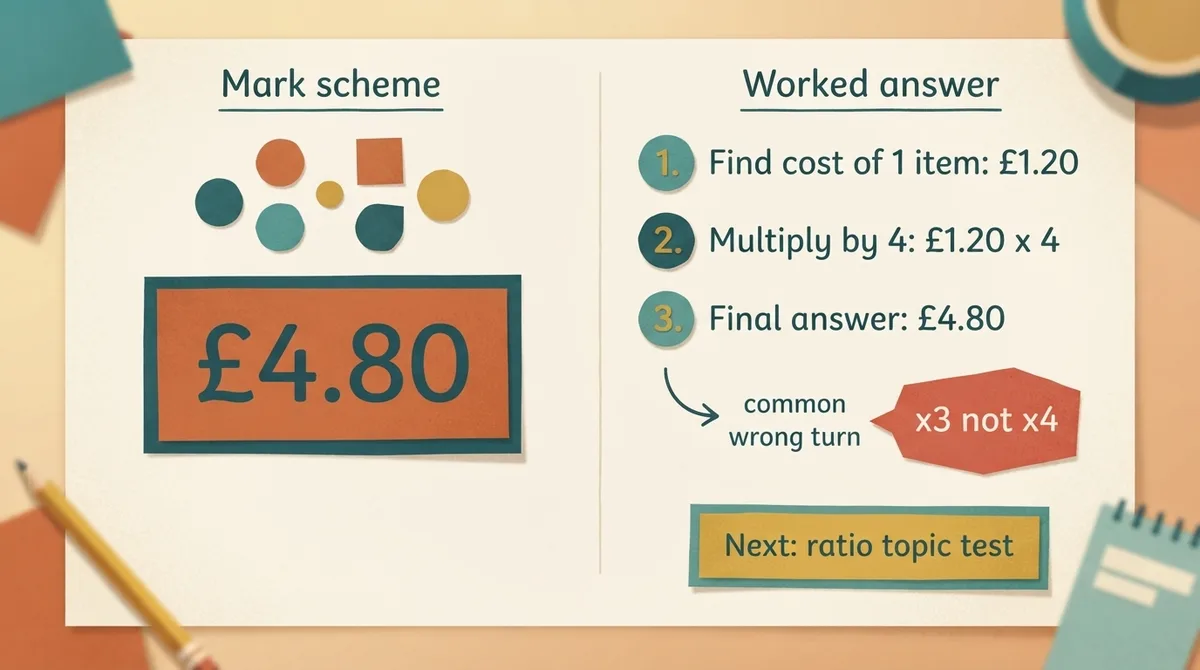
Every answer here is a worked method, not a letter in a mark scheme. A mark scheme tells you your child was wrong. A worked answer tells you which step went wrong, which wrong turn is the common one, and which topic test to do next. Everything below is free to download and print, it sits inside our wider library of free 11 plus practice papers with answers if you need the other subjects too, and there is a short format and scoring reference near the end for families who still need to work out what their local test actually looks like.
What is on this page
- How to choose which download to start with, in three common situations
- Index A: full 11 plus maths papers by board style, timing and difficulty
- Index B: short topic tests by curriculum domain
- What our worked answers include, and what the difficulty labels mean
- Format and scoring reference: what the real paper looks like in your area
- Official free papers published by boards and councils
- FAQs about 11 plus maths papers
How to choose: three situations, three starting points
Parents arrive at an 11 plus maths practice library in one of three states, and the right first download is different in each.
Situation one: you have not sat a full paper yet. Start with a full paper, not a topic test. You cannot diagnose a weakness you have not measured, and a full paper measures three things at once: topic knowledge, accuracy under time pressure, and stamina. Choose an On-level paper in the board style closest to your area, sit it timed, and mark it with the worked answers. Do not pre-teach anything first. A first paper is a measurement, and a measurement you have coached is worthless.
Situation two: you have a marked paper and a pattern in the mistakes. This is where nearly every other library abandons you. Take the two or three domains where the losses cluster, go to Index B, and work through short topic tests until the errors stop repeating. Fifteen to twenty minutes on one domain beats an hour of mixed practice, because a mixed paper gives your child perhaps three ratio questions and a topic test gives them fifteen.
Situation three: the topics are solid but the score is not. If your child gets questions right at home and loses marks in timed conditions, the problem is pacing, not maths. Go back to Index A and sit Stretch papers to time, marking strictly. Look at where in the paper the marks are lost. Marks lost in the last quarter usually mean a timing problem; marks scattered evenly usually mean a knowledge problem, which sends you back to Index B.
One rule cuts across all three: mark the paper together, question by question, on the same day. A paper marked a week later teaches nothing, because your child no longer remembers what they were thinking.
Index A: full 11 plus maths papers, by board style, timing and difficulty
Each paper below is labelled with the board style it imitates, the time allowed, the question count and a difficulty band. Board style describes the shape of the paper (multiple choice or standard answer, number of options, question density), not the content of any real test. Every paper downloads as a PDF with a separate worked answer booklet.
- Paper A1. GL-style, Foundation. 45 minutes, 45 questions, multiple choice with five options. Weighted towards number, place value and the four operations. Best first paper for a Year 5 child.
- Paper A2. GL-style, On-level. 50 minutes, 50 questions, multiple choice with five options. Full domain spread including ratio and simple algebra. The standard diagnostic paper for most families.
- Paper A3. GL-style, Stretch. 50 minutes, 50 questions, multiple choice. Higher proportion of multi-step word problems and reverse percentage questions.
- Paper A4. CEM-style, On-level. 22 minutes, 27 questions, multiple choice with four options. Short, fast and mentally demanding, with numerical reasoning embedded in worded contexts.
- Paper A5. CEM-style, Stretch. 25 minutes, 30 questions. Tighter time per question, designed to expose pacing problems rather than knowledge gaps.
- Paper A6. CSSE-style, On-level. 60 minutes, standard written answers with working space. Longer multi-step questions in the Essex tradition, where method marks matter.
- Paper A7. CSSE-style, Stretch. 60 minutes, standard written answers. Heavier on proportional reasoning and multi-stage measurement problems.
- Paper A8. ISEB-style, On-level. 50 minutes, 50 questions, multiple choice with four options. Broad coverage at a steady pace, suited to independent school pre-test preparation.
- Paper A9. Independent-school style, On-level. 60 minutes, standard written answers, working required. Fewer questions, more marks per question.
- Paper A10. Independent-school style, Stretch. 60 minutes, standard written answers. Includes extended problems that carry several marks and reward clear setting out.
If you want a wider view of what genuine school and board material exists beyond our own library, our guide to 11 plus past papers maps the official sources area by area, and our round-up of free 11 plus papers with answers covers the other subjects.
Index B: 11 plus maths topic tests, one weakness at a time
These are the same questions, resliced. Each topic test is short enough to finish in a single sitting on a school night, and each maps to a domain of the Year 5 and 6 national curriculum maths programmes of study. Every test comes in three difficulty bands unless noted.
- Number and place value. 12 questions, 15 minutes. Rounding, negative numbers, ordering large numbers, reading scales.
- The four operations. 15 questions, 20 minutes. Long multiplication, short and long division, order of operations, remainders in context.
- Fractions, decimals and percentages. 15 questions, 20 minutes. Equivalence, adding and subtracting unlike denominators, fraction of an amount, percentage increase and decrease.
- Reverse percentages and percentage change. 10 questions, 15 minutes. Stretch band only. The single most common source of dropped marks in the papers above.
- Ratio and proportion. 15 questions, 20 minutes. Sharing in a ratio, unequal shares, scaling recipes, best value comparisons.
- Algebra. 12 questions, 15 minutes. Simple formulae, function machines, missing number problems, sequences with an nth term.
- Measurement. 15 questions, 20 minutes. Unit conversion, perimeter, area, volume, time and timetable problems.
- Geometry: properties of shapes. 12 questions, 15 minutes. Angles on a line and around a point, triangles, quadrilaterals, nets.
- Geometry: position and direction. 10 questions, 12 minutes. Coordinates in four quadrants, translation, reflection.
- Statistics. 12 questions, 15 minutes. Pie charts, line graphs, two way tables, mean.
- Multi-step word problems. 10 questions, 20 minutes. Stretch band only. Mixed domains, deliberately worded to slow readers down.
Ratio, proportion and algebra are worth flagging: the national curriculum introduces them in Year 6, so a Year 5 child sitting a full paper in the spring may meet them for the first time in a practice paper rather than in class. That is normal, and it is not evidence of a problem. If you want the full picture of what each domain looks like in exam form, our companion article on 11 plus maths topics and question types breaks the question styles down domain by domain.
What our worked answers include, and what the difficulty labels mean
A mark scheme gives you a letter or a number. Ours gives you three things for every question.
- The method, step by step. Not the shortest possible route, but the route a Year 6 child can reproduce under time pressure.
- The common wrong turn. For a ratio question sharing 45 in the ratio 4:5, the common wrong turn is dividing 45 by 4 or by 5 instead of by 9 parts. Naming that error is what lets a parent recognise it again next week.
- Where to go next. Each answer points at the topic test in Index B that drills the same skill, so marking a paper produces a to-do list rather than a score.
The difficulty labels are relative to our own library, not to any official standard.
- Foundation. Single step and two step questions, familiar contexts, generous time per question. Suitable from the start of Year 5.
- On-level. The full Year 6 domain spread at realistic exam pace. This is where the honest diagnostic sits.
- Stretch. Multi-step problems, heavier reading load, tighter timing. Useful for superselective and independent targets, and for children who already score comfortably on On-level papers.
A child scoring poorly on a Stretch paper has not failed anything. Stretch papers exist to find the ceiling, and a paper that finds no mistakes has told you nothing you can act on.
What the real 11 plus maths paper looks like in your area
Formats vary sharply by region, and this changes which papers you should download first. Two published examples show how far apart the extremes sit.
Buckinghamshire. The Secondary Transfer Test consists of two papers and all the questions are multiple-choice. One paper tests verbal skills including comprehension, technical English and verbal reasoning; the other tests mathematics and non-verbal skills including spatial reasoning. Each paper is about 45 minutes long, or 60 minutes including the introduction and examples, with a short break between papers and an audio soundtrack giving instructions. Children normally sit a practice test first, which looks the same as the real test, is timed and sat in test conditions, takes about 40 minutes per paper, and is not marked or sent home. Details are published by Buckinghamshire Council. Families here should prioritise GL-style multiple choice papers, and should not spend long on papers that require written working.
Essex (CSSE). Candidates sit two tests, one in English and one in Mathematics. The maths paper runs for 60 minutes and the English paper runs 60 minutes plus 10 minutes additional reading time. CSSE also notes that with effect from September 2024, for 2025 entry, the English paper does not contain Applied Reasoning questions. Families here should start with the CSSE-style papers in Index A, where working is written out and method matters. Our guide to the CSSE exam in Essex covers the wider differences.
GL Assessment itself is explicit that formats differ: the 11+ consists of a single test or a series of tests covering one or more of English, maths, verbal reasoning and non-verbal reasoning, and tests vary because local authorities or individual schools decide which subjects to test and the balance of question types. Always confirm your own school or consortium's published arrangements for the year your child sits, because timings and combinations change.
How maths is scored: standardised scores, age allowance and weighting
Raw marks are almost never the number that decides anything. GL Assessment defines a Standard Age Score as one that converts a pupil's raw score to a standardised score which takes into account the pupil's age in years and months, giving an indication of performance relative to a national sample of pupils of the same age, with an average score of 100.
Two consequences matter when you mark a practice paper at home.
First, age allowance is real but modest. A September-born and an August-born child sitting the same paper are not compared on raw marks. This is worth knowing, but it is not a strategy, and no amount of age allowance rescues a systematic gap in ratio or fractions.
Second, weighting can make maths a minority of the decision. In Buckinghamshire the Secondary Transfer Test Score is weighted 50% verbal skills, 25% mathematical skills and 25% non-verbal skills, so maths contributes only a quarter of the total. A child's standardised score there falls between 60 and 170, and a score of 121 or above is needed to qualify for a grammar place, with the council stating that it expects about 37% of children to reach 121 or more. In Essex, by contrast, maths is one of two papers and carries far more of the decision. Two hours a week on maths is a sensible allocation in one of those areas and a poor one in the other.
If you want the marks tracked question by question across repeated papers rather than in a notebook, our paper tests feature records every attempt and shows which domains are improving and which are stuck.
Official free maths papers published by boards and councils
Our library is not a substitute for official material, and you should use both. Three sources are worth downloading directly.
- CSSE. Free downloadable past mathematics papers for 2021, 2022 and 2023 entry, each with a mark scheme, alongside free English papers, on the CSSE practice material page. All CSSE examination papers are protected by copyright.
- GL Assessment. A free maths familiarisation paper supplied as a downloadable ZIP of PDFs for home printing, on the GL Assessment free materials page. GL describes providing 10 hours of free familiarisation materials, and notes that familiarisation papers aim for general familiarity with test styles while printed practice papers offer comprehensive preparation.
- Your local council or consortium. Most grammar school areas publish a sample paper or familiarisation booklet for their own test. That single document is worth more than any commercial paper, because it is the only one that shows the real layout and instructions.
GL also warns that 11+ tests vary from area to area, so the exact timings, the combination of topics covered and the number of questions in your local test may differ from those in its familiarisation and practice materials. Treat every practice paper, ours included, as a rehearsal of skills rather than a preview of the real thing.
Frequently asked questions about 11 plus maths papers
Where can I find free 11 plus maths papers with answers? Both indexes on this page are free, and every paper and topic test has a worked answer booklet rather than a bare mark scheme. For official material, CSSE publishes past maths papers with mark schemes and GL Assessment publishes a free familiarisation paper. Many individual independent schools also publish a sample maths paper on their admissions pages.
What papers are in the 11 plus? It depends entirely on the area. GL Assessment states that the 11+ consists of a single test or a series of tests covering one or more of English, maths, verbal reasoning and non-verbal reasoning, and that local authorities or individual schools decide which subjects to test. Some areas run two multiple-choice papers that bundle maths with non-verbal reasoning; others run a standalone 60 minute maths paper. Check your own consortium's published arrangements.
Are 11 plus maths papers hard? The content sits inside the Year 5 and 6 national curriculum, so the maths itself is not beyond what is taught in school. The difficulty comes from pace, multi-step wording and the fact that selective tests are designed to spread out a strong cohort. That is why our papers carry Foundation, On-level and Stretch bands: a child who finds an On-level paper comfortable is not being served by another On-level paper.
How many practice papers should my child do? Fewer full papers and more topic tests than most families expect. A useful rhythm is one full paper every week or two, marked properly on the same day, with the gaps filled by short topic tests aimed at whatever that paper exposed. Sitting six papers in a row without repairing anything in between simply measures the same gap six times.
What score should we be aiming for on a practice paper? There is no transferable pass mark, because outcomes depend on standardised scores, age allowance, local weighting and the number of places available. Use practice papers to track direction, not to predict a result. A raw score that climbs across three papers of the same difficulty band is meaningful; a single score compared against someone else's threshold is not.
Should we do the topic tests before the full papers? Only if your child is early in Year 5 and has not covered much of the Year 6 content yet, in which case Foundation topic tests are a gentler entry point. Otherwise sit a full On-level paper first. The paper tells you which topic tests are worth doing, and skipping that step usually means drilling something that was never the problem.
Topics
- 11 plus maths
- practice papers
- topic tests
- worked answers
- downloads