
The 11 Plus in London: Consortium Tests and Sutton SET
A dated, source-led walkthrough of how the London 11 plus actually resolves into an offer: borough by borough, test by test, from May registration to March national offer day.
 Elspeth Marlow
- 13 min read
Search for the 11 plus in London and you will mostly find tuition brands. What you will struggle to find is the thing London parents actually need: an explanation of how the system resolves into an offer. Most guides stop at a list of schools. Lists are the easy part, and they are also the part that changes least. The hard part is that London contains several genuinely different selective systems running on overlapping but non-identical calendars, and the order in which their deadlines fall creates traps that catch careful families every year.
The biggest of those traps is simple to state. In Sutton, passing the headline test does not get you a place; it gets you an invitation to a second, differently formatted exam eighteen days later. In Kingston, the second stage falls after the deadline for your local authority application, so you have to rank a school before you know whether your child is still in the running for it. And if you are also applying to independent schools, their offers arrive weeks before the state system says anything at all, usually with an acceptance deadline attached.
This guide is a chronological walkthrough of a single admissions year, using published dates for September 2027 entry. It is written for a parent orienting themselves in spring, before registration opens, and it is built to be returned to as a calendar. Every date and format below comes from a school or government source, named as we go. Admission arrangements are revised annually and vary by borough, so always confirm the current year's detail on the school's own admissions page before you act on anything here.
The London 11 plus is not one exam
There is no single London 11 plus. There is a state grammar sector organised borough by borough, a small partially selective sector, and a large independent sector that runs on its own machinery. A family in Sutton, a family in Barnet and a family applying to a west London independent school are preparing for three different things.
The practical consequence is that content does not transfer. Sutton's test is Maths and English only and contains no verbal or non-verbal reasoning at all. The Henrietta Barnett School's first round is verbal reasoning, non-verbal reasoning and English, which is close to the exact inverse. Tiffin's first stage is English and Maths. The ISEB Common Pre-Test, used across the independent sector, covers all four. A family living between Sutton and Barnet, a journey of under an hour, faces two almost disjoint preparation syllabuses.
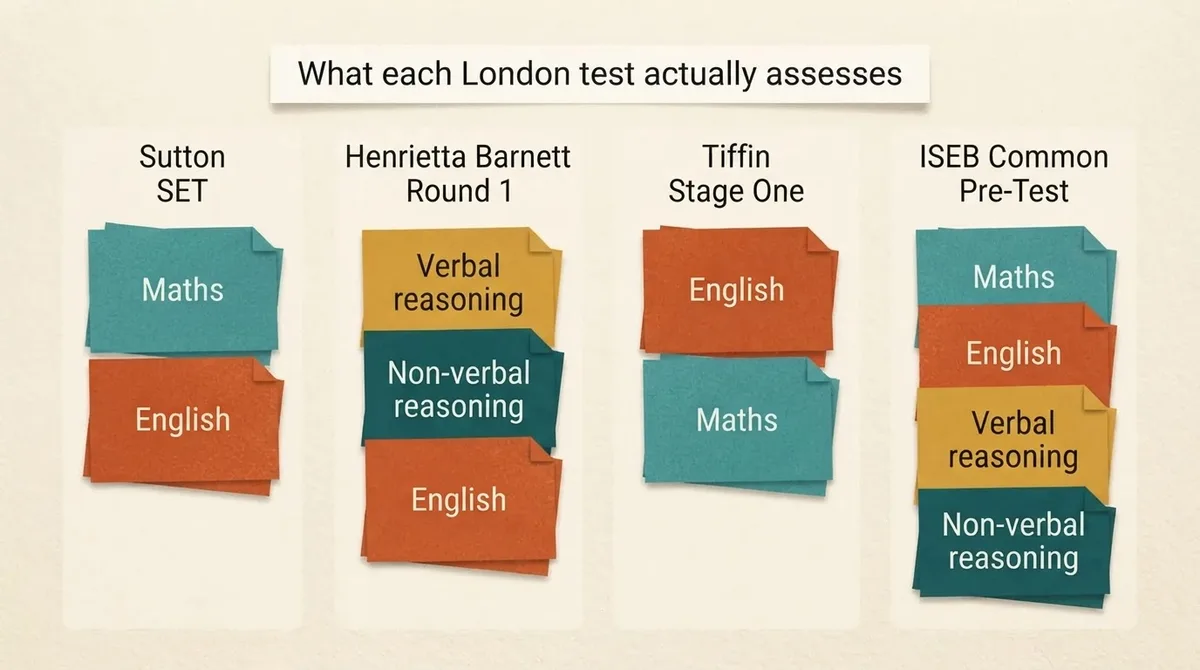
So the first job is not buying practice papers. It is deciding which two or three tests you are actually entering, because that decision determines whether non-verbal reasoning belongs in your child's week at all. Our guide to grammar schools by area is a useful cross-check if you are weighing London against a nearby county system such as Kent or Buckinghamshire.
Three selective systems, one city
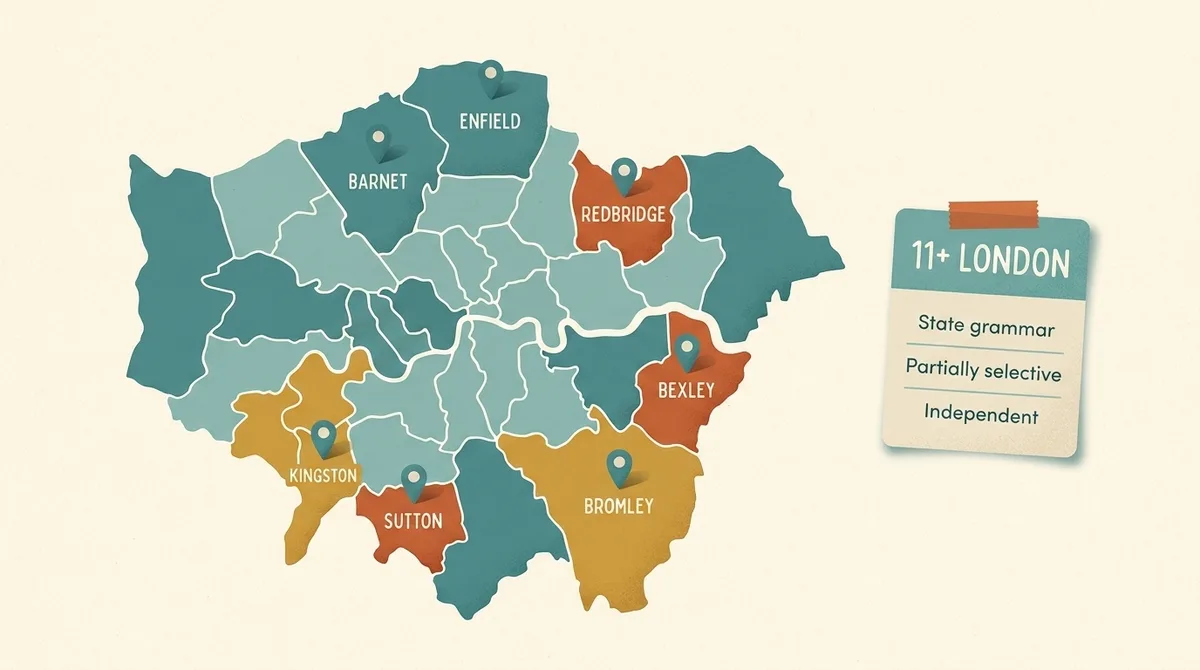
Fully selective state grammars. Seven London boroughs run them: Barnet, Bexley, Bromley, Enfield, Kingston upon Thames, Redbridge and Sutton. These are free schools with their own entrance tests, and admission is competitive on test performance, sometimes combined with distance or catchment criteria. Crucially, the test is only half the process; the other half is your local authority application.
Partially selective schools. A smaller group admits a proportion of its intake on aptitude or ability while the rest of the intake follows normal comprehensive criteria. Greenshaw High School in Sutton, for example, participates in the shared Sutton test for its selective band. Tiffin School reserves up to ten per cent of places for boys demonstrating aptitude in Sport (five per cent) or Music (five per cent), assessed in July with an earlier registration deadline than the academic route.
Independent schools. These charge fees and select through their own assessments, most commonly the ISEB Common Pre-Test, and in west and north London through the London 11+ Consortium's shared process. They sit entirely outside the local authority application, and they move on a different and earlier timetable.
Spring: choose your tests before registration opens
Registration windows in London open early and close hard, so the decision work has to happen in the spring of Year 5. Three questions settle it. Which schools are genuinely commutable on a school day, in rush hour, with a child carrying a bag? Which subjects does each of those schools test? And are you running a state-only campaign or a dual state and independent one?
Answer those, then write down the union of subjects tested. If every school on your list is in Sutton or Kingston, your preparation is Maths and English, and time spent on non-verbal reasoning is time taken from the papers that count. If Barnet or any independent school is on the list, reasoning is in scope and needs a schedule of its own. If you are unsure how early to begin, our year-by-year preparation plan sets out realistic starting points.
May to July: the Sutton registration window
Sutton runs the largest shared test in London. One registration for the Selective Eligibility Test (SET) covers six schools: Greenshaw High School (selective band), Nonsuch High School for Girls, Sutton Grammar School, Wallington County Grammar School, Wallington High School for Girls and Wilson's School. For September 2027 entry, registration opens on 1 May 2026 and closes on 31 July 2026, with the test sat on 15 September 2026.
The SET is two multiple-choice papers, Mathematics and English, answered in lozenges on a separate answer sheet, each lasting roughly 40 to 50 minutes with a rest break in between. It contains no verbal reasoning and no non-verbal reasoning. Two mechanical details deserve practice in their own right: transferring answers to a separate sheet, and pacing a paper of that length. Neither is difficult, but both are unfamiliar, and both cost marks when they are met for the first time on the day.
September: test day, and what passing actually means
Here is the point that most London guides omit entirely. Passing the SET does not secure a place. It confirms eligibility to progress to a Second Stage Entrance Examination. Sutton Grammar's admissions FAQs are explicit that scores are age-standardised, that each school sets its own pass mark after marking is complete, and that "It is not possible to state a pass mark in advance of the test". Outcome emails go out during the week after the test.
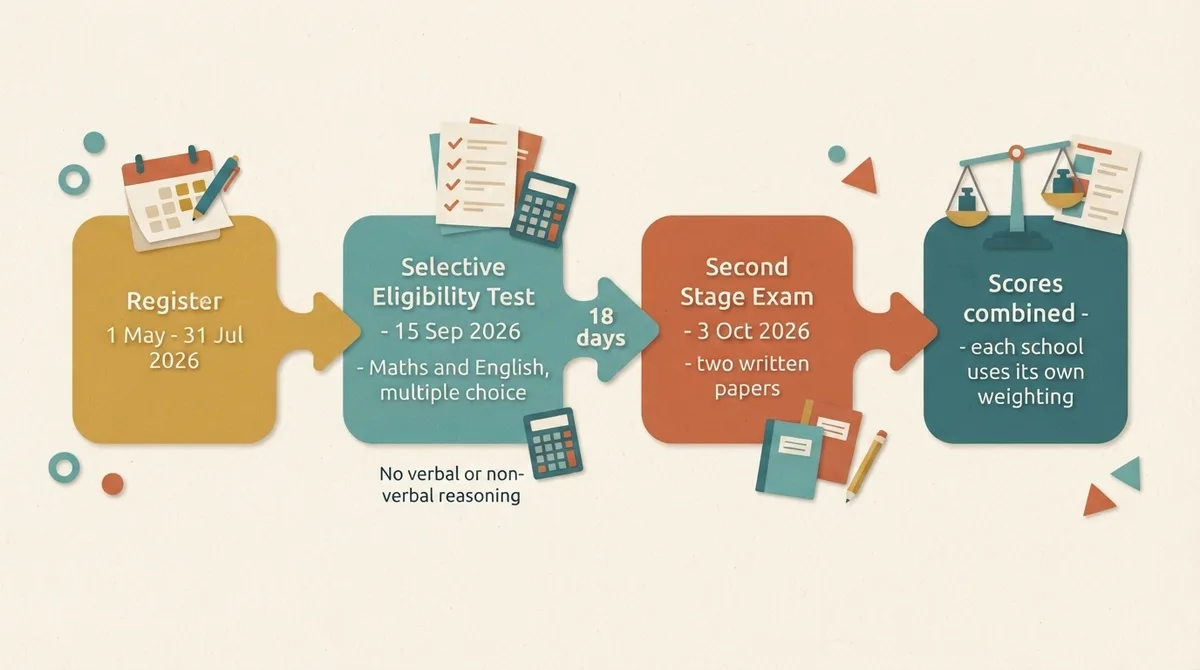
The Second Stage falls on Saturday 3 October 2026, eighteen days after the SET. It is two papers, Mathematics and English, each approximately 45 minutes to an hour, and they are not multiple choice. The SET score is then combined with the Second Stage result using weighting formulas that differ from school to school, and each school notifies candidates separately before the October half term break. You can read the format detail in Sutton Grammar School's admissions FAQs.
The preparation implication is large. A child drilled purely on multiple-choice technique meets extended written answers, working shown for method marks and a longer writing task with two and a half weeks' notice. Build written practice in from the start, not in the gap.
October: Kingston, and the deadline collision
Tiffin School registration opened on 5 June 2026 with a deadline of 12:00 on 1 September 2026, and the school states that no late applications will be accepted. Stage One, on 2 October 2026, tests all applicants in English and Mathematics. Successful candidates are notified by 16 October 2026, and Stage Two follows in mid-November for invited candidates only. The Tiffin Year 7 admissions page carries the full sequence, including the separate Sport and Music aptitude route assessed in July, which closes for registration on 6 June 2026.
Now look at the calendar collision. Secondary school applications in England open on 1 September and must be submitted by 31 October. Tiffin's Stage Two is in mid-November. So a Kingston family must decide where Tiffin sits on their ranked preference list while the Stage Two result does not yet exist. There is no way around this; there is only planning for it. Rank the school honestly against your realistic alternatives, use all your available preferences, and remember that GOV.UK states plainly that listing only one school will not increase your chances of getting a place there.
Barnet, and the other selective boroughs
Barnet hosts Queen Elizabeth's School for boys, The Henrietta Barnett School for girls and St Michael's Catholic Grammar School. Henrietta Barnett runs two rounds: a First Round test covering verbal reasoning, non-verbal reasoning and English, then a Second Round English and Mathematics test for those who progress. The school publishes a Published Admission Number of 120 places for September 2027 entry and allocates on entrance test ranking rather than catchment or proximity, making offers in rank order after each round. It also notes that GL Assessment provides free familiarisation material for Round 1 but that no past papers or resources are released for Round Two, which again rewards families who prepare written work early.
Bexley operates a shared selection test used by its grammar schools, including Beths, Bexley Grammar, Chislehurst and Sidcup and Townley. Bromley has St Olave's and Newstead Wood, both heavily oversubscribed and both running their own multi-stage arrangements. Enfield has The Latymer School, which draws from across north London. Redbridge has Ilford County High and Woodford County High. Formats and stage structures differ between all of these, and several use their own two-round processes, so treat each school's admissions page as the authority rather than assuming a borough-wide pattern.
November to February: the independent track
Most London families running a grammar campaign are also applying to at least one independent school, and the two tracks interlock decisively.
The ISEB Common Pre-Test is four online, adaptive assessments covering Mathematics, English (reading comprehension and grammar), verbal reasoning and non-verbal reasoning. They can be sat together on one day or split across several, are typically taken in Year 6 or Year 7, and feed entry into Year 7 or deferred entry into Year 9. The testing window runs from September to late May and results are available immediately after completion. If this is your route, our ISEB Common Pre-Test guide covers the adaptive format properly, and our comparison of GL, CEM and ISEB explains how the boards differ in practice.
The London 11+ Consortium is a group of independent schools sharing one application process, described by member schools as aiming to be fair, clear, robust and accessible to children from all schools and backgrounds. Godolphin and Latymer, a member school, publishes the 2027 entry sequence: registration closes at noon on Friday 6 November 2026, the entrance exam is sat on either Friday 27 November or Tuesday 1 December 2026, interviews are held on Friday 15 January 2027 with no alternative dates offered, and offers are made on Friday 12 February 2027. Applicants must be born between 1 September 2015 and 31 August 2016.
Read that offer date against the state calendar. Independent offers land in February. National offer day for state secondary places is in March. Independent offers usually carry an acceptance deadline, which means many London families are asked to accept or decline a fee-paying place before they know their state outcome. That is the defining strategic fact of a dual-track London campaign, and it is worth discussing as a household in the spring, not in February.
The London 11 plus calendar at a glance
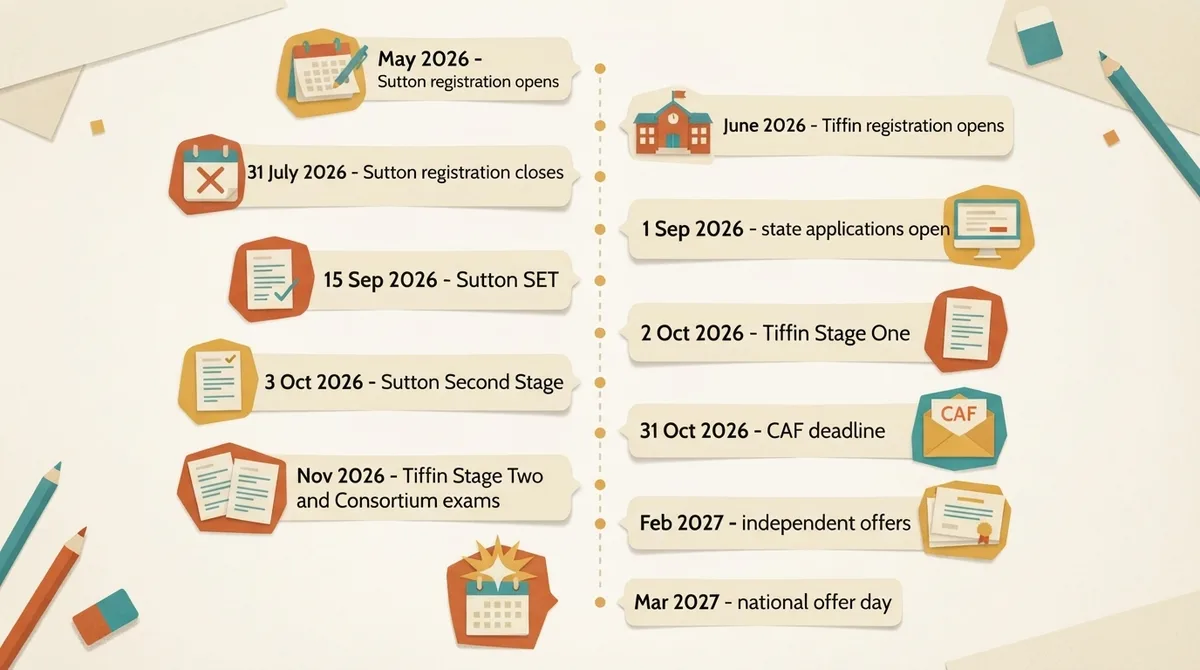
- 1 May 2026: Sutton SET registration opens
- 5 June 2026: Tiffin registration opens (Sport and Music aptitude closes 6 June)
- 31 July 2026: Sutton SET registration closes
- 1 September 2026: Tiffin registration closes at 12:00; state applications open
- 15 September 2026: Sutton Selective Eligibility Test
- 2 October 2026: Tiffin Stage One
- 3 October 2026: Sutton Second Stage Entrance Examination
- By 16 October 2026: Tiffin Stage One outcomes
- Before October half term: Sutton second stage outcomes, school by school
- 31 October 2026: Common Application Form deadline
- Mid-November 2026: Tiffin Stage Two; Consortium exams late November and early December
- 15 January 2027: Consortium interviews
- 12 February 2027: Consortium offers (Godolphin and Latymer)
- March 2027: National offer day for state places
How the CAF interacts with your test results
This is the mechanic that trips people up, so it is worth stating plainly. Your test rank and your application are two separate things. The test determines whether you are eligible and where you sit in a school's ranking. The Common Application Form, submitted through your own local council even when the schools are in another borough, determines which single offer you receive.
Sutton Grammar School spells this out: after passing the two-stage process, boys must still name the school on the CAF to be considered, and meeting the required standard does not guarantee admission because the school is oversubscribed. Passing is necessary, not sufficient.
Test performance decides whether a school will offer you a place. Your ranked preference list decides which of your offers you actually get.
Three rules follow. Use every preference slot you are given. Rank in true order of preference, since the system awards the highest-ranked school that will offer you a place. And include at least one school you would be content with and are confident of reaching, because a list of five long shots can resolve to none of them.
What to prepare, and the mistakes to avoid
- Match the format, not the reputation. If your list is Sutton and Kingston, reasoning practice is optional. If Barnet or an independent school is on it, reasoning is core.
- Practise written answers early. Multiple-choice fluency will not carry a child through Sutton's second stage or Henrietta Barnett's Round Two.
- Rehearse the mechanics. Separate answer sheets, timed 45-minute papers and a rest break between papers are all learnable in advance.
- Diarise registration, not just exams. Sutton closes on 31 July; Tiffin closes at noon on 1 September. Missing a window ends the campaign before it starts.
- Plan the February decision. Decide in advance what you will do if an independent offer arrives with a deadline before your state outcome.
A structured plan helps more than volume here. Trace Learn's exam plan builds a schedule around the specific tests on your list, so a Sutton family is not spending evenings on non-verbal reasoning they will never sit, and a Barnet family is not neglecting it.
Work out your list in spring, register on time, prepare both formats, and treat the CAF as a strategic document rather than a form. That sequence is the whole game in London.
Topics
- 11 plus london
- sutton set
- grammar schools
- consortium
- admissions