
How to Choose an 11 Plus Learning Platform
A disclosed buyer guide written by a company that sells one: how to decode the word adaptive, test whether a progress report is real evidence, and run a seven-day trial that actually decides.
 Elspeth Marlow
- 15 min read
Disclosure first, because nothing below is worth reading without it: Trace Learn sells an 11+ learning platform. We are a vendor. That is exactly why this guide does not open with a ranked list that happens to put us at number one, why it names the places rivals are genuinely better, and why our own product appears last, with a paragraph on who should not buy it.
Search for the best 11 plus learning platform and most of what comes back is a vendor asserting that it is the answer, plus a few comparison articles published by companies that rank themselves first without saying so. That is why parents end up asking a Mumsnet thread or a Facebook group instead: they suspect the published comparisons are bought, and they are often right.
So this is not another ranked list. It is a testable framework. It defines the words the marketing hides behind, gives you a way to tell a progress report from a progress theatre, and ends with a seven-day script you can run inside free trials plus a scoring sheet for two or three shortlisted products. Nothing here needs you to trust us. It needs you to check.
Myth: there is one 11+, so any good platform covers it
Reality: there is no national 11+ syllabus for a platform to cover. GL Assessment, the largest test provider, states that the 11+ "consists of a single test or a series of tests, covering one or more of the following subjects: English, maths, verbal reasoning and non-verbal reasoning", and that "local authorities or individual schools decide which subjects to test, as well as the balance of question types" (GL Assessment).
Two real examples show how far apart the destinations sit. In Buckinghamshire, 13 grammar schools run transfer testing together; children sit two papers of about 60 minutes covering verbal, non-verbal and mathematical skills, a score of at least 121 counts as qualified, and children at a state-funded Buckinghamshire primary are entered automatically without registering (Buckinghamshire Council). In Essex, the CSSE consortium sets an English paper of 60 minutes with ten minutes' extra reading time plus a 60-minute maths paper, and states that from September 2024 entry the English paper no longer contains Applied Reasoning questions (CSSE).
A platform tuned for Buckinghamshire non-verbal reasoning is close to irrelevant for Essex, where non-verbal reasoning is not tested at all. And a question bank still drilling Applied Reasoning for Essex candidates is worse than useless, because it spends your child's attention on a question type that has been withdrawn. So the real first mistake is choosing a platform before reading your own admission authority's page. Do that first, write down the subjects, the paper lengths and the qualifying rules, then shop. Our exam boards comparison is a starting point, but the council or consortium page is the authority.
The buying question: "Which admission authority is this content built for, when was it last reviewed against that authority's published format, and what changed at the last review?" A vendor that cannot date its last syllabus review is telling you it does not do them.
Myth: adaptive means the software knows your child
Reality: ask what a provider means by "adaptive" before comparing features. In practice vendors mean one of five quite different things.
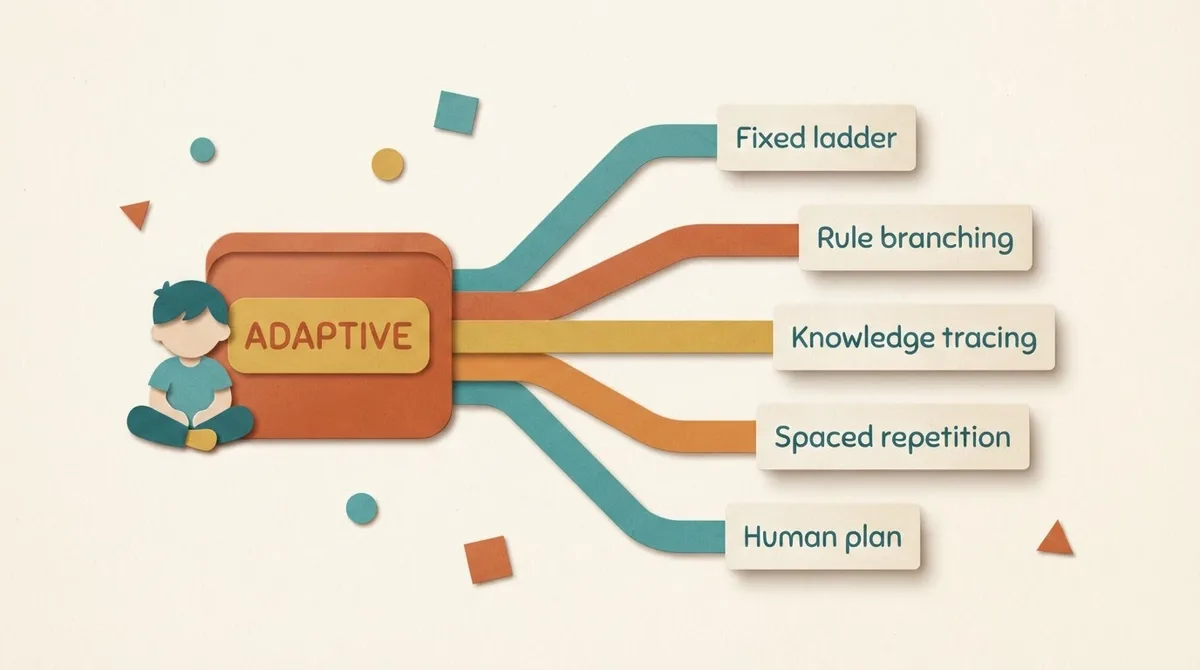
- A fixed difficulty ladder. Levels 1 to 5 in a set order. Get enough right, move up. Cheap, transparent, and genuinely fine for building fluency.
- Rule-based branching. "Three wrong in a row, drop a level; five right, go up." Responsive within a topic, blind across topics.
- A statistical model. Item response theory or knowledge tracing, where each question has a measured difficulty and the system maintains an estimate of your child's ability and updates it after every answer. This is what most people imagine they are buying.
- Spaced repetition scheduling. The clever part is not difficulty but timing: material you nearly forgot comes back before it goes. Excellent for vocabulary, spelling and number facts.
- A human picks the weekly plan. A tutor or an editor sets the path. Often the most useful of the five, but it is not an algorithm.
Atom Learning's 11+ page says its algorithm "adapts to every student's current level" and works "in the background", without stating which of the five that is. Bond is the clearest worked example of why you should ask: Bond's adaptive tiers are powered by CENTURY.tech rather than built by Bond, so the adaptivity you are evaluating belongs to a third party with its own model and its own roadmap.
The one question that reveals the answer: "If my child gets three in a row wrong, what happens on the very next question, and can you show me on screen?" A ladder gives you an easier question of the same type. Rule-based branching drops a level. A statistical model may switch topic entirely because it now doubts a prerequisite. A spaced-repetition system reschedules rather than re-serves. "A human picks" means nothing happens until Monday. All five are legitimate. Paying model prices for a ladder is not.
While you are there, price the other three weasel words. Personalised often means the child chose an avatar. Unlimited usually means unlimited attempts at a finite bank, so ask for the bank size per subject and per year group, not the headline total. And instant feedback is frequently instant marking. Marking tells you the answer was wrong. Feedback tells you why, and what to do next.
Myth: every platform tracks progress, so tracking is not a differentiator
Reality: every platform shows numbers. Very few show evidence. A useful 11 plus progress report passes five tests, and a vanity dashboard fails at least three of them.
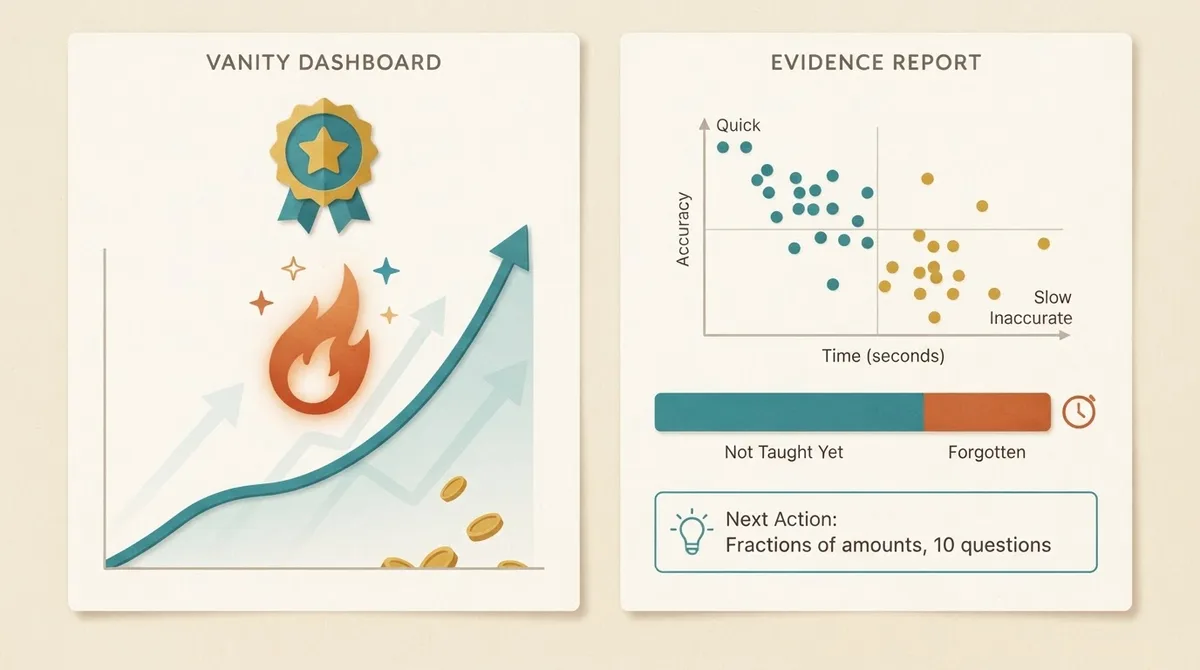
- Does it separate accuracy from speed, under timed conditions? A child scoring 85% untimed and 55% at exam pace has a pacing problem, not a knowledge problem, and the two need opposite remedies. One number hides that.
- Does it distinguish not taught yet from taught and forgotten? Both look like red on a heat map. One needs teaching; the other needs retrieval practice this week.
- Does the trend run against a fixed reference? A child who only ever attempts easy questions produces a beautiful rising line. Ask what the line is measured against: a stable difficulty scale, a standardised score, or simply their own recent average.
- Does it name the next specific action? "Maths: 62%" is decoration. "Ten questions on fractions of amounts, then re-test Thursday" is a report.
- Can it ever be wrong? This is the sharpest test. Ask the vendor to show you a report that tells a parent their child is behind. If every screenshot is encouraging, the report is a marketing surface.
Standardised age scores need the same scepticism. Age standardisation compares a child with others of the same age in months, which is why a summer-born child's raw and standardised scores differ; CSSE applies age standardisation to candidates' scores, and Buckinghamshire's qualifying mark of 121 is a standardised figure, not a raw one. When a platform reports a standardised age score, ask which population it standardised against: its own users, a national sample, or the test provider's. Only the last is comparable with a real result. "Compare with successful applicants to your target school" claims deserve one follow-up: how many applicants, from which years, and were their real exam outcomes verified or self-reported? The 11 plus exam explainer shows where standardisation belongs in the wider process.
Myth: you can judge question quality from the free sample
Reality: the free sample is the best content in the bank. Judge the middle instead, and do it in one sitting of about forty minutes.
Start with explanation quality, the thing that separates a teaching product from a testing product. Deliberately answer three questions wrong: one verbal reasoning, one maths word problem, one comprehension inference. Then read the explanations. A weak one restates the answer ("The answer is C"). A good one names the method, shows the working, and explains why the tempting wrong option was tempting. RSL Educational's free-resources roundup is blunt about this and criticises Bond's answer materials for "lacking much explanation"; that critique is the right lens to apply to everyone, including us.
Then test coverage. Pick three narrow topics from your authority's format, ideally awkward ones: cloze with a given letter pattern, ratio with unequal sharing, inference about a narrator's motive. Search the bank for each. A platform that has one item per narrow topic will recycle it, and a child who remembers the answer learns nothing the second time.
Finally test fidelity. If your child will sit a paper with a separate answer sheet, does the platform ever rehearse that, or is every question a tap on a coloured box? Transfer errors on an answer sheet are worth real marks.
Myth: the tutor side is just a login
Reality: if you are paying a tutor, shared evidence is the highest-value feature on the list, and it varies enormously.
Atom is genuinely strong here and deserves the credit: it is free for tutors, gives them their own dashboard to manage students, and exposes over 90,000 practice questions with work marked instantly. Note the commercial shape, though, which is disclosed on their tutor page: the tutor product is paid for by the families, and tutors receive a 10% discount on their first payment and 20% off additional subscriptions when they start student subscriptions. That is a legitimate model. It is also a referral incentive, and you should know it exists when a tutor recommends a platform.
The questions that matter for an 11 plus platform for tutors are practical. Can the tutor see the same weakness data you see, or only a summary? Can they assign work, or only observe? Does a tutor invite hand a stranger full account access, including your child's name, school and results, and can you revoke it in one click without deleting your child's history? Can two adults (say, separated parents) each hold their own login rather than sharing one password?
Safeguarding sits in the same place. Ask what is stored about the child, whether the child is profiled for anything beyond teaching, whether there is any child-to-child messaging, and whether marketing is ever shown to the child's account. The ICO's Age Appropriate Design Code is the standard UK services aimed at children are expected to meet, and it is a fair yardstick to hold any vendor against, including us.
Myth: the price on the pricing page is the price you pay
Reality: the sticker is the easy part. Published monthly figures for the platforms parents usually shortlist range from roughly £5.99 a month for a topic-only package at 11PluseHelp and £7.50 a month for single-user Bond Online, through £15.99 monthly for 11PluseHelp's complete package, up to Atom's £39.99 a month for English, Maths and Science and £69.99 a month for Exam Prep Plus (£55.99 monthly if billed annually, £671.90 up front). Bond's Premium Plus, which is ISEB-endorsed and adds over 2,000 questions aligned to the ISEB Common Pre-Tests Framework, is £28.99 a month billed annually at £347.92.
The gap between £7.50 and £69.99 is not a quality gradient. It is a difference in what is included: a question bank, versus a question bank plus teaching content plus reporting plus tutor tooling. Decide which of those you actually need before you compare numbers.
Then read the terms, which is where the ranking pages go quiet. CGP states plainly that monthly 11+ Online subscriptions renew automatically each month and can be cancelled at any time, with yearly plans renewing annually and saving 30%. Atom's pricing page shows "Try for free" buttons but does not state the trial length or cancellation terms on the page itself. Bond's online page does not set out cancellation terms either. None of that is sinister; it does mean you should establish, in writing before you pay: how long the trial runs, whether it needs card details, what date the first charge lands, whether an annual plan can be refunded pro rata, and how many clicks cancellation takes from inside the account. If cancelling requires an email to support rather than a button, budget a week.
Myth: screens have replaced paper, and platforms have replaced teachers
Reality: the exam is still sat on paper, against a clock, in a hall, with a pencil. Screen practice trains knowledge; it does not train the physical exam. Four things belong on paper: full timed papers with a separate answer sheet, anything requiring working out in a margin, long comprehension where the child needs to annotate the text, and extended writing.
The good news is that the official material is free. GL Assessment publishes roughly ten hours of free familiarisation materials as printable PDFs, and CSSE publishes free downloadable familiarisation papers alongside its guidance documents (CSSE examination page). No platform should be sold to you as a substitute for the papers your actual test provider gives away. We keep a curated set of free practice papers for the same reason, and our own paper tests exist because printing matters.
A human beats any platform in four situations, and this is where subscription money is often misspent. Creative and persuasive writing needs a reader who can say why a paragraph does not land. A stalled child, one who has plateaued for six weeks, needs diagnosis no algorithm currently does well. Comprehension inference, where the answer is not in the text, is taught by conversation. And exam anxiety is a person's job, never a dashboard's; if practice has become a battleground, start with the lower-pressure reset, not a new subscription.
The seven-day trial script
Run this on two or three shortlisted products, ideally in the same week. Twenty minutes a day is enough.
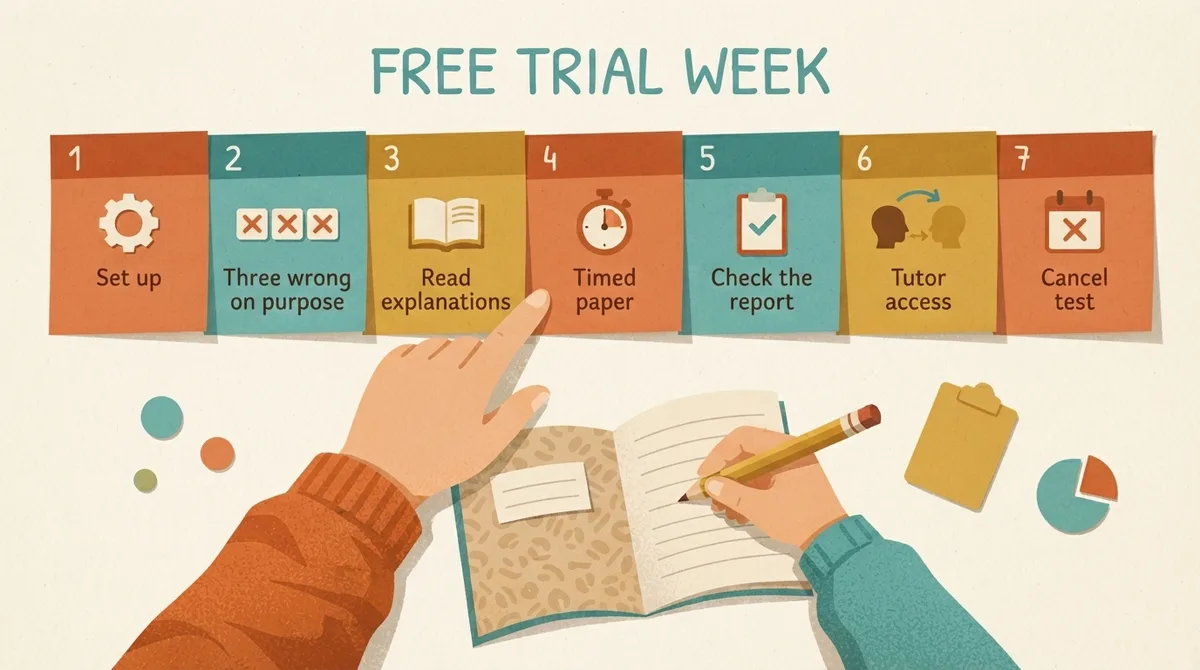
- Day 1, set up and baseline. Register, note whether card details were required and what date the first charge falls. Run the shortest diagnostic. Screenshot the starting report.
- Day 2, break it on purpose. Have your child (or you) answer three in a row wrong in one topic. Record exactly what the next question is. That is your adaptivity answer, and it beats any marketing copy.
- Day 3, read three explanations. Two wrong answers and one right one. Does it teach the method, or restate the answer?
- Day 4, run a timed paper. Compare accuracy timed against untimed from Day 1. If the platform cannot do timed conditions, that is a finding.
- Day 5, interrogate the report. Apply the five tests above. Ask support directly: "Can this report tell me my child is behind?"
- Day 6, test the edges. Invite a second adult or your tutor. Check what they can see and how fast you can revoke it. Print something.
- Day 7, test the exit. Find cancellation from inside the account and time it. If you are continuing, you have lost nothing by knowing.
Score each product out of 5 on eight lines, then compare totals: exam-format match to your authority; adaptivity mechanism (and whether they showed you); explanation quality; coverage depth on your three awkward topics; report honesty; timed and paper fidelity; tutor and second-parent access; and price plus exit friction. A product scoring 4 or 5 on exam-format match and report honesty is worth more than one scoring well everywhere else, because those two are the ones you cannot fix with effort.
Where the others win, and where Trace Learn fits
Honestly, and with our commercial interest already on the table: Atom is the strongest tutor-side tooling and target-school benchmarking on the market, and the reasonable pick if you want one system for tutor and family. Bond Online and CENTURY offer the cheapest credible entry point, and Bond Premium Plus is the obvious choice for ISEB Common Pre-Test candidates. CGP is unfussy volume with clear renewal terms. 11PluseHelp has the broadest board coverage at the lowest price ladder. RSL Educational writes the best written explanations we have read. And GL and CSSE give away official familiarisation material that beats any paid imitation of it.
Trace Learn is built around the three things this guide says matter: content mapped to a named admission authority and dated at each review, reports designed to be able to say your child is behind, and printable timed papers with real answer sheets. If you want the whole approach rather than the product, our 11+ preparation plan sets it out step by step, and you can start a trial from sign-up.
Who should not buy it: families whose child sits an independent-school pre-test we have not mapped; anyone who wants a gamified app to keep a reluctant child busy without adult involvement, because ours assumes an adult reads the weekly report; and anyone six weeks from the exam with a stalled child, who should spend that money on a good tutor instead. If that is you, we would rather you knew now than after the first charge.
Topics
- 11 plus
- platforms
- adaptive learning
- progress reports
- buying guide