
When Your Child Hates 11 Plus Practice: A Lower-Pressure Reset
A step-by-step reset for parents whose child has stopped co-operating with 11 plus practice: how to tell ordinary resistance from real distress, a seven-day pause, the exact words to use, and how to decide whether to reduce, pause or stop.
 Elspeth Marlow
- 16 min read
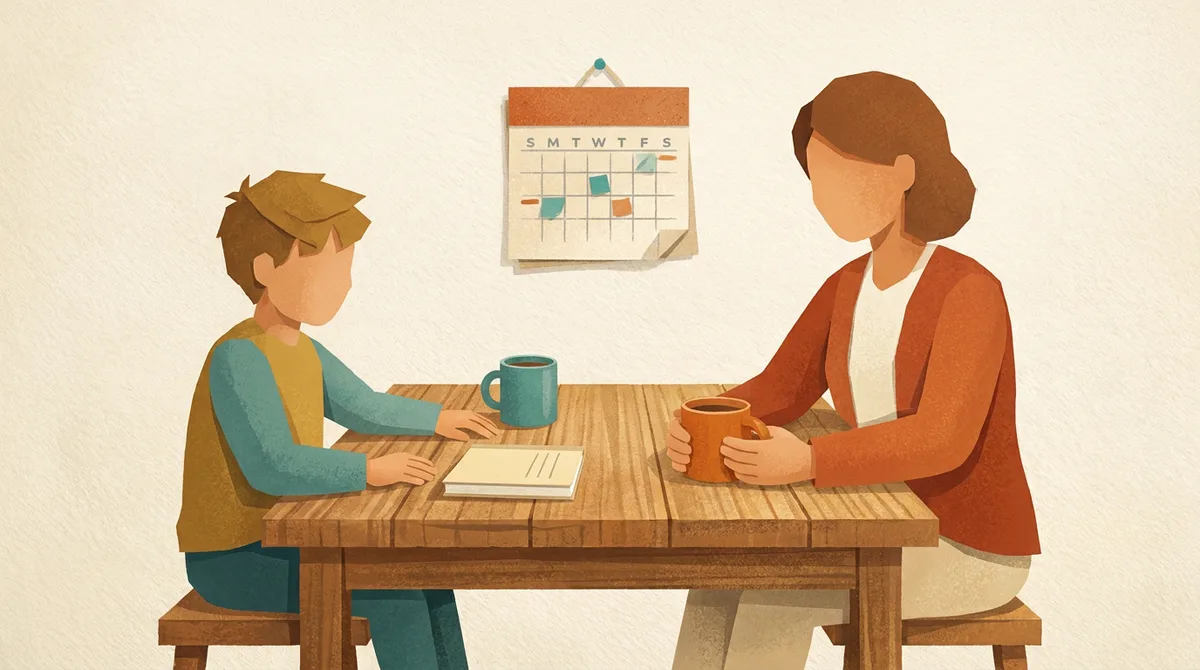
If 11 plus practice has turned into a nightly argument, start here: your child is not lazy, and you have not ruined anything. Refusal is information. A ten-year-old who shuts the book, stalls for forty minutes or bursts into tears over a non-verbal reasoning page is telling you something quite specific about the work, the volume, the visible progress, the goal, or how they think you will react. The task this week is not to restore compliance. It is to find out which of those things is true.
Most pages written for this moment give you sympathy and a list of tips, or they quietly answer a different question ("how to pass") and hope you do not notice. This one is a procedure: diagnose, pause, reset, decide. It is designed to be started tonight and finished in about a week, and it assumes you have a job, other children and a limited appetite for another evening of this.
It also says the thing most publishers avoid, because it undercuts the sale: reducing, pausing for much longer, or not entering the test at all are legitimate outcomes, and each of them has real mechanics and real dates attached. You are allowed to change your mind, and there is usually far more room to do it than parents believe.
Myth: refusal means your child has given up. Reality: it is the most accurate data you will get all term
The myth is that a child who refuses has lost their work ethic, and that the fix is a firmer routine. The reality is that a child who has been quietly struggling for weeks will comply right up until the moment they cannot, so refusal usually arrives after the useful early warnings have been missed, not instead of them.
That is why "push through it" so often backfires. If the underlying problem is that your child cannot decode a wordy maths question, another twenty papers will confirm that daily, and the only new thing they learn is that trying does not help. If the problem is that they are doing ninety minutes a night on top of a full school day plus swimming, another paper is not a motivation intervention, it is more of the cause.
So treat this week as a diagnostic. You are not deciding about grammar school. You are working out what the refusal means. The decision comes later, and you almost certainly have more time for it than the atmosphere in your kitchen suggests.
Ordinary resistance or real distress? Where the line actually sits
Most 11 plus refusal is ordinary resistance. A Year 5 child who would rather be on the trampoline, who groans, negotiates, does the work badly on purpose, then plays happily an hour later and sleeps fine, is behaving normally. That is not anxiety, and treating it as anxiety helps nobody. Do not pathologise a grumpy ten-year-old.
A smaller group of children are genuinely struggling, and the signals are different in kind, not just in volume. The NHS lists signs of anxiety in children including finding it hard to concentrate, not sleeping or waking in the night with bad dreams, eating more or less than usual, quickly getting angry or irritable and being out of control, constantly worrying or having negative thoughts, feeling tense and fidgety or using the toilet often, always crying, being clingy, and complaining of tummy aches and feeling unwell (NHS, anxiety in children).
The distinguishing question is not how loud the refusal is. It is three things, which is also the NHS's own threshold for getting help: whether it is not getting better or is getting worse, whether self-help is not working, and whether it is affecting school, family life or friendships. Ordinary resistance is loud and local: it belongs to the practice session and stops when the session does. Distress leaks: into bedtime, into Sunday nights, into how your child talks about themselves.
If any of those three apply, the NHS says an appointment with a GP is a good place to start, and the GP may refer your child to local children and young people's mental health services (CYPMHS). It also suggests talking to the school about the anxiety and the support your child needs, and notes that youth counselling services are available via Youth Access if your child will not see a doctor. You are describing patterns to a professional, not diagnosing anything. Do that in parallel with the pause below, not after it.
Seven reasons children refuse, and the tell for each
Five of these are motivational. Two are structural, and they are the two nobody writes about.
- The work is boring. Tell: they refuse the workbook but will happily argue about a logic puzzle at dinner. The material, not the thinking, is the problem.
- It is too hard and they cannot see improvement. Tell: the refusal is loudest before a paper, not during it, and they cannot name a single thing they have got better at. A child scoring 11 out of 25 on non-verbal reasoning three weeks running has correctly concluded that effort is not paying, because at that accuracy they are guessing, not learning.
- They have no control over any of it. Tell: they resist the timing more than the content ("not now", "after tea", "why do you decide"). Offer a genuine choice and the resistance often evaporates.
- They are frightened of letting you down. Tell: they hide papers, minimise scores, or ask what you will do if they fail. Watch for compliance that looks like anxiety: perfect behaviour, rising perfectionism, tears at small errors.
- They are simply exhausted. Tell: the refusal tracks the calendar rather than the subject. Thursdays are terrible; half-term is fine.
- Unmet learning needs (the first structural one). Tell: the difficulty is narrow and consistent across contexts. Reading aloud, copying from the board, handwriting stamina, working memory or timed anything is a struggle at school too, not just at home. See the SEND section below.
- They do not want the goal. Tell: they are fine with the work but flat about the destination, or they say plainly that their friends are going to the local secondary. This is a real and reasonable position, and it deserves a straight answer rather than a persuasion campaign.
Write down which one or two fit. You will use this on Day 6.
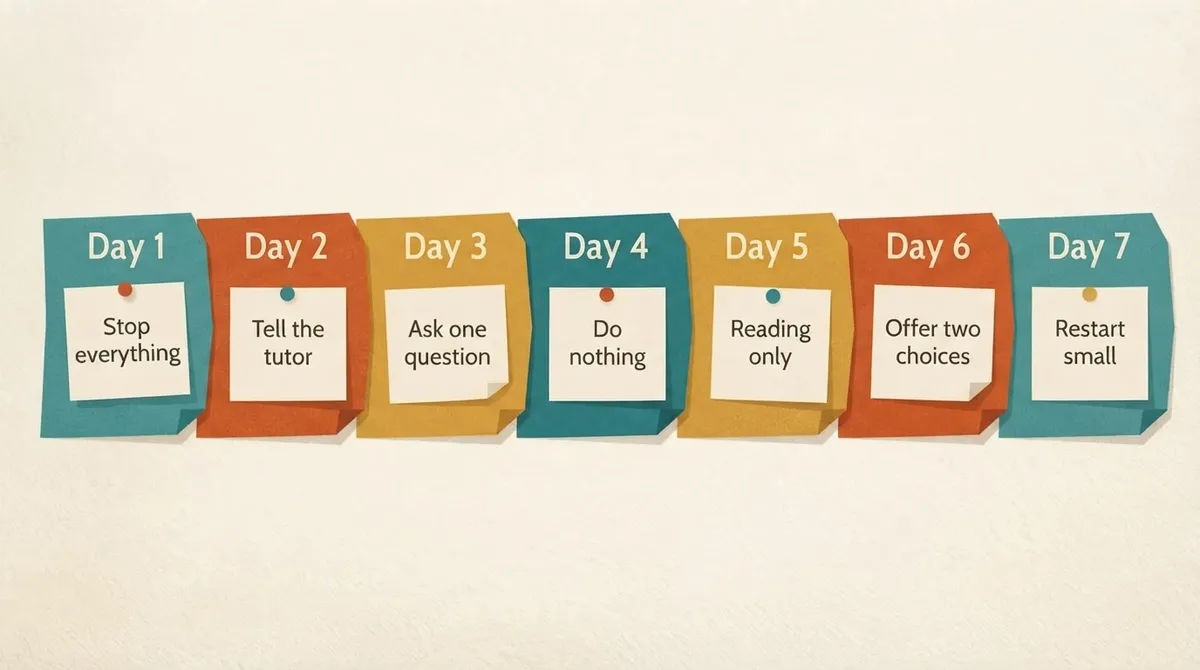
The one-week pause you can start tonight
A pause only works if it is announced, bounded and unconditional. The trap is using it as leverage ("we'll stop if you promise to try harder next week"), which converts a rest into a threat and teaches your child that refusing harder gets a better deal.
- Day 1 (tonight). Tell your child: practice is stopping for a week. No conditions attached, no catch-up to be repaid later. Then say nothing else about it.
- Day 2. Message the tutor: "We are pausing for a week to reset. I will confirm on the 14th whether we restart, restart at a lower frequency, or stop." A good tutor will not push back, and their observations are worth asking for.
- Day 3. Email the class teacher. Ask two questions: how is your child coping in class, and are they finding anything harder than their peers? You are gathering evidence, not complaining.
- Day 4. Do nothing. Genuinely nothing. Resist filling the gap with "just some reading practice" that is really practice in disguise.
- Day 5. Reading only, and only what they choose: graphic novels, football autobiographies, anything. Reading for pleasure is the one input that keeps paying off during a pause.
- Day 6. Have the conversation (scripts below). Ask, listen, do not counter-argue in the moment.
- Day 7. Decide the restart shape together, and put it in writing on the fridge so it is a plan rather than a mood.
One week is enough to break the pattern and short enough that nothing is lost. If you are more than a term out from the test, two or three weeks costs you almost nothing either.
What to say in the five hardest moments
Neutral wording matters more than warmth here, because a distressed child hears reassurance as pressure in disguise.
- Opening the conversation: "I've noticed the practice has been horrible for both of us. I'm not cross and you're not in trouble. I want to know what the worst part of it is, because I've probably got it wrong somewhere."
- After a bad score: "Fine. Which questions were the ones you'd never seen before, and which were the ones you knew but ran out of time on?" This turns a verdict into two solvable problems and skips the comfort-then-correct sandwich children see straight through.
- When they say "I'm stupid": "You're not, but I can see why today felt like that. That paper tests three things you've never been taught at school. Not knowing something you've never been shown isn't stupid, it's just new." Do not argue them out of the feeling; name what the paper actually measures.
- When they say "I don't want to do it": "That might be the right answer. Tell me what you'd want instead, and I'll take it seriously." Then genuinely take it seriously, because if you do not, this door closes for good.
- When you are the angry one: "I need ten minutes, this isn't your fault." Leave the room. Repair afterwards, plainly: "I got frustrated earlier. That was about me, not about your work." Children carry parental frustration home from these sessions far longer than they carry a low score.
Restarting smaller, with choices that are actually real
Restart at roughly a third of what you were doing. Fifteen to twenty minutes, four days a week, is a genuine preparation load when it is consistent and well aimed, and it beats an hour of resented drilling by a distance. We make the case for that in short daily practice beats cramming, and it is the shape most families can actually hold for a year.
A workable session looks like this: five minutes of one question type they can already do (confidence, not revision), eight minutes of the current target skill, two minutes reviewing only the wrong answers out loud. No timer for the first fortnight. If you cannot see improvement inside three weeks, the target skill is pitched wrong, not the child.
Give three real choices, meaning ones you will honour even when the answer is inconvenient: which day is the day off, which subject goes first, and paper or screen. If your child chooses badly, let the consequence teach them rather than overruling it.
If the material itself was the problem, change it before you change anything else. GL Assessment, the body behind many UK 11 plus tests, publishes ten hours of free familiarisation materials in verbal reasoning, non-verbal reasoning, English and maths, and is explicit that familiarisation papers aim at general familiarity with test styles while practice papers offer comprehensive preparation. They are especially useful for the reasoning papers, because children often have not met those question types at all. Starting a nervous child on full timed papers is a common and avoidable mistake. Tracking a small number of skills, rather than a running tally of scores, also removes the daily verdict that many children are actually refusing; that is what progress tracking is for.
When it is not motivation: unmet SEND and a window that closes early
Some refusal is an access problem wearing a motivation costume. A child with undiagnosed dyslexia, slow processing, ADHD or visual stress is not avoiding the paper because they lack grit. They are avoiding a task that costs them three times what it costs their classmates.
The route is the school, not a private assessment first. GOV.UK advises parents who think their child needs SEN support to talk to the teacher or the SEN co-ordinator (SENCO), and lists school-level support such as a special learning programme, extra help from a teacher or assistant, and help communicating with other children (GOV.UK, SEN support).
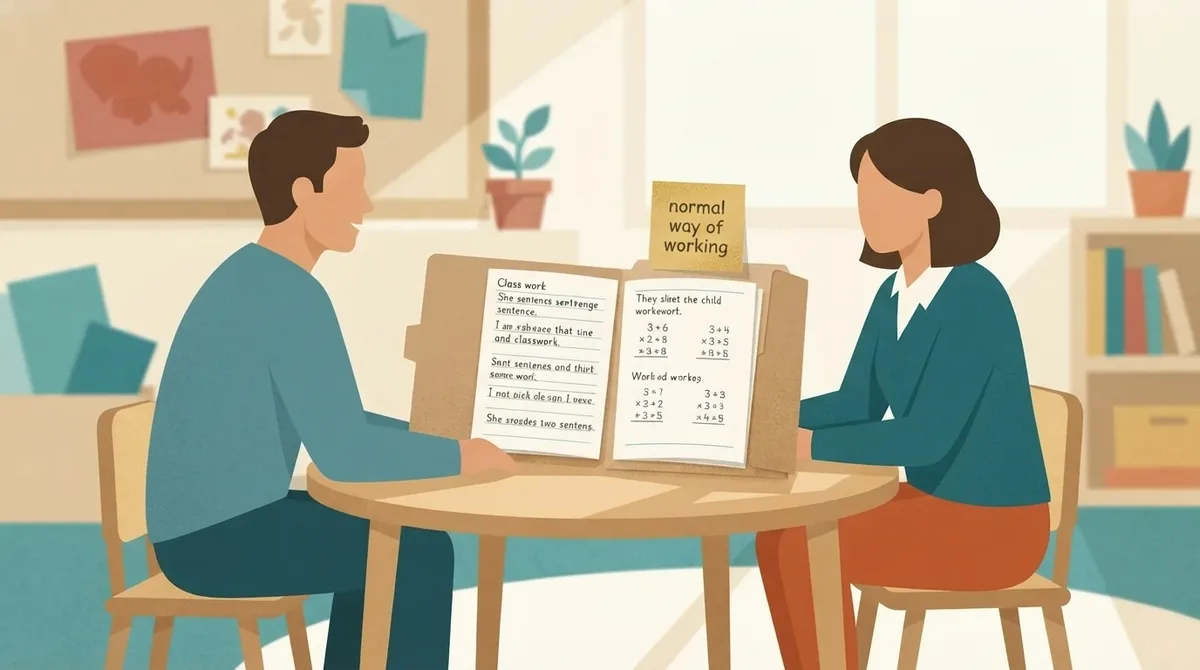
Here is the part no competing article mentions, and it is the reason to act now rather than in September. Access arrangements for the 11 plus exist: Buckinghamshire Council, for example, defines them as adjustments designed to support children with particular needs to access the Secondary Transfer Test, and notes they may be appropriate for pupils with an education, health and care (EHC) plan. But they are applied for by the headteacher, not by you, and they must reflect the child's "normal way of working", which the council describes as the support a child receives in class on a regular basis, giving rest, movement breaks or an adult helping a child stay on task as examples.
Read that twice. If the support does not already exist in class, it cannot simply be requested for test day. A parent who waits until their child is falling apart in September has missed the window by roughly a year. Ask the SENCO this term what is in place and what is recorded. Our guide to 11 plus access arrangements covers evidence and timelines in detail, and arrangements vary by area, so check your own local authority's page.
Your actual runway, and how to decide
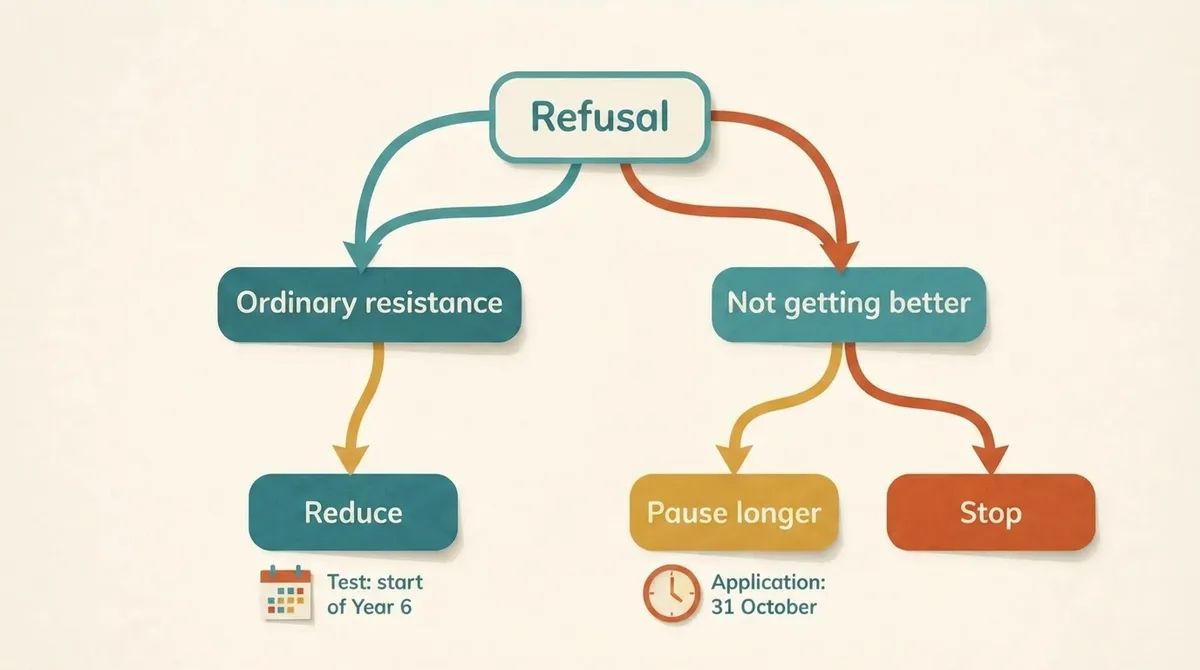
Parents panic because they think the decision is due now. Usually it is not. In selective areas the test is sat in Year 6, often within days of the new school year starting: Buckinghamshire's published dates for children moving up to secondary school in September 2027 are 8 and 10 September 2026, with a shorter practice test usually taken two days before the main test so children know what to expect. The separate secondary school application runs later and applies to everyone: GOV.UK states that applications usually open on 1 September and that you must apply for a secondary school place by 31 October (GOV.UK, how to apply).
Two consequences follow. First, sitting the test does not commit you to anything: passing an entrance exam is one of the admission criteria GOV.UK lists, alongside distance, siblings, faith and feeder schools, and you still choose which schools go on the form. Second, entry can be unwound. In Buckinghamshire, children at state-funded Buckinghamshire primary schools are automatically registered for the test, and parents who do not want their child to sit it withdraw using an online form by 2 June, or by contacting the admissions team directly after that date (Buckinghamshire Council, registration). Other areas require you to opt in, often with a summer deadline. Check your local authority's page, note the two dates that matter to you, and put them in a calendar.
With that in hand, choose one of three:
- Reduce if the tell was boredom, control or exhaustion, and your child still wants the goal. Restart at a third of the load using the session shape above, and rebuild the year around it with our year-by-year 11 plus preparation plan.
- Pause for longer if the tell was difficulty or unmet needs. Spend a term on the underlying skill with the SENCO's input and revisit at a fixed date you write down now.
- Stop if your child does not want the goal, or if distress is not improving. Nothing about a grammar place justifies damaging a child or a family, and a child who sits an exam they have been dragged to rarely performs anyway.
If you stop, say it cleanly so it does not land as failure. To your child: "We've decided not to do the test. That's a decision we've made, not something you failed. Here's what happens next." To the school: a short note that you are withdrawing and would like the child's name kept off test-day arrangements. To the tutor: end it properly rather than letting sessions dwindle. Then make the alternative concrete quickly, with a visit to the school your child will actually attend, because ambiguity is what children find frightening, not comprehensives.
Questions parents ask most
Can a child pass the 11 plus without tutoring? Yes, and many do. What matters is familiarity with the question types (particularly verbal and non-verbal reasoning, which are not taught in the primary curriculum), strong reading, and consistent short practice. A tutor buys structure and accountability, not a different brain. If tutoring is the specific thing your child is refusing, self-directed materials at home are a reasonable substitute, and the free familiarisation papers are a sensible starting point.
My 11-year-old is refusing to go to school. What can I do? Treat this as separate from the 11 plus and more urgent. Tell the school immediately and ask for a meeting: they see patterns you cannot. Because it is affecting school, it meets the NHS's own threshold for seeking help, so book a GP appointment as well; the GP can refer on to CYPMHS. Pause 11 plus practice entirely while this is live. Do not make the test the price of returning to school.
How do I help a child who hates 11 plus practice? In order: pause for a week, work out which of the seven causes fits, restart at a third of the load with three real choices, and fix the material before you fix the child. If it does not improve within a few weeks, that is data too.
How do I know if my child should sit the 11 plus? Ask whether they can handle the work at a sustainable pace, whether they want the destination, and whether the specific schools suit them. Preparation that starts too early or runs too hot tends to produce resentment rather than readiness. The 11 plus exam explainer sets out what the test and application actually demand. If two of those three answers are no, entering is probably the wrong call, and that is a decision about fit, not ability.
Where do I start tonight? Say the pause out loud, and put the two local dates in your calendar. Everything else can wait a week.
Topics
- 11 plus
- motivation
- wellbeing
- parents
- send