
Why Short 11 Plus Sessions Beat Cramming
The 11+ advice online tells you to practise for seven minutes, twenty minutes, forty-five minutes or two whole papers a day. Here is what the evidence really supports, and what it does not.
 Elspeth Marlow
- 15 min read
If you have spent an evening reading 11+ advice, you have been told to do seven to ten minutes a day, or ten minutes a day, or twenty to thirty minutes a day, or a forty-five minute session four times a week, or an hour twice a week, or, in the final stretch, at least two practice papers a day. Those recommendations come from established publishers and tutoring companies. They cannot all be right. Most parents quietly pick the one that sounds most virtuous, which is usually the biggest number, and then feel guilty when the household cannot sustain it.
Those figures do not establish an optimum: the research on how children learn does not produce a magic number of minutes. What it does support, quite strongly, is the shape of practice. Spread it out rather than bunching it. Make the child retrieve answers from memory rather than reread notes. Get feedback close to the attempt. Attach the session to something that already happens every day. Those four things are well evidenced and easy to apply. "Twenty minutes is the optimal session length" is folklore that the 11+ niche repeats because a number is easier to sell than a principle.
This guide explains the mechanism in plain language, then does the three things the download hubs skip: a genuine Year 3 to Year 6 progression, an honest reconciliation of short daily practice with papers that actually run forty-five to sixty minutes, and explicit stop rules for the evenings that go wrong. For the full calendar view, our year-by-year 11+ preparation plan sets out the whole timeline; this page is about what happens inside a single session.
Why does every 11+ site give a different number of minutes?
Because the number usually reflects the product, not the child. A publisher selling ten-minute test booklets recommends ten-minute sessions. A tuition centre selling hour-long classes recommends two hour-long classes a week. A revision-guide brand facing the last fortnight recommends two papers a day. None of these pages cites a study, because there is no study that identifies a single optimal session length for a ten-year-old sitting a selective test.
What varies between children is enormous: attention span, reading fluency, how much homework the school sets, whether reasoning question types are new, and how far the child already is from the standard required. A confident Year 5 reader can hold twenty-five focused minutes. A tired Year 4 with a swimming lesson on Tuesday cannot, and should not be asked to.
So treat every published figure as a starting guess, not a target. The useful question is not "how many minutes?" but "did this session contain real retrieval, did the child get feedback, and did it happen again the next day?" A ten-minute session that meets all three beats a forty-minute session where the child copied answers from the back of the book.
It is worth noting who is least prescriptive here. Buckinghamshire Council, which runs one of the largest selective systems in England, tells parents to make sure their child reads with comprehension, completes their homework and works through the familiarisation booklet, and points them to free materials from GL Assessment. That is the entire official preparation recommendation from the body that sets the test (Buckinghamshire Council). No hours per week. No session length.
What do we actually know about how children learn?
Four principles are robust enough to build a routine on, and they are all about structure rather than duration.
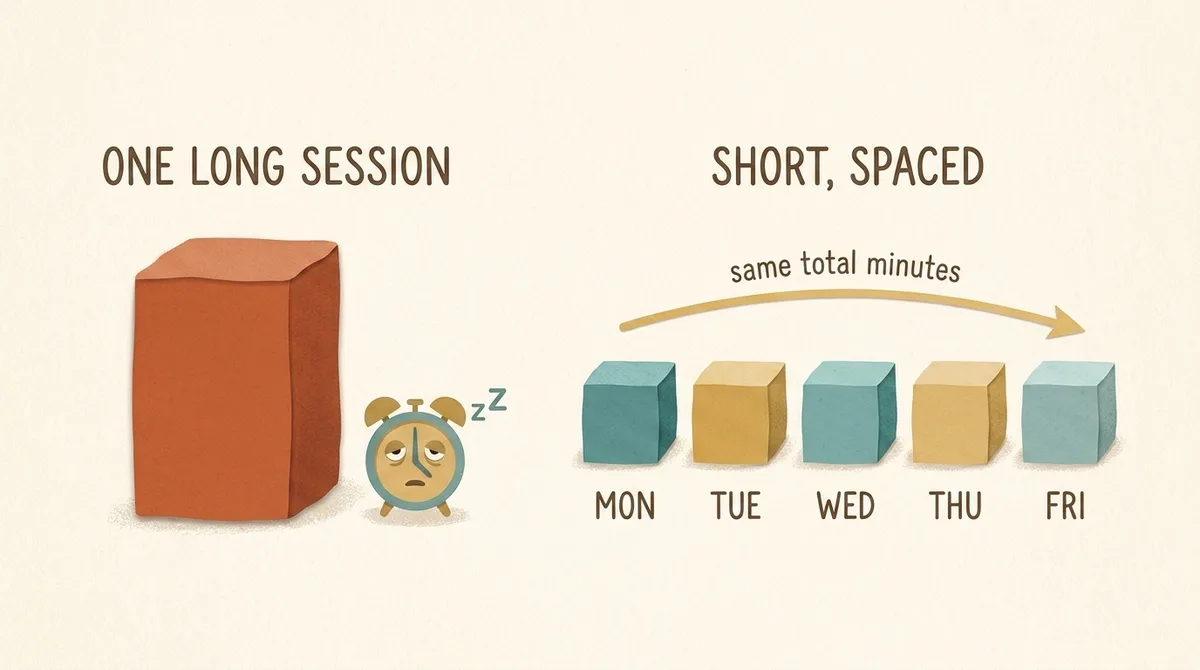
- Spacing. The same total practice produces more durable learning when it is distributed across days than when it is massed into one sitting. Cramming feels more productive because performance during the session is high, but that fluency fades fast.
- Retrieval. Answering from memory strengthens memory far more than rereading. A child who reads a page of verbal reasoning rules learns much less than one who attempts five questions cold and then checks.
- Feedback close to the attempt. The correction has to land while the child still remembers what they were thinking. Marking a paper three days later teaches almost nothing, because the reasoning that produced the error is gone.
- Interleaving. Mixing question types within a session is harder in the moment and better for the test, because the real paper does not announce which method each question needs.
Notice that none of these say anything about minutes. They say something about density. A session of any length can satisfy all four or none of them. That is why the contradiction across the SERP does not actually matter much: sites arguing about seven versus forty-five minutes are arguing about the least important variable.
Why does the same 40 minutes work better split across four days?
Here is the concrete version. Suppose your Year 5 child needs to get comfortable with verbal reasoning letter-sequence questions.
Massed version. Saturday morning, forty minutes, twenty-five letter-sequence questions in a row. By question eight the child has locked onto the pattern-spotting method and is applying it semi-automatically. Accuracy looks excellent. Nothing is being retrieved, because nothing has been forgotten yet. By the following Thursday, the method is hazy.
Spaced version. Monday, six questions, ten minutes, marked immediately. Wednesday, six more, but the child has to remember the method rather than continuing from it. Friday, six more mixed in with two number-sequence questions so they cannot assume which approach applies. Sunday, four questions plus a two-minute recap of the one they got wrong on Wednesday. Same forty minutes. Three extra episodes of effortful recall, three extra rounds of feedback, and one round of interleaving.
The second version feels worse. Wednesday's session will look shakier than Saturday's did, because retrieval difficulty is the point. That is the single hardest thing for a parent to accept, and the reason so many families drift back to long weekend sessions: the long session produces a better-looking hour and a worse-remembering month.
The practical rule that falls out of this: frequency first, duration second. Decide how many days a week you can genuinely protect, make those days short enough that they survive a bad Tuesday, and only lengthen once the habit has held for a month. Our year-by-year preparation plan shows how to fit that rhythm around clubs, siblings and school homework.
How do you make practice happen without a nightly argument?
Habits attach to cues, not to intentions. "We'll do some 11+ after school" fails because "after school" is not a moment; it is a two-hour window full of competing demands. Anchor the session to a specific event that already happens without negotiation.
Workable anchors that families actually keep:
- Immediately after breakfast, before shoes go on. Short, non-negotiable, and the child is not yet tired. Best for eight to twelve minute sessions.
- The moment the school bag is hung up, before any screen. The rule is easier to hold than a time, because the screen is the reward that follows.
- Straight after dinner, before pudding. Crude, but it works, and it caps the session naturally.
Two details matter more than which anchor you choose. First, keep the materials in one place so the session starts within thirty seconds; hunting for a booklet is where motivation dies. Second, make the end of the session visible. A tick on a wall chart, a completed row, a filled progress bar. Children persist with routines whose end they can see, which is why our progress tracking shows completed sessions rather than only scores.
And keep marking inside the session. If you cannot mark it, choose material that marks itself. A ten-minute session with instant feedback is worth more than a twenty-minute one you promise to look at on Sunday and do not.
What should practice look like in Year 3 and Year 4?
Year 3 should not contain 11+ preparation. It should contain the two things that predict later performance and cost nothing: reading with genuine comprehension, and the habit of sitting down to do something focused every day.
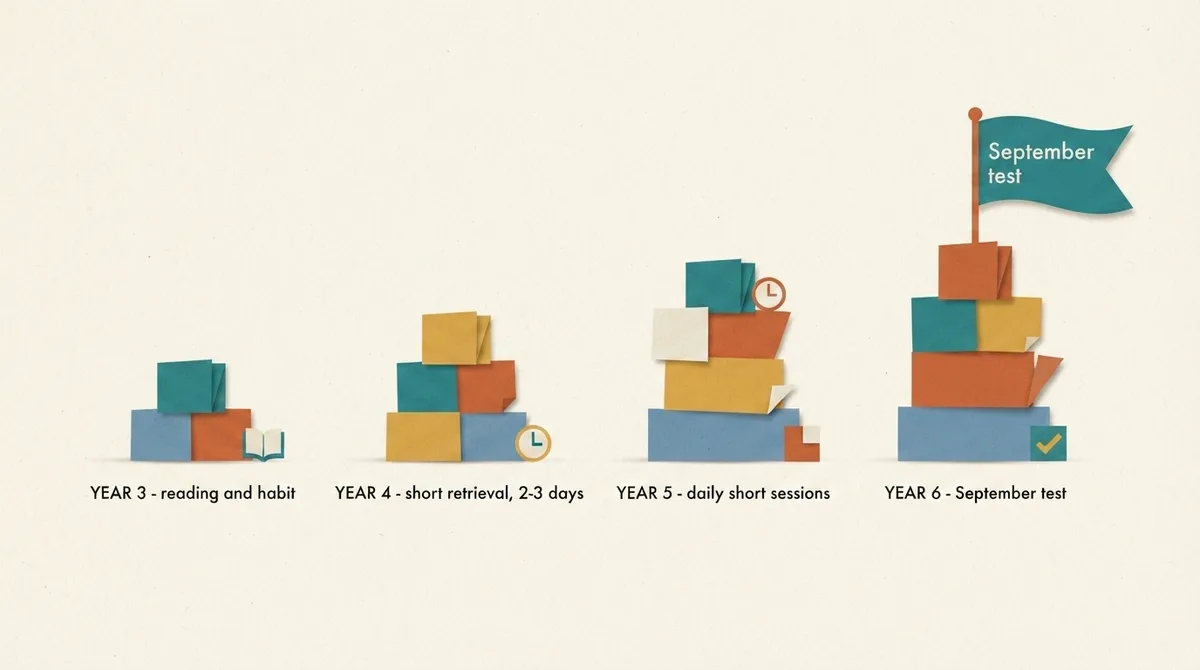
In Year 3, aim for fifteen to twenty minutes of reading most days, with two or three minutes of conversation afterwards: what happened, why did that character do that, what does that word mean? Comprehension is where the marks are lost later, and it is built by talking, not by worksheets. Add mental arithmetic in the car or at the sink. Nothing timed, nothing marked, no papers.
Year 4 is where structure appears, gently. Two or three short sessions a week, eight to twelve minutes each, is plenty. Introduce verbal and non-verbal reasoning here, because GL Assessment notes that reasoning question types are ones children may not have met at school, and it publishes 10 hours of free familiarisation materials covering verbal reasoning, non-verbal reasoning, English and maths. Familiarity, not speed, is the Year 4 goal: no timing, no scores compared week to week. Our guide on when to start 11+ preparation goes into what to skip at each age.
One caution from GL itself: the exact timings and number of questions in your local test may differ from the practice materials. Treat the free packs as format familiarisation, not as a rehearsal of your area's paper.
What changes in Year 5 and the run-up to the test?
Year 5 is when short, frequent sessions do the heavy lifting, and the timeline is tighter than most parents assume. In Buckinghamshire, the Secondary Transfer Test for September 2027 entry falls on 8 and 10 September 2026. The CSSE Essex exam for the same entry year is on Saturday 19 September 2026 (CSSE). The test sits in the first fortnight of Year 6, so the "final push" everyone imagines happening in Year 6 actually happens over the summer between Years 5 and 6. Year 5 is the year.
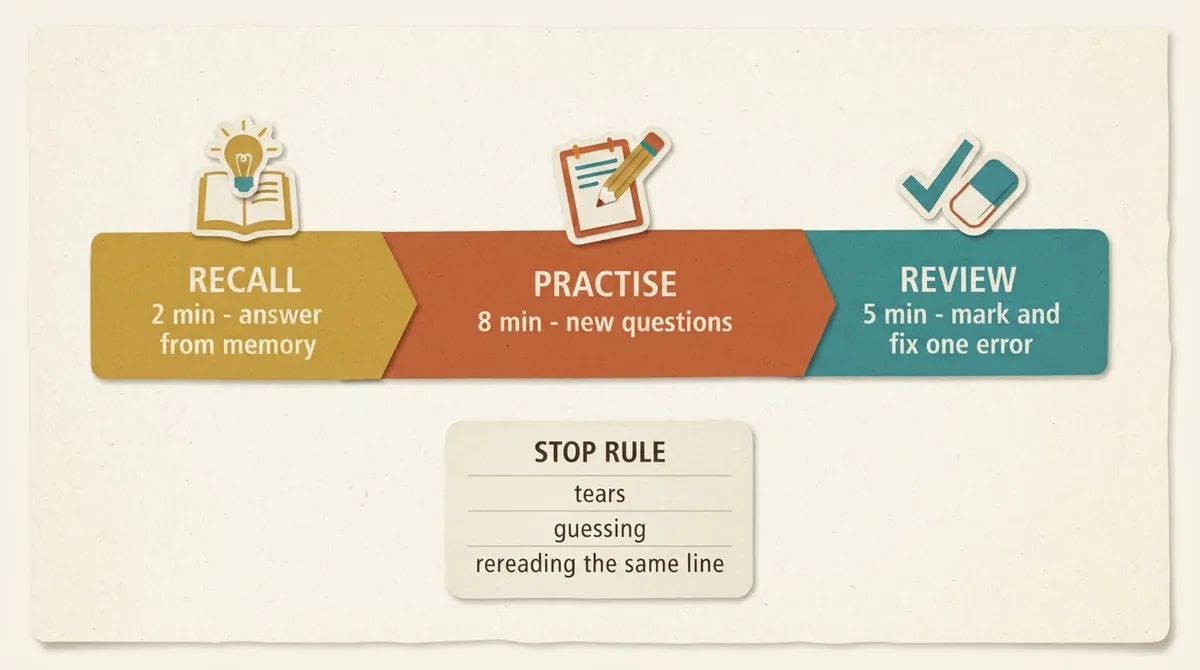
A realistic Year 5 shape is four to five sessions a week of fifteen to twenty-five minutes, plus reading, structured as: two minutes recalling yesterday's error, eight to twelve minutes of new mixed questions, five minutes marking and fixing one mistake properly. "Properly" means the child explains why the right answer is right, not just writes it in.
Keep a running list of error types rather than scores. Three entries of "misread 'not' in the question" is a diagnosable habit; a column of percentages is not. That list drives what goes into the recall slot at the start of each session, which is how short practice compounds instead of merely repeating.
A ten-question round like the one below fits a short session: pick a subject, and it is timed and marked at the end.
This part of the guide is a free timed practice test. It works in your browser.
When is short practice the wrong answer?
Here is the reconciliation nobody attempts: the daily habit builds knowledge and fluency, but the actual papers are long, and stamina is a separate skill that short sessions cannot build.
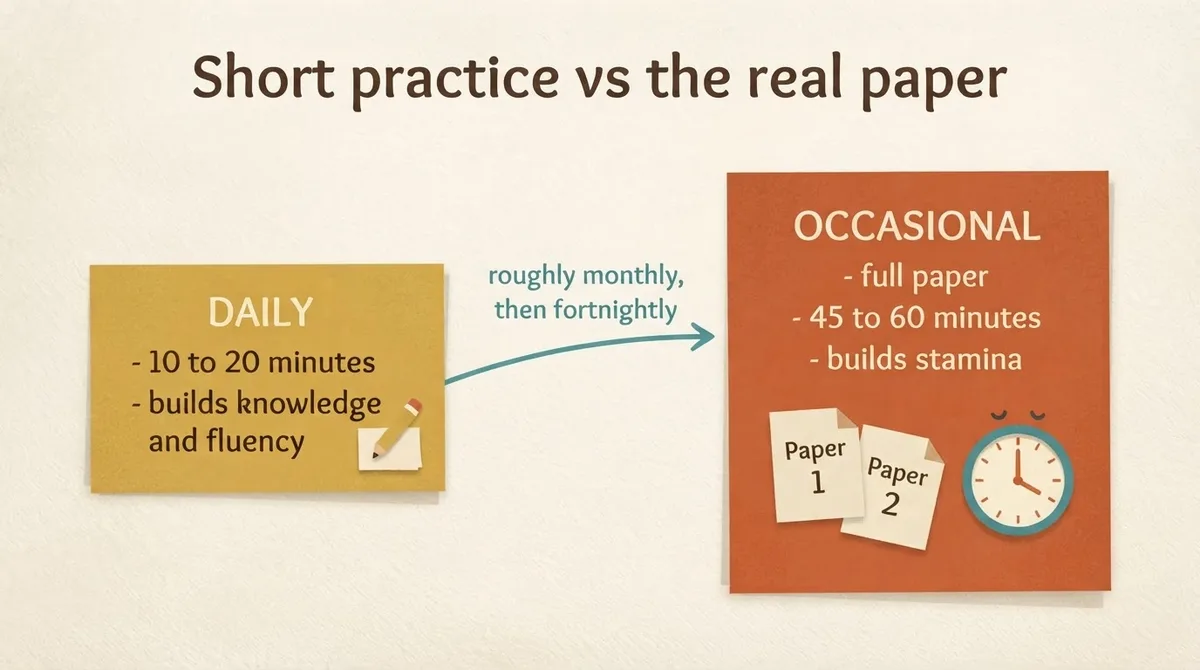
The real durations are specific and public. Buckinghamshire children sit two papers, each about 45 minutes long, or 60 minutes including the introduction and examples: one covering verbal skills including comprehension, technical English and verbal reasoning, the other covering mathematics and non-verbal skills including spatial reasoning (Buckinghamshire Council). CSSE candidates sit a 60-minute English paper with ten minutes additional reading time, plus a 60-minute maths paper. That is around two hours of concentration in a strange room.
So schedule stamina deliberately, as an exception:
- From about a term out: one full timed paper roughly every three to four weeks, on paper, at a table, phone away, parent silent.
- In the final six to eight weeks: move to fortnightly, and at least once do two papers back to back with a short break, mirroring the real sitting.
- Run it properly: fixed start time, child manages their own time, announcements at halfway and ten minutes remaining, no help mid-paper. Mark it afterwards, together, on the same day.
Buckinghamshire itself runs a preparatory practice test using the same format and audio instructions as the real test, with papers taking about 40 minutes each that are not marked or sent home. The purpose is familiarity with question types and the answer sheet, not a score. Copy that logic at home: full mock papers are for the conditions, not the number. Between them, go back to ten minutes a day.
How do you end a session early without it feeling like failure?
No 11+ page inspected for this article offers a stop rule. Every parent needs one, because pushing through a collapsed session teaches the child that practice is something to endure.
Stop when you see any of these:
- Tears, or the flat silence that precedes them.
- Guessing: answers arriving faster than the question can be read.
- Rereading the same line three times without moving.
- Accuracy falling off a cliff mid-session, after a solid start.
- Physical fidget escalating, or repeated "how many left?"
The script matters as much as the rule. Say something like: "Right, we're stopping there. That's a sensible place to stop, not a problem. You did four questions and you got the tricky one about the code. We'll pick this one up tomorrow." Then actually stop, and do not renegotiate.
Three things make this work. Name the stop as your decision, not the child's failure. Point at one specific thing that went well, because a vague "well done" reads as consolation. And keep the next session on schedule, so stopping does not become a way to end the routine. If stops are happening more than about twice a fortnight, the sessions are too long, too hard or too late in the evening. Shorten first, then simplify. If pressure is a persistent theme, return to the purpose and scope in the 11 plus exam explainer before adding more work.
What does a flexible week actually look like?
This is an example to bend, not a schedule to obey. It assumes a Year 5 child with a normal amount of homework and at least one weekday club.
- Monday: 15 minutes maths, mixed topics, marked immediately. Reading 20 minutes.
- Tuesday: club night. 8 minutes only: verbal reasoning, five questions, plus yesterday's error. Reading if there is time.
- Wednesday: 20 minutes English, one comprehension extract, discussed aloud rather than fully written. Reading 20 minutes.
- Thursday: 15 minutes non-verbal reasoning, interleaved with two maths questions. Reading 20 minutes.
- Friday: off, or 5 minutes of vocabulary from the week's reading.
- Saturday: either 20 minutes of error review from the week, or, once a month, a full timed paper.
- Sunday: reading only.
That is roughly 75 to 90 minutes of structured practice plus daily reading, and it flexes: a bad week drops to the Tuesday shape every day and still counts. What you must not do is bank the missed minutes and pay them back in a three-hour Sunday, which reintroduces exactly the massing the routine exists to avoid.
What do parents get wrong, and what do they ask?
Is 70% enough to pass the 11+?
There is no fixed percentage, because raw marks are converted into a standardised score. Buckinghamshire's marking is done by GL Assessment, and standardisation takes into account each child's age in years and months on the test date as well as balancing performance year to year. A child needs a Secondary Transfer Test Score of 121 or above to qualify, and the council states it expects about 37% of children to reach that (Buckinghamshire Council). Percentages on home practice papers tell you about progress, not about qualifying. Areas differ, so check your own authority's rules.
How long does it take to prepare for the 11+?
Honestly: it depends on the starting point and how far it is to the standard your area requires. As a shape rather than a promise, most families who feel calm about it began light reasoning familiarisation in Year 4, ran short sessions consistently through Year 5, and used the summer before the September test for stamina work. Twelve to eighteen months of small, regular practice is far more common among relaxed households than six months of intensive work.
The mistakes that cost the most
- Volume as reassurance. Two papers a day in the final fortnight, as some publishers suggest, mostly produces fatigue and unmarked scripts. One paper properly reviewed beats four rushed.
- Marking later. Feedback delayed past the same day loses most of its value.
- Never mixing topics. Blocked practice inflates performance and hides weakness.
- Screen-only practice. Real papers are paper, with a separate answer sheet, so some paper-based practice has to happen.
- Scores as the metric. Track error types and consistency of the habit instead.
The underlying point is simple. You cannot control whether twenty minutes is the perfect length, because nobody knows. You can control whether practice happens most days, whether the child retrieves rather than rereads, whether feedback arrives while it still means something, and whether the routine survives a bad week. Those are the levers, and they are all shape, not size.
Topics
- study routine
- daily practice
- spaced practice
- year 3
- year 5
- exam stamina