
11 Plus Access Arrangements for SEND: Evidence, Deadlines and Support
Access arrangements for the 11+ are decided by your admission authority, not by a national rulebook. Here is how to find out which body decides, what evidence it will demand, and what to do if it says no.
 Elspeth Marlow
- 15 min read

Most pages about 11+ access arrangements begin by defining the term. That is the wrong place to start, because the definition is the part that barely varies. What varies, enormously, is who decides. A parent in Buckinghamshire applies through a council panel with a June deadline. A parent in Essex applies to a consortium that closes evidence in late June and communicates decisions in September. A parent applying to Hampton School applies to the school itself by 1 November. A parent whose child sits an ISEB pre-test deals with a body that will tell you plainly its decisions do not transfer anywhere else.
So the first question is not "what is an access arrangement?" It is "which body is the admission authority for the schools I am applying to, and what does that specific body publish?" Get that wrong and you can do everything else correctly and still miss a deadline that several authorities refuse to extend under any circumstances.
Do this before you read further. Open the current admissions documents for the specific schools you are applying to, and email the admissions team today to ask which access arrangements form applies and when it closes. Dates move every cycle, and several authorities state outright that late or incomplete applications will not be processed. Treat published policy as the authority; treat this article as the map to it.
Step one: identify your admission authority
For 11+ access arrangements, the admission authority is the body that owns the form, sets the deadline, convenes the panel and issues the decision. It falls into four broad shapes.
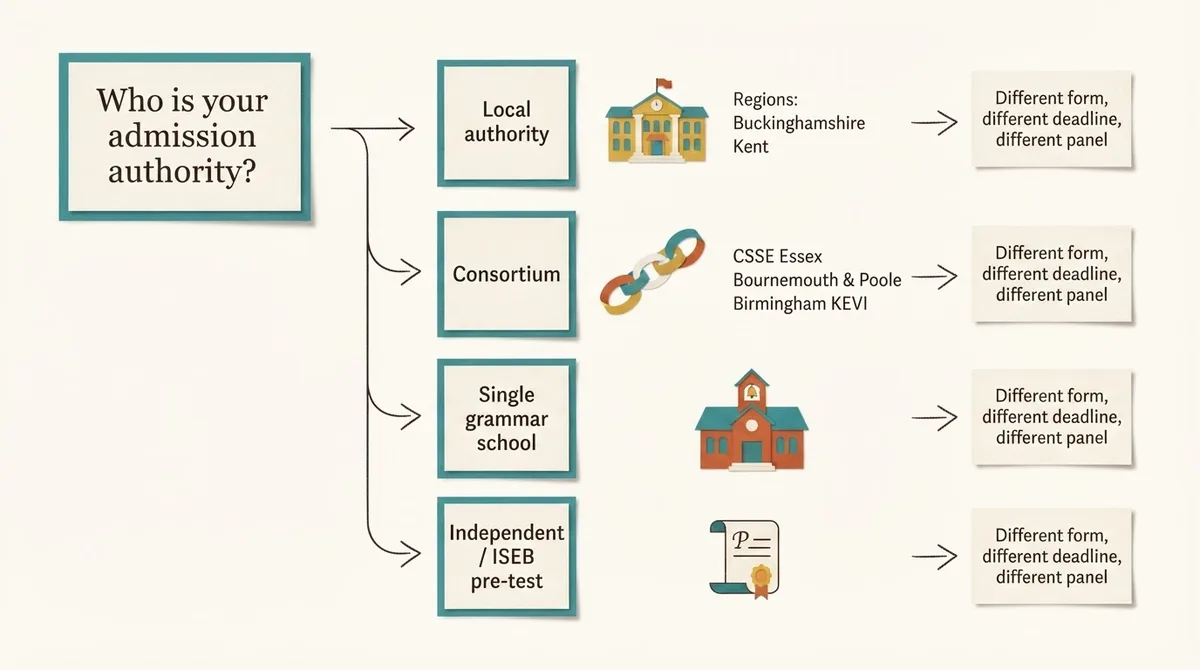
- Local-authority administered. The council runs the transfer test and the access panel for a whole county. Buckinghamshire and Kent work this way.
- Consortium. A group of schools shares one test and one central SEND process: the Consortium of Selective Schools in Essex (CSSE), the Bournemouth and Poole grammar schools, and the King Edward VI Foundation in Birmingham.
- Single school as its own admission authority. Many stand-alone grammar and independent schools run their own entrance test and decide their own arrangements. Hampton School is a clear example.
- Assessment body for independent-sector pre-tests. ISEB handles arrangements for its Common Pre-Tests and Common Entrance, separately from any state grammar process.
Several tutoring sites still frame the landscape as "GL versus CEM". CEM stopped supplying 11+ tests, and the test provider never decided access arrangements anyway. Our comparison of GL, CEM and ISEB covers exam formats; for arrangements, the durable axis is the admission authority.
What an arrangement changes, and what it deliberately does not
An access arrangement adjusts how a child accesses the test. It does not adjust the standard the child must meet. Buckinghamshire's grammar schools admit children who score at least 121 on the Secondary Transfer Test, and that figure does not move because extra time was granted. Bournemouth and Poole put the same principle negatively: arrangements "that offer applicants an unfair advantage over others or that give rise to misleading test outcomes will not be made".
That framing explains much of what follows. A panel is not asking "does this child deserve help?" It is asking "without this adjustment, would the test measure something other than the reasoning ability it is designed to measure?" A child who cannot physically read a standard-sized paper is being blocked by print size, not by reasoning. A child who simply finds timed conditions stressful is, in the panel's eyes, in the same position as most candidates.
Selection by academic testing is itself lawful. The Bournemouth and Poole guidance calls it a "permitted form of selection" under the Equality Act 2010, while adding that schools "do, however, have a duty to make reasonable adjustments for disabled pupils in operating a selection process". Under Schedule 13, a school's responsible body must meet the first and third reasonable adjustment requirements (provisions, criteria or practices, and auxiliary aids and services); the physical-features requirement does not apply to schools. Crucially, the duty covers admission decisions, not just teaching once a child is on roll.
'Normal way of working': the one test almost every panel applies
If there is a national standard in this field, this is it, and it is the reason most refusals happen.
Buckinghamshire defines it as "the support a child receives in class on a regular basis. For example, rest, movement breaks or an adult helping a child to stay on task." ISEB says the same: "we mean that the pupil regularly receives that support as part of normal classroom practice". Bournemouth and Poole go further, requiring that arrangements "MUST reflect the support given to the applicant in their current school in the classroom and/or in internal school tests", confirmed in writing by the SENDCo on headed paper, without which arrangements "will not be considered".
Read that as a practical instruction. A diagnosis alone is not the qualifying fact; the school's habitual practice is. Bournemouth and Poole say so explicitly: "The existence of a medical diagnosis or a physical disability in itself does not imply that the applicant in question has special educational needs."
A worked example. Two Year 5 children both have a dyslexia diagnosis. Child A has had 25% extra time in every internal school assessment since Year 4, logged on her SEN Support plan, and her SENDCo can write that on headed paper. Child B was diagnosed privately in the spring of Year 5 and has never had extra time in a school test. Same diagnosis, very different applications. Child B's parents' most useful next move is not a stronger report; it is asking the school to put the support in place now, in ordinary lessons, and to record it.
Four regimes compared
Below are four published regimes as they stood in recent cycles. Read them as a demonstration of how wide the variation is, not as your deadlines.
Buckinghamshire Council (local authority). Applications go to Special Access Panels made up of "people with experience in primary education and SEND (Special Educational Needs and Disability) and an educational psychologist". Deadlines split by school type: 2 June for Buckinghamshire primary or Partner schools, where the headteacher applies automatically if adjustments are already being made in class, and 16 June for all other schools. A pending assessment is not grounds for late submission. See the council's adjustments to the testing guidance.
CSSE (consortium, Essex). For 2027 entry, registration opened 12 May 2026 with an "Absolute deadline date for consideration of evidence: 26th June 2026" and decisions in September. Late or incomplete applications "will not be processed". A Headteacher's Letter (form F3) is mandatory: "Applications will not proceed until the Headteacher's Letter has been received", and securing it is the parent's responsibility. Test centres "cannot approve, modify or amend Access Arrangements" on the day.
King Edward VI Foundation, Birmingham (consortium). The additional form had to be uploaded by 12 June 2026, earlier than the test registration deadline itself: "If the additional form has not been uploaded by the deadline, NO special arrangements can be considered." An independent panel of five professionals decides. The Foundation "does not make suggestions regarding adjustments and there are no set adjustments for a certain condition", and "the decision of the panel is final and will not be reviewed".
Hampton School (single school) and ISEB (independent pre-tests). Hampton requires requests to be "received by 1 November prior to the entrance examination", offers "up to 25% additional time", and states "The School's decision on exam concession requests is final." ISEB recommends an Educational Psychologist report "usually no older than 24 months" and requires enlarged papers and editable formats to be requested at least a year in advance. It warns that "Access arrangement decisions are not valid for any other tests such as GCSEs or A level examinations."
Two patterns are worth extracting. First, in several regimes the school applies, not you: Kent advises parents to discuss needs with the primary SENCO before registering, because the school submits and requests are not accepted after registration closes. Second, arrangements deadlines can fall before the test registration deadline, so diarise the arrangements date. Our practical parent guide to the 11 plus explains where test registration sits in the wider application sequence.
The evidence file: who writes it, how recent, what scores
Most pages tell you to submit "a recent report". Some authorities publish exactly what that means.
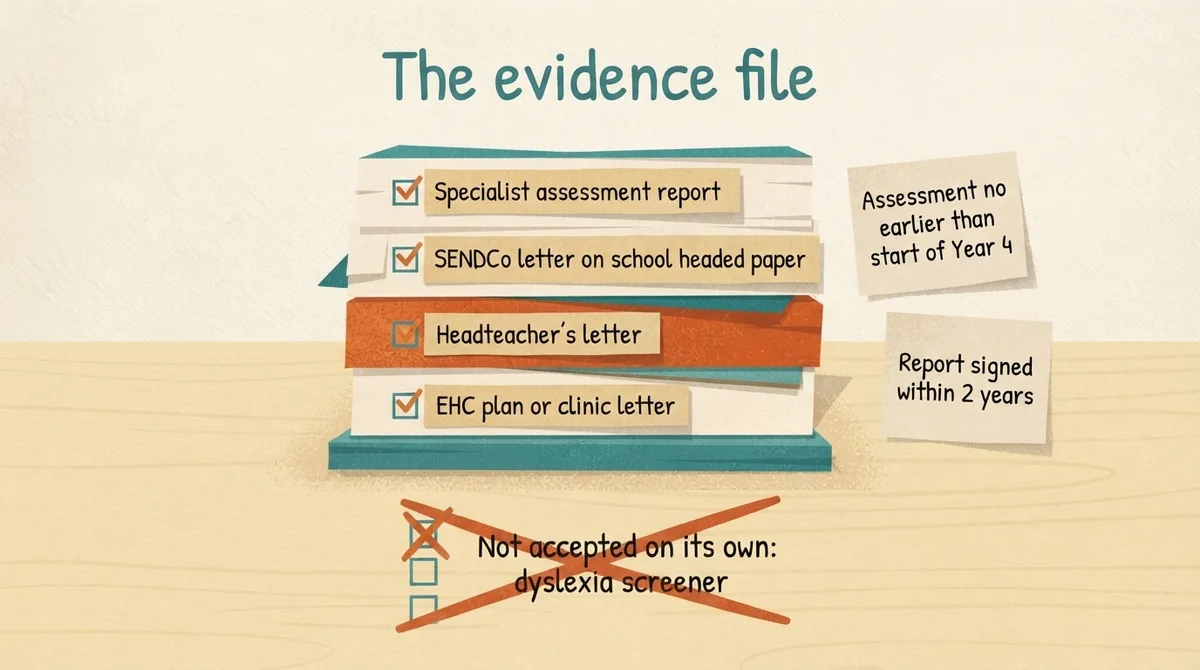
Bournemouth and Poole require, for specific learning difficulties, a specialist assessment completed "no earlier than the start of Year 4" showing either two below-average standardised scores of 84 or less, or one score of 84 or less plus one low-average score of 85 to 89, in speed of reading, speed of reading comprehension, or cognitive processing. The assessor must be an HCPC-registered psychologist, "a specialist assessor with a current SpLD Assessment Practising Certificate", or an assessor with an equivalent Level 7 qualification including at least 100 hours of individual specialist assessment. For other needs, such as autism, sensory or physical impairment, ADHD, mental health, or speech and language, it asks for a letter from CAMHS, an NHS clinical psychologist, a hospital consultant, an NHS psychiatrist, the LA Educational Psychology or Sensory Impairment Service, a Speech and Language Therapist, or an EHC plan. Detail is in the consortium's guidance notes for parents.
Hampton asks for a report from an "Educational Psychologist, Qualified Specialist Teacher with a current Assessment Practising Certificate or equivalent Medical practitioner (not a GP)", "written and signed within two years of the date of the entrance examination", plus evidence of a history of provision at the current school.
These are different bars, not one national bar. Together they tell you what to ask an assessor before you pay: are you HCPC-registered or APC-holding, will the report be signed and dated in a form that survives a two-year recency rule, and will it report standardised scores for reading speed, reading comprehension speed and cognitive processing rather than only a narrative? A report that omits standardised scores can fail a threshold test even when the child clearly struggles.
What is routinely refused
No ranking page publishes this list, and it saves wasted applications.
- Extra time for slow handwriting. Bournemouth and Poole state it "will not be awarded for applicants with slow handwriting speeds as this is not a requirement of the entrance test".
- Extra time where literacy difficulty is driven by English as an additional language. It "will not be allowed if an applicant's literacy difficulties are primarily caused by English not being their first language".
- Dyslexia screeners as standalone evidence. "Dyslexia screeners alone will not be considered as evidence."
- Dictionaries. Dictionaries "(of any type) may not be used".
- Rest breaks used as thinking time. A single supervised rest break "should be no more than 30 minutes" and "must not be used as 'thinking time'".
- Adjustment of marks after the event. CSSE "does not apply adjustments to a candidate's test papers after the examination has taken place".
Where extra time is granted, 25% is the common figure. There is no national 11+ extra-time entitlement, and anyone who tells you there is has not read the policies.
CSSE's model explains why modest requests succeed more often. It tiers arrangements so they are "proportionate to need and supported by appropriate evidence": Tier 1 low impact (modified materials, seating), Tier 2 medium impact (extra time, non-verbal prompts), Tier 3 high impact (a reader, word processor or laptop, movement breaks). It also states that "Access Arrangements are not approved on the basis of request alone". Its full SEND guidelines are public.
Building the evidence trail from Year 4
Because normal way of working is the universal gatekeeper, the strongest thing you can do is not an application; it is a paper trail that exists before the application.
- Autumn of Year 4. Meet the SENDCo. Ask for needs and any support to be recorded on a SEN Support plan or equivalent, in writing, with dates.
- Across Year 4 and 5. Ask that whatever support is agreed is used routinely in class and in internal school assessments, not only in one-to-one intervention. Panels look for both.
- Spring of Year 5, at the latest. If a specialist assessment is needed, book it. Check the assessor's registration and the recency rule that applies to your authority.
- Early spring of Year 5. Email admissions for the current form and deadline, and ask who submits: you, the primary school, or both.
- Six weeks before the deadline. Request the SENDCo letter and, where required, the Headteacher's Letter. CSSE puts the responsibility for chasing it on the parent.
- Two weeks before. Submit, and keep proof of submission.
Running familiar practice under the arrangement you are requesting also helps a child use it well. Twenty-five per cent extra time only helps if a child knows what to do with it, a habit worth building through timed mock tests rather than discovering on the day.
To practise with extra time, enter the paper below and switch on 25% extra time. It shows how the budget per question and the checkpoints shift, and the practice clock runs for the longer paper.
This part of the guide works out seconds per question and checkpoints for a timed paper. It works in your browser.
Illness on test day is a different route entirely
Access arrangements must be agreed in advance. Illness on the day is handled separately, and CSSE's published position is the clearest available model. Where a child cannot attend because of temporary illness or injury, with medical evidence, "the CSSE may arrange for the child to sit the test on an alternative test day". But if your child attends and struggles: "Candidates who leave the room during the test will not be given additional time", and a candidate too unwell to continue who leaves the premises "will not be permitted to complete any test that has already been started".
The decision that follows is uncomfortable but clear. If your child is genuinely too unwell to sit, the stronger move is usually to keep them at home, get medical evidence the same day, and contact the authority immediately about an alternative test day. Sending a very unwell child in generally gets you neither the alternative day nor an adjustment. Since no marks are adjusted retrospectively, CSSE signposts the remaining route: parents who believe performance was affected by exceptional circumstances "may present these circumstances to an independent appeal panel at one or more of their chosen schools following National Offer Day".
EHC plans, SEN Support and independent pre-tests
An EHC plan is powerful evidence, but it is not a golden ticket. Bournemouth and Poole list it among acceptable evidence for non-SpLD needs, yet the requirement that arrangements reflect current classroom support still applies. If a plan specifies provision the school no longer delivers as described, submit the SENDCo confirmation as well. Equally, children on SEN Support without a plan are not disadvantaged in principle: a well-documented record of consistent in-class practice can satisfy the normal-way-of-working test just as effectively.
For independent-sector pre-tests, ISEB considers extra time, rest breaks, human or computer readers, scribes, prompts, enlarged A3 papers and examination reading pens, as set out in its access arrangements guidance. Decisions do not transfer: an ISEB arrangement is not evidence of entitlement at a state grammar, and neither is valid for GCSEs later. Families applying to both sectors are running two applications, on two timetables, to two decision-makers.
If your request is refused
Several authorities state that the panel's decision is final. Competitors stop there. There is more to say, and it is honest rather than encouraging.
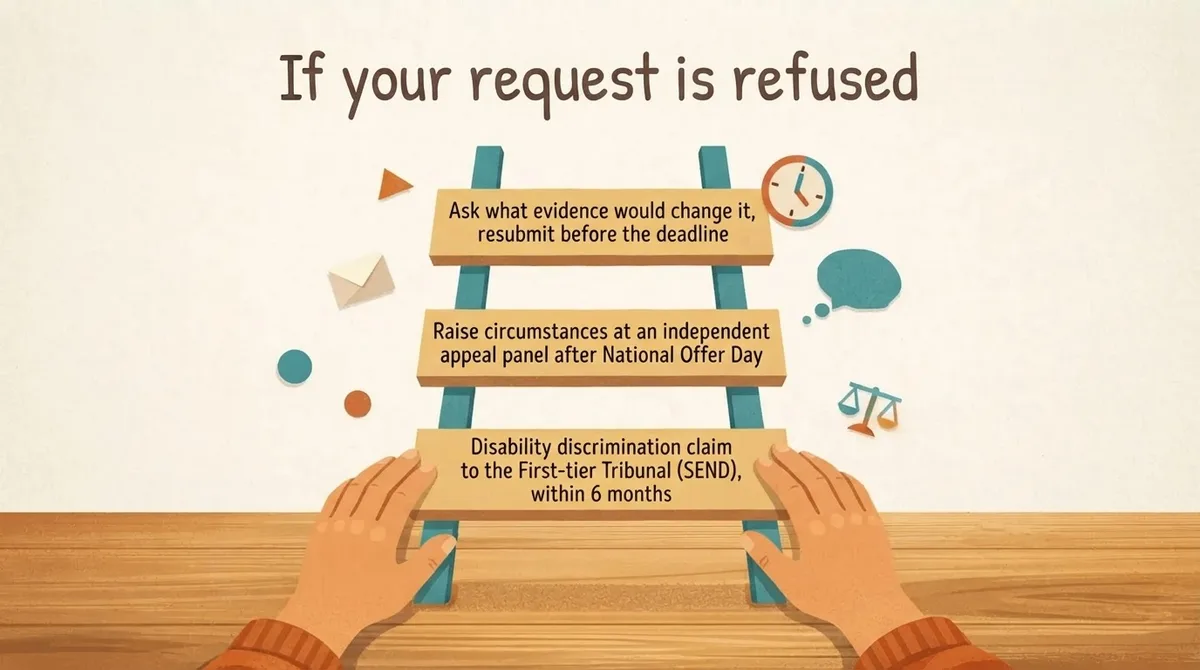
- Ask what evidence would change the outcome, and resubmit before the deadline. "Final" usually means the panel will not re-review the same file. A materially different file, submitted inside the published window, is a fresh application. Ask a narrow question: which specific element was insufficient, the specialist evidence or the school confirmation of normal way of working?
- Raise the circumstances at an independent admission appeal panel after National Offer Day. This is the forum CSSE itself signposts. It does not re-run the test or change a score, but it is the place to argue that the outcome did not reflect your child's ability. The Trace Learn grammar-school appeals tool explains the qualification and oversubscription stages, the national evidence, and its limits.
- If the refusal is itself disability discrimination, claim to the First-tier Tribunal (SEND). The claim goes to the SEND tribunal on form SEND4A, and, per GOV.UK, "You must send your complaint to the tribunal within 6 months of the discrimination taking place." That six-month clock is the single most important date in this article, because it can expire while a family is still writing letters. This is a legal route about failure to make a reasonable adjustment, not a way to dispute an academic judgement, and it is worth taking free advice from a SEND charity or a solicitor first.
Throughout, keep everything in writing and dated. Email admissions rather than phoning; if you must phone, follow up with a summary email the same day.
What to do this week
Name your admission authority. Open its current access arrangements page or PDF and write down three things: the deadline, who submits, and the exact evidence list. Email the admissions team to confirm all three, and email your child's SENDCo to ask what is currently recorded as normal way of working. If a gap exists between what your child needs and what the school routinely provides, close it now, in ordinary lessons, while there is still time for it to become normal.
Then let preparation carry on as preparation. Our parent guide to the 11+ covers how tests differ by region. Access arrangements are a paperwork problem with a hard deadline; they reward being early far more than being persuasive.
Topics
- 11 plus
- send
- access arrangements
- admissions
- extra time