
Spatial Reasoning in the 11 Plus
A source-led guide to spatial reasoning for 11+ families: six worked question types, what the official Buckinghamshire familiarisation booklet says about exam conditions, and a decision guide on whether your child needs to revise it separately.
 Elspeth Marlow
- 15 min read
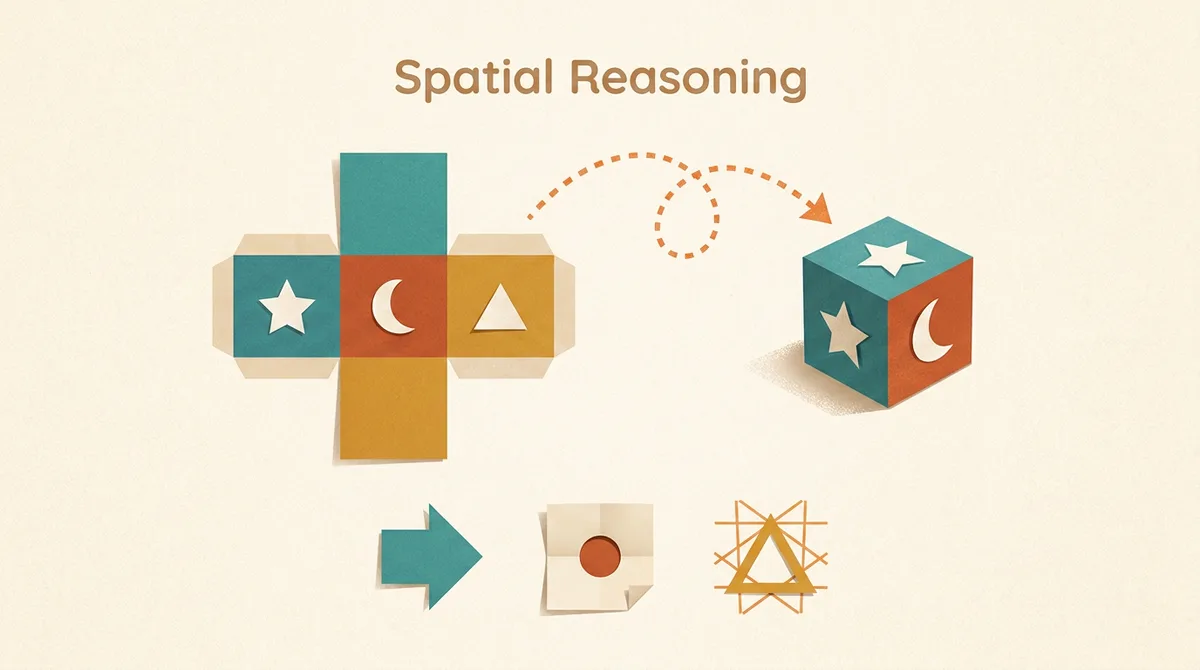
Search for a spatial reasoning test and almost everything you find was written for a twenty-two year old applying to a graduate scheme. The pages are excellent at what they do, but they assume a candidate sitting at a desk with a pen, a sheet of rough paper and sixty seconds per question. Practically all of them give the same headline tip: sketch the shape, draw the net, work it through on paper.
If your child is sitting an 11+ paper, that advice is not just unhelpful. In at least one major grammar school area it is against the rules. The official familiarisation material for the Buckinghamshire Secondary Transfer Test states plainly that pupils may bring two HB pencils and an eraser, and that a ruler, a calculator, a protractor and scrap paper are not allowed. Rough working can only go in the question booklet, never on the answer sheet. Check the permitted equipment for the actual test before practising with tools your child cannot take in.
This guide fixes that. It starts with a plain definition and six worked questions so you can see what the thing actually looks like, then moves into the 11+ specifics: which boards name spatial reasoning as its own section, what the official booklet says about timing and instructions, and how to practise at home in a way that matches the real conditions. Every factual claim about a board is linked to that board's own published material.
What a spatial reasoning test actually measures
Spatial reasoning is the ability to picture a shape and move it around in your head. Rotate it, flip it, fold it, look at it from a different side, or imagine what it would look like assembled from flat parts. No words, no arithmetic, no general knowledge.
The cleanest published definition of the difference between spatial reasoning and its close cousin comes from the Buckinghamshire Secondary Transfer Test Familiarisation Booklet, which describes non-verbal reasoning as testing "how well you can work out and apply rules and relationships between shapes and patterns", and spatial reasoning as testing "how you can manipulate shapes and space in your head". The booklet puts it more simply elsewhere: spatial reasoning questions are like non-verbal reasoning questions, "but also test how well you can picture a shape and move it around in your head".
That distinction matters more than it sounds. A non-verbal reasoning question usually rewards spotting a rule. A spatial reasoning question usually rewards holding an object steady in your imagination while you turn it. Children who are strong at one are not automatically strong at the other.
Try it first: six questions with worked answers
These are original examples written for this article, covering the six families your child is most likely to meet. Read the question, decide your answer, then read the method.
1. Cube nets
A flat net is made of four squares in a horizontal row, labelled A, B, C and D from left to right. A fifth square, E, sits directly above B. A sixth square, F, sits directly below B. When the net is folded into a cube, which face is opposite A?
Answer: C. On any strip of four squares in a row, faces one and three are opposite each other, and faces two and four are opposite each other. So A pairs with C, and B pairs with D. That leaves E and F, the two squares hanging off the strip, as the remaining opposite pair. You never need to fold anything: you need the strip rule.
To test the strip rule on a net of your own, switch on six squares below and check whether it folds into a cube. Once it does, tap any square to see which square ends up opposite it.
This part of the guide lets you build a net from six squares and check whether it folds into a cube. It works in your browser.
2. Hidden shapes
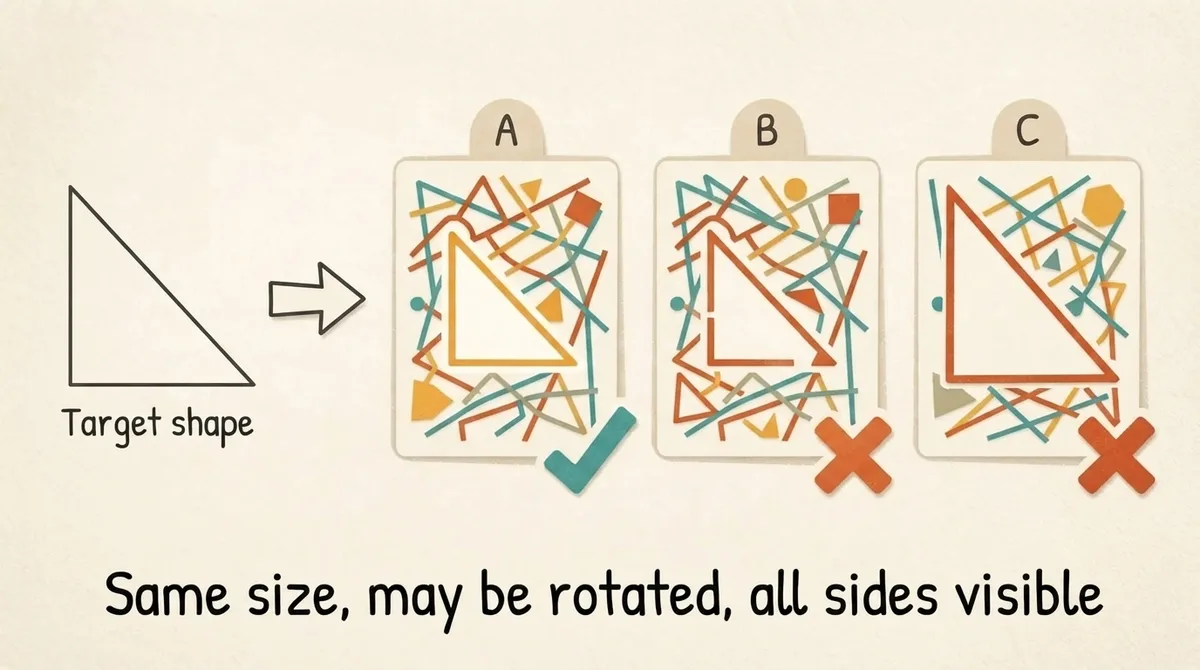
You are shown a target shape, say a right-angled triangle. Four busy line drawings follow, and you must find the one containing that exact triangle hidden inside it.
Method: the official rule, quoted from the Buckinghamshire booklet, is that the hidden shape "is exactly the same size as the target shape, but it may have been rotated (spun round) where it is hidden", and that "all of the sides of the target shape must be visible in the diagram where it is hiding". Both halves matter. Same size means a scaled-up copy is wrong, however convincing. All sides visible means a triangle whose third side is implied but not actually drawn is wrong. That second rule resolves the most common wrong answer in the whole question type.
3. Figure analysis (fold and punch)
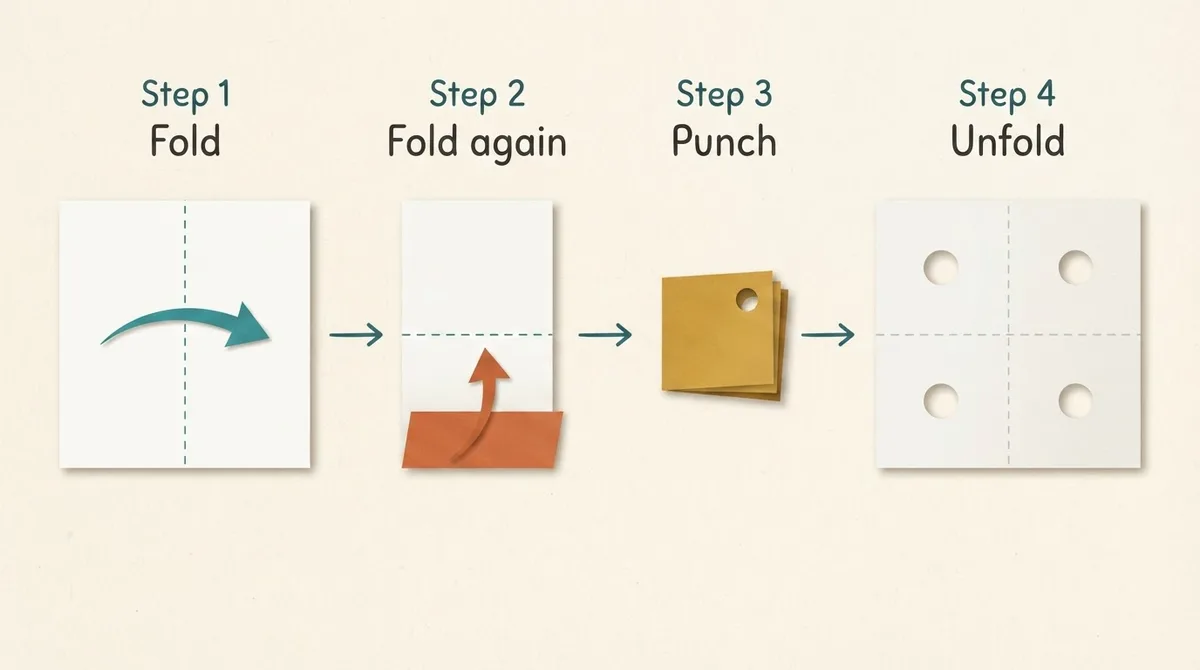
A square sheet is folded in half from right to left, then folded in half again from bottom to top. One hole is punched through the small folded square. How many holes are in the paper when it is opened out?
Answer: four. Each fold doubles the number of holes, so one hole through two folds gives one, then two, then four. The positions mirror across each fold line in turn, which is why the four holes sit symmetrically, one per quarter. Count the folds, double per fold, then check the answer options for the one with the right count before you worry about position.
Try a fold and punch now: predict the holes, then open it out to check.
This part of the guide is a short interactive exercise. It works in your browser.
4. Rotation and reflection
An L-shape stands upright with a small dot in the corner of its foot, at the bottom right. It is rotated 90 degrees clockwise. Where is the dot?
Answer: bottom left. The reliable trick is to track a single feature rather than the whole shape. Under a clockwise quarter turn, bottom right travels to bottom left, bottom left goes to top left, and so on. Rotation preserves handedness; reflection reverses it. If an answer option looks right but the shape reads back to front, it is a reflection posing as a rotation.
5. Block counting
A solid stack is built on a three by three base. The bottom layer is complete. The middle layer has cubes on one full row of three. The top layer has one cube sitting on the middle of that row. How many cubes in total?
Answer: thirteen. Nine plus three plus one. Count by layer, never by what you can see, because the picture will always hide cubes at the back that must be there to support the ones above them.
Try a block count now, including the cubes you cannot see.
This part of the guide is a short interactive exercise. It works in your browser.
6. Shape combination
Two flat pieces are shown: a square with a semicircular bite taken out of its right edge, and a semicircular tab. Which of the four options shows the pieces joined without overlapping or leaving a gap?
Answer: the option where the tab fills the bite exactly, restoring a complete square. Look for the matching edge first. In this family, one edge on each piece is always a mirror image of an edge on the other, and finding that pair collapses four options down to one.
If those felt unfamiliar, the wider pattern-and-rule side of the paper is worth working through as well. Our pillar guide to non-verbal reasoning question types walks through every family with worked examples in the same format.
Spatial reasoning or non-verbal reasoning? Two labels, one skill set
Here is the honest answer to the question most parents are really asking. Spatial reasoning is a genuine sub-skill, but almost no board treats it as a separate subject to be revised separately. Where it appears with its own heading, it sits inside the non-verbal paper. Where it does not appear by name, the same content usually turns up under non-verbal reasoning anyway.
That is why you should be sceptical of any site claiming a fixed number of regions that "test spatial reasoning" without linking to a single admissions authority. The naming varies, the underlying skills overlap heavily, and the only reliable source is your own board's published material.
A decision guide: does your child need to revise it separately?
Work out which of these four situations you are in, then act accordingly. Formats differ by region and change from year to year, so always check your own area's current arrangements.
If your child is sitting the Buckinghamshire Secondary Transfer Test. Yes, treat it as its own thing. Bucks is the clearest case in the country: its Mathematical and Non-Verbal Skills paper "is divided into two sections: Non-Verbal/Spatial Reasoning and Mathematics", and the familiarisation booklet gives spatial reasoning its own labelled section with its own demonstrated question types. Practise hidden shapes and fold-and-punch specifically.
If your child is sitting a GL Assessment paper somewhere else. No separate revision needed, but do not skip the spatial question types inside your non-verbal practice. GL Assessment's own 11+ shop sells practice papers in four areas only: verbal reasoning, non-verbal reasoning, English and maths. Its non-verbal reasoning practice papers list the content as processing graphic information and following patterns and rules, applying mathematical skills such as rotation, reflection and symmetry, "use of spatial awareness", and applying logical thinking. Spatial work is in there, folded into non-verbal reasoning rather than sold on its own.
If your child is sitting the ISEB Common Pre-Test or another independent school assessment. Spatial reasoning is not named. The ISEB Common Pre-Tests cover four subjects: mathematics, English (reading comprehension and grammar), verbal reasoning and non-verbal reasoning. They are online adaptive assessments usually taken in Year 6 or Year 7, and can be sat on one day or split across several. Prepare the non-verbal element properly and you have covered the ground. Our ISEB Common Pre-Test guide covers the format in detail.
If your child is sitting a local test from a different provider. Check the wording. The Bexley Selection Test, for example, is provided by Quest Assessments rather than GL Assessment. It runs as two booklets of timed multiple-choice questions, each around 50 minutes plus instructions, with the whole session lasting roughly two and a half to three hours, and its non-verbal element is described as assessing the ability to recognise patterns, understand relationships between objects and make logical deductions. No separate spatial section is named.
What the official booklet reveals about exam day
This is where the adult psychometric guides cannot follow, and where most 11+ pages simply have not read the source. Four things stand out from the Buckinghamshire familiarisation booklet.
The real time pressure is five minutes, not sixty. The whole Mathematical and Non-Verbal Skills paper takes around an hour, but the Non-Verbal and Spatial Reasoning part is not one long run. It "is divided into smaller sections, each of which starts with a chance to practise a few questions, guided by the audio instructions. After that, you will have 5 minutes to complete each of the sections." Training against a 45-minute mock is a different regime entirely from training against a five-minute block.
An audio soundtrack sets the pace. Instructions are delivered by recording, and the child cannot slow it down or rewind it. Some sections require two answers to be marked rather than one, which is why the booklet warns pupils to read the instructions carefully in each section.
The answer sheet is machine marked. Answers must not be crossed out, and no working may be written on the answer sheet at all.
Getting stuck has an official answer. "If you get stuck on a question, don't spend ages thinking about it but miss it out and carry on to the end of the section or test. If you have time at the end, you can go back over that section, fill in any missing answers and check your work." Children who do not practise skipping will not do it under pressure.
Why "just sketch it out" fails in the 11+
Adult candidates are told to draw the net, mark the faces, redraw the rotation. It works, because they have paper and a minute per question. Your child has neither. There is no scrap paper, there is a five-minute block, and any marks made must sit in the question booklet rather than on the answer sheet.
So the skill being trained at home is not drawing. It is mental modelling that has been rehearsed until it is fast, backed by a small set of rules that remove the need to visualise at all: the strip rule for cube nets, doubling per fold for punched holes, tracking one feature through a rotation, counting by layer for blocks, matching one edge for combinations.
A light pencil dot beside a rejected option in the question booklet is legitimate and quick. A full redrawing of the shape is not. Practise the first, and drop the second early.
How to practise with physical nets at home
Spatial reasoning is one of the few 11+ skills that genuinely improves faster off screen than on it. The transfer from hands to head is real, and it takes very little equipment.
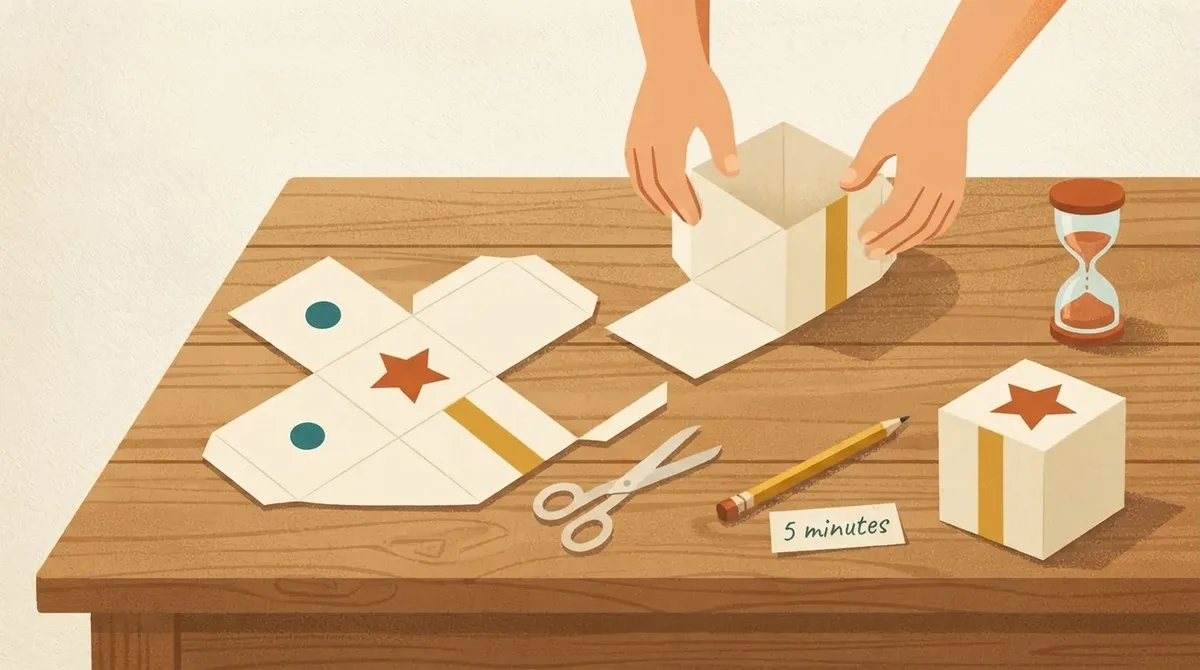
- Cut out a cube net from card. Mark three faces with a dot, a star and a stripe. Before folding, ask your child which face will end up opposite the star. Then fold and check.
- Repeat with the eleven different cube nets. After a week, ask for the prediction only, and fold to check afterwards rather than during.
- Fold a square of paper twice, punch a single hole, and ask your child to draw the unfolded result before opening it. This is the fold-and-punch question type exactly.
- Build small stacks from wooden blocks or sugar cubes, photograph them from one angle, then ask for the total count from the photo. This teaches counting the hidden supporting cubes.
- Move to timed sets. Five questions, five minutes, no paper, no rubbing out. That single change makes home practice match the real block length.
Once the physical stage is doing its job, move the timing pressure onto full papers. Our guide to 11+ mock exams covers how to run them without turning them into a weekly ordeal, and Trace Learn's mock test tools let you set short timed sections rather than only whole papers.
Five mistakes that cost the most marks
- Choosing a hidden shape that is the right shape but the wrong size. The official rule is same size, rotation allowed. Nothing else.
- Accepting a hidden shape with a missing side. All sides of the target must actually be drawn in the diagram.
- Confusing rotation with reflection. If the answer looks correct but reads back to front, it is a mirror image and it is wrong.
- Counting only the visible blocks. Any cube supporting another cube must exist, even if the picture never shows it.
- Refusing to move on. In a five-minute section, one stubborn question can cost three easy ones. The official guidance is to skip and return.
A good preparation plan tests for these directly rather than counting total questions answered. If you are tracking which errors keep recurring, progress tracking is far more useful than a running percentage, because the same five mistakes tend to repeat until they are named.
Frequently asked questions
Is spatial reasoning the same as non-verbal reasoning? Not quite. Non-verbal reasoning is about spotting and applying rules between shapes and patterns. Spatial reasoning adds the requirement to picture a shape and move it in your head. Most boards test both under the non-verbal heading. Our 11+ non-verbal reasoning overview explains how the two sit together on a real paper.
Can spatial reasoning be improved, or is it fixed? It improves with practice, particularly with physical folding and building at first, then with timed question sets. Progress is usually quicker than in verbal reasoning because the rule set is small.
Are cube nets the most important question type? They are the most taught online, but the Buckinghamshire familiarisation booklet demonstrates hidden shapes and figure analysis in its spatial reasoning section rather than cube nets. Cover all six families rather than over-training the one the internet likes best.
How long should we spend on it each week? Two or three short sessions of ten to fifteen minutes beat one long one. The skill fatigues quickly, and tired visualisation practice teaches guessing.
Where do I check what my child's actual exam contains? Your local authority or school admissions page, and the test provider's own material. Anything else, including this article, is secondary. If you are still mapping out the year, our 11+ preparation plan sets out a sensible order to tackle subjects in, and you can start a free account to try timed spatial sections at home.
Topics
- spatial reasoning
- non-verbal reasoning
- 11 plus
- cube nets
- exam technique