
Non-Verbal Reasoning in the 11 Plus: Format, Timing and Marks
Non-verbal reasoning is not one test, and in some areas it is not tested at all. Here is where NVR appears region by region, how long each section runs and what share of the score it carries.
 Elspeth Marlow
- 14 min read
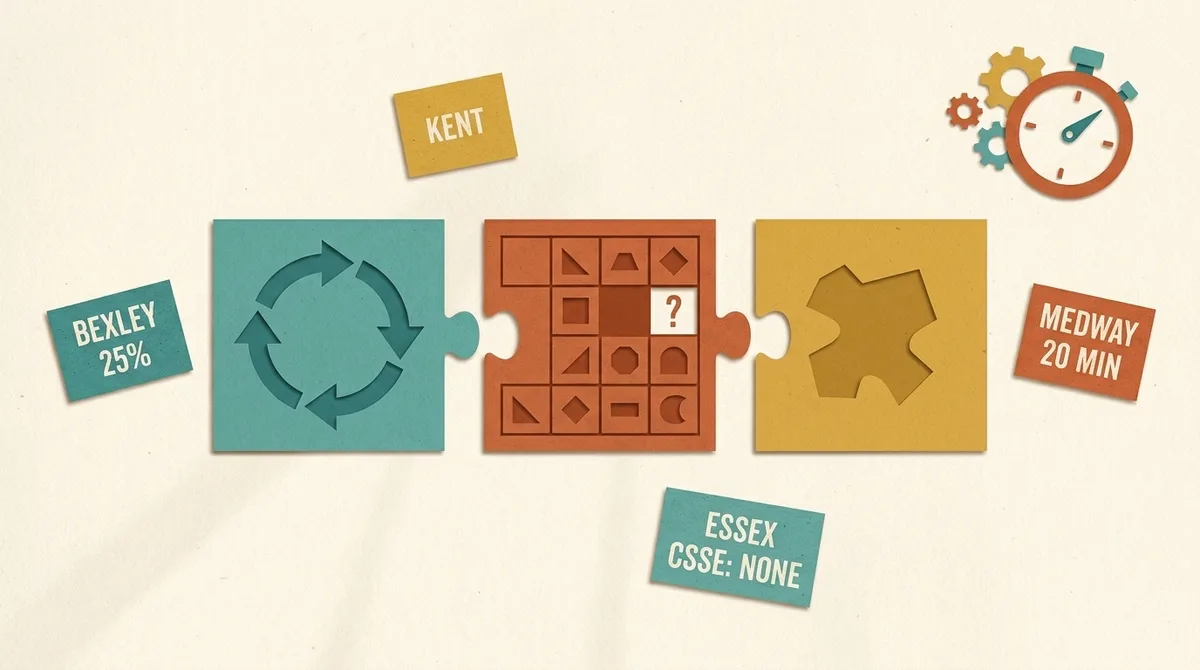
Almost every page about non-verbal reasoning in the 11 plus treats "the NVR test" as a single object: a fixed thing with fixed question types that you prepare for by downloading papers. That framing quietly skips the three questions parents actually ask first. Is non-verbal reasoning even in my child's test? Where does it sit in the paper? And how much of the final score does it carry?
The honest answer is that NVR is not one test. In Essex, the CSSE consortium sits two papers, English and Maths, and there is no non-verbal reasoning at all. In Bexley, NVR is a quarter of the score. In Buckinghamshire it is not even a paper of its own: it lives inside the Mathematical and Non-Verbal Skills booklet and runs in five-minute blocks paced by an audio track. In Kent it is split into short sections timed individually. GL Assessment, whose materials most families buy, says plainly on its own free materials page that timings and question counts in your local test may differ from its practice papers.
This guide is a playbook rather than an explainer. It works in seven steps: confirm whether your region tests NVR, find where it sits on the paper, train the section clock instead of the paper clock, learn the question families, rehearse the answer sheet, convert the weighting into practice hours, and read the standardised score properly. If you want the underlying skill work, our 11+ non-verbal reasoning guide covers the solving method itself.
Step 1: Confirm whether your region tests NVR at all
Start here, because a surprising number of families prepare for a section their child will never see. Check the admissions authority or consortium page for the specific schools you are applying to, not a national summary. What the official sources currently say:
- Essex (CSSE): no non-verbal reasoning. "The candidates sit two tests. One in English and one in Mathematics." The English paper is sixty minutes with ten minutes of additional reading time, and Maths is sixty minutes. From September 2024 entry onwards, the English paper no longer contains Applied Reasoning questions. Source: csse.org.uk.
- Bexley: yes, and heavily weighted. The selection test assesses verbal ability and English comprehension, numerical reasoning, and non-verbal reasoning, sat as two booklets of roughly fifty minutes each. Source: bexley.gov.uk.
- Kent: yes, inside a reasoning paper. The Kent Test uses an English and maths paper of about an hour and a reasoning paper of about an hour, the latter containing a verbal reasoning section and a non-verbal reasoning section of roughly the same length. Source: kent.gov.uk.
- Medway: yes, sharing a paper with verbal reasoning. The Medway Test is three papers: English (30 minutes), Mathematics (50 minutes) and Reasoning (45 minutes). The reasoning paper covers spatial, non-verbal and verbal reasoning. Source: medway.gov.uk.
- Buckinghamshire: yes, bundled with maths. The Secondary Transfer Test uses two booklets. One tests verbal skills; the other contains questions testing non-verbal and mathematical skills.
- Lincolnshire and other consortium areas: several build a qualifying aggregate from verbal and non-verbal reasoning only, with no separate English or maths paper. Where that is the case, NVR is not a supporting subject, it is half the test.
Regional variation is the rule, not the exception, and areas review their arrangements. Treat the list above as a prompt to check your own authority's current page rather than as a substitute for it. Our parent guide to the 11+ explains how admissions authorities, consortia and individual schools differ.
Step 2: Find where NVR sits on the paper
Once you know NVR is in, find its container. There are three shapes, and they demand different preparation.
- Standalone NVR paper. Rarest of the three in state selective areas, common in independent school entrance and in some consortium tests. One paper, one clock, one subject.
- A section inside a reasoning paper. Kent and Medway both work this way. In Medway, the 45-minute reasoning paper splits into 20 minutes for spatial and non-verbal reasoning and 25 minutes for verbal. In Kent, the non-verbal reasoning portion is roughly the same length as the verbal portion.
- A section inside a mixed subject booklet. Buckinghamshire puts non-verbal and spatial reasoning in the same booklet as maths. The whole booklet takes around an hour, with the maths section taking 25 minutes plus five minutes of practice.
This matters because it determines what a realistic mock looks like. A child in Medway who only ever practises 45-minute NVR-only papers has rehearsed nothing about switching from shape puzzles to verbal reasoning halfway through a paper.
Step 3: Train the section clock, not the paper clock
This is the single biggest gap between how families practise and how the test runs. Most advice says "do a full timed paper". In several major areas that is actively poor preparation.
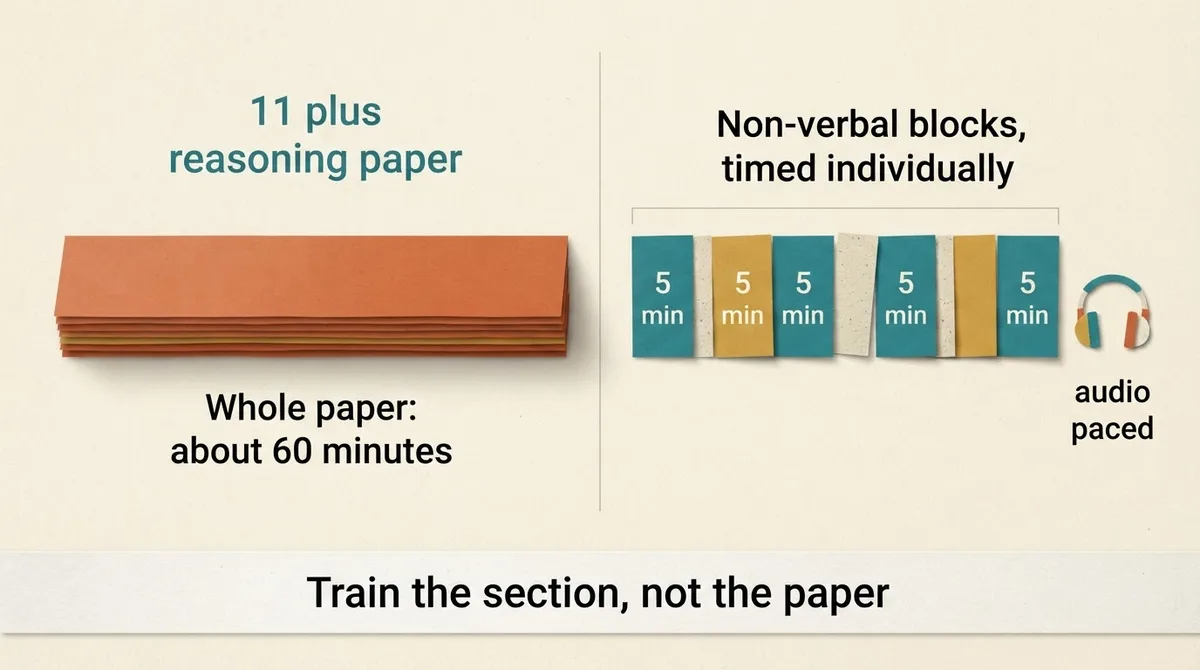
In Buckinghamshire, the non-verbal and spatial reasoning portion is divided into smaller sections. Each starts with a chance to practise a few questions guided by audio instructions, and after that the child has five minutes to complete each section. Kent states that its non-verbal reasoning will be split into short sections, administered and timed individually.
The consequences are concrete:
- You cannot borrow time. In a single-clock paper, a child who finishes maths early can spend the surplus on the last hard question. In audio-paced blocks the invigilator or recording stops the section, and unspent seconds evaporate. Banking time is not a strategy that exists here.
- Recovery windows are tiny. A wobble in a 50-minute paper is recoverable. A wobble in a five-minute block of, say, twelve questions costs a visible share of that block's marks.
- The restart is a skill. Stopping, listening to instructions, doing two practice questions, then going flat out again is a rhythm children need to have felt before test day.
How to rehearse it. Set a kitchen timer for five minutes. Give your child a block of ten to fourteen NVR questions of one type. When the timer sounds, pens down, no exceptions, and mark it. Then reset and run a different question type. Three blocks with genuine stops between them takes twenty minutes and teaches more about test-day pacing than one sixty-minute paper. If you want scored versions of this shape, our mock tests run sectioned timing rather than one long clock.
A useful worked target: if a block is five minutes and holds twelve questions, that is twenty-five seconds per question including reading the stem. Time your child on a set of twelve and compare. If they are averaging forty seconds, the fix is pattern recognition speed, not more papers.
Step 4: Learn the question families, and tell NVR from spatial
Buckinghamshire's familiarisation material draws a distinction worth borrowing. Non-verbal reasoning questions test how well you deal with new and unusual information without using words. Spatial reasoning questions are similar but also test how well you can picture a shape and move it around in your head. Its worked non-verbal examples are classes (odd one out), matrices and codes; its spatial example type is hidden shapes.
In practice, the families you should be fluent in are:
- Odd one out / classes. Four or five figures share a rule; one breaks it. Original example: four tiles each contain a shaded shape with an even number of sides, and a fifth contains a shaded triangle. Sides, not shading, is the rule.
- Analogies. A is to B as C is to what. Train the habit of naming the transformation in words before looking at the options: "rotated ninety degrees clockwise and the shading swapped".
- Matrices. A grid with one cell missing. Read across the rows first, then down the columns, and check whether the rule is cumulative (elements adding) or transformational (a shape turning).
- Codes. Figures are labelled with two-letter codes; you deduce which feature each letter position encodes. Original example: shapes labelled AX, AY, BX, BY where the first letter tracks outline shape and the second tracks shading.
- Series and sequences. A row of figures progressing by a rule, often rotation combined with a counter that increments.
- Hidden shapes and nets (spatial). Which option contains the target shape embedded in it, or which cube folds from this net.
Question counts are the detail almost nobody publishes, including GL itself, so treat any specific number you read online with suspicion unless it is on your authority's own page. What you can control is coverage: our full breakdown of every NVR question type with worked examples is a useful checklist to make sure no family is a blind spot.
Step 5: Rehearse the answer sheet, because it costs real marks
Computer-marked answer sheets have rules, and children who have never met them lose marks that have nothing to do with reasoning ability.
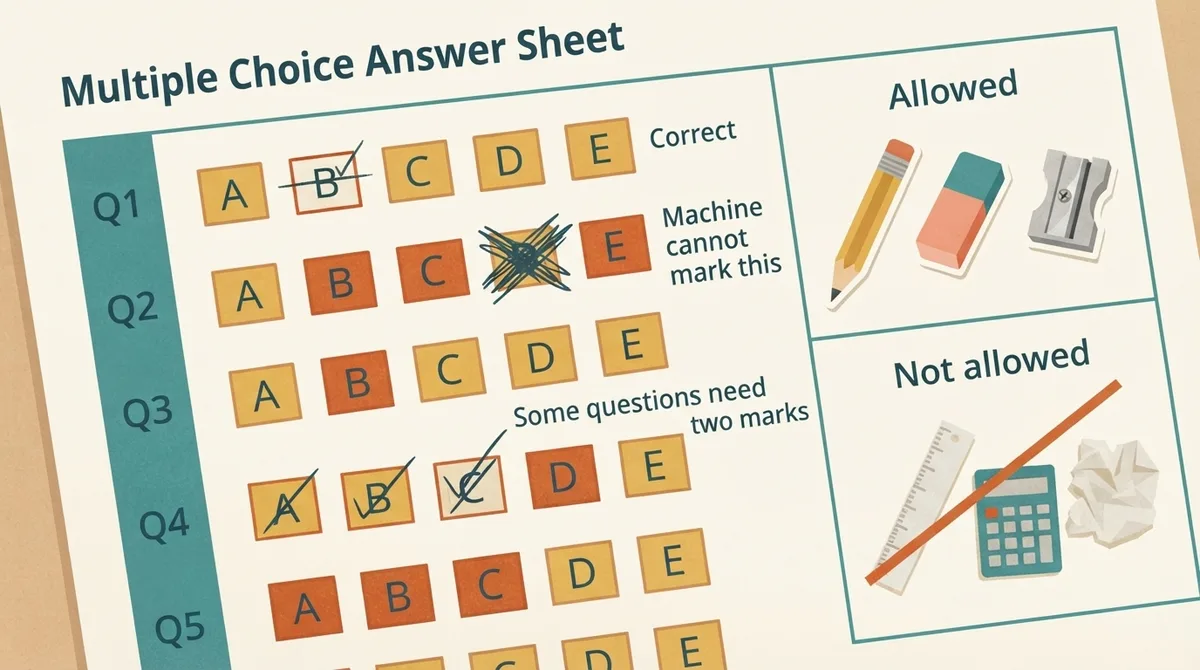
Buckinghamshire's familiarisation booklet is unusually specific, and the principles generalise to other GL-marked tests:
- Answers are marked by drawing a thin line with a pencil through the small rectangular box beside the correct answer, on a separate answer sheet, one per booklet.
- The sheets are marked by a computer. Neatness is not politeness, it is legibility to a scanner.
- Do not cross out answers on the answer sheet, because the computer will not be able to mark them. Changing an answer means erasing it cleanly, which is why an eraser is on the equipment list.
- Some questions may require two correct answers to be marked. A child in a rhythm of one mark per row can miss these entirely.
- Equipment allowed is an HB pencil, eraser and sharpener. A ruler, calculator, protractor and scrap paper are not allowed.
- Rough working goes in the question booklet, never on the answer sheet.
Bexley states the same principle in its own words: all working out must be done in the test booklet, as rough paper will not be provided.
A five-minute drill worth doing twice. Print a blank grid of lettered boxes. Read out fifteen answers at a brisk pace and have your child mark them with a single clean pencil line. Then read out three corrections and make them erase and re-mark. Time the whole thing. Children who have done this once stop treating the answer sheet as an afterthought.
Step 6: Convert the weighting into practice hours
How much NVR practice is worth doing depends entirely on what share of the score it carries, and this is where regional detail pays off.
- Bexley publishes its weighting. Age-standardised scores are combined as 50 per cent verbal ability, 25 per cent numerical reasoning and 25 per cent non-verbal reasoning. The average total is 200, and roughly two-thirds of candidates score between 170 and 230. A quarter of the score is a serious allocation: if your child is doing eight hours of prep a week, two of them belong to NVR.
- Verbal-plus-non-verbal aggregate areas such as Lincolnshire build the qualifying score from verbal and non-verbal reasoning only. Here NVR is roughly half of everything, and it deserves an equal split with verbal work.
- Kent reports three standardised scores, English, maths and reasoning, plus a total aggregate. NVR is a component of one of three reported scores, so it is meaningful but diluted by verbal reasoning within the same paper.
- Medway will not tell you. Under the Freedom of Information Act, Medway Council states it is unable to provide raw scores, percentages, scores for each test paper or individual sections, pass marks, or the standardisation calculation, citing commercial sensitivity under Section 43(1) and (2). That is an honest thing to know: in Medway you can find the timings but not the weighting, so plan on the timings and treat any weighting claim you read elsewhere as inference.
- Essex CSSE: zero hours. If your only target schools are CSSE consortium schools, NVR practice has no marginal value on the test itself.
The practical rule: allocate NVR time in rough proportion to its published weight, then adjust for your child's gap. A Bexley child who is already strong at NVR and weak at comprehension should still not be doing half their week on shapes. Track it rather than guess, which is what progress tracking is for.
Step 7: Read the standardised score properly
NVR results are almost never reported as raw marks. GL Assessment's Standard Age Score is age-standardised so that the average score for any age group is always 100, with a standard deviation of plus or minus 15 points and scores running from 60 or below to 140 or above.
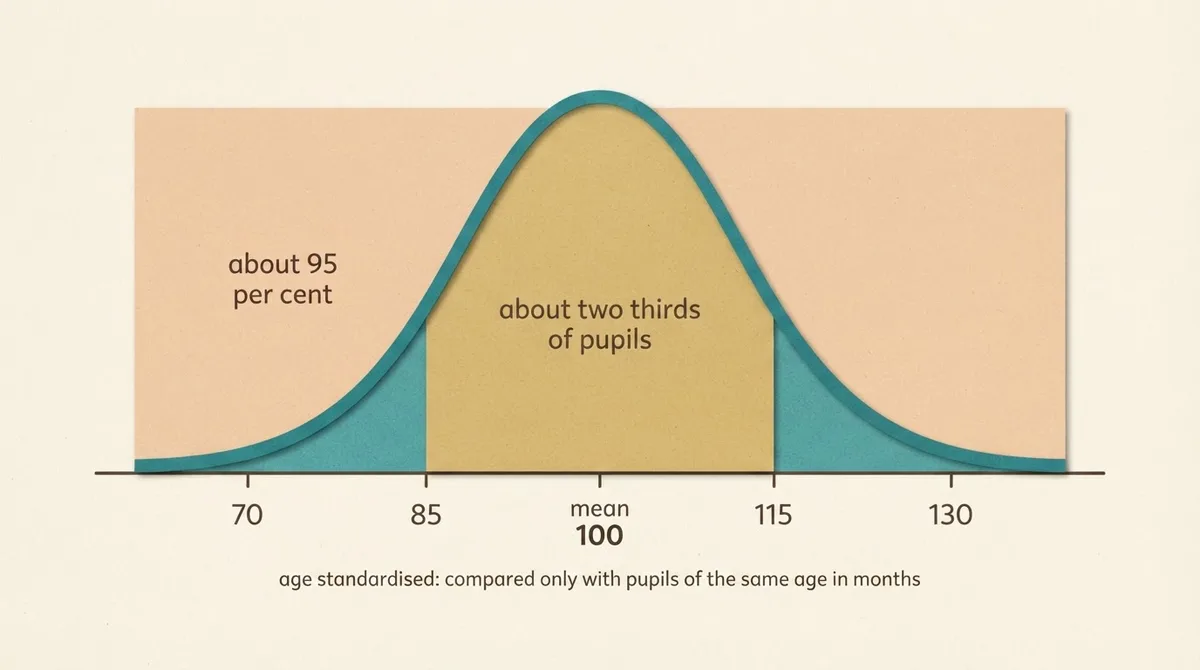
That means, per GL's own documentation:
- Approximately two-thirds of pupils score between 85 and 115.
- Approximately 95 per cent score between 70 and 130.
- Pupils are compared only with others of the same age, because in a typical year group the oldest pupils are very nearly twelve months older than the youngest. A September-born and an August-born child with identical raw marks will not get identical standard age scores.
So what is a "good" NVR score? For selective entry, comfortably above 115 is the sensible working target, and areas with high demand effectively require more. But note what is missing: almost no authority publishes the raw-to-standardised conversion, and Medway explicitly refuses to. Anyone quoting you a precise NVR pass mark is estimating.
Official practice material, and why it will not match exactly
GL's free materials page is worth downloading, as are your own authority's familiarisation booklets, which are usually the closest thing to the real paper you will ever see. Do the familiarisation booklet first and the commercial papers second, not the other way around.
But read GL's own caveat: the exact timings for, and number of questions in, your local 11 plus test may differ from its practice materials. Familiarisation booklets show layout, instruction wording and answer-sheet mechanics faithfully. Commercial papers give you volume. Neither gives you your local weighting. Use paper tests for volume and the official booklet for fidelity, and if you want a plan that sequences the two, start with a free account and build one around your test date.
Frequently asked questions
Is non-verbal reasoning part of the 11 plus? Sometimes. It is a substantial part in Bexley (25 per cent of the score), Buckinghamshire, Kent, Medway and several verbal-plus-non-verbal aggregate areas including Lincolnshire. It is absent entirely from the Essex CSSE test, which is English and Maths only. Check your own admissions authority before spending a single hour on it.
How long is the NVR section? It depends on the container. Medway gives 20 minutes to spatial and non-verbal reasoning inside a 45-minute reasoning paper. Buckinghamshire runs it in five-minute blocks inside an hour-long booklet. Kent times its non-verbal sections individually. There is no single national duration.
What is the difference between non-verbal and spatial reasoning? Non-verbal reasoning asks you to handle unfamiliar visual information without words. Spatial reasoning adds a mental manipulation element: picturing a shape and moving, folding or rotating it in your head. Hidden shapes, nets and 3D rotation questions are spatial; classes, matrices and codes are non-verbal.
Can my child cross out a wrong answer on the answer sheet? No. On computer-marked sheets, crossed-out answers cannot be read by the scanner. The correct procedure is to erase cleanly with the eraser and mark the new answer, which is why an HB pencil and eraser are on the equipment list.
Does doing full-length timed papers help? Less than you would think for NVR specifically. Where sections are individually timed or audio-paced, short blocks with hard stops are the closer rehearsal. Full papers remain useful for stamina and for practising the switch between sections in mixed papers.
How much should we practise if our area weights NVR at 25 per cent? Roughly a quarter of the total preparation time, adjusted for where your child's gaps actually are. Consistency beats volume: three short sectioned sets a week for several months will do more than occasional long sessions. Our year-by-year preparation plan shows how to phase this across the run-up to the test.
Topics
- nvr
- 11 plus
- non-verbal reasoning
- gl assessment
- exam format