
Non-Verbal Reasoning: Every Question Type with Worked Examples
A complete taxonomy of 11+ non-verbal reasoning question types, each with a worked example, a repeatable solving rule and the distractor examiners plant. Includes official ISEB and GL exam facts.
 Elspeth Marlow
- 15 min read

Most pages about non verbal reasoning do one of two things. They list the question types and show you none of them, or they demonstrate two or three and never tell you how many exist. Parents end up with a vocabulary they cannot picture, or a picture they cannot generalise from.
This guide does both. Below are around eighteen named question types spanning the paper-based GL format used by many grammar schools and the online adaptive ISEB Common Pre-Test used by many independent senior schools. Each type gets the same four parts: what the question looks like, the solving rule written as an instruction your child can repeat, a worked example, and the specific distractor examiners plant in that type.
It is written as a playbook rather than a listicle, because the point is not to memorise eighteen tricks. It is to learn one method, built on the small set of visual variables that every one of these questions manipulates, and then recognise which variable is in play.
Last reviewed: 25 August 2026.
Non-verbal reasoning, defined in one paragraph
Non-verbal reasoning is problem solving with pictures instead of words. ISEB defines it as the ability to analyse visual information such as pictures, diagrams and graphs, and to solve problems using visual reasoning. Nothing in a well-set question depends on reading ability, vocabulary or curriculum knowledge, which is precisely why selective schools like it: a child who has never seen the format can still, in principle, work out the rule. What practice changes is speed and the ability to spot which feature matters.
11+ or graduate aptitude test? Which non-verbal reasoning you are looking for
Two very different audiences search this phrase. If you are preparing for a job application, you want graduate-level inductive reasoning or diagrammatic reasoning tests: mathcentre publishes free graduate non-verbal reasoning practice materials produced for a university employability network.
The shape logic is genuinely the same family. Sequences, matrices and rule-finding appear in both. The differences are framing and pressure: graduate tests use denser abstract grids, often run under roughly 40 to 75 seconds per item, and are usually normed against other applicants. The 11+ version uses simpler figures, gives more scaffolding, and is sat by ten and eleven year olds. Everything below is the 11+ version.
Every non-verbal reasoning question type at a glance
Pattern and relationship: odd one out, complete the pair, series and sequences, matrices, belongs with and find the twin, codes.
2D manipulation: rotation, reflection, symmetry, hidden shapes, shape addition and subtraction, layering and overlap, counting and position.
3D and spatial: nets and cubes, rotating 3D shapes, counting blocks, shapes from above, paper folding and hole punch.
Which exams test non-verbal reasoning
Formats vary by region and by school, so check your own target before planning anything.
- ISEB Common Pre-Test. All four papers are online, adaptive and multiple choice. Non-verbal reasoning is allocated 30 minutes as standard, or 37.5 minutes with approved 25% extra time, inside a 2 hour 15 minute battery alongside English (40), Maths (40) and Verbal Reasoning (25). ISEB's framework splits the paper into non-verbal reasoning (analysing 2D figures for patterns) and spatial reasoning (manipulating 3D figures), and notes other question types may also appear.
- GL Assessment papers. GL states that 11+ tests vary from area to area and that local authorities or schools decide which subjects are tested. It also warns that exact timings and question counts in your local test may differ from its own free familiarisation materials. Its non-verbal papers cover pattern and rule following, rotation, reflection and symmetry, spatial awareness and logical problem solving.
- Local authority tests. Buckinghamshire Council, for example, says its Secondary Transfer Test measures verbal, non-verbal and mathematical skills across two papers of about 60 minutes each with a break between, preceded by a shorter practice test, and treats a score of at least 121 as qualifying for a grammar school place.
If you are still mapping the wider process, our parent guide to the 11+ covers subjects, deadlines and regional differences.
The nine variables every non-verbal reasoning question is built from
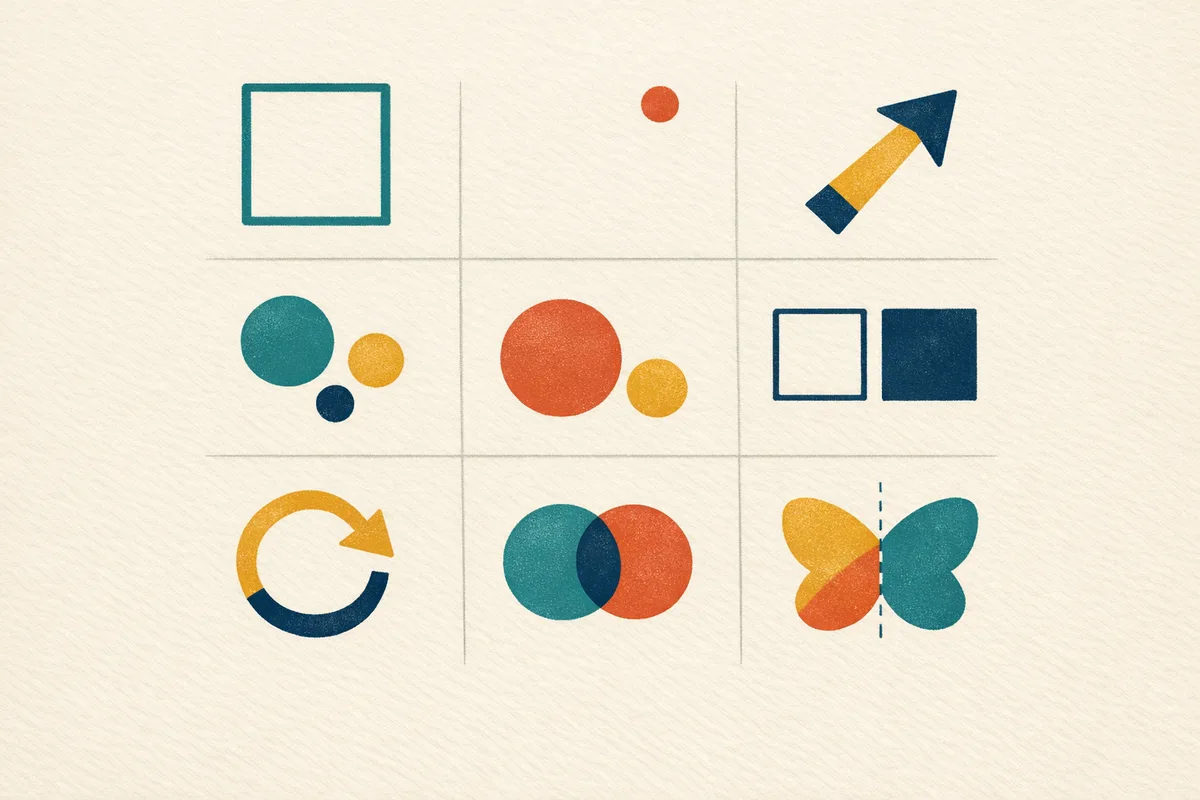
This is the idea that turns eighteen types into one skill. ISEB's own family guidance lists the visual features children should learn to observe: shape, position, angle, number, size, shading, rotation, overlapping and symmetry.
Every question below varies one or more of those nine and holds the rest constant. So the first move is never "what type is this?" It is "which variables are changing?" Teach your child to run the list in a fixed order, out loud at first, then silently. Most wrong answers come from spotting one changing variable, feeling satisfied, and missing the second.
Pattern and relationship types, with worked examples
These test whether a child can find a rule and apply it. They dominate the first half of most papers.
Odd one out
Four or five figures obey a shared rule and one breaks it. The instruction: name the rule the majority follow, in a full sentence, before you look at the suspect. Worked example: in four figures the number of dots inside equals the number of sides minus one; the fifth has four dots inside a four-sided shape, so it is the odd one. The planted distractor is a figure that looks obviously different (larger, darker, tilted) while still obeying the rule.
Try an odd one out now: find the rule four of the figures share.
This part of the guide is a short interactive exercise. It works in your browser.
Complete the pair
The format is "A is to B as C is to what?" The instruction: describe the change from A to B as a list of operations, then apply every operation to C. Worked example: A becomes B by rotating 90 degrees clockwise and swapping black shading for white, so C must do both. The distractor is the option that performs one operation faithfully and quietly drops the other, which is why writing the list matters more than eyeballing it.
Series and sequences
A row of figures changes by a fixed rule and you supply the next or the missing one. The instruction: track one variable across the whole row and say its values as a list before predicting anything. Worked example: dots run 1, 2, 3 while the arrow turns 45 degrees clockwise each step, so the fourth figure has 4 dots and a 135 degree arrow. The distractor freezes the second variable: right number of dots, arrow left where it was.
Matrices
A 2x2 or 3x3 grid with one empty cell. The instruction: read across the row to find the rule, then check the same answer down the column; a correct option must satisfy both. Worked example: across the row the inner shape shrinks, down the column the outline changes from solid to dashed, so the missing cell is a small shape in a dashed outline. The distractor is an option that is perfectly right for the row and wrong for the column.
Try a matrix now. Look for one rule across and one rule down.
This part of the guide is a short interactive exercise. It works in your browser.
Belongs with and find the twin
You are shown a target figure and asked which option shares its defining property. ISEB refers to this format as "Find the Twin". The instruction: state the property that is structural rather than decorative. Worked example: if the target has an odd number of enclosed regions, then colour, size and orientation are all noise. The distractor copies the target's most eye-catching surface feature, usually shading or overall silhouette, while getting the structural property wrong.
Codes
Figures carry two-letter codes and you must code a new figure. The instruction: group the figures by first letter and ask what those figures share, then repeat for the second letter. Worked example: if every figure coded A has a curved outline and every figure coded X is shaded, a curved shaded figure is AX. The distractor offers letter pairs that never co-occur in the given set, which a child can eliminate without solving the whole code.
2D manipulation types, with worked examples
These ask a child to move a flat figure in their head. Accuracy beats speed here, because the wrong answers are designed to be nearly right.
Rotation
The figure turns about a point without flipping. The instruction: choose one asymmetric feature as a pointer and track only where that pointer lands. Worked example: a flag sits top left pointing up; after a 90 degree clockwise turn it sits top right pointing right, and every other feature follows. The distractor is a reflection dressed as a rotation. If your child cannot tell them apart, check whether the internal features stayed in the same clockwise order.
Try a rotation question now: turn the shape until it matches.
This part of the guide is a short interactive exercise. It works in your browser.
Reflection
The figure flips across a mirror line. The instruction: check that whatever was nearest the mirror is still nearest it after the flip. Worked example: an L shape with its foot pointing right becomes an L with its foot pointing left, and any internal shading flips with it. The distractor is a 180 degree rotation, which looks convincing on figures that are close to symmetrical. Comparing the side nearest the mirror line separates the two reliably.
Symmetry
You count lines of symmetry or complete a figure so it becomes symmetrical. The instruction: fold the figure mentally along each candidate line and confirm that every detail coincides, shading included. Worked example: a five-pointed star has five lines of symmetry, but shade one point and it has none. The distractor is a figure whose outline is symmetrical while its internal pattern is not, which children accept far too readily when they are working quickly.
Hidden shapes
You must find which option contains the target shape concealed inside a busier figure. The instruction: fix the target's exact size and orientation first, because it is embedded unchanged. Worked example: a right-angled triangle hides inside a house-shaped outline where the roof line and one wall form two of its sides. The distractor contains the shape at a different scale or tilted a few degrees, which reads as a match to anyone who is pattern matching by feel.
Shape addition and subtraction
Two figures combine, or one is removed from the other. The instruction: decide first whether shared lines are kept or cancelled, then draw the result yourself before reading the options. Worked example: two overlapping squares added with shared lines cancelled leave a single eight-sided outline with no internal line. The distractor keeps exactly the line the rule cancels, so it matches the outer shape perfectly and fails on one internal detail.
Layering and overlap
You judge which shape sits in front, or what a stack of shapes looks like. The instruction: read the broken lines, because the shape whose outline is interrupted is the one behind. Worked example: if a circle's edge runs unbroken across a triangle while the triangle's edge stops at the circle, the circle is on top. The distractor uses the right shapes in the right positions with the stacking order reversed, which is invisible unless you check the interruptions.
Counting and position
You count sides, dots, intersections or enclosed regions, or judge where a marker sits relative to a shape. The instruction: count once in a fixed direction, then recount starting somewhere else and compare totals. Worked example: a dot lies inside the overlap of two circles, so it is inside both, not inside one. The distractor gives the correct total with the marker placed in a neighbouring region, so the count feels verified and the position quietly fails.
3D and spatial types, with worked examples
ISEB treats these as spatial reasoning: manipulating 3D figures to visualise them a different way. They are the types most children have least exposure to, so they repay targeted practice.

Nets and cubes
Which cube folds from this net, or which net folds into this cube? The instruction: identify opposite faces first, because faces separated by exactly one face in a straight line can never be seen together. Worked example: if the striped face and the dotted face are opposite in the net, any cube showing both is eliminated instantly. The distractor is precisely that cube, showing two opposite faces as neighbours, and it removes several options in one move.
Try a net now: fold it and watch which faces end up opposite each other.
This part of the guide is a short interactive exercise. It works in your browser.
Rotating 3D shapes
The same solid is shown from a different viewpoint. The instruction: pick one feature you can always locate, such as a notch or a shaded face, and count how many neighbours it has. Worked example: an L-shaped block with three cubes on its long arm still has three whichever way you view it. The distractor is a mirror image of the solid, identical in every count but impossible to reach by rotation alone.
Counting blocks
How many cubes are in this stack, including the ones you cannot see? ISEB names this format directly. The instruction: count layer by layer from the bottom and assume any cube that supports another must exist. Worked example: a stack whose top cube floats above a gap must have a hidden cube beneath it. The distractor is the total of visible cubes only, and it is usually the most popular wrong answer in the whole paper.
Shapes from above
You choose the plan view, or occasionally the side view, of a 3D arrangement. The instruction: flatten the object to its footprint and ignore height except where height changes the outline. Worked example: a cone from above is a circle with a point at its centre, and a cylinder from above is a plain circle. The distractor offers a side elevation instead of a plan, which is correct for the object and wrong for the question asked.
Paper folding and hole punch
Paper is folded once or twice, a hole is punched, and you predict the unfolded sheet. The instruction: unfold in reverse order, mirroring the holes across one fold line at a time. Worked example: fold in half twice and punch once, and you get four holes arranged symmetrically about both fold lines. The distractor has the right number of holes mirrored across the wrong axis, so counting alone will not save you.
The five distractor patterns examiners reuse, and a four-step method
Across every type above, the wrong answers come from a small repertoire:
- The near miss: correct on one variable, wrong on a second.
- The mirror: a reflection offered where a rotation was required.
- The surface match: copies the eye-catching feature, misses the structural rule.
- The visible-only answer: counts what is shown and ignores what is implied, as in hidden cubes.
- The over-complete option: adds one plausible extra feature the rule never licensed.
The method that beats all five is the same in every section:
- Scan the nine variables and say which are changing and which are held constant.
- State the rule in one sentence before you look at any option.
- Predict the answer in your head, or sketch it, and only then read the options.
- Eliminate by variable, not by feel. Reject each option by naming the variable it gets wrong. If you cannot name one, do not reject it.
Step 3 is the one families skip and the one that matters most. Reading the options first invites the near miss to look right. Our method-led NVR walkthrough drills this sequence in more depth.
Exam day, a realistic practice plan, and common questions

A plan that works for most families, adjusted to your own exam date:
- Months one and two: untimed accuracy. One type per session, no clock. The goal is that your child can state the rule aloud.
- Month three: timed by type. Ten questions of a single type against a timer, then review only the wrong ones by naming the variable that was missed.
- Month four onward: mixed papers. Full-length sets under exam conditions, because switching between types is its own skill. Free 11+ practice papers are useful here, and mock tests recreate the pacing.
- Final fortnight: maintenance only. Short sessions on the two or three weakest types, and no new material.
What is a non-verbal reasoning example?
The simplest is odd one out: five figures where four contain an even number of enclosed regions and one contains three, so the third figure is the answer. Every worked example above follows the same shape of reasoning.
How long is the non-verbal reasoning test?
It depends on the exam. ISEB allows 30 minutes as standard. Buckinghamshire uses two papers of about 60 minutes covering several skills. GL explicitly warns that local timings and question counts differ from its own materials, so confirm with your school or local authority.
How many questions should we practise a day?
Twenty to thirty focused questions with a proper review beats a full untimed paper. Track accuracy by type rather than by session, so weak types surface early; progress tracking does this automatically. Consistency over months matters far more than intensity in the final weeks.
Topics
- non-verbal reasoning
- 11 plus
- nvr
- question types
- spatial reasoning