
Practice Papers and Mock Tests
11 Plus Mock Exams: Online, In Centre and at Home
An honest comparison of the three ways to sit an 11 plus mock exam, with real 2026 prices, official test formats to match, and what a mock score can and cannot tell you.
 Elspeth Marlow
- 13 min read
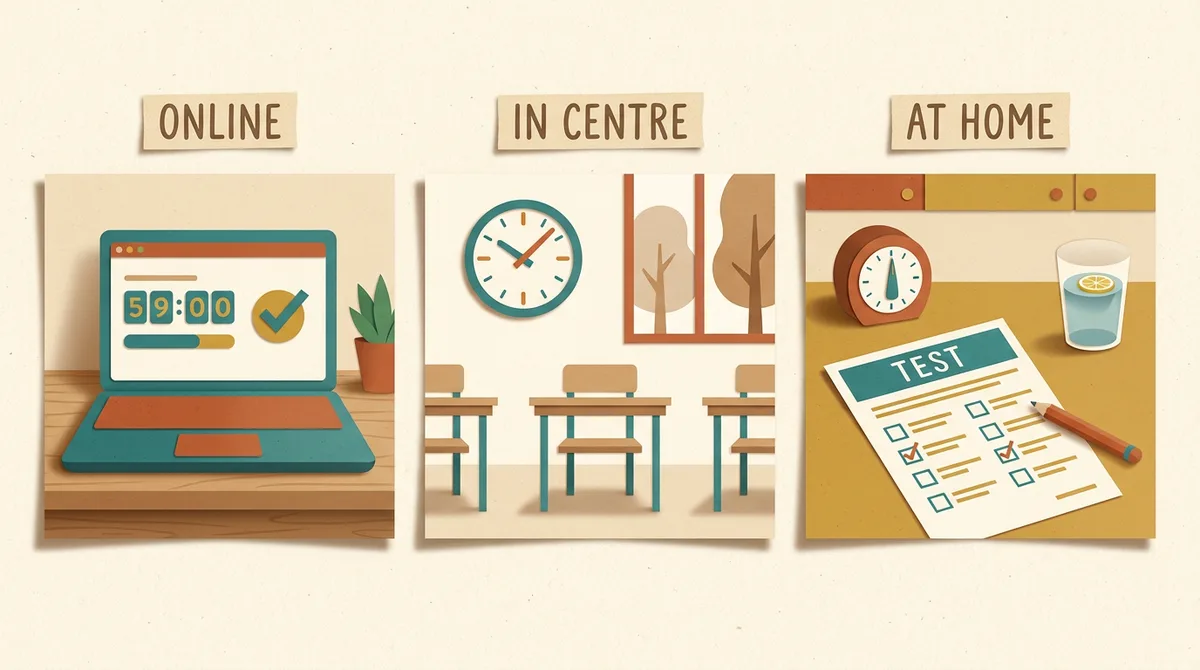
Almost every page that ranks for "11 plus mock exam" is selling you a seat in a hall. That is not a scandal, but it does shape what those pages can say. A provider charging £70 or £75 a sitting cannot honestly tell you that a well-run mock at your kitchen table gets you most of the way there for nothing, and a subscription site cannot tell you that two or three mocks is usually plenty. So the three questions parents actually have (which route, what it should cost, and how to run one so the result means something) go mostly unanswered.
We do not sell mocks in a hall, so we can answer them. What follows compares the three routes on their real merits, quotes published prices rather than vague ones, and grounds the format advice in what the councils and exam boards actually publish about how the real test is run. That last point matters more than parents expect: a mock built to the wrong region's format is worse than no mock at all, and a nationally marketed centre mock is exactly the product that invites that mistake.
One warning before we start. The single most damaging thing a mock can do is give you a number you then misread. Buckinghamshire does not report percentages at all. It reports a standardised score between 60 and 170, adjusted for your child's age in years and months, with 121 as the qualifying mark (Buckinghamshire Council). No raw mark out of 50 from any provider's paper converts to that. Hold onto that while you read the rest.
Myth: a mock tells you whether your child will pass
Reality: a mock tells you where the gaps are and how your child behaves under a clock. That is all it can do, and it is genuinely valuable, but it is not a prediction.
The reason is arithmetic, not cynicism. In Buckinghamshire the Secondary Transfer Test Score combines 50% of the standardised score for verbal skills, 25% for mathematical skills and 25% for non-verbal skills, then standardises against the whole cohort with an age adjustment. GL Assessment describes the same principle for its Standard Age Score: raw marks are converted so that they show "how the pupil is performing relative to a national sample of pupils of the same age", where the average score is 100 (GL Assessment).
A mock provider does not have the cohort. It has the fifty or two hundred children who booked that Saturday, most of them tutored, most of them from families willing to pay £75. Benchmarking against that group is interesting, but it is not the national sample, and a percentile derived from it should be read as a rough signal rather than a forecast.
So the honest use of a mock is diagnostic. Which question types collapsed. Where the timing went wrong. Whether your child transferred answers to the sheet cleanly. Those findings are actionable in a way that "68%" never is.
Myth: the in-centre mock is the realistic one
Reality: the centre is realistic on exactly two axes, and you can replicate a surprising amount of the rest at home if you know the real format.
Here is what each route genuinely buys you.
In centre. You get the hall, the strangers, the invigilator's voice, the walk in with a churning stomach. For an anxious child, or a child who has only ever worked at the kitchen table with a parent hovering, that rehearsal is worth real money. You also usually get a peer ranking and a written report. What you do not automatically get is a format that matches your area, and you rarely get feedback included in the headline price.
Online. You get instant marking, unlimited retakes, adaptive difficulty in some products, and no Saturday morning drive. Online mocks are the best value per diagnostic insight by a wide margin. What they cannot simulate is a room full of other children, a paper answer sheet, or the specific misery of not being able to check your work because the invigilator has called time.
At home. You get free, repeatable, and total control over the format, which means you can match your own board's timings exactly. What you have to supply yourself is discipline: real silence, a real clock, no help, no second attempt, and the willingness to let your child struggle for forty-five minutes without rescuing them.
Most families do not need to choose. The sensible pattern is a lot of online practice, a handful of properly run papers at home, and one in-centre mock late on if the hall itself is the thing you are worried about.
What 11 plus mock exams actually cost in 2026
The top results for this search almost never show a price on the page you land on, so here are published ones.
- KSOL charges £70 per 11+ GL mock exam for non-members and £65 for members, with an optional detailed feedback package at £25 per exam (KSOL). Each mock is two papers of 45 to 50 minutes, multiple choice, separate answer sheets, short break between papers.
- 11plusmocks.co.uk in Birmingham and Warwickshire sells individual GL mocks at £75, with a two-hour small-group review session at a further £40.
- The 11+ Institute sits in the same band at around £75.
- Subscription products that include mock-style papers run from roughly £7.50 a month at the budget end to around £70 a month at the premium end.
Read those numbers carefully. The advertised price is frequently the sitting only. Add the feedback session and a single in-centre mock with a debrief lands between £95 and £115. Sit four of them across a year and you have spent £400 or more, which is not obviously better value than a subscription that gives you unlimited timed papers plus the same diagnostic data.
The honest test is this: are you paying for the diagnosis or for the room? If it is the diagnosis, an online mock does it faster and cheaper. If it is the room, one or two sittings is the right number, not six.
The format your mock has to match
This is where a nationally marketed mock can quietly waste your money, because 11+ formats differ by area and GL Assessment itself says so: timings, topic combinations and question counts "may differ" in your local test (GL Assessment).
Buckinghamshire publishes its format in unusual detail. The Secondary Transfer Test is two papers, all multiple choice. One tests verbal skills including comprehension, technical English and verbal reasoning; the other tests mathematics and non-verbal skills including spatial reasoning. Each paper is about 45 minutes of questions inside a 60-minute slot once introductions and examples are counted, an audio soundtrack delivers the instructions, and children get a break between papers (Buckinghamshire Council).
There is also a detail almost nobody replicates. Before the real test, Bucks children sit two Practice Test papers under test conditions, about 40 minutes each, and those papers are not marked and not sent home. Their entire purpose is familiarity with question styles and answer sheet procedure. That is the council telling you, in its own materials, that a substantial part of mock value has nothing to do with the score.
Essex is a different exam altogether. The CSSE test is two papers, English and Maths. English is sixty minutes plus ten minutes of additional reading time; Maths is sixty minutes. From September 2024 the English paper no longer contains Applied Reasoning questions (CSSE), which means older mock papers built around that section now actively mislead. If you are in Essex, read our breakdown of what makes the CSSE exam different before you book anything.
So the first question to ask any provider is not "is it realistic?" It is "which board and which region is this modelled on?" If the answer is a generic "GL style", you are buying a reasonable practice paper, not a mock of your child's exam. Our comparison of GL, CEM and ISEB covers how much the formats actually diverge.
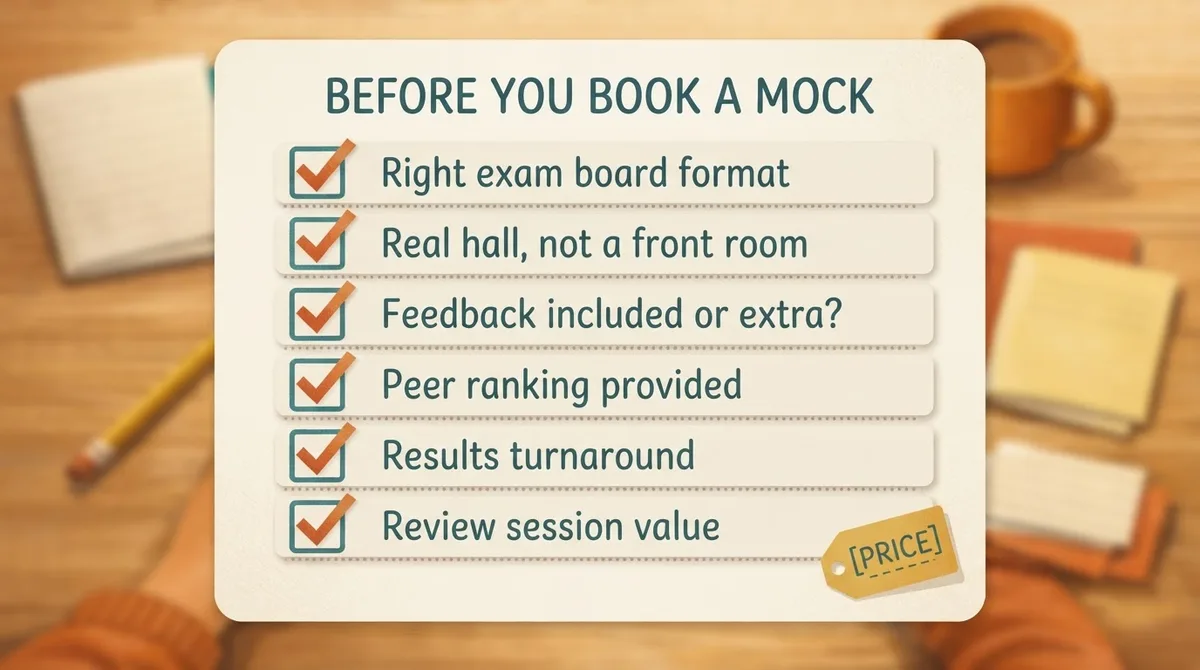
Booking an in-centre mock: what to check before you pay
Searches for mocks are heavily local, and a national page cannot tell you which Birmingham or Wolverhampton hall is good. What it can do is give you the questions that separate a serious operation from a tutor's front room.
- Format match. Does it follow your board and region, with the right paper count and timings? Ask directly.
- The venue. A real hall with single desks and an invigilator, or a converted living room with six children? The room is most of what you are paying for.
- Feedback: included or extra? At £25 to £40 on top of a £65 to £75 sitting, this roughly doubles the cost. Decide before you book, not after.
- What the report contains. A total mark is nearly useless. You want per-topic breakdowns and per-question-type accuracy.
- Peer ranking, and against whom. Ask how many children sat that paper and whether the cohort is tutored.
- Turnaround. Same-day or 24 to 48 hours is normal now. A week is too slow for the memory of the paper to still be fresh.
- Is the review session worth it? If it is two hours in a small group going through answers, ask whether you could do the same debrief yourself in forty minutes with the marked paper.
Online mocks: fast, cheap, and honest about their limits
Online mocks win on iteration. Instant marking means the debrief happens while the questions are still in your child's head, which is when it actually changes behaviour. Retakes cost nothing. Data accumulates across attempts so you can see whether the ratio problem is a one-off or a pattern.
The limits are real and worth stating. There is no hall. There is no paper answer sheet, and transferring answers to a separate machine-marked sheet is a genuine skill that catches children out, particularly if they skip a question and slip a row. And on-screen reading is different from reading a printed comprehension passage, which matters most for CSSE-style English.
The fix is not to avoid online mocks. It is to run most of your volume online and deliberately print two or three papers with a separate answer sheet so the mechanics are not new on the day. Trace Learn's free timed mock tests give you the timed conditions and instant results without a booking fee, which is the part the £75 providers are structurally unable to compete on.
How to run a proper mock at home
Most home mocks fail for the same reason: they are not mocks, they are homework with a timer nearby. The protocol below is built to match the published Bucks structure and adapts cleanly to other boards by swapping the timings.
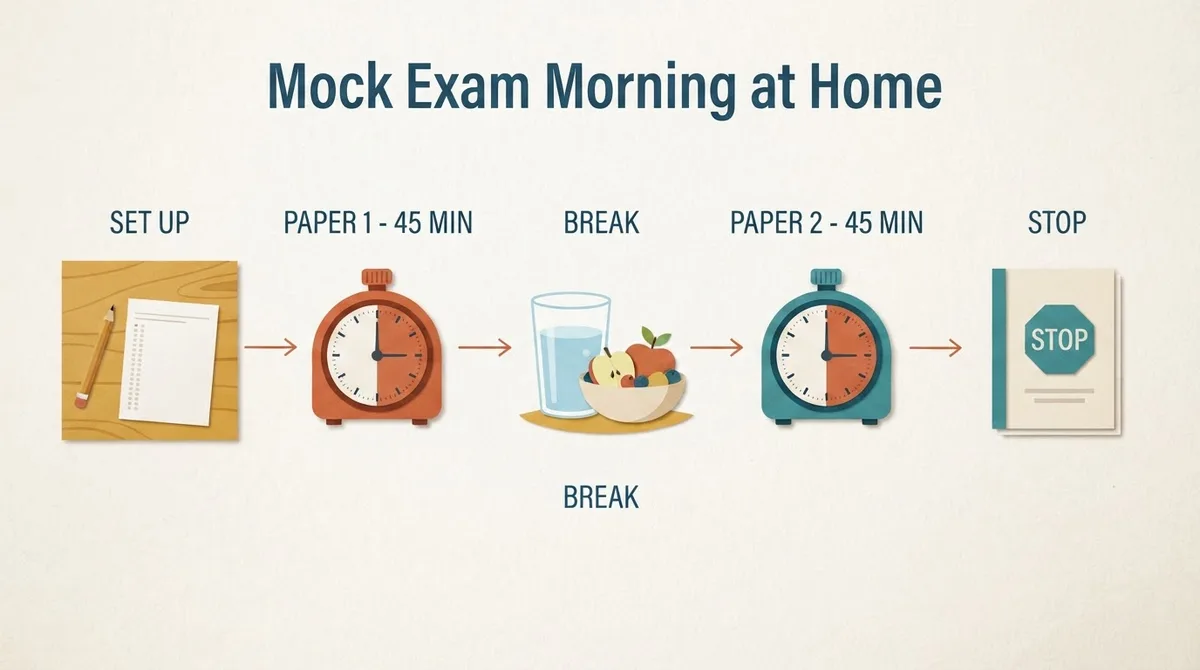
- Book it. Put it in the calendar a week ahead, at the time of day the real test runs. Treat it as fixed.
- Clear the table. Nothing on it but the paper, a separate answer sheet, two sharpened pencils, an eraser and a glass of water. No phone, no dictionary, no scrap notes from last week.
- Read the instructions aloud once, then stop talking. Bucks uses an audio soundtrack precisely so every child hears the same words. Your job after that is silence.
- Set 45 minutes and leave the room. This is the hard part. No hovering, no "are you sure about that one", no rescuing a child who has stalled. Sitting with discomfort is the skill being practised.
- Take the break. Ten to fifteen minutes, water, fresh air, no discussion of paper one. The break is part of the format, and children who go straight into paper two get an artificially low second score.
- Run paper two the same way, then stop dead when time is up. Unfinished is data. Letting your child finish "just the last three" destroys the only useful thing you were measuring.
- Put the paper away for an hour. Mark it out of sight of your child, so the first thing they hear is your considered summary rather than your face.
If you need papers to run this with, our guide to free 11 plus practice papers with answers lists what is genuinely free. GL Assessment also publishes around 10 hours of free familiarisation materials in printable PDF form covering verbal reasoning, non-verbal reasoning, English, maths and verbal skills (GL Assessment free materials), and CSSE publishes free downloadable familiarisation papers. Between the two, most families never need to buy a paper at all.
Marking the paper, and reading the score honestly
Mark it yourself, question by question, and record three things per question: right, wrong, or not attempted. That third category is the one parents skip and the one that tells you the most, because a paper with twelve unattempted questions is a pacing problem, not a knowledge problem, and those two need completely different responses.
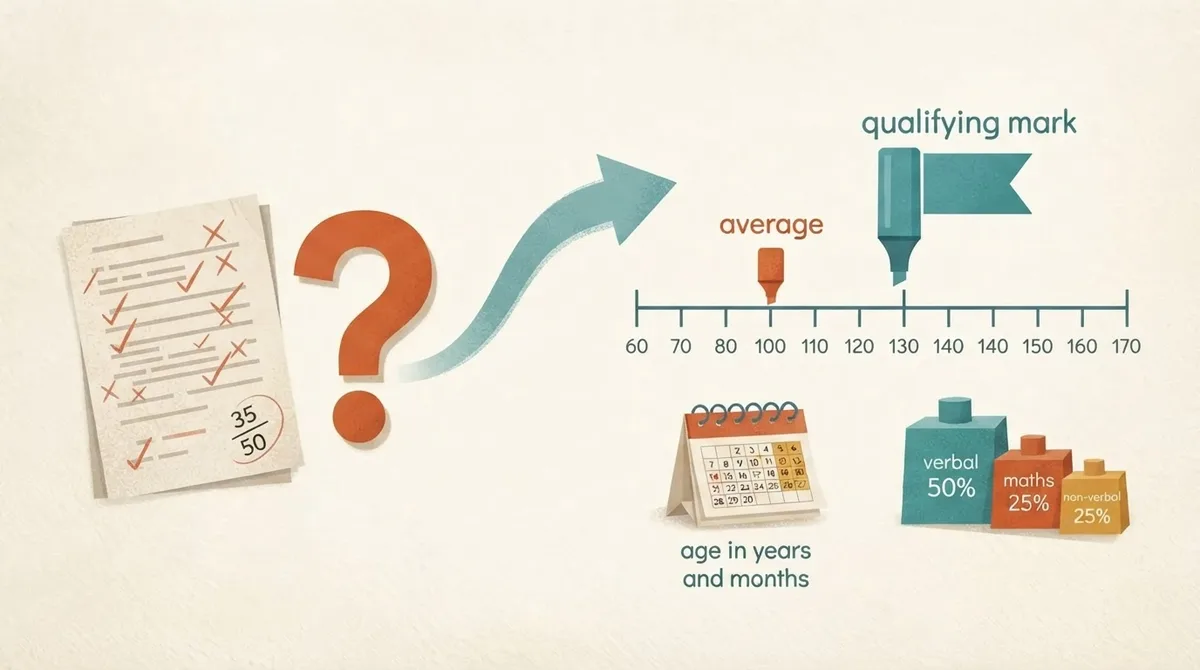
Then resist the conversion. "Is 70% enough to pass?" has no answer, because the real test does not work in percentages. In Buckinghamshire a child qualifies at a standardised score of 121 or above, around 37% of children are expected to reach it, and scoring well above 121 confers no extra admissions priority. That score is built from age-adjusted standardisation against the cohort, which your kitchen table cannot reproduce.
What you can read from a mock, reliably:
- Question types with clustered errors. Four wrong out of five on codes is a teachable gap.
- The drop-off point. If accuracy collapses after question 30, that is stamina or pacing.
- Careless versus unknown. Ask your child to re-attempt each wrong question untimed. Anything they now get right was a timing or attention error, not a content gap. Our exam technique and timing guide covers how to fix each type.
- Answer sheet mechanics. Any misaligned row is a process error worth ten minutes of drilling and nothing else.
The debrief, and how many mocks you actually need
Do the debrief within 24 hours and keep it to twenty minutes. Start with one specific thing that went well. Then pick at most two things to work on, chosen because they are frequent and fixable, not because they were the most annoying. Write those two things down and revisit them after the next mock. A debrief that lists nine weaknesses produces nothing but a demoralised child.
On frequency: three to five full mocks across the final year is plenty, spaced so there is time to act on each one. More than that and you are testing rather than teaching, and the scores stop moving because nothing between them has changed.
On timing, work backwards from your actual test date. The Buckinghamshire Secondary Transfer Test dates for children moving up in September 2027 are 8 and 10 September 2026, which means the preparation peak falls across the preceding summer, not the autumn term. Families who plan for a September push are roughly a term late. Other regions test in the autumn, so check your own board's calendar before you build the schedule.
And if the budget is tight, spend it in this order: free official familiarisation material first, timed online mocks second, one in-centre sitting last, and only if the hall itself is the anxiety. That order is the opposite of what page one of Google will tell you, for reasons that have more to do with their business model than your child's.
Topics
- mock exams
- practice papers
- gl assessment
- csse
- exam technique