
Verbal and Non Verbal Reasoning Practice in Year 5
In many areas the 11+ is sat in the opening days of Year 6, which makes Year 5 the whole preparation window. Here is a term-by-term plan for verbal and non-verbal reasoning, with a clear order of question families and honest accuracy targets.
 Elspeth Marlow
- 13 min read
Most parents discover the 11+ timetable a year later than they should. The mental model is that the test sits at the end of Year 6, somewhere near the natural finish line of primary school, and that Year 5 is the year for gently thinking about it. That model is wrong in most selective areas, and the consequences of getting it wrong are entirely practical.
In Kent, the 2026 test for children at a Kent primary school falls on Thursday 10 September 2026, with children not at a Kent primary tested over the weekend of 12 and 13 September, and results published on Thursday 15 October (Kent County Council). That is the first week of Year 6. Whatever your child knows on the last day of Year 5 is very close to what they will bring into the exam hall, because the September gap contains a summer holiday and roughly four school days.
So Year 5 is not the warm-up. It is the whole run. This guide turns that into something you can actually put on the fridge: what to teach in the autumn term, what to add in spring, what the summer term is for, when to start using a clock, and what a score of seven out of ten in a practice set really tells you. It covers verbal and non-verbal reasoning together, because in Kent they arrive in one paper, and your child is one child.
What are verbal and non-verbal reasoning actually testing?
Verbal reasoning is a family of word puzzles: letter codes, letter and number sequences, hidden words, compound words, synonyms and antonyms, analogies, and a long tail of logic and rule-following questions. Non-verbal reasoning is the same idea with shapes: odd one out, next in series, matrices, reflection, rotation, folding and coding by visual attribute.
What matters more than the definitions is how they behave under pressure. Both papers are multiple choice. In Kent, "the Kent Test papers are multiple-choice questions with a separate answer sheet. They are marked by a computer", and the reasoning paper "will take about 1 hour, including the practice sections and questions. It will contain a verbal reasoning section and a non-verbal reasoning section of roughly the same length" (Kent County Council).
One detail from that same page reshapes how you should practise. The non-verbal reasoning "will be split into short sections, administered and timed individually". Your child is not being asked to sustain concentration across a long unbroken paper. They are being asked to be fast and accurate in a short burst, on one narrow question family, and then to reset and do it again. That is a very specific skill, and it is trainable long before anyone sits a full paper.
Formats vary by area, and any guide that pretends otherwise is selling you something. Buckinghamshire splits the content differently: "The Secondary Transfer Test measures verbal, non-verbal and mathematical skills. Children sit two test papers, each about 60 minutes long, with a break between", with one paper covering verbal skills and the other covering mathematics alongside non-verbal and spatial reasoning (Buckinghamshire Council). GL Assessment, whose familiarisation materials many families use, says plainly that local timings and question counts can differ from practice materials. Check your own authority's published guidance before you fix any minute counts in your head.
Why is Year 5 the only full year of runway?
Count the weeks honestly. From the start of the autumn term in Year 5 to the summer holidays you have roughly 38 school weeks, minus half terms, minus the fortnight around Christmas when nothing productive happens, minus illness and school trips and the weeks your child is simply too tired. Call it 32 usable weeks.
That is enough for a great deal, if it is spent in the right order. It is not enough to be spent twice. Families who start in the spring of Year 5 lose the entire autumn, which is, as the next section argues, the most productive term of the three. Families who plan to "do the work in Year 6" have misread the calendar entirely.
The reassuring counterweight comes from ISEB, which runs the Common Pre-Test used by many independent schools: "the Pre-Tests are based on the national curriculum, so your child will be prepared through their schooling and additional preparation is not a requirement" (ISEB). Take that at face value. The purpose of a Year 5 plan is not to cram; it is to spread a modest amount of familiarisation across a long window so that it never has to be compressed into a frightening one. Thirty minutes, four times a week, across 32 weeks, is a great deal of practice and almost no disruption to childhood.
Which question types should you teach first?
One way to prioritise practice is to rank the question families by teachability, not by the order they happen to appear in a book.
Some families are rule-based. A worked rule gives a starting point, but children still need to recognise variations and check each question. In verbal reasoning these include letter codes, letter and number sequences, compound words, hidden words, and move-a-letter questions. In non-verbal reasoning they include odd one out, next in series, and the reflection and rotation families. A child who understands a simple alphabet shift can then practise recognising different shifts, directions and wrap-around cases.
Other families ride on vocabulary. Synonyms, antonyms and word analogies are only partly technique; mostly they are a measure of how many words a child knows and how precisely they know them. Vocabulary grows slowly, through reading and exposure, and it cannot be crammed in a fortnight. Ten new words a week for 32 weeks is 320 words. A long last-minute list leaves less time to revisit words and use them in context.
So the ordering rule is straightforward:
- Front-load the rule-based families. They convert effort into marks quickly, which builds the confidence that carries the harder work later.
- Run vocabulary as a background thread from week one. Low intensity, high consistency, all year.
- Introduce the vocabulary-dependent question families later, once there is a stock of words for the technique to operate on.
Our companion guides go family by family with worked examples, if you want the teaching detail: verbal reasoning question types and, for the shape side, the cluster pillar on non-verbal reasoning question types. For the single most teachable verbal family, codes and letter sequences is worth an early week on its own.
What should the autumn term of Year 5 look like?
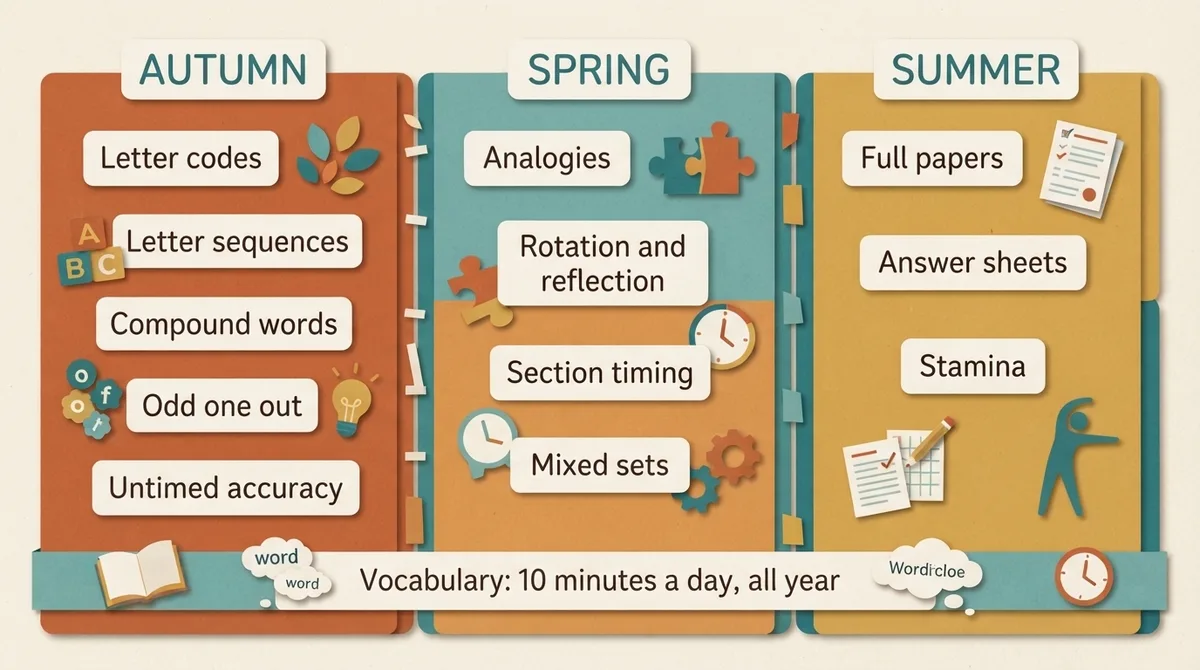
Autumn is for teaching, not testing. The aim by Christmas is that your child recognises a question type on sight and knows which method to reach for. Nothing is timed.
A workable shape is roughly one new question family per fortnight, alternating verbal and non-verbal:
- Weeks 1 to 2: letter sequences (verbal). Alphabet fluency both forwards and backwards is the underlying skill, and it pays off across several families.
- Weeks 3 to 4: odd one out (non-verbal). Teach the habit of naming the attribute being varied: shading, count, rotation, symmetry.
- Weeks 5 to 6: letter codes (verbal). The highest return of any single family.
- Weeks 7 to 8: next in series (non-verbal), where the method is to track one attribute at a time rather than staring at the whole shape.
- Weeks 9 to 10: compound words and hidden words (verbal), which reward a systematic scan rather than a flash of insight.
- Weeks 11 to 12: reflection and rotation (non-verbal). Physical props help here more than worksheets do.
Underneath all of that, ten minutes of vocabulary a day: a reading habit, plus a small notebook of new words with a sentence for each. Not lists to memorise, words to use.
A worked example of the kind of thing you are teaching, entirely made up so you can use it tonight. If BRIM is coded as CSJN, what is the code for TRAP? Each letter has moved forward one place, so the answer is USBQ. The point of the lesson is not the answer; it is that your child writes the shift under each letter rather than trying to hold it in their head. Method beats memory, and method is what transfers to the next question.
When do you start using a clock?
The standard advice, untimed then easy timed then full timed, is correct and almost useless, because nobody tells you what triggers the move. Here is an explicit gate.
Accuracy first, clock second, and always one family at a time. Only introduce timing on a question family once your child scores consistently high on that family untimed. In practice: three consecutive untimed sets at around nine out of ten or better, on that one family, with the errors being slips rather than misunderstandings. Until then, a clock only teaches them to guess faster.
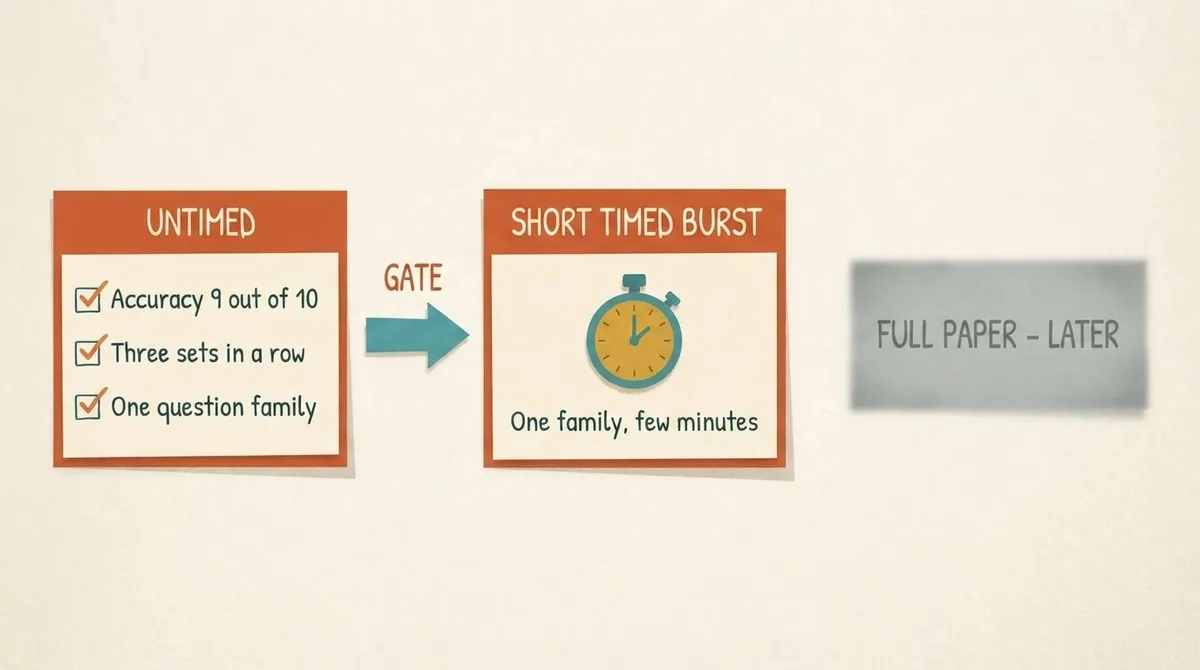
When the gate opens, do not jump to a full paper. Jump to a short timed burst on that single family, because that is what the real test looks like when non-verbal reasoning is "split into short sections, administered and timed individually". A few minutes on one family, then stop, then talk about what happened. If accuracy drops by more than a mark or two under the clock, go back to untimed on that family for a fortnight. The clock is a setting you can turn off, not a ratchet.
One family will pass the gate in November and another not until April. That is normal and it is the entire reason for tracking families separately rather than tracking a single overall score. A progress view that breaks results down by question family tells you which gate to open next; a single percentage tells you nothing you can act on.
What should spring and summer terms add?
Spring is for coverage and section timing. Introduce the vocabulary-dependent families now: synonyms, antonyms and analogies, which by January have a term's worth of words to work with. Add the harder non-verbal families, matrices and folding, which combine rules your child already knows. At the same time, families that passed the gate in autumn move to short timed bursts. By Easter the goal is that every question family has been met and roughly half are being practised against a clock.
Spring is also when mixed sets start to matter. A set of twenty questions all of one type lets a child settle into a groove; a mixed set forces the harder skill of identifying the type before choosing the method. Type recognition is the thing that quietly costs marks in a real paper, and it can only be practised in mixed conditions.
Summer is for whole papers and the mechanics of exam day. Now the full-length practice makes sense, because the components are secure. Two things deserve deliberate rehearsal. The first is the separate answer sheet: marks are lost to misaligned rows, not to ignorance, and Kent's papers are computer marked from that sheet. The second is what to do when a question defeats you, which is to mark a best guess, since these are multiple choice papers, and move on rather than surrender four easy marks later in the section.
Aim for a small number of properly conducted full mock papers across the summer term, spaced out, rather than a weekly grind. Kent publishes a free familiarisation paper and points parents to GL Assessment's free materials; those are the right things to use for the real rehearsals. Build the routine into a schedule you will actually keep, using our guide to building an 11+ revision timetable.
What accuracy should you actually be aiming for?
"She got seven out of ten, is that all right?" deserves a real answer rather than encouragement.
Raw marks are not what schools see. Kent explains standardisation as "a statistical process which compares your child's performance with the average performance of other children in each test. A slight adjustment is made to take account of each child's age so that the youngest are not at a disadvantage" (Kent County Council). Buckinghamshire standardises for age too, and weights the verbal, mathematical and non-verbal sections.
The bars are demanding. In Buckinghamshire, "children who achieve a standardised score of at least 121 are eligible to be considered for a Buckinghamshire grammar school place". In Kent in 2025, "to be given a grammar school assessment, children needed a total score of 332 or more, with no single score lower than 108. Test scores range from 69 to 141."
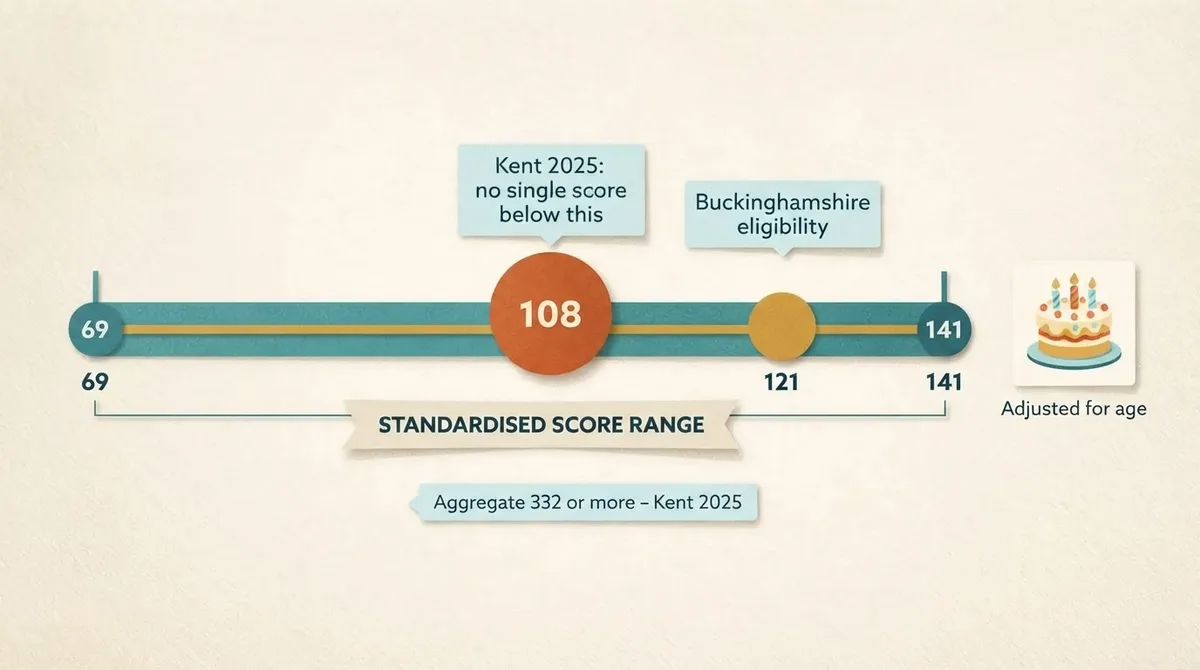
That second clause is the one to sit with. Kent gives "3 standardised scores, one for English, one for maths and one for reasoning, and a total (aggregate) score", and verbal and non-verbal reasoning are combined into that single reasoning figure. A minimum on every score means a weak reasoning section cannot be rescued by a strong English paper. It also means the verbal and the non-verbal halves are pooled, so a child who is excellent at word puzzles and shaky on shapes arrives with one mediocre number.
Working backwards, that is why practice-set accuracy targets have to be high. On familiar, untimed, single-family sets in Year 5, treat nine out of ten as the working standard and anything at seven or below as a signal that the method has not landed. Seven out of ten is not a near miss; it is a teaching instruction. Thresholds change every year and differ by authority, so use these as calibration rather than prophecy, and always check your own area's published figures.
What does a realistic Year 5 week look like?
Four short sessions, not one long one. Something like:
- Two sessions of about 25 minutes on the current question family, midweek, untimed in autumn and increasingly timed later.
- One session of about 20 minutes revisiting an older family so it does not decay.
- One weekend session of about 30 minutes, mixed types from spring onwards.
- Ten minutes of vocabulary most days, folded into reading rather than bolted on.
That is under two hours a week. It is deliberately less than the schedules sold by course providers, because a plan that is abandoned in February is worth less than a modest plan that survives to July.
Two habits make it work. Mark and discuss every set the same day, spending longer on the wrong answers than the right ones. And keep the practice adaptive, so questions track the level your child is currently working at rather than repeating what they have mastered. That is not a marketing preference: ISEB's Common Pre-Test is itself adaptive, with "each child shown questions based on their in-test performance", so practising adaptively is practising the way at least one real test genuinely behaves.
If you want the whole thing sequenced for you, our exam plan lays the families out in this teachability order across the Year 5 year, opens the timing gate per family as accuracy allows, and gives you this week's set rather than another book to buy. Start with one family, untimed, this week, and let the calendar do the rest of the work.
Topics
- verbal reasoning
- non-verbal reasoning
- year 5
- 11 plus
- study plan