
Verbal Reasoning Codes and Letter Sequences
Codes and letter sequences look like two separate 11+ topics, but they run on one skill: knowing where a letter sits in the alphabet and counting hops accurately at speed. Here is the method, the traps and 20 practice questions with worked answers.
 Elspeth Marlow
- 15 min read
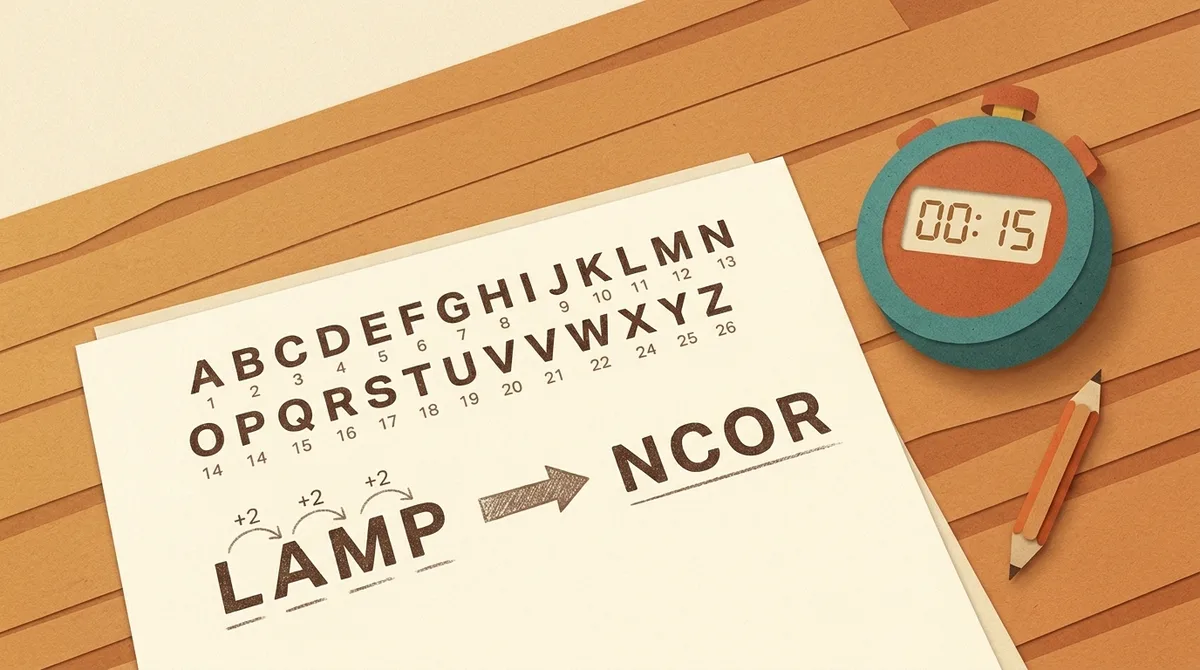
Open almost any 11+ verbal reasoning paper and you meet two question families that look nothing alike. One gives you a word and its code and asks you to encode or decode a second word. The other gives you a run of letters with a gap and asks what comes next. Practice books file them under different chapters, and most websites teach them on separate pages.
That separation is why so many children stall. Underneath the wrapper, letter-for-letter codes, changing-step codes, mirror codes, number substitution codes, letter sequences and paired sequences all run on exactly one skill: knowing where a letter sits in the alphabet and counting hops forward or backward without losing your place. Get that skill automatic and six question types collapse into one move. Leave it shaky, and your child re-derives the alphabet from scratch on every question.
Time is the real constraint. North Yorkshire publishes a Verbal Reasoning section of 32 questions in 20 minutes, roughly 37 seconds per question including reading the stem and marking the answer sheet (North Yorkshire Council). So the question is not "can my child solve this codes question" but "can my child solve it in 37 seconds, on the twenty-eighth question of the paper, without rewriting the alphabet".
Milestone 0: what these questions actually are
A code question gives you a word and the string that represents it, then asks you to apply the same rule to a new word (encoding) or reverse it (decoding). The rule is almost always positional: each letter moves a predictable number of places along the alphabet, or is reflected across the alphabet, or is swapped for a digit.
A letter sequence question gives you a run of letters with one missing. The rule is again positional: the gap between consecutive letters follows a pattern. A paired sequence does the same thing twice at once, with two letters per term running on two independent rules.
GL Assessment, whose papers are used across many selective areas, describes verbal reasoning as measuring "the ability to think logically about written information and then use this skill to solve problems", and lists "identifying patterns" among the skills involved (GL Assessment FAQs). Codes and sequences are the purest pattern-identification questions on the paper: no vocabulary knowledge, no comprehension, just a rule and accurate execution.
Milestone 1: where these questions turn up, and how many seconds you get
Formats vary by area. GL states plainly that "tests will vary because local authorities or individual schools decide which subjects to test, as well as the balance of question types within the tests" (GL Assessment FAQs). North Yorkshire adds that GL's familiarisation materials show "the range of skills required" but "do not guarantee that they will be found in the actual test".
What the published information does tell you is how much these questions are worth and how fast they must be answered:
- North Yorkshire: a 45-minute Verbal Skills test in two parts, English (25 minutes) and Verbal Reasoning (20 minutes, 32 questions). That is the roughly 37 seconds per question figure.
- Bexley: two booklets of approximately 50 minutes each, multiple-choice throughout, with the final result weighted 50% from the verbal ability score, 25% numerical and 25% non-verbal (Bexley Council). Verbal work carries half the total mark, and our Bexley 11 plus guide sets out the rest of that process.
- Buckinghamshire: two Secondary Transfer Test papers, one covering "verbal skills including comprehension, technical English and verbal reasoning", each paper "about 45 minutes long (60 minutes including the introduction and examples)", with "all the questions are multiple-choice" (Buckinghamshire Council).
Two consequences follow. Every method below has to be trainable to well under 37 seconds, which rules out writing the alphabet out from A each time. And because these papers are multiple-choice, every method gets an elimination shortcut: compute only enough of the answer to kill four options.
Milestone 2: the alphabet position method
This is the one thing to master. Everything else is a wrapper.
- Write the alphabet once, at the top of the working space, and index it. A=1 through Z=26. That takes about 15 seconds and is done once for the whole section, not once per question.
- Learn the anchor letters cold. A=1, E=5, J=10, O=15, T=20, Y=25, Z=26. With these in memory, your child locates any letter in one or two hops rather than counting from A.
- Count in hops, never in guesses. "D to G" is three hops forward, not "about three". Say it out loud in practice.
- Apply the wrap-around rule. Past Z you continue at A: position 27 is A, 28 is B. Before A you continue at Z: position 0 is Z, -1 is Y. Arithmetically, add or subtract 26.
- Check by reversing one letter. Hop back from your answer's first letter to confirm you land on the original. Two seconds, and it catches most slips.
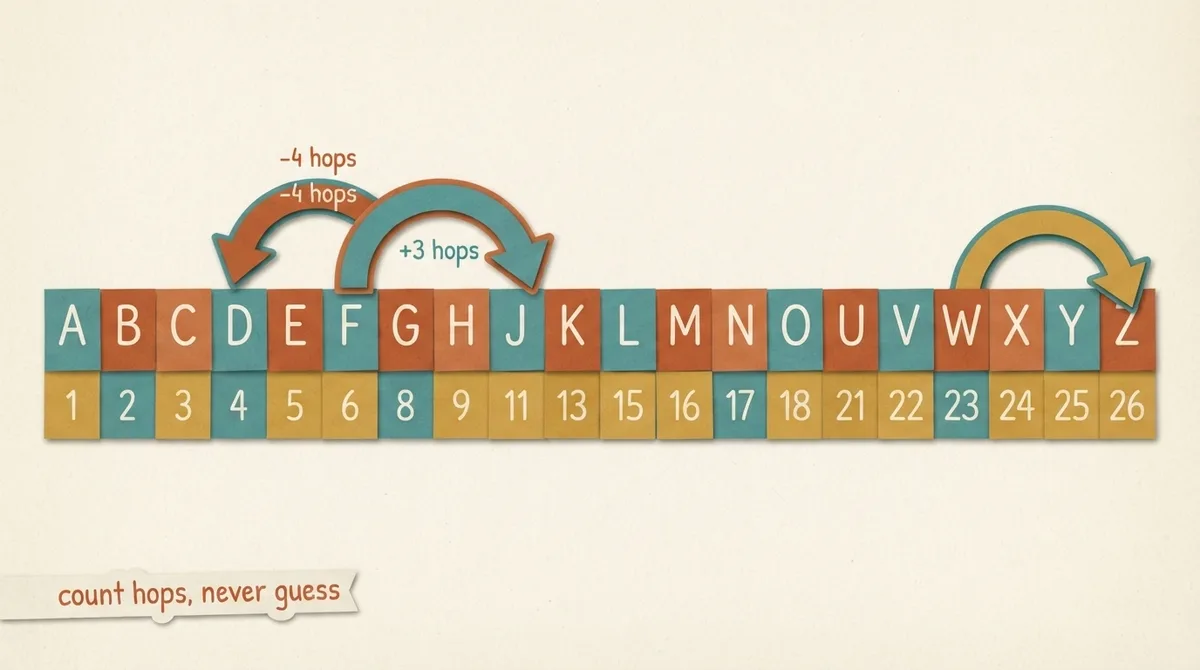
Until hops are automatic, everything downstream is slow. Ten minutes a day on nothing but "what is the letter seven after P" is the highest-value practice in this topic.
To practise counting hops on a numbered alphabet, try the questions below. After each answer, step through the working one letter at a time, wrap-arounds included.
This part of the guide is a numbered alphabet for cracking letter codes and letter sequences. It works in your browser.
Milestone 3: letter-for-letter codes
The most common wrapper. Each letter of the word moves by a step.
Constant step forward. LAMP is written as NCOR: every letter is +2, so SHIP becomes UJKR.
Constant step backward. FROG is written as COLD: every letter is -3, so MINT becomes JFKQ.
Changing step. BIRD is written as CKUH: B+1=C, I+2=K, R+3=U, D+4=H, so the step increments by one each letter. Applied to CALM that gives DCOQ. Steps can also decrement (+4, +3, +2, +1).
Sign flipper. Alternate letters move forward then backward by the same amount. With +2 then -2 applied to GATE: G+2=I, A-2 wraps to Y, T+2=V, E-2=C, giving IYVC.
The procedure is identical every time. Write the step above each letter of the example pair first, and only then decide whether the rule is constant, incrementing or alternating. Children who guess the rule from the first letter alone are the ones who lose marks on changing-step questions.
Multiple-choice shortcut: compute the first letter, scan the options, and only compute a second letter if two options survive.
Try one now: work out the shift, then code the word.
This part of the guide is a short interactive exercise. It works in your browser.
Milestone 4: mirror codes
A mirror code reflects the alphabet: A swaps with Z, B with Y, C with X. The arithmetic is one subtraction: new position = 27 minus old position.
HAND becomes SZMW. H is 8, and 27 minus 8 is 19, which is S. A is 1, giving 26, which is Z. N is 14, giving 13, which is M. D is 4, giving 23, which is W. Mirror codes are their own inverse, so decoding uses the same subtraction: OLZM decodes to LOAN.
The reason mirror codes catch children out is that they look like shift codes at a glance. The tell is that the steps are inconsistent and symmetrical: in GRIP to TIRK, G moves forward 13 places but R moves back 9. Any time your written steps disagree wildly in size and direction, test 27 minus position.
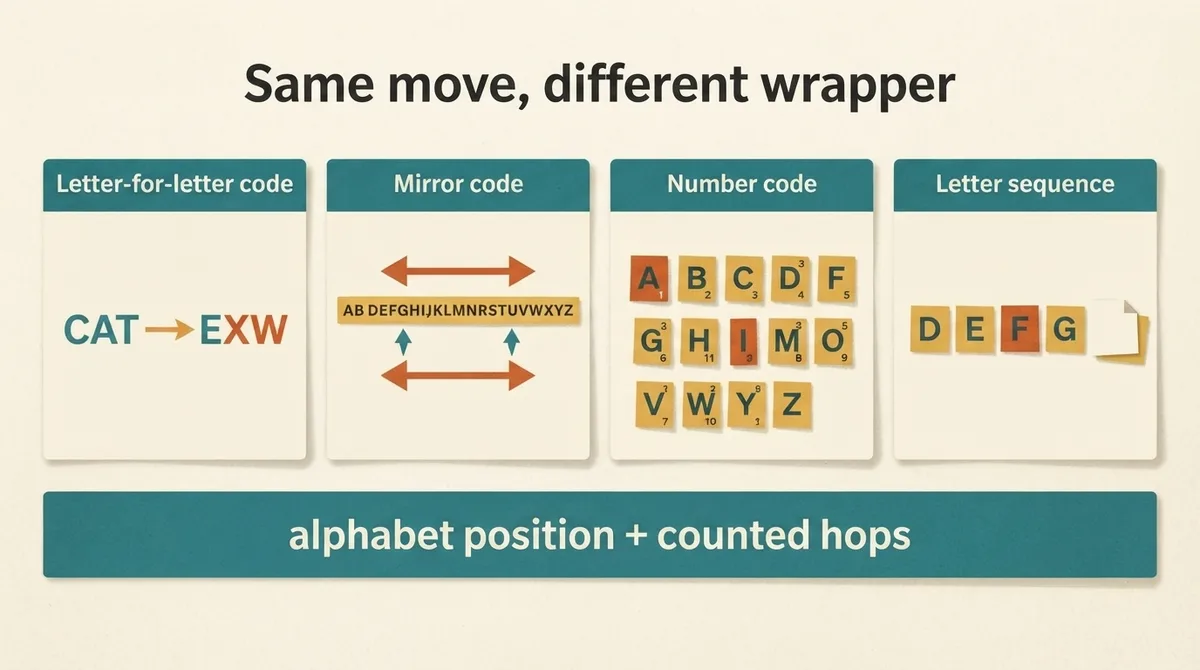
Try a mirror code now, with the alphabet folded in half.
This part of the guide is a short interactive exercise. It works in your browser.
Milestone 5: number codes and word-and-code matching
Here each letter is replaced by a digit, and the paper usually gives several words and several codes in a jumbled order.
Work the example. The words are FLAP, LEAF, PALE and FEEL. Three codes are given in random order: 4325, 1234 and 1552. What is the code for LEAF?
- Start with repeats, not with the first word. 1552 has the same digit twice in the middle, and only FEEL has a double letter in the middle. So FEEL is 1552, fixing F=1, E=5 and L=2.
- Use one known letter to place a second code. 1234 begins with 1, which is F, so it must be FLAP. That confirms L=2 and adds A=3 and P=4.
- Verify with the leftover. 4325 should be P, A, L, E, which is PALE. It checks out.
- Build the answer. LEAF is 2, 5, 3, 1, giving 2531.
The order matters: repeated letters and repeated digits are the free information in these questions, and children who start by trying the first word usually spend 90 seconds where 25 would do.
Milestone 6: letter sequences, gaps and paired sequences
Same mechanic, different presentation. Write the hop size in each gap, then read the row of hop sizes.
Constant step: C, F, I, L, ? The hops read +3, +3, +3, so the answer is O.
Alternating step: B, D, G, I, L, N, ? The hops read +2, +3, +2, +3, +2, so the next is +3, giving Q.
Growing step: A, B, D, G, K, ? The hops read +1, +2, +3, +4, so the next is +5, giving P.
Gap in the middle: E, H, ?, N, Q. Read the hops you can see: E to H is +3, so the rule is +3 and the answer is K.
Paired sequences are two sequences printed side by side. Split them with a vertical pencil line, then solve each independently. In AZ, CX, EV, GT, ?, the first letters run +2 to I and the second run -2 to R, giving IR.
If your child is working through the wider topic map, our guide to every verbal reasoning question type places these families alongside the vocabulary and logic questions, and the same hop-counting discipline transfers to non-verbal reasoning question types.
Try a paired letter sequence now: track each letter of the pair on its own.
This part of the guide is a short interactive exercise. It works in your browser.
Milestone 7: the five traps that cost the most marks
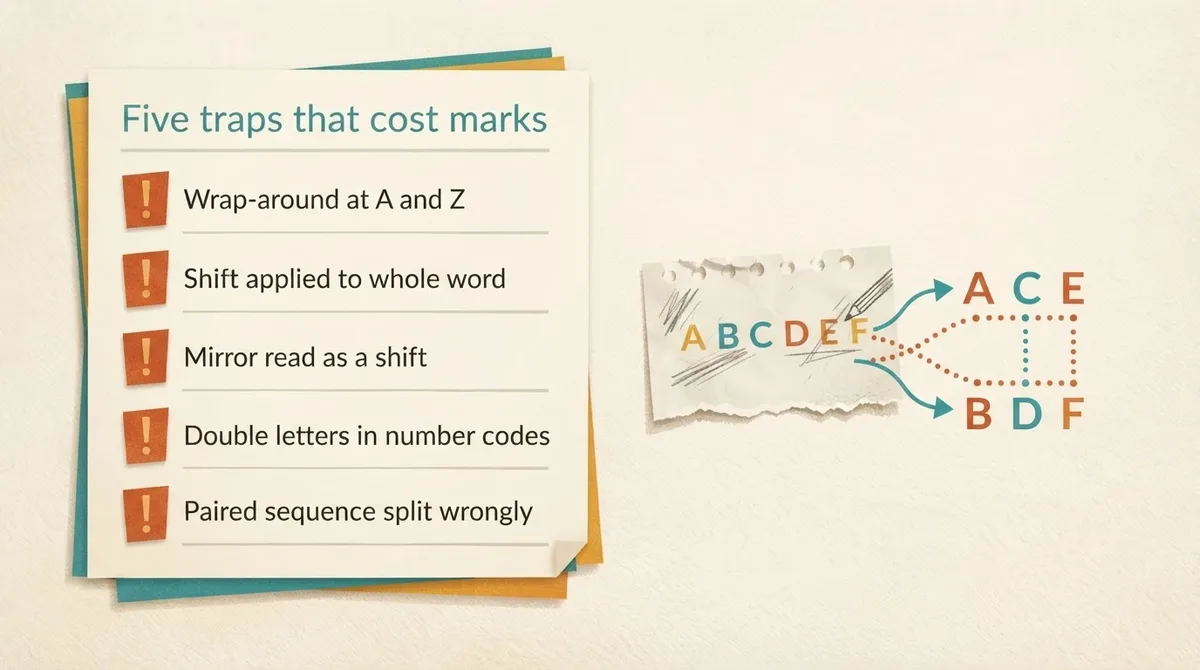
- Wrap-around at A and Z. W plus 4 is A, not "off the end". Add 26 when you go below 1 and subtract 26 when you go above 26. This single error accounts for a large share of lost marks in our marked practice sets.
- Applying the first letter's shift to the whole word, missing an incrementing step. Cure: write all four steps before deciding the rule.
- Reading a mirror code as a shift code. If the steps are wildly inconsistent, test 27 minus position.
- Double letters in number codes. A repeated digit must match a repeated letter. Use this as your first move, not your last resort.
- Mis-splitting paired sequences. Solving one as a single long run produces confident nonsense. Draw the vertical line every time.
A useful diagnostic: score a set, then label each wrong answer with the trap number. Most children have one dominant trap rather than five small ones, and fixing it moves the score more than another twenty questions would. Trace Learn's progress tracking does this labelling automatically.
Milestone 8: the ten-minute daily routine
Run this four or five times a week rather than one long weekend session.
- Minutes 0 to 2, hop drill. Rapid oral questions: "six after L", "four before D", "the mirror of S". No writing.
- Minutes 2 to 6, mixed set of eight questions, timed at 35 seconds each. Mixed, not blocked: blocked practice only teaches the child to expect codes.
- Minutes 6 to 8, mark and label. Every error gets a trap number.
- Minutes 8 to 10, redo the errors cold, with the working written out.
Once that routine is stable, move to full sections under real timing. A whole-paper rehearsal behaves differently from a drill, which is why we keep timed mock tests separate from daily practice, and why the pacing habits in our guide to 11+ exam technique and timing matter as much as the method.
Twenty mixed practice questions
Work these in one sitting with the alphabet written once at the top of the page. Target: 12 minutes.
- If LAMP is written as NCOR, what is the code for SHIP?
- If FROG is written as COLD, what is the code for MINT?
- If YARD is written as CEVH, what is the code for WAVE?
- If BIRD is written as CKUH, what is the code for CALM?
- A code moves each letter forward five places. Decode XJSI.
- A code moves alternate letters forward 2 then back 2, starting forward. Code GATE.
- If HAND is written as SZMW in a mirror code, what is the code for ROSE?
- Decode the mirror code OLZM.
- GRIP is written as TIRK. Is this a shift code or a mirror code?
- The words FLAP, LEAF, PALE and FEEL have codes 4325, 1234 and 1552 in random order. What is the code for LEAF?
- If STOP is written as 1234, what is the code for TOPS?
- If CHESS is written as 62944, what is the code for SECS?
- C, F, I, L, ?
- B, D, G, I, L, N, ?
- Z, W, T, Q, ?
- E, H, ?, N, Q
- A, B, D, G, K, ?
- AZ, CX, EV, GT, ?
- DF, GJ, JN, MR, ?
- ZB, XE, VH, TK, ?
Worked answers
- UJKR. The rule is +2 throughout.
- JFKQ. The rule is -3: M(13) to J(10), and so on.
- AEZI. The rule is +4 with wrap-around: W(23)+4 is 27, minus 26 is 1, which is A.
- DCOQ. The steps increment: C+1=D, A+2=C, L+3=O, M+4=Q.
- SEND. Decoding reverses the rule, so subtract five: X(24) to S(19), and so on.
- IYVC. G+2=I. A-2 wraps to 25, which is Y. T+2=V, E-2=C.
- ILHV. Mirror means 27 minus position: R(18) gives 9=I, O(15) gives 12=L, S(19) gives 8=H, E(5) gives 22=V.
- LOAN. Mirror codes are self-reversing.
- A mirror code. The steps are inconsistent (+13 then -9), which rules out a shift, and every pair satisfies 27 minus position.
- 2531. 1552 has a middle double so it is FEEL, fixing F=1, E=5, L=2. 1234 starts with F so it is FLAP, adding A=3 and P=4.
- 2341. From STOP=1234, TOPS is 2, 3, 4, 1.
- 4964. From CHESS=62944, C=6, H=2, E=9, S=4 (repeated 4 matching repeated S).
- O. Hops of +3; L(12)+3 is O(15).
- Q. Hops alternate +2, +3; the next is +3, so N(14)+3 is Q(17).
- N. Hops of -3; Q(17)-3 is N(14).
- K. E to H is +3, so the missing term is H(8)+3, which is K(11).
- P. The hops grow +1, +2, +3, +4, so the next is +5: K(11)+5 is P(16).
- IR. First letters run +2 to I; second letters run -2 to R.
- PV. First letters run +3 to P(16); second letters run +4 to V(22).
- RN. First letters run -2 to R(18); second letters run +3 to N(14).
If your child scored 16 or better inside 12 minutes, move to full timed sections. Below 12, spend a fortnight on the hop drill before adding question volume. There is a further graded set in our verbal reasoning practice test, and printable timed sections under paper tests.
Frequently asked questions
What is the letter code in verbal reasoning? A letter code replaces each letter of a word with another letter according to a positional rule, usually a fixed or changing number of places forward or backward, or a reflection across the alphabet. You are given one word with its code, then asked to encode or decode a second word.
What are the 11+ verbal reasoning number codes? Number codes replace each letter with a digit. A common format gives four words and three codes in a jumbled order and asks for the missing pairing. Match repeated digits to repeated letters first, then use one confirmed letter to place a second code.
What are the four types of codes? Constant step, changing step (the step increments or decrements), sign flipper (alternate letters move forward then backward) and mirror (position becomes 27 minus position). Number substitution is often listed as a fifth family.
Do letter sequences appear in every 11+ paper? No. GL confirms that authorities and schools choose the balance of question types, and North Yorkshire warns that familiarisation materials do not guarantee which types appear. Prepare both families, and check your area's published test information.
How much free official practice is available? GL Assessment offers around 10 hours of free familiarisation materials as downloadable PDFs, and notes they are "particularly useful for verbal reasoning and non-verbal reasoning tests as children may not have encountered these types of questions before" (GL Assessment). Use them for format familiarity, then build fluency elsewhere.
Codes and sequences are the most trainable questions on a verbal reasoning paper, because the rule set is small and finite. A child who can index the alphabet in 15 seconds, count hops without guessing and name their own dominant trap will clear these questions in well under the time available. You can start a free plan and set the daily drill running this week.
Topics
- verbal reasoning
- codes
- letter sequences
- 11 plus
- practice questions