
Bexley 11 Plus Selection Test and Grammar Schools
Bexley's Selection Test is now written by Quest Assessments, not GL. Here is what changed, what did not, and how each of the four grammar schools actually allocates its places.
 Elspeth Marlow
- 14 min read

If you have searched for the Bexley 11 plus in the last year, you have probably read two contradictory things. Several established guides still tell parents the Bexley Selection Test is written by GL Assessment. Bexley Council's own page says something different, and it says it in one flat sentence: "Quest Assessments is the Bexley Selection Test provider." That is the single most important fact on this page, and it is the reason a surprising number of families have bought practice material that no longer matches the paper their child will sit.
The good news is that the change is narrower than the panic around it suggests. The weighting has not moved, the session shape has not moved, and the maths content is still capped where it always was. What has changed is the house style of the questions, which affects how you practise rather than what you practise.
The second thing almost nobody explains is what happens after the result email lands. Being deemed selective in Bexley is step one of two. Around 2,070 children reached the selective standard for September 2026 entry, and there were 800 grammar places. The four schools then apply materially different oversubscription rules to decide who actually gets an offer. This guide covers both halves, with every figure traced back to the council page or the school policy it came from.
Who writes the Bexley Selection Test now, and does it change the exam?
Bexley Council states plainly on its Selection Test page that Quest Assessments is the provider. This replaces GL Assessment. If a site you are reading has a section headed "GL Assessment papers" or describes the test as "written by GL Assessment", that page has not been updated and you should not plan your preparation around it.
Here is what the council still specifies, unchanged by the provider switch:
- Three assessed areas: Verbal Ability, Numerical Reasoning and Non-verbal Reasoning.
- A weighted total of 50% verbal ability, 25% numerical reasoning and 25% non-verbal reasoning.
- Numerical Reasoning capped at Year 5 curriculum content.
- Two separate booklets in one session, each running roughly 50 minutes plus instructions.
- All questions multiple choice and timed, with no rough paper provided.
So the specification is stable. What a new provider changes is the flavour: how question stems are worded, how answer options are laid out, how many items sit in each block, how the answer sheet works. Those are exactly the things a child absorbs through familiarisation rather than through content teaching.
There is one trap worth flagging. Individual school admissions policies were written before or during the transition and some still carry legacy wording. Beths Grammar School's published policy for 2026-27 entry, for example, still describes age standardisation as being performed by "CEM/GL". That is stale drafting in a school document, not evidence that the council page is wrong. Where a school policy and the council disagree about who runs the test, the council is the authority, because the council runs the test.
Which four schools does the Bexley test actually get you into?
Bexley has 16 secondary schools and exactly four of them are grammar schools, all of them academies, which is why each one sets its own admission priorities. They are:
- Beths Grammar School (boys), published admission number 192.
- Bexley Grammar School (mixed), published admission number 210.
- Chislehurst and Sidcup Grammar School (mixed), published admission number 192 for September 2027 entry.
- Townley Grammar School (girls), admission limit 224.
That is the complete list, and it matters because one page-one result for "grammar schools in bexley" opens its list with Dartford Grammar School. Dartford Grammar is in Kent. It does not use the Bexley Selection Test and it admits on the Kent Test. If you are working from a list that includes it, you are budgeting for the wrong exam. The council's own secondary schools page is the reliable borough-scoped list, and our national overview of grammar schools near me shows how the borough sits against neighbouring areas that run entirely separate tests.
Medway and Kent both operate their own testing systems. A Bexley selective outcome does not transfer into them, and vice versa, with one specific exception covered further down.
What does test day actually look like?
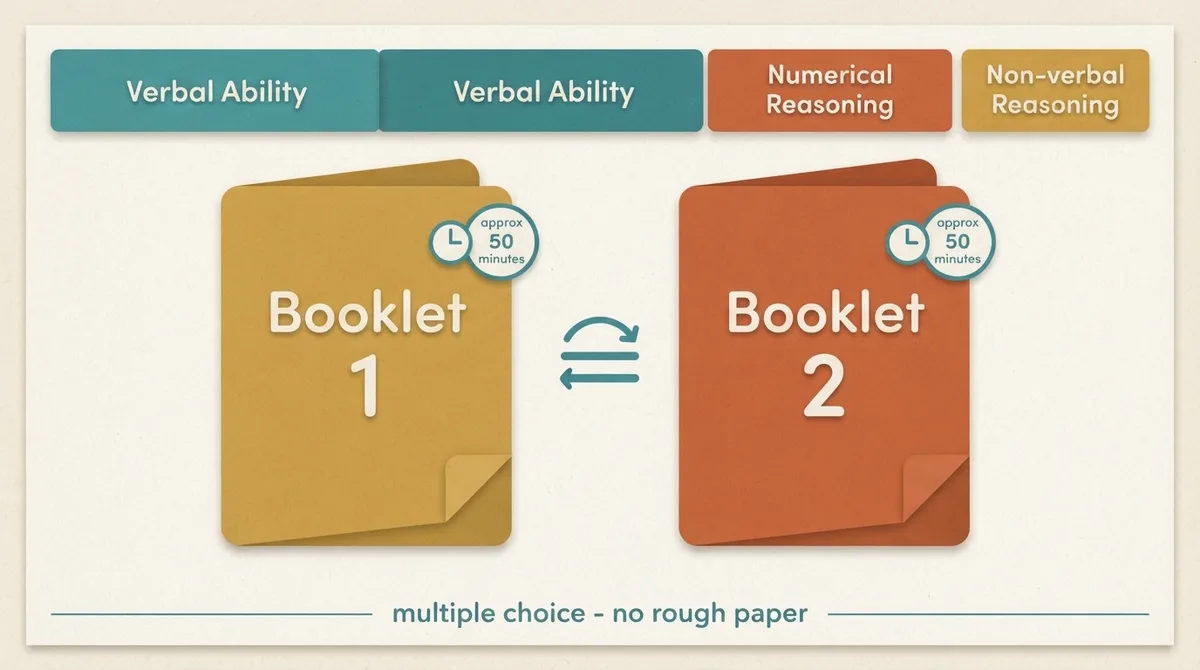
Children sit two separate booklets in a single sitting. Each booklet runs approximately 50 minutes plus instruction time, and the whole session, including a break, takes between two and a half and three hours. Every question is multiple choice and every section is strictly timed. Crucially, no rough paper is provided.
That last detail catches out children who have been taught to work numerical reasoning out longhand in a margin. Practise mental arithmetic and jotting in the small space available on the booklet itself, because on the day there will be nowhere else to put working.
Tests take place at primary schools between 2 and 10 September 2026, and at grammar school test centres between 7 and 10 September 2026. Where your child sits depends on their school, and the invitation tells you which applies.
How is the score calculated, and is there a pass mark?
Raw marks are age standardised, then combined with the 50/25/25 weighting. The council states that the average score is 200, and roughly two-thirds of candidates score between 170 and 230. If standardisation is unfamiliar, our explainer on how 11 plus standardised scores and age weighting work covers the mechanism in general terms.
The practical consequence of the weighting is often missed: verbal ability carries as much weight as numerical and non-verbal reasoning combined. A child who is strong in maths and shaky on vocabulary is not balanced in the way the total score treats them. Half the mark comes from words.
On a pass mark, the council is explicit that there is no published fixed threshold: "The pass mark will be determined once the results are received by Bexley LA but prior to parents being informed." It moves each year with the cohort.
This is where you should be sceptical of numbers you find online. One page-one competitor publishes a "minimum standardised score of 216" with no source attached. Beths Grammar School's own admissions policy says something different: that the school "would be content to offer to students who attained a minimum of 212 - the mark that, historically, has not been offered below on the Bexley Test". We are not going to pretend those agree. What we will say is that 212 is a first-party figure from a school's published policy, 216 is not attributed to anything, and neither is a pass mark you can plan against, because the threshold is set by Bexley LA after the papers are marked.
What are the real odds of a place?
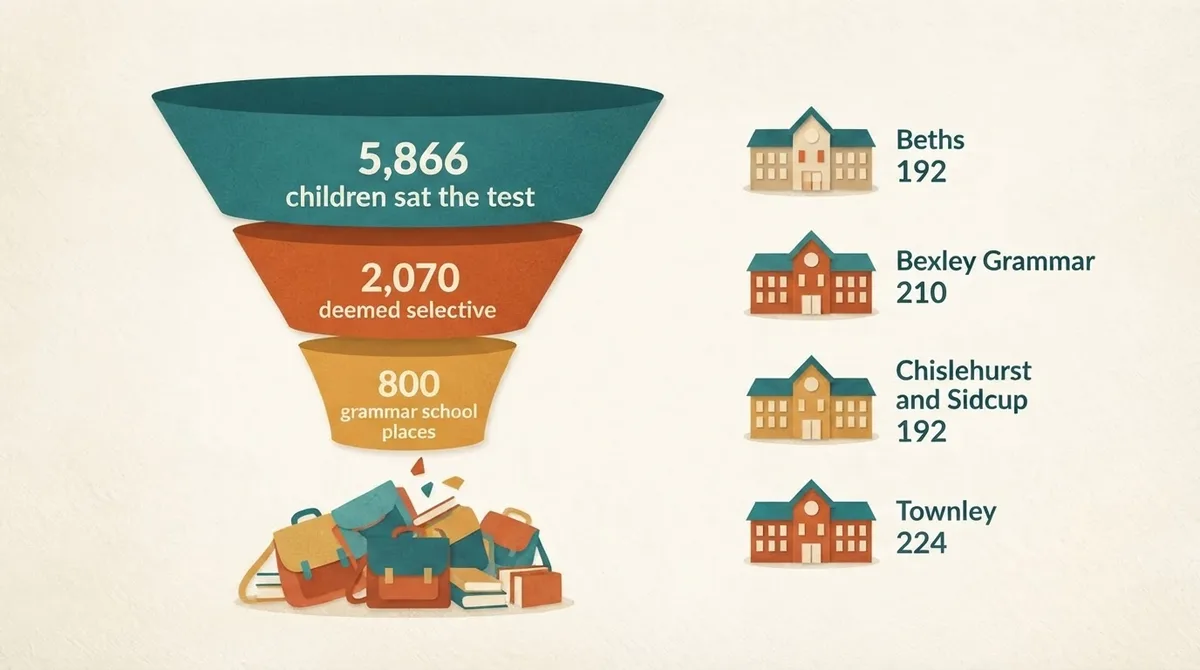
For September 2026 entry the council published three numbers that, put together, tell you more than any pass mark would:
- 5,866 children sat the Bexley Selection Test.
- 2,070 achieved the selective standard.
- 800 grammar school places were available across the four schools.
Read that carefully. Roughly one in three candidates reaches the selective standard. But there are around 2.6 selective children for every grammar place. That gap is the entire second half of this article, and it is why "did we pass?" is the wrong question to stop at.
Those numbers describe one cohort in one borough. Competition ratios differ enormously between areas, as we discuss in our guide to 11 plus pass marks and qualifying scores by area.
Passing is not getting in: how does each school allocate places?
Every Bexley grammar is an academy and its own admission authority, so after the selective decision each school runs its own oversubscription criteria. The differences are real.
Beths Grammar School is the most distinctive. Its policy gives the highest 180 scorers "top scorer" status, which the policy describes as "priority similar to that of a sibling", against a published admission number of 192. Up to 12 places are reserved for Pupil Premium and free school meals applicants. Beyond those categories, proximity is measured as shortest radial distance to the east entrance in Hartford Road, and where two applicants are equidistant, test scores break the tie at 0.001 of a mile.
Chislehurst and Sidcup Grammar School states the eligibility gate baldly in its admissions information: "Only pupils who have sat the Bexley Selection Test and who are deemed selective will be eligible to be considered for entry to the school." Its published admission number for September 2027 entry is 192.
Townley Grammar School has an admission limit of 224 and carries an unusual clause: if places remain once all selective girls have been offered, "offers will be made to girls who score one point below the selective threshold", working down in descending order of aggregate score. That is a narrow but genuine route worth knowing about.
Bexley Grammar School has the largest intake of the four at 210 and publishes no cut-off score, which is consistent with the council's position that the threshold is set centrally each year.
The strategic point: a child near the threshold may have very different chances at each school depending on where you live and which criteria bite. Read all four policies for the year of entry, not a summary of them, and do it before you rank your preferences.
Is there a second chance if Bexley says no?
There is one, and it is barely discussed. Beths' criterion 8 covers a child "not deemed selective in the Bexley 11+ test, but a child has been deemed selective in the Kent (Dartford 11+) test, and can supply the School with confirmation of this". Such a boy can still be considered.
That is a specific, verifiable cross-border route, not a general principle. It applies to Beths, it depends on the child having sat and passed the Kent Test, and it requires you to supply confirmation. Kent registration and testing run on their own timetable, which our Kent Test guide sets out. For families on the Bexley and Dartford boundary, sitting both is a decision worth making deliberately in the spring, not discovering in October.
Do not extend this into a general assumption. Bromley has no schools in the Bexley Selection Test, and Medway is a separate system again.
When do you register, and what catches parents out?
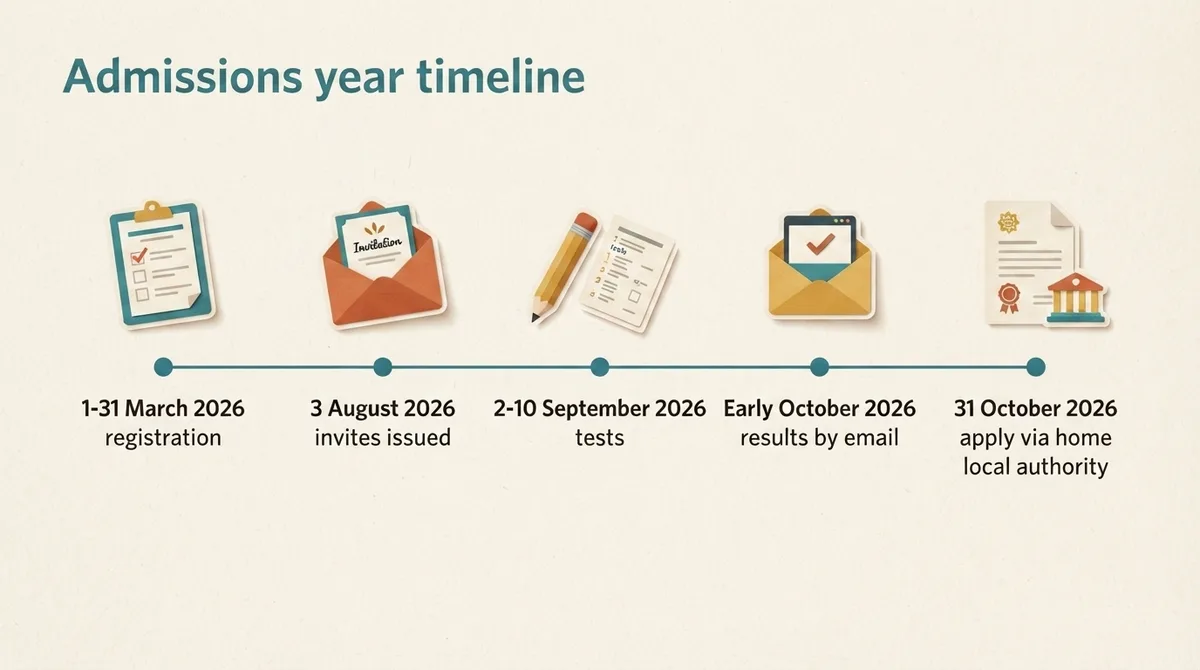
The 2026 cycle dates published by the council are:
- Registration: 1 to 31 March 2026, closing at midnight. Late entries are rejected and there is no appeal against that.
- Access arrangement requests: between 1 March 2026 and the final day of the spring term 2026.
- Test invitations issued: 3 August 2026.
- Tests: 2 to 10 September 2026 (primary schools) and 7 to 10 September 2026 (grammar school centres).
- Results by email: early October 2026.
Results arrive before the national secondary application deadline, so you will know the outcome before you rank preferences with your home local authority.
Three rules genuinely catch families out. First, registration is never automatic: every family must register online, including those whose child is already at a Bexley primary school. Second, eligibility for the 2026 test is limited to children born between 1 September 2015 and 31 August 2016. Third, illness. If your child is unwell you must not send them and must tell the headteacher immediately, and a late test can usually be arranged by the first week of October. The council's warning is unambiguous: "if a child sits the test while unwell or upset, no retrospective allowances can be made."
Reviews are similarly constrained. Only a headteacher, not a parent, can request one, and the Independent Review Panel "will only change selective decisions in exceptional circumstances", with no further appeal.
The lookup below lists the Bexley dates we have checked against the council, with its registration link.
This part of the guide looks up which 11+ test your area uses. It works in your browser.
What should you practise now the papers have changed?
Be honest about what you are buying. GL-branded Bexley paper sets no longer match the provider. They are not worthless, because the underlying skills are identical, but do not treat them as a format rehearsal.
A sensible plan:
- Weight your time to match the marks. Verbal is half the score. Vocabulary breadth, comprehension and verbal reasoning deserve the largest share of the week.
- Keep maths inside Year 5 content and push for fluency and speed rather than harder topics.
- Train non-verbal reasoning by question type, so unfamiliar layouts do not cost thinking time.
- Rehearse the conditions, not just the content: multiple choice, strict timing, and no rough paper.
- Use the official familiarisation material. Bexley links families to familiarisation resources once registration is complete. That is the only material guaranteed to reflect the current provider, so treat everything else as skills practice.
Full-length timed sessions are what convert content knowledge into a score. Our mock tests are built to rehearse pacing and answer-sheet discipline under exam conditions, which is precisely the part a provider change disrupts.
Bexley 11 plus frequently asked questions
When is the Bexley 11 plus in 2026?
Tests run 2 to 10 September 2026 at primary schools and 7 to 10 September 2026 at grammar school test centres. Invitations confirming your child's date and venue are issued on 3 August 2026.
When can I register for the 2027 test?
Bexley has run registration through March in the current cycle (1 to 31 March 2026 for September 2027 entry). Expect a comparable window and confirm the exact dates on the council's registration page, which is the only place they are official.
How many children sit the Bexley 11 plus?
5,866 children sat for September 2026 entry. Of those, 2,070 achieved the selective standard, competing for 800 places.
What is the pass mark?
There is no published fixed pass mark. Bexley LA sets the threshold after results are received and before parents are informed. Beths' policy references 212 as a mark below which offers have historically not been made, but that is a school's retrospective observation, not a target.
How hard is it to get into Bexley Grammar School?
Hard, and in two stages. Reaching the selective standard puts you in a pool of roughly 2,070 children for around 800 places borough-wide. From there, each school's own oversubscription criteria decide the outcome, and for most of them distance is a major factor.
Are there official Bexley 11 plus past papers?
No commercially published past papers reflect the current provider. Bexley provides a familiarisation link once registration is complete, and that should be your reference for format. Use general skills material for the three assessed areas.
Does my child need to sit the Kent Test as well?
Only if you want to be considered for Kent schools, or if you want to keep Beths' criterion 8 route open. It is a separate registration and a separate test with its own deadlines.
Where to start
Diarise March for registration, then build a term plan that puts half the effort into verbal ability because that is where half the marks are. Work from the council page for facts, from each school's current policy for allocation, and from timed practice for exam readiness. If you want that structure built for you, a Trace Learn account turns the specification above into a weekly plan with progress you can actually see.
Formats and thresholds vary considerably between 11 plus regions, so check anything you read about another area against Bexley's own published information before applying it here.
Topics
- bexley
- 11 plus
- grammar schools
- selection test
- admissions