
Non Verbal Reasoning Questions With Answers
Nine original non-verbal reasoning questions with full answers, written out on the page, plus the reason every wrong option is wrong and how the real timed sections work.
 Elspeth Marlow
- 14 min read
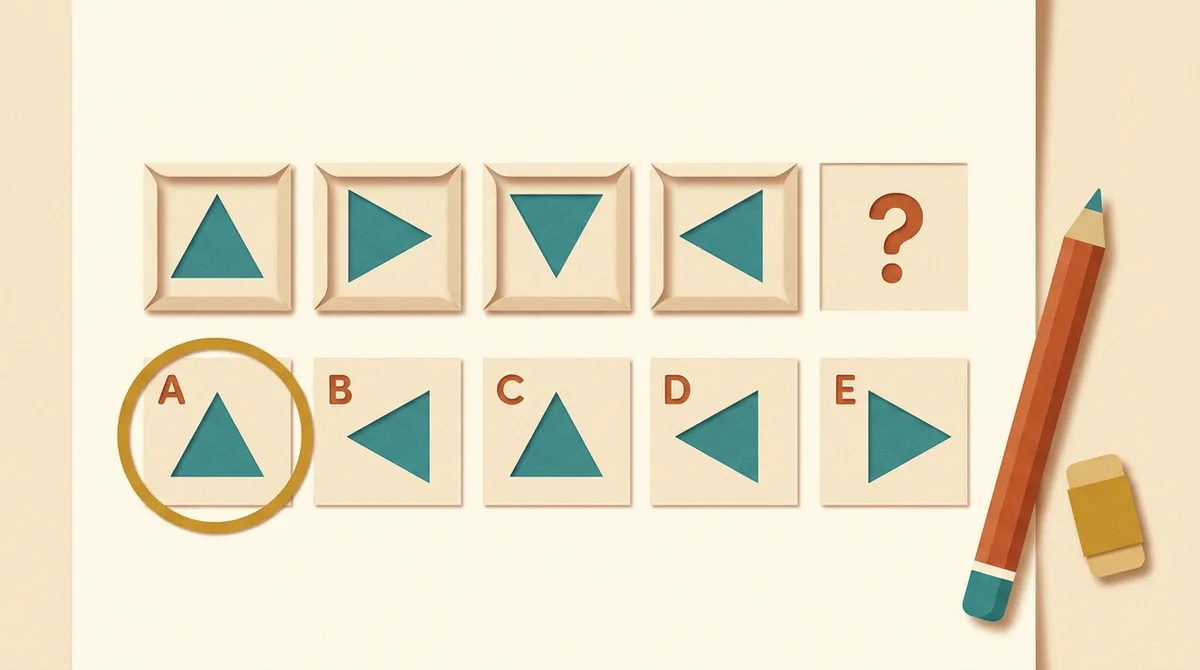
Search for non verbal reasoning questions and you will mostly be handed things to download. Link farms of PDFs, pages explaining what non-verbal reasoning is in the abstract, tips about jigsaws and Sudoku. The worked questions below explain each rule and why the other options do not fit.
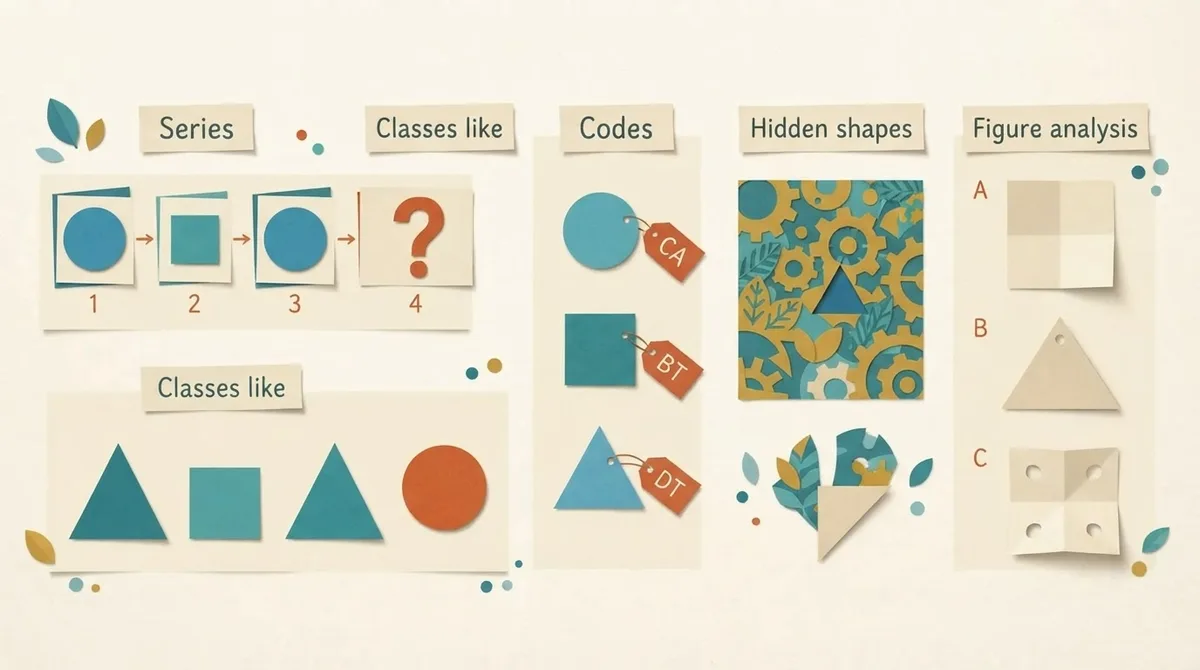
That is what this page is. Below are nine original non-verbal reasoning questions, written out in words so you can read them on a phone with your child next to you, grouped by the five question families that GL Assessment itself uses in the official familiarisation booklet it produces for Buckinghamshire. Each one comes with the rule that generates the right answer and a short note on the traps built into the wrong ones.
The questions are described rather than drawn, deliberately. If your child can read a description and picture the shape, they are doing the exact mental move the test measures: manipulating shapes and space in their head. Grab a pencil and rough paper for the folding ones.
Myth: you need a practice paper before you can see a real question
Reality: one worked example teaches more than a forty page download that never gets printed. Here is the shape of the thing.
Worked example. Four boxes in a row. Box 1 has a black dot in the top-left corner of a square. Box 2 has the dot in the top-right corner. Box 3 has it in the bottom-right. Box 4 has it in the bottom-left. Which option comes fifth?
- A: a square with a dot in the top-left corner
- B: a square with a dot in the top-right corner
- C: a square with a dot in the centre
- D: a square with two dots, top-left and bottom-left
- E: a diamond with a dot in the top-left corner
Answer: A. The dot moves one corner clockwise each step, so after bottom-left it returns to top-left. B is what you get if you lose your place and step twice. C invents a position that never appears in the sequence. D changes the number of dots, which no step does. E changes the outer shape, which also never changes.
That last paragraph is the part that matters. Reading "the answer is A" teaches your child one question. Reading why C and E are wrong teaches them that examiners build wrong options by changing a feature the sequence never changes, and that transfers to every question they will ever meet.
Myth: non-verbal reasoning is one big blur of shapes
Reality: the official booklet names five families, and every question in a GL-style paper is a variation on one of them. The Buckinghamshire familiarisation booklet, written by GL Assessment, sets them out with a worked example and two practice questions each: Series (page 16), Classes like (page 17), Codes (page 18), Hidden shapes (pages 19 to 20), and Figure analysis, meaning paper folding and hole punching (pages 21 to 22). You can read the whole thing in the official familiarisation booklet.
That booklet also gives the cleanest definition available of what is being tested: non-verbal reasoning "tests your ability to apply rules and relationships to shapes and patterns and how well you can manipulate shapes and space in your head" (page 14).
Five families is a useful number because it is small enough to audit. Other sites invent their own groupings of seven or eight loose topics, which makes it impossible to tell whether your child has covered everything. If you want the full breakdown of subtypes inside each family, our pillar guide to every non-verbal reasoning question type goes deeper than this page does.
Series questions: complete the sequence
Question 1. Box 1: a white triangle. Box 2: a grey square. Box 3: a white pentagon. Box 4: a grey hexagon. What is fifth?
- A: a grey heptagon (seven sides)
- B: a white heptagon
- C: a white hexagon
- D: a white octagon
- E: a grey pentagon
Answer: B. Two rules run at once: the number of sides goes up by one each step, and the shading alternates white, grey, white, grey. Five must be seven-sided and white. A is the classic right-shape-wrong-shading trap: it satisfies one rule and ignores the other. C keeps the shading but freezes the side count. D advances the side count too far. E goes backwards.
Question 2. An arrow points north. In the next box it points east, then south, then west. Each time, the arrowhead alternates between solid black and hollow, starting solid. What is fifth?
- A: a solid arrow pointing north
- B: a hollow arrow pointing north
- C: a solid arrow pointing east
- D: a solid arrow pointing south
- E: a hollow arrow pointing west
Answer: A. The arrow turns ninety degrees clockwise per step, so the fifth points north again. Boxes 1 to 4 are solid, hollow, solid, hollow, so box 5 is solid. B gets the direction right and the shading wrong, the single most common way to drop a mark here. C and D are correct shading with a mistimed rotation. E gets both wrong.
Classes like: shapes that belong together
These show a small group of figures that share a hidden property, and ask which option belongs with them. Odd-one-out questions are the same skill run backwards.
Question 3. The group is an arrowhead, a kite and an isosceles triangle. Which option belongs with them?
- A: a square
- B: a rectangle
- C: a capital letter T
- D: a parallelogram
- E: a circle
Answer: C. Every figure in the group has exactly one line of symmetry. A capital T has exactly one, down the middle. A square has four, a rectangle two, a parallelogram none, and a circle has infinitely many. Notice that four of the five options are symmetrical in some way, so "it looks symmetrical" is not a rule. The rule is the number.
Question 4 (odd one out). Four figures, each a shape divided into equal parts with some parts shaded: a square with one of four parts shaded, a circle with two of eight shaded, a triangle with one of four shaded, a rectangle with two of six shaded. Which is the odd one out?
Answer: the rectangle. Three of the four are one quarter shaded. Two sixths is one third. The trap is that children count shaded regions rather than comparing proportions, and two of the figures have two shaded parts, which makes the rectangle look like it has company.
Code questions: matching shapes to letters
Question 5. Four shapes carry codes. A striped triangle is MP. A dotted triangle is MQ. A striped circle is NP. What is the code for a dotted circle?
- A: MP
- B: MQ
- C: NP
- D: NQ
- E: QN
Answer: D. Split the code into positions. The first letter encodes the outline: M for triangle, N for circle. The second encodes the fill: P for striped, Q for dotted. A dotted circle is therefore N then Q. E contains both correct letters in the wrong order, the trap designed for children who decode the features correctly and then stop concentrating.
Question 6. A small square with one line through it is RT. A small square with two lines is RU. A large square with two lines is SU. What is a large square with one line?
- A: RT
- B: ST
- C: SU
- D: TS
- E: RU
Answer: B. First letter is size (R small, S large), second is the number of lines (T one, U two). Large plus one line is ST. A and E each repeat a code already used, which is worth noticing as a general rule: in a well-built code question the answer is usually a combination that has not yet appeared.
Hidden shapes: finding the figure inside the pattern
The booklet is precise about the rules here. The target shape "is exactly the same size" in the answer figure, "but it may have been rotated (spun round) where it is hidden", and all of its sides must be visible.
Question 7. The target is a small right-angled triangle. Which figure contains it?
- A: a pattern containing a right-angled triangle of the same size, tilted forty-five degrees
- B: a pattern containing a right-angled triangle twice the size
- C: a pattern where two sides of the triangle are drawn but the third is missing
- D: a pattern containing an equilateral triangle of a similar size
- E: a pattern where the triangle shape is formed but a line cuts across it
Answer: A. Rotation is allowed, so a tilted copy still counts. B fails the same-size rule, C fails the all-sides-visible rule, D is the wrong triangle altogether, and E is the hardest to reject: the shape is there, but an extra line crossing it means the figure is not cleanly present. Mirror images, which appear in most hidden-shape sets, are the other number one trap: a reflection is not a rotation.
Figure analysis: paper folding and hole punching
This is the family most children have never seen before, and the one that improves fastest with real paper. Fold, punch with a pencil, open it out, then look at the answer.
Question 8. A square sheet is folded in half, right side over left. One hole is punched near the middle of the folded sheet. How does it look unfolded?
- A: one hole in the centre
- B: two holes, one either side of the vertical centre line, at the same height
- C: two holes, one above the other
- D: four holes in a square arrangement
- E: two holes at different heights
Answer: B. One fold produces one mirror image, and the mirror line is the fold, which runs vertically. A forgets the paper was folded at all. C mirrors across a horizontal line, which is what happens when a child rotates the fold in their head. D is a two-fold answer, since each fold doubles the number of holes. E breaks the mirror.
Question 9. A square is folded along its diagonal to make a triangle. One hole is punched in the middle of the triangle. Unfolded?
- A: one hole
- B: two holes mirrored across the diagonal
- C: two holes mirrored across the vertical centre line
- D: two holes mirrored across the horizontal centre line
- E: four holes
Answer: B. The mirror line is always the fold, and here the fold is a diagonal. C and D are the same trap in two costumes: the right number of holes reflected in the wrong line. Children who have only practised straight folds pick one of these almost every time.
Myth: the answer key is the useful part
Reality: in multiple-choice reasoning, marks are lost in the wrong options, not found in the right one. Wrong options are engineered, not random, and they cluster into a handful of shapes you can teach a child to name.
- Right shape, wrong shading. The option satisfies the rule you spotted and breaks the one you did not.
- Right rotation, wrong direction. Clockwise and anticlockwise look identical at a glance under time pressure.
- Mirrored rather than rotated. A reflection can look like a turn until you check a distinguishing corner.
- Right count, wrong arrangement. Common in folding questions, where four holes in a row beats nobody.
- A feature that never varies suddenly varies. Outer shape, container, dot colour: if the sequence never changes it, the answer does not either.
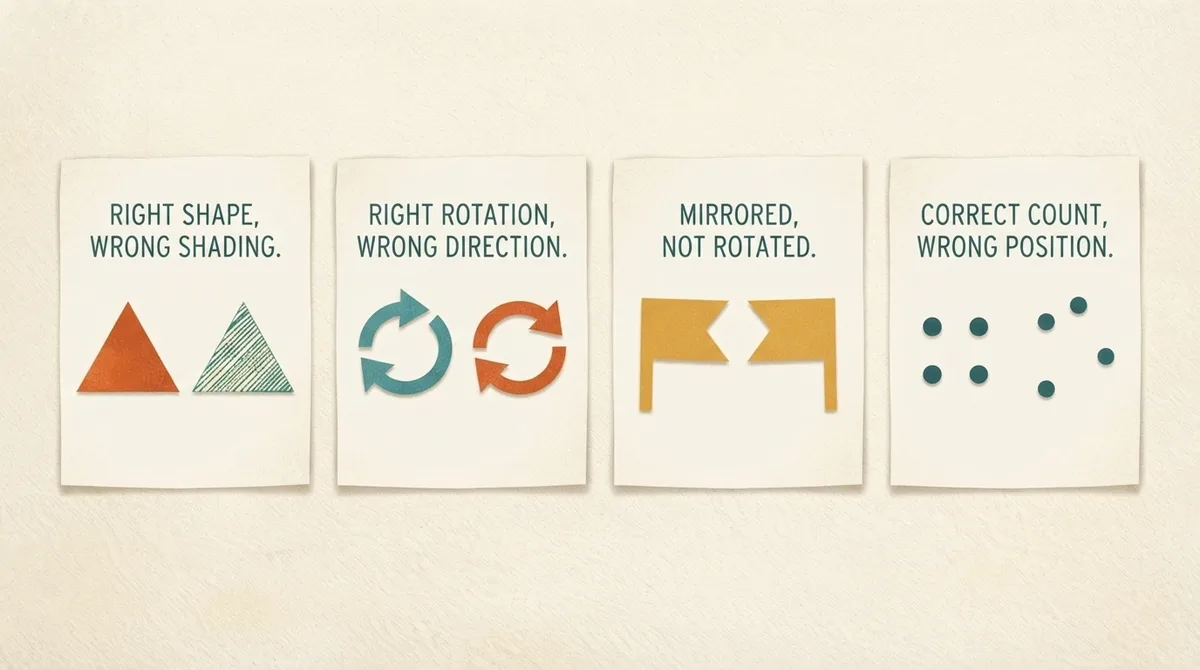
The home routine that works is short. After every question your child gets wrong, ask them to say out loud which trap it was, using those names. After every question they get right, ask them to pick the option they nearly chose and say why it fails. Two extra sentences per question, and it turns a worksheet into transferable technique.
Myth: practise long papers because the exam is a long paper
Reality: the non-verbal reasoning part of a GL-style test is usually a set of short, separately timed blocks, so an hour of uninterrupted practice trains the wrong stamina. In Buckinghamshire, the Mathematical and Non-Verbal Skills paper takes around an hour and contains "4 smaller sections for Non-Verbal Reasoning of 5 minutes each" (page 14 of the familiarisation booklet). Kent's arrangement rhymes: Kent County Council states that "the non-verbal reasoning will be split into short sections, administered and timed individually". Formats differ by area, so check your own authority, but the direction of travel is the same wherever GL papers are used: short bursts, fast recovery, no time to agonise.
The answer-sheet rules matter just as much, and no tips-led article seems to mention them. Buckinghamshire's booklet instructs children to do "any rough working in the test booklet, but do not do any rough working on the answer sheet", and warns "do not cross out answers as the computer will not be able to recognise your final answer" (page 6). Mistakes are rubbed out, not crossed out. Equipment is restricted to two HB pencils and an eraser in a transparent case, with no calculator, no ruler or protractor, no scrap paper, no watch and no pen of any kind (page 5).
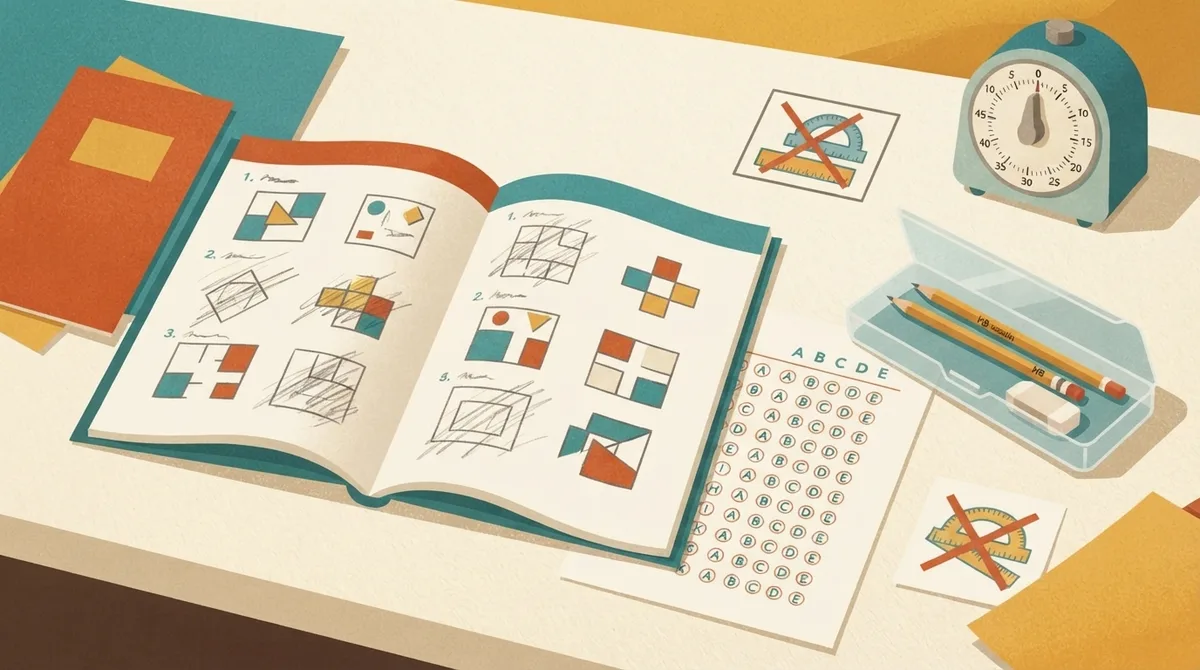
How to run a five minute block at home
Rule up a printable answer sheet before you start: a column of numbers 1 to 20 with five small circles beside each, labelled A to E. It takes a minute to draw, and it changes what your child is practising.
- Set a timer for five minutes and use the nine questions above as one block.
- Rough working goes on the question page only. The answer sheet gets filled bubbles and nothing else.
- No ruler, no protractor, no scrap paper. Folding questions are done mentally or sketched in the margin.
- Corrections are rubbed out, never crossed out, because a crossed-out bubble can cost a mark a child has actually earned.
- When the timer stops, mark the sheet together and name the trap behind every miss.
If your child has never transferred answers to a separate sheet under time pressure, expect the first attempt to be slower than their untimed work. That gap is exactly the thing worth closing, and it is why we build paper-style timed tests that mirror the separate answer sheet rather than letting children click answers directly under each question.
For a timed block that marks itself, the practice test below mixes non-verbal question types and shows a worked answer for each one.
This part of the guide is a free timed practice test. It works in your browser.
Free non-verbal reasoning practice papers, and common questions
Where can I get genuinely free papers? GL Assessment publishes around ten hours of free familiarisation materials across six packages including non-verbal reasoning, and notes they are "particularly useful for verbal reasoning and non-verbal reasoning tests as children may not have encountered these types of questions before". Kent County Council publishes a free familiarisation paper too. Our round-up of free 11+ practice papers with answers covers what else is worth downloading.
How many questions should we do a week? Little and often beats a weekend marathon. Two or three five minute blocks a week, marked properly with trap-naming, does more than an hour of silent worksheet filling.
Is it worth sitting a practice test? In Buckinghamshire there is a formal one: two multiple-choice papers of about forty minutes each, sat under test conditions, not marked and not sent home, recommended but not compulsory, according to Buckinghamshire Council. Elsewhere you can create the same effect at home with a timer and a ruled answer sheet.
What if my child is strong at maths but weak here? That is common and not a warning sign. Non-verbal reasoning rewards a different habit: describing what changed between two pictures. For the format and marking detail in one place, read our guide to non-verbal reasoning in the 11+.
Nine questions is a start, not a programme. The habit to build from here is the one this page has tried to model: never accept an answer without the rule, and never leave a wrong option unexplained.
Topics
- non-verbal reasoning
- 11 plus
- practice questions
- gl assessment
- exam technique