
Practice Papers and Mock Tests
Kent Test Practice Papers and Where to Find Them
An honest inventory of every genuinely free Kent Test practice resource, why real past papers do not exist, and how Kent scoring actually works.
 Elspeth Marlow
- 14 min read
If you have spent an evening searching for Kent Test practice papers, you already know how the search goes. The council page explains the test but contains no papers. The publisher's page is four paragraphs long. The two longest results are exam guides that end in a product grid, and half the download links either want your email address or quietly turn into a checkout. Meanwhile the related searches underneath tell you exactly what everybody is actually after: pdf, free, with answers.
This article does three things those pages do not do together. It gives you a straight inventory of every genuinely free Kent-relevant resource that exists, including which ones are misleadingly labelled. It answers the question underneath all of this, which is whether real Kent Test past papers exist at all. And it corrects the record on scoring, where the top-ranking commercial pages are not just vague but actively contradict each other.
Then it points you at full-length Kent-style papers with mark schemes and a standardised score conversion, so that a practice session produces a number that means something rather than a percentage that means nothing.
Are there any real Kent Test past papers?
No, and there never will be. This is worth stating plainly because a great deal of money is made from the ambiguity.
The Kent Test is written by GL Assessment, which runs a secure question bank and reuses material across years and across the many local authorities that buy its tests. Releasing a used paper would burn a portion of that bank permanently. So GL publishes familiarisation material and sells practice papers, but it publishes no past examination papers at all, and it says so on its own free materials page.
Kent County Council publishes one familiarisation booklet. That is the entire first-party corpus. Everything else you will find described as a "Kent Test past paper" is somebody's reconstruction, and the honest sellers say so in the small print.
Medway Council, which uses the same provider, puts it more bluntly than Kent does. It states that GL Assessment is the test provider and that any test materials found online or in retailers, other than on the GL website, are not official and are not supported by either organisation. Check the council's guidance before buying material described as official.
None of this means practice papers are pointless. It means the value of a practice paper lies entirely in whether it reproduces the real structure, timings and question types, not in whether somebody has stamped the word "official" on the cover.
Which free Kent Test resources actually exist, and what does each leave out?
Here is the full inventory as it currently stands, with what each one really is.
- The KCC familiarisation booklet. First-party, free, no signup, a genuine PDF from the council. Limitation: it is a familiarisation document, not a paper. It shows question formats and answer-sheet technique, and its own text warns the examples may not be exactly the same question types that appear in the real test.
- GL Assessment free familiarisation materials. First-party from the test publisher, free, printable PDFs across six areas. Limitation: these are short familiarisation sets rather than timed papers, and GL states its practice papers are only available for purchase as printed booklets. No past papers at any price.
- Owl Tutors free 11+ papers. Twenty-four practice papers with mark schemes, instant PDF download, genuinely no signup, licensed for non-commercial use. This is the most useful free resource on the list and it deserves credit. Limitation: the papers labelled "Grammar School / Kent Test" are general grammar-school maths and English papers rather than papers built to Kent's specific two-paper structure and timings, and the dedicated Kent maths pack is a paid £10 add-on.
- How2Become's "free Kent Test paper". Real content, but the download sits behind a newsletter signup. It costs an email address rather than money, which is a fair trade for some parents and a dark pattern to others. Either way it is not free in the sense the search term implies.
- 11plusSwot "Kent Test Downloads". The name suggests free downloads. In practice the material sits behind membership or separate purchase. If you take one thing from this list, take this: the word "downloads" in a page title is not a promise of a free file.
- 11plusguide's Kent page. Useful, honest and worth reading, and it says plainly that Kent does not issue past papers. Limitation: its only genuine free download is the council's own familiarisation booklet, which you can get directly from the source.
- Your child's primary school. Kent primaries are used to fielding this question and many hold familiarisation material or run a familiarisation session. Free, and worth asking about in the summer term of Year 5.
That is the honest map. Two first-party familiarisation sets, one strong but generic free paper bank, and a lot of pages whose free tier is thinner than the page title suggests.
What is actually inside the Kent familiarisation booklet?
It is short, and it is not a paper, but it does a specific job well. The booklet describes the parts of the test, suggests how to approach the different question types, and shows how to record answers on the separate answer sheet. It contains example and practice questions with the explicit caveat that these may not be exactly the same question types as the real test.
The answer-sheet section is the part parents underrate. The Kent Test is multiple choice, answered on a separate sheet and marked by computer. Children who have only ever written answers in the question booklet lose marks to mechanical errors: a slipped row, a half-filled lozenge, a section attempted in the wrong block. Ten minutes with the booklet fixes a problem that no amount of extra maths tuition will touch.
Use it once for format, then move to timed full-length practice. It is not a resource you can drill.
Where exactly does GL Assessment's free tier stop?
GL offers roughly ten hours of free familiarisation content as printable PDFs, covering verbal reasoning, non-verbal reasoning, English, maths, a combined non-verbal reasoning and maths set, and verbal skills. That is more than most parents realise, and it is the closest thing to authentic question styling available at no cost.
The free tier stops at familiarisation. GL's own free materials page states that while familiarisation papers are freely downloadable, its practice papers are only accessible for purchase as printed booklets. There is no free full-length timed paper, and there is no past paper.
If you want to understand how GL question styles differ from CEM-derived and bespoke school formats, our guide to GL Assessment style practice papers covers that in more detail.
Is a paid Kent Test pack worth £10 to £24?
The commercial range runs from about £10 for a two-paper Kent maths pack, through £11.50 for a high-street revision book, to £23.99 for a branded mock pack. Some of these are well made. The question is what you are buying.
You are not buying past papers, because none exist. You are buying somebody's reconstruction of the format, plus mark schemes, plus in the better cases a scoring guide. Judge a pack on three things only.
- Does it use Kent's actual structure, with the two combined papers and the writing exercise, rather than four separate subject papers?
- Does it include mark schemes with worked reasoning, not just an answer key?
- Does it convert raw marks into something age-adjusted, or does it leave you holding a percentage?
A £24 pack that fails all three is worse value than a free paper that passes all three. Buy after you have exhausted the free tier, not before.
What must a realistic Kent Test paper get right?
This is the checklist that separates a Kent paper from a generic 11+ paper. The council's Prepare for the Kent Test page sets it out.
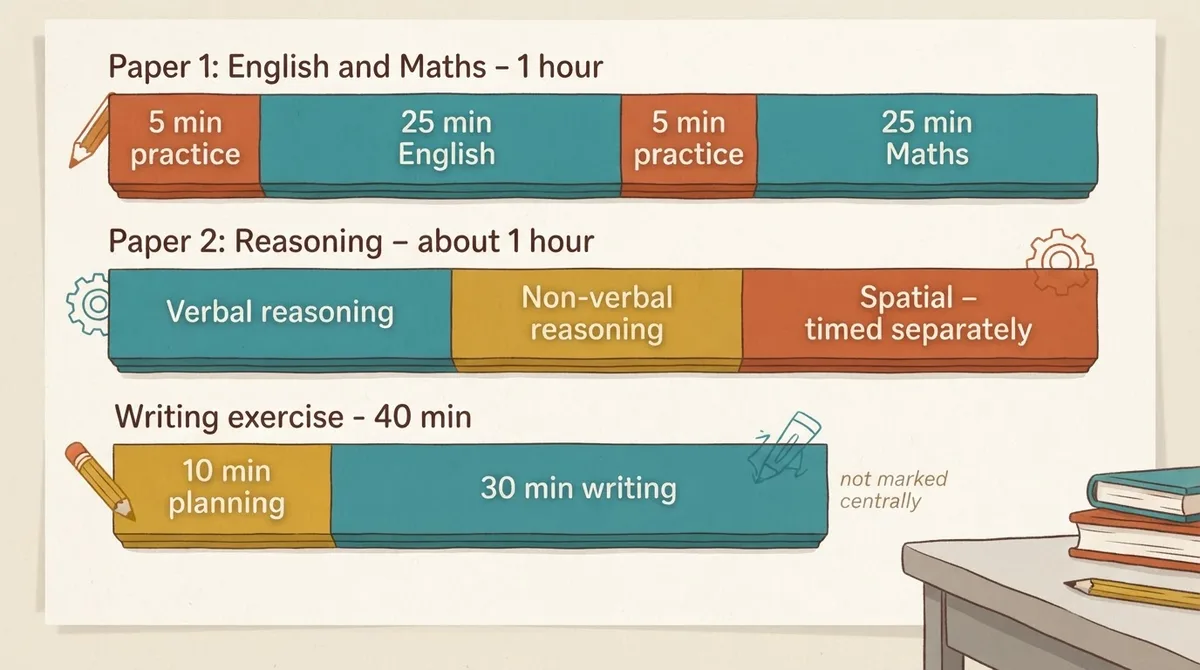
- Paper one, English and maths, one hour. Each section involves a five-minute practice exercise followed by a twenty-five minute test. The English section is a comprehension exercise plus additional questions testing literacy skills.
- Paper two, reasoning, about one hour including practice sections. It contains a verbal reasoning section and a non-verbal reasoning section of roughly the same length, with the non-verbal reasoning split into short sections that are administered and timed individually.
- The writing exercise, forty minutes including ten minutes of planning. It is not marked as part of the test score, but it may be used by a local headteacher panel as part of the headteacher assessment stage.
Those short individually timed reasoning sections are the detail most commercial packs skip, and they change the experience completely. A child who has practised a single twenty-minute non-verbal block is not prepared for a sequence of tightly timed mini-sections where a slow start cannot be recovered later in the paper.
The writing exercise is skipped even more often, on the logic that an unmarked task does not matter. It matters for any child who ends up at the headteacher assessment panel, where scores, recent school work, the writing task and school comments are all considered together. Ten minutes of planning is also a skill in itself, and children who have never been made to plan for ten minutes will start writing at minute two.
How is the Kent Test really scored, and why do you see 320, 332 and 106 quoted elsewhere?
Here is where the top results go wrong. One major site states a pass mark of 320 or more with no score below 106. Another states 332 or more with individual scores above 109. Both present their figure as the pass mark. Neither explains the thing that matters.
The actual mechanics, from Kent's results page, are these. Children receive three standardised scores, for English, maths and reasoning, plus a total aggregate, with a slight adjustment for each child's age so the youngest are not disadvantaged. Each score runs from 69 to 141, giving a maximum total of 423. In the year cited, a child needed a total of 332 or more with no single score below 108 to be assessed as suitable for grammar school.
And critically: the threshold is set each year, not fixed. The competing numbers you see quoted are not lies so much as snapshots from different years, presented as if they were permanent. Planning against last year's number is planning against a moving target.
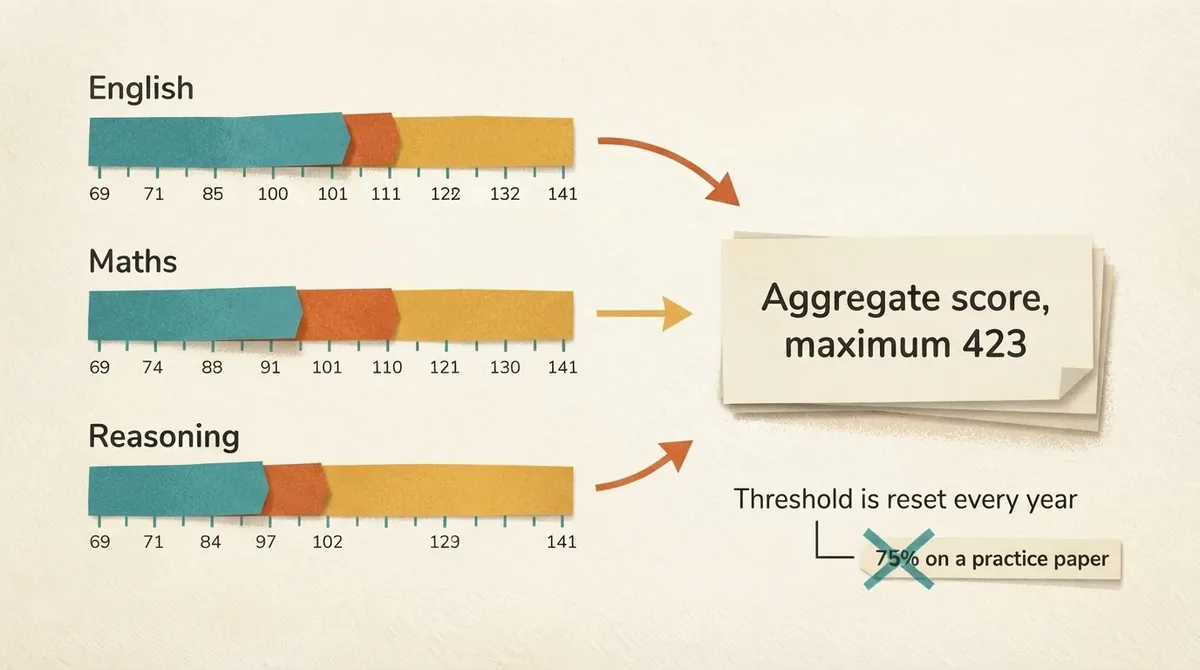
This is also why "she got 75% on the practice paper" is a meaningless sentence. The Kent Test is cohort-referenced: your child is measured against every other child sitting it that year, after an age adjustment, not against a fixed percentage. A raw 75% could be comfortably above or clearly below the line depending on the paper's difficulty and the year's cohort. If a practice paper hands you a percentage and stops, it has given you the least useful number available.
It is also why the headteacher assessment route deserves a mention early rather than as a footnote. If a child does not reach the threshold, their primary school can refer them to a local panel of primary and secondary headteachers, which looks at a full range of work regardless of which score fell short.
Where can you get free full-length Kent-style papers with mark schemes?
Our practice material is original and unofficial. Trace Learn's Kent-style set is free and is built to the structure above rather than to a generic 11+ shape:
- a one-hour English and maths paper, with a five-minute practice exercise before each twenty-five minute section, and a comprehension plus literacy questions in the English half;
- a one-hour reasoning paper split into individually timed verbal, non-verbal and spatial sections, so the pacing pressure matches the real thing;
- a forty-minute writing exercise with ten minutes of planning built in, with guidance on what a headteacher panel is actually looking at;
- mark schemes with reasoning, and a standardised score conversion so a completed paper produces an age-adjusted number rather than a percentage.
You can see how the timed papers work on our paper tests page. If you want the wider free bank across all regions and formats before you narrow to Kent, start with our pillar guide to free 11 plus practice papers, and pair the papers with our Kent Test format and dates guide so the admissions timeline does not catch you out. Registration for the Kent Test closes on 1 July, and results are emailed in mid-October.
Are Medway Test papers the same as Kent Test papers?
No, and this is the most expensive assumption in the whole search. Medway is a separate local authority with a separate test, and Kent papers will actively mistrain a Medway child.

The Medway Test is three papers: English at thirty minutes, mathematics at fifty minutes, and reasoning at forty-five minutes across four separately timed spatial, non-verbal and verbal sections, separated by breaks of at least twenty minutes. There is no resit, no remarking and no appeal.
The scoring differs even more. Medway raw scores are standardised for age and then weighted, English times two plus mathematics times two plus reasoning times one, to give a total weighted score. A minimum weighted score is set annually so that roughly 26% of Medway maintained school pupils qualify. It was 481 for 2026 admissions, when 25% qualified, 482 for 2025 with 25%, and 492 for 2024 with 23%.
Read that weighting again. In Medway, English and maths carry twice the weight of reasoning. A child drilled on Kent-style reasoning at the expense of the two double-weighted subjects has been prepared for the wrong exam. Our Medway Test guide covers the timetable and the qualifying score in detail, and the council's own scoring page is the source to check each year.
If your child might sit both, prepare the shared content once and the paper structures separately. The underlying skills overlap heavily; the exam experiences do not.
How should you use practice papers across Year 5 and Year 6?
A paper bank only helps if it is rationed. The pattern that works for most families looks like this.
Summer term of Year 5. Familiarisation only. Work through the council booklet and the GL free sets, cover answer-sheet technique, and identify topic gaps with short exercises rather than full papers. No timing pressure yet.
Summer holiday before Year 6. Introduce timing gradually. Single sections at real length, so twenty-five minutes of maths rather than a full hour. This is where the individually timed reasoning sections should first appear, because pacing is a trainable skill and it takes weeks, not days.
September of Year 6. Full papers under proper conditions, roughly one a week, with the writing exercise included at least every other time. Convert each one to a standardised-style score, log it, and look at the trend across four papers rather than reacting to any single result.
The final fortnight. Reduce volume. Review previous mistakes rather than generating new ones. A child who is still doing three papers a week in October is being taught that the test is enormous, and that belief costs more marks than any topic gap.
Two cautions. Cohort-referenced tests punish erratic performance more than modest performance, so consistency beats one spectacular paper. And formats vary considerably across the country, so if you are also looking at schools outside Kent and Medway, check each one's format before assuming a paper transfers.
The honest summary is that the free tier for Kent is thinner than the search results imply, but it is not empty, and the paid tier is not buying you anything secret. What it should buy you is the right structure, real mark schemes and a score you can interpret. Those three things are worth having, whether you pay for them or not.
Topics
- kent test
- practice papers
- medway test
- gl assessment
- 11 plus