
The Medway Test Explained for Parents
A current, source-led guide to the Medway Test: three papers, no writing task, how the x2/x2/x1 weighting works, the published minimum scores, and what out-of-area families need to know.
 Elspeth Marlow
- 14 min read
If you search for the Medway Test, a good share of what you will read describes a test that no longer exists. Several of the highest-ranking guides still tell parents that Medway includes a marked extended writing paper that feeds into the final score, and that there is an academic Review process for children who narrowly miss. Both of those things were true once. Neither has been true since 2024.
The confusion is understandable. Kent, next door, does have a writing exercise and does have a headteacher panel. Thousands of families sit both tests, the vocabulary bleeds across, and outdated pages keep getting linked and re-linked. Meanwhile Medway Council publishes the accurate version of events across roughly eight separate pages of its website, so no single page joins the format, the marking, the thresholds, the registration deadlines, the results process and the out-of-area odds into one picture.
This guide is that single picture. Every number below carries the council page it came from, and all council sources were last checked on 4 October 2026. Where something is a judgement rather than a published fact, we say so. If you want the wider question of which selective schools are realistically within reach of your address, our guide to finding grammar schools near you is the companion piece to this one.
What is the Medway Test, and who runs it?
The Medway Test is the selective entrance assessment used by the six grammar schools in Medway. It is administered by Medway Council, and the papers are produced by GL Assessment and, in the council's own words, "written specifically for Medway Council". That last phrase matters: Medway papers are not a generic GL pack with a local badge on it, which is why familiarisation material sold as "Medway practice" from third parties can drift from the real format. The council and GL both warn that "any test materials found online or in retailers, other than on the GL website are not official" (Medway Council, About the Medway Test).
The test is sat in September of Year 6, and the result feeds into the secondary school application your family submits by 31 October. It is a suitability assessment, not an offer. As the council puts it plainly, "if your child has been assessed as suitable for grammar school, it does not guarantee them a grammar school place."
One hard boundary catches out-of-area families every year: "The Medway Test is used only by the 6 Medway grammar schools. It cannot be used for grammar schools in other areas." A child must also sit the papers at a Medway Council venue inside Medway. There is no remote option and no sitting it elsewhere in the UK.
What changed in 2024, and why so many guides are wrong?
Three changes landed for the 2025 entry cycle, tested in autumn 2024. Together they are the reason so much of the published advice on this topic is stale.
- The extended writing task was removed. In its place there is now a 30 minute English paper testing comprehension, punctuation and grammar. There is no creative writing element, no "fringe case" writing task and no writing score contributing to the total.
- The reasoning paper was broadened. What used to be described as a verbal reasoning paper is now a single 45 minute reasoning paper covering spatial reasoning, non-verbal reasoning and verbal reasoning.
- The academic Review process was abolished. Medway Council stated in October 2024: "There is no longer an academic review process for the Medway Test. Instead, an additional two per cent of the cohort were assessed as eligible for a grammar school place through the test" (Medway Council results announcement, October 2024).
That third change is the one worth sitting with. Rather than letting a panel revisit borderline children after the event, Medway widened the assessed cohort at the front end, from 23 per cent to 25 per cent. In the 2024 sitting, 3,844 children took the test including 2,103 Medway pupils, and 936 Medway pupils were assessed eligible, up from 847 the year before, as the minimum score fell from 492 to 482.
So when a parent forum asks whether the Medway Test is harder than the Kent Test, the honest answer is that they are different shapes rather than different difficulties. Medway has no writing element and a broader reasoning paper; Kent has an unmarked writing exercise and a panel route. The share of children assessed as suitable is broadly comparable. What differs sharply is what happens after the result, which we come to below.
Which schools use the Medway Test, and what changes in September 2026?
Six grammar schools use it: Chatham Grammar, Fort Pitt Grammar, Holcombe Grammar, Rainham Mark Grammar, Sir Joseph Williamson's Mathematical School (the Math) and Rochester Grammar. Some guides list seven by including The Howard School, which is not a grammar school. Six is the number.
The important recent change is structural. Chatham Grammar, Fort Pitt Grammar and Holcombe Grammar have DfE approval to change intake, and as Chatham Grammar's admission arrangements state, "All three schools will therefore become co-educational from September 2026" (Chatham Grammar admissions). If you are working from a two-year-old shortlist that sorted Medway grammars into boys' and girls' schools, redo it. For a child living near Chatham, the set of schools that can realistically be named on the application form has just widened.
One detail almost nobody surfaces: Chatham Grammar's arrangements offer places "to 150 students who are deemed to be selective based on the LA Testing Arrangements (Medway Test and/or Kent Test)". A Kent Test pass can therefore open a Medway door at that school. Do not assume it generalises to all six; check each school's published arrangements for the year of entry.
What does each paper actually look like?
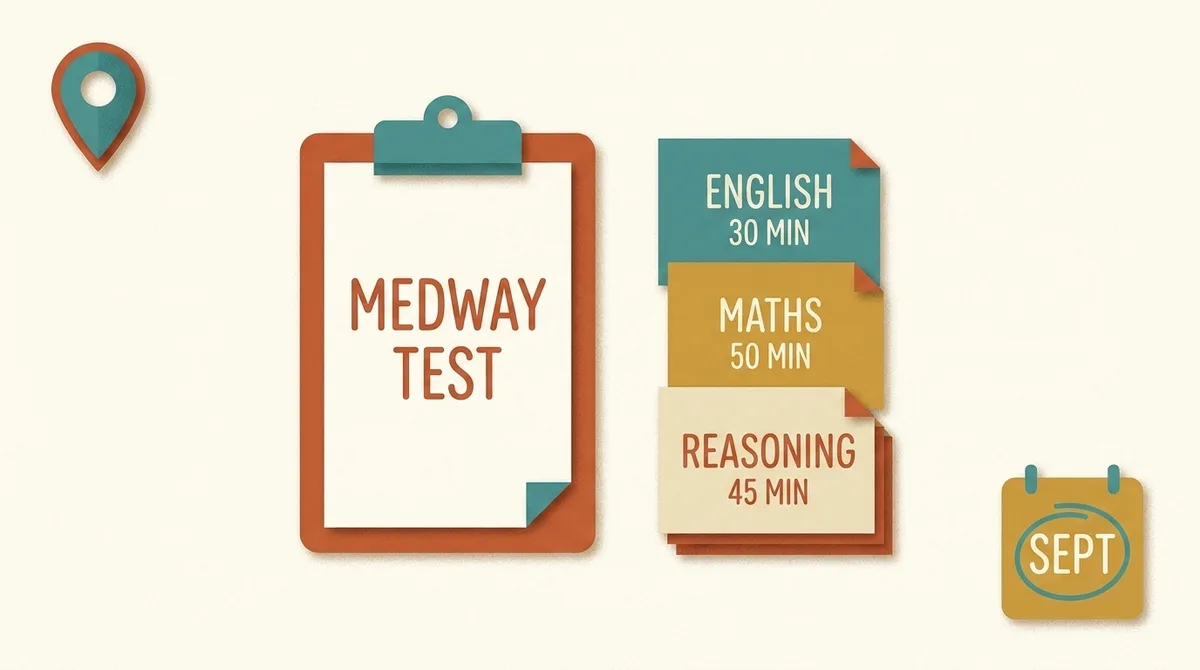
The Medway Test is three papers with a minimum 20 minute break between them (Medway Council, About the Medway Test).
- English. Three practice questions in five minutes, then a continuous 30 minute marked test on comprehension, punctuation and grammar.
- Mathematics. Two practice questions in two minutes, then a continuous 50 minute test.
- Reasoning. 45 minutes in total. Spatial and non-verbal reasoning take 20 minutes across four individually timed sections, and verbal reasoning takes 25 minutes in a single section.
Note the structural difference between the papers. English and Maths run continuously, so a child can budget their own time across the whole paper. The non-verbal and spatial portion of the reasoning paper is chopped into four short, separately timed blocks, which punishes children who linger on one hard item. That is a pacing skill, and it is trainable independently of the reasoning content itself. Our overview of non-verbal reasoning question types and timing covers the sub-skills that appear in this section.
One worked illustration of the pacing problem, using our own numbers rather than any published question: if a spatial section holds 20 items in five minutes, that is 15 seconds an item. Spending 90 seconds on the one question a child cannot see the pattern in costs them five later questions they could have answered in seconds. Practising under a short timer, then reviewing what got left behind, is usually worth more than another worksheet.
Because GL writes the papers, the general question styles will feel familiar to families who have looked at GL material elsewhere; our comparison of GL, CEM and ISEB formats explains what that does and does not tell you. Formats vary considerably by region, so do not import assumptions from another county's test.
How is the Medway Test marked?
Each paper produces a raw score. Each raw score is then standardised against the child's age at the time of testing, so that summer-born children are not disadvantaged relative to autumn-born children in the same year group.
The standardised scores are then weighted, and this is where Medway differs from most systems:
Total weighted score = (standardised English x 2) + (standardised Maths x 2) + (standardised Reasoning x 1)
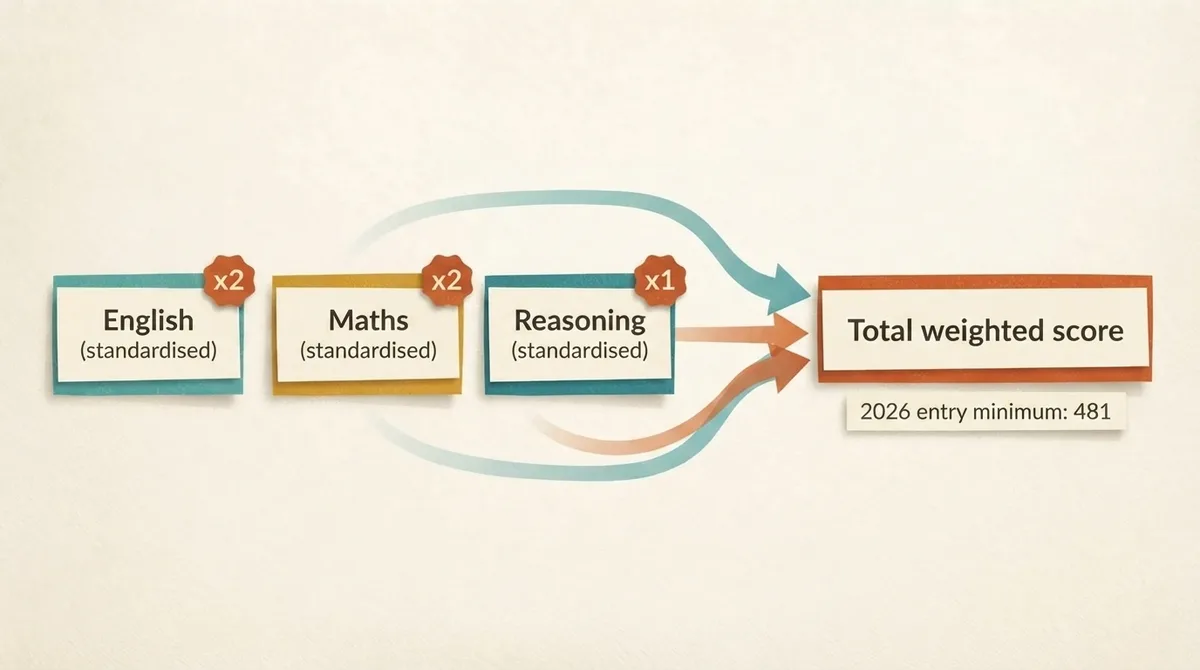
The practical consequence is straightforward. English and Maths carry four fifths of the weight between them. Reasoning still matters, and a weak reasoning score can absolutely cost a borderline child their place, but a family with limited preparation time and a child who is shaky in one area should usually not spend the bulk of it on reasoning drills. This is the sort of allocation decision an exam plan is for.
The council describes the test as "designed to assess the equivalent of 26% of children attending Medway maintained schools as grammar". Medway maintained pupils are ranked by weighted score, and non-Medway children who meet the same published minimum also qualify (Medway Council, how the test is marked).
What score does a child need?
Medway publishes the actual minimum weighted score each year, which is unusually transparent. The published figures are:
- 2026 admissions: 481, representing 25 per cent of the cohort.
- 2025 admissions: 482, representing 25 per cent of the cohort.
- 2024 admissions: 492, representing 23 per cent of the cohort.
Read these as history, not as a target. The threshold is not fixed in advance; it is derived after the fact from where 25 per cent of the total Medway cohort falls. As the council put it in October 2025, "The minimum score is determined by 25 per cent of the total Medway cohort" (Medway Council results announcement, October 2025). That year 3,984 children sat the test including 2,118 Medway pupils, and 956 Medway pupils were assessed eligible.
Anyone quoting you a precise pass mark for a test that has not been sat yet is guessing. Aiming comfortably clear of the recent band is more useful than aiming at a number. Timed mock tests under real conditions give a better read on where a child sits than percentage scores on untimed practice.
How and when do you register?
Registration is the single most common way families lose the opportunity entirely, because it is on parents and the window is absolute.
For the 2026 sitting, registration opened Monday 18 May 2026 and closed Friday 12 June 2026, with the council stating: "Registrations after the closing date cannot be accepted. There are no exceptions to this." Parents, not schools, register each child separately through the Parent Portal, and if no confirmation email arrives, the child is not registered (Medway Council, registering for the Medway Test).
Access arrangements run on a separate track. Schools must submit special arrangements requests by Monday 22 June 2026. Children with an EHCP or identified learning needs are considered automatically, but the request still has to come from the school, so speak to the SENCo well before June rather than after.
The council also advises against registering a child who is not working at or above expected levels for their age. That is worth reading as care rather than gatekeeping.
Test dates for 2026 were Tuesday 15 and Wednesday 16 September for children at Medway maintained primary and junior schools; Thursday 17 and Friday 18 September for special arrangements; and Saturday 19 or Sunday 20 September for independent-school and out-of-area children. Invitations went out by email or post by the end of August. Medway maintained pupils sit at their own school; everyone else sits at an allocated Medway Test Centre (Medway Council, test dates).
Children at external centres must bring a completed test day contact form and attend the centre named on their invitation. And withdrawal is one way only: "Once you withdraw your child from the test you cannot change your mind and re-register them."
The lookup below shows the Medway dates we have checked against the council, with the registration link. Pick another area to compare, such as Kent.
This part of the guide looks up which 11+ test your area uses. It works in your browser.
What happens on results day?
Results for the 2026 sitting were emailed after 10am on Wednesday 14 October 2026, posted where the council holds no email address. The council states plainly that "we cannot give out test scores over the phone".
You receive a total score, a breakdown by paper, and a grammar or non-grammar assessment. You will not receive raw scores, percentages, pass marks, highest or lowest scores, the standardisation calculations, or the papers themselves. The council cites section 43 of the Freedom of Information Act and the Data Protection Act 2018 as grounds for withholding them.
Crucially, a grammar assessment is a ticket to apply, not a place. Applications close on 31 October through your home local authority, and national offer day is 2 March.
What if the result is not what you hoped?
This is where Medway diverges most sharply from Kent, and where stale guides do real damage. The council's position is unambiguous: "There is no resit and there is no remarking of any Medway Test papers. There is no appeal process for a remark of any paper." There is also, since 2024, no academic Review.
What you can still do:
- Name grammar schools on the application anyway. Children not assessed as suitable are not blocked from listing them.
- Use the statutory admission appeal after 2 March. This is a legal right attached to a refused place, heard by an independent panel, and it is separate from anything to do with the test paper.
- Look properly at the non-selective options. In Medway that is a serious set of schools, and a plan built around the right school beats a plan built around the right label.
If a guide tells you to request a Review, it was written before 2024. Check its date.
Should you register from outside Medway?
This is the question with the biggest gap between what families assume and what the data shows.
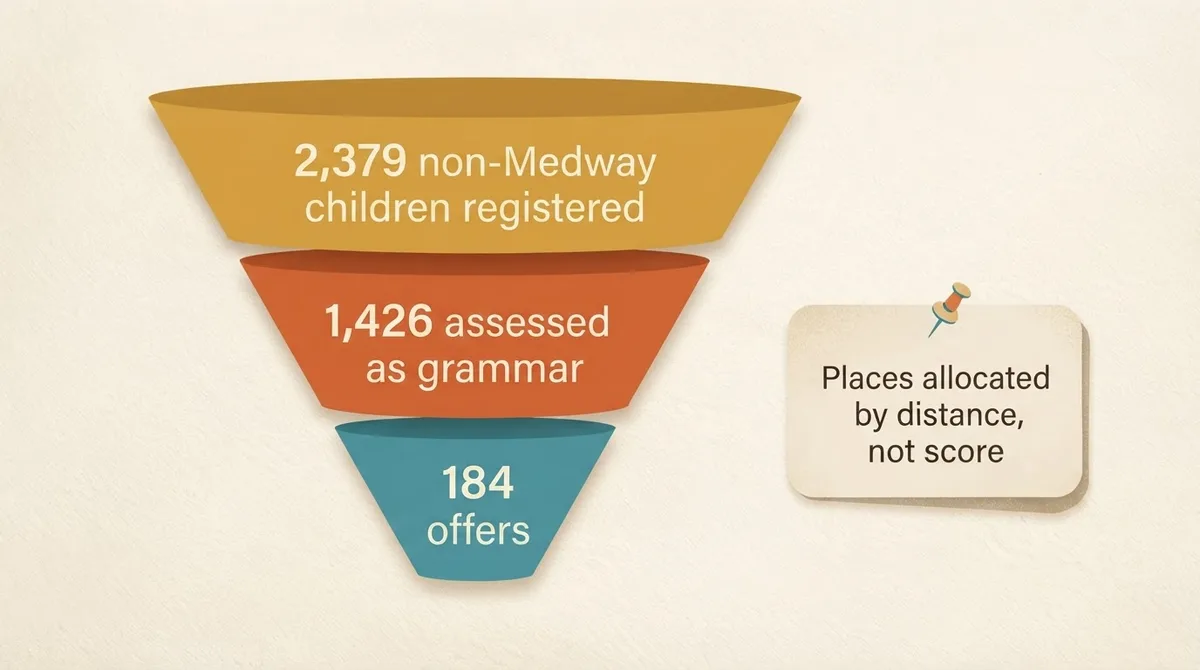
For 2026 admissions, 2,379 non-Medway children registered. Of those, 1,426 were assessed as suitable for grammar school. Only 184 received an offer. That is fewer than 8 per cent of non-Medway registrants, and under 13 per cent of those who passed (Medway Council, out of area guidance).
The reason is not standards. It is geography: "All grammar schools in Medway are oversubscribed and places are mainly allocated based on how far your child lives from the school. Places are not allocated based on test score." Chatham Grammar's oversubscription criteria illustrate the pattern, running through looked-after children, family association with selective assessment, and children of staff, before landing on distance from home. Around 20 per cent of non-Medway registrants do not turn up on the day at all, which suggests a lot of families work this out late.
None of that means do not register. It means register with a clear head about the distance criterion for the specific schools you would name, and do not build your whole autumn around it.
Medway or Kent: how do they actually differ?
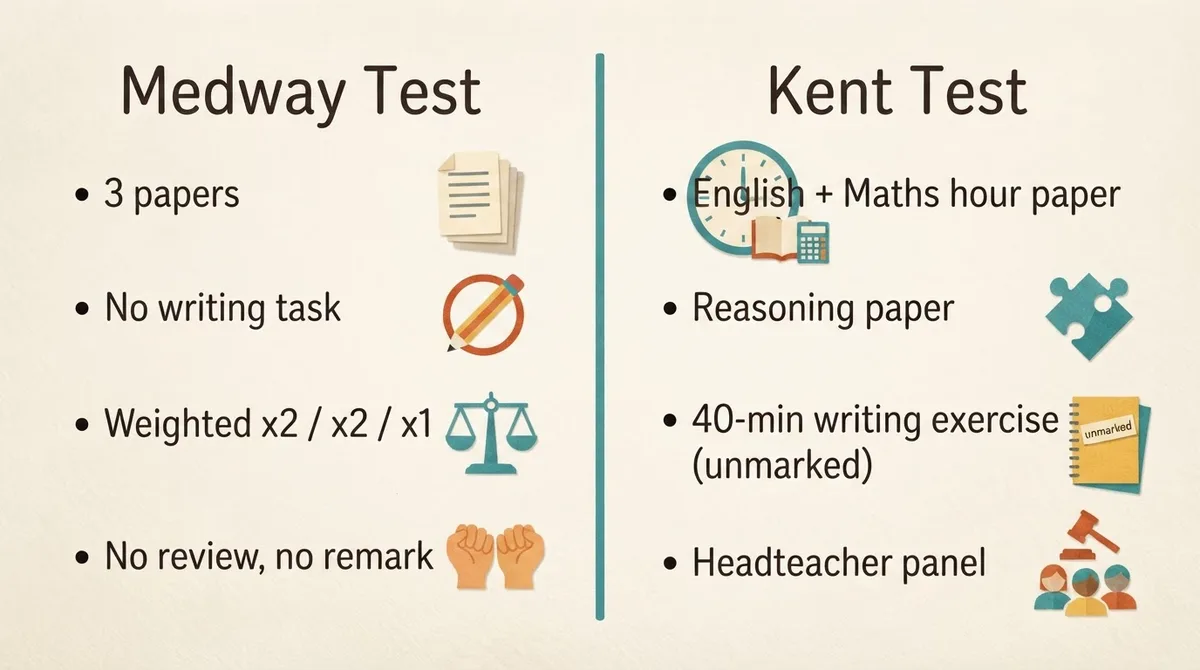
- Medway: three papers (English, Maths, Reasoning), no writing task, weighted x2/x2/x1, published minimum score, no review, no remark, no resit.
- Kent: a combined English and Maths paper, a reasoning paper, plus a 40 minute writing exercise that is not marked but can be referred to a local headteacher panel (Kent County Council, prepare for the Kent Test).
Families near the boundary often sit both. Our Kent Test guide covers that system in the same detail. The overlap in content is high enough that preparation transfers well; the difference to plan for is the Kent writing exercise, which has no Medway equivalent, and the September date clash risk if both tests fall in the same fortnight.
Where to start if you are preparing
Given the weighting, the highest-value preparation is comprehension, punctuation and grammar, then maths fluency and pacing, then reasoning breadth including spatial questions many families overlook. Use only official GL familiarisation material for format, and treat everything else as practice for the underlying skill rather than a preview of the paper.
If you want structure rather than a pile of worksheets, Trace Learn tracks accuracy by skill and by timing so you can see which of the three papers is actually costing marks. You can see how that works on our progress tracking page, or start a free account and run a diagnostic before deciding where the time goes.
All council sources in this guide were last checked on 4 October 2026. Dates, thresholds and school arrangements change each cycle, so verify anything decision-critical against the council pages linked above before you act on it.
Topics
- medway test
- 11 plus
- grammar schools
- kent
- admissions