
Practice Papers and Mock Tests
GL Assessment Style Practice Papers and How They Differ
A source-led walkthrough for checking whether a downloaded paper is genuinely GL style, including a seven-point checklist for spotting mislabelled or obsolete files, and free printable and online sets to start with.
 Elspeth Marlow
- 14 min read
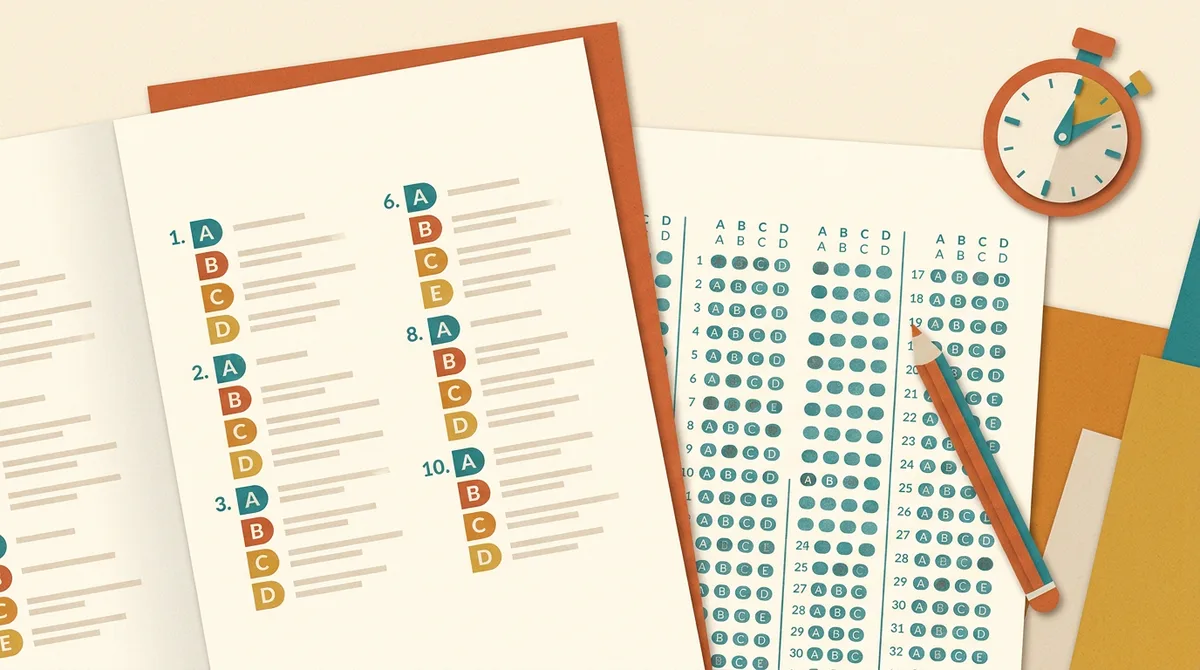
Most parents arrive at this question in the same way. You search for GL Assessment practice papers, you click something that promises a free PDF with answers, and ninety seconds later there is a file on your desktop called something like GL-11-Plus-Paper-1.pdf. It opens. It has questions on it. Your child could sit down and do it this afternoon. And there is absolutely nothing in that document that tells you whether it resembles the test your child will actually sit next September.
That gap is the whole problem, and it is remarkably badly served. Search results for this query are dominated by GL's own shop and by link dumps: pages that hand over dozens of PDFs organised by publisher, with a sentence or two each, and no explanation of what makes any of them GL style. Worse, a meaningful amount of the material still circulating was written for CEM, a different provider that has withdrawn from paper-based 11+ testing while several regions moved across to GL. At least one major 11+ publisher ranking on page one still divides its free 11+ samples into a "CEM Test" set and a "GL Assessment" set, side by side, with no indication that one of those columns describes a format your child will not meet. A parent working diligently through the top ten results can easily spend a term practising the wrong thing.
So this is not another list of downloads. It is a walkthrough: what to check, in what order, from the moment a file lands in your downloads folder to the point where GL style papers are a settled part of your week. Every format claim below is anchored to a primary source, either GL Assessment itself or a council that runs a GL test, and where the sources refuse to commit to a detail, we say so rather than filling the gap with guesswork.
Step one: separate "GL style" from "11+ papers"
"11+ papers" is not a format. It is a category label that covers independent school entrance exams, individual grammar school papers, tutor-written practice, and material from more than one assessment provider, all of which look and behave differently. "GL style" is narrower and, usefully, testable. It means the paper imitates the conventions of a test written by GL Assessment: a specific answer-recording method, a specific subject vocabulary, a specific approach to timing, and a specific way of reporting results.
The distinction matters because the mechanics are what a practice paper is for. Your child already learns fractions and inference at school. What a paper adds is the experience of meeting those skills in an unfamiliar arrangement under time pressure. If the arrangement is wrong, you have bought a worksheet with extra anxiety attached.
It is also worth being precise about who GL is in this arrangement. GL writes and supplies the test; your local authority or grammar school decides which parts of it to use and how long to run them for. Redbridge Council, for example, names GL Assessment as the supplier of its grammar school entrance test while setting its own two-paper structure and its own test date. That split between provider and local decision runs through everything below, and it is the single most misunderstood thing about GL papers. If you are still working out which provider applies to you at all, our comparison of GL, CEM and ISEB is the place to settle that first.
Step two: check the layout, starting with the answer sheet
Open the file and look at where the answers go. This is the fastest single check available to you.
A genuine GL style paper is multiple choice, and the answers are recorded on a separate answer sheet rather than in the question booklet. GL's own paid packs make this explicit: each pack contains three question papers together with answer sheets and guidance for parents. The reason is mechanical. Buckinghamshire's admissions information states plainly that GL Assessment marks the papers and that scores are then standardised, which is only practical at scale with machine-readable answer sheets.
That single design decision produces several downstream habits your child needs to rehearse, and none of them are rehearsed by a paper with blank lines under each question:
- Reading a question in the booklet, then transferring a mark to a numbered row on a separate sheet, without losing their place.
- Keeping booklet and sheet aligned, so that skipping a hard question does not shunt every subsequent answer up a row.
- Marking cleanly and changing an answer properly, rather than scribbling over it.
- Accepting that working out is done in the booklet or margin and never earns credit on its own.
A child who has only ever written answers into gaps will meet all four of these for the first time on test day. That is an avoidable disadvantage, and it has nothing to do with how well they understand the subject.
Step three: check the subject vocabulary
GL's material sits within a fixed four-subject vocabulary: verbal reasoning, non-verbal reasoning, English and maths. GL sells practice papers in exactly those four areas, with three packs available for each, and describes the content as reflecting the layout children are likely to find when they sit the real test.
Within verbal reasoning, GL describes the skills assessed as processing verbal information, identifying similarities and differences between words, applying logical thinking and problem solving, recognising patterns, and understanding language rules and meaning. In practice that means a defined bank of recurring question types rather than open-ended puzzles: word codes, letter sequences, odd ones out, hidden words, relationships between word pairs, and short logic problems. Non-verbal reasoning works the same way, with recurring families of series, analogies, matrices and odd-one-out shape questions, which we break down in more detail in our guide to non-verbal reasoning format and timing.
Here is the useful consequence. Because the question types recur, a genuine GL style paper feels repetitive across a series in a way that a generic 11+ paper does not. If every paper in a pack introduces novel question formats you have not seen before, that is a signal about the writer rather than a sign of thoroughness.
One more thing worth knowing before you buy anything: GL states that the different numbers on its practice paper books are simply for reference and do not indicate a difference in difficulty between the books. Pack 1, 2 and 3 are not an easy, medium and hard progression, so there is no need to hold pack 3 back as a finale.
Step four: check how the paper is timed
GL style papers are built from short, separately timed sections rather than one open block into which a child paces themselves. Sections are announced, started and stopped, which is why familiarity with the rhythm matters so much.
The real tests are then assembled from those parts locally. Buckinghamshire's Secondary Transfer Test, produced by GL Assessment, measures verbal, non-verbal and mathematical skills and consists of two test papers of about sixty minutes each with a break between them. Redbridge also runs two papers, but pairs them differently: English with verbal reasoning, then mathematics with non-verbal reasoning. Same provider, same underlying question bank, different assembly.
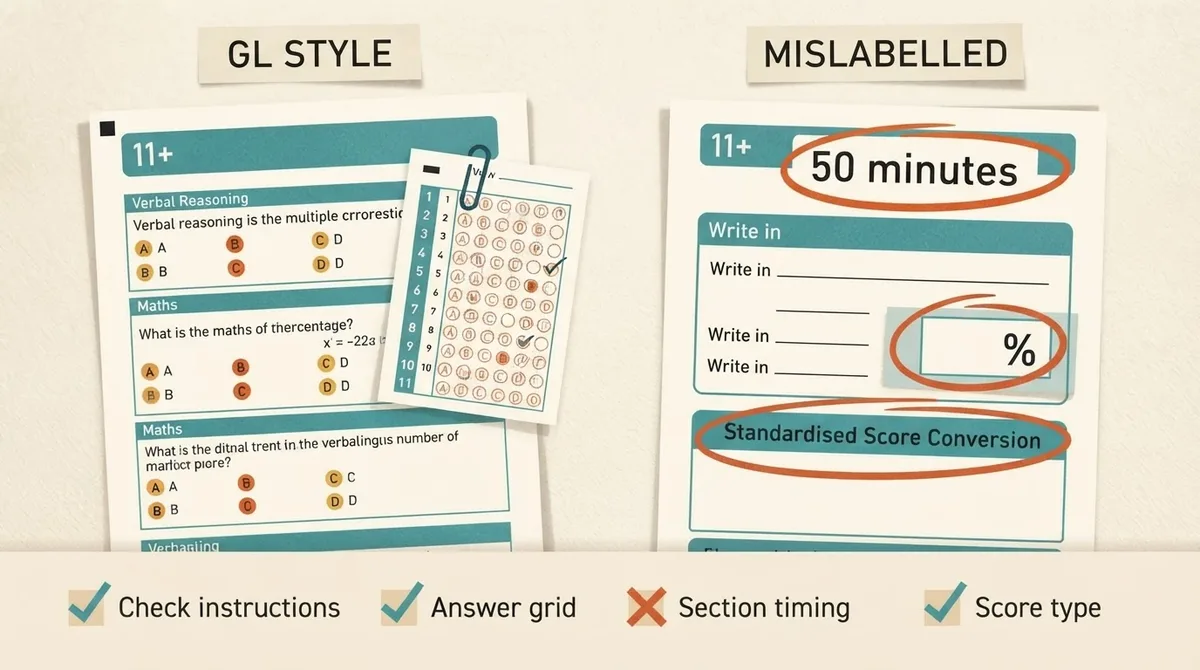
So when a downloaded paper carries a single instruction such as "you have 50 minutes to complete this paper", it is telling you it was not written to GL conventions. It may still be decent practice material. It is not a rehearsal.
Step five: check how it is scored
GL results are reported as a standardised score, not a raw mark and not a percentage. Buckinghamshire requires a standardised score of at least 121 to qualify for a grammar school place there, and explains that each child's score is standardised to account for their age at the time of the test, then weighted across verbal, mathematical and non-verbal skills.
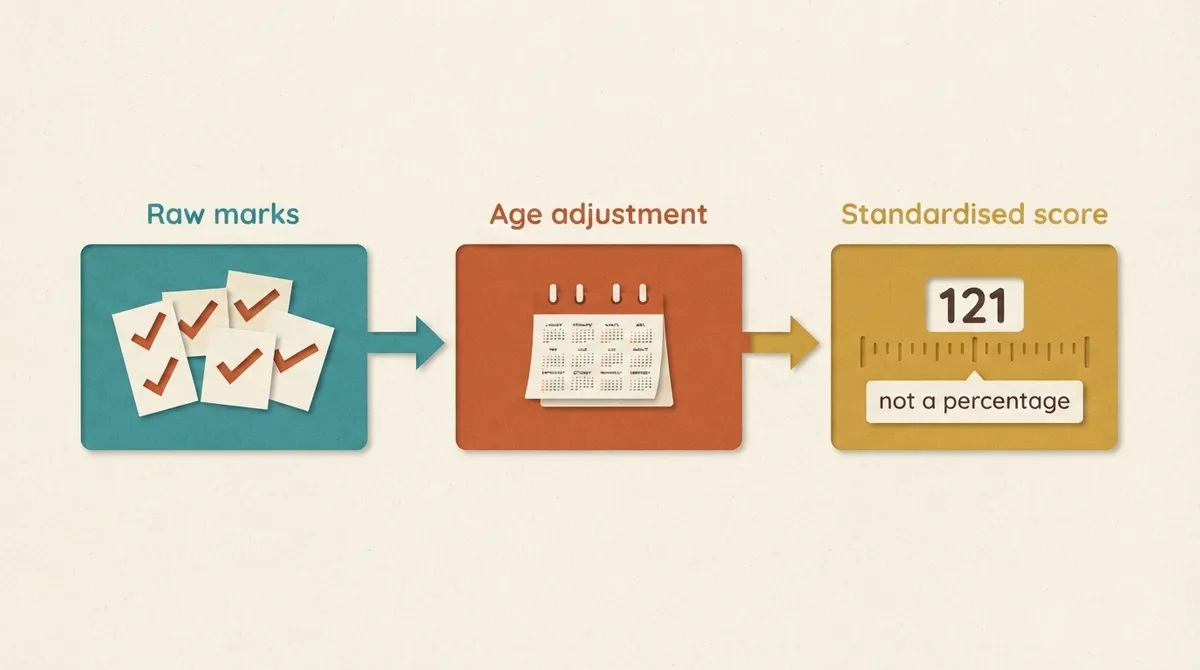
Two practical implications follow, and both are commonly missed. First, an autumn-born and a summer-born child with identical raw marks will not receive identical standardised scores, because the adjustment exists precisely to account for that difference in age. Second, no home practice paper can generate a real standardised score, because standardisation depends on the performance of the whole cohort sitting that test. Any product that prints one for you is producing an estimate, however well built.
That is not a reason to ignore marks at home. It is a reason to treat them as a trend line rather than a verdict, and to pay more attention to which question types your child loses marks on than to the total. Score thresholds and weightings vary by area, so check your own authority rather than assuming 121 applies to you.
Step six: run the seven-point mislabelled paper check
If you want one thing to keep from this article, keep this. Any of the following in a file that claims to be GL is a reason to demote it from rehearsal to revision:
- Write-in answer spaces instead of a separate answer sheet with a numbered grid.
- No answer sheet supplied at all, only an answer key for the parent.
- A single untimed block, typically 45 or 50 minutes, covering the whole paper.
- Percentage marking, or a grade boundary expressed as a percentage.
- "CEM" anywhere in the filename, header or marketing, including papers sold as covering both.
- Mixed or unfamiliar subject labels, such as spatial reasoning presented as a core section.
- No date and no edition anywhere in the document, which usually means nobody has revisited it since the CEM transition.
Points five and six deserve particular attention right now. CEM has withdrawn from paper-based 11+ testing and regions have migrated to GL, but the material has not disappeared from the internet. Some of it is explicitly flagged as no longer used, which is honest. Much of it is not flagged at all, and simply sits in a folder alongside GL material as though the two were interchangeable. They are not.
A paper that fails one point may still be useful. A paper that fails three or more is generic 11+ filler with a GL label attached, and should not be the thing your child does under exam conditions the weekend before the test.
Step seven: work out which of the three material types you have
GL distinguishes between familiarisation materials, practice papers and past papers, and the difference determines how you use each one.
Familiarisation materials are free and exist to show a child what the format looks like. GL offers six free familiarisation downloads: verbal reasoning, non-verbal reasoning, English, maths, a combined non-verbal reasoning and maths paper, and verbal skills, amounting to what GL describes as ten hours of material, supplied as PDFs to print at home. Practice papers are the paid printed booklets, three question papers and answer sheets per pack, priced at the time of writing at £11.99 per pack or £31.99 for all three in a subject.
Past papers are the category that does not exist. GL does not release used test papers, and no legitimate free download of one exists either. If a site is advertising GL past papers, what it is offering is practice material with an inaccurate label, which tells you something about the care taken elsewhere on the page. Our guide to what is genuinely available as a past paper covers which schools and boards do publish real ones.
Step eight: get your local timings from the only source that has them
This is the caveat the providers and councils state clearly and almost nobody repeats. GL warns on its free materials page that the exact timings for, and number of questions in, your local 11+ test may differ from those in its familiarisation and practice materials, because tests vary from area to area. Its FAQ page goes further and declines to state any local format at all, directing parents instead to contact the admissions department of their local grammar school or local authority. Redbridge makes the same point from the other side, noting that while GL's free materials help children get used to the format and style of questions, the free materials might not match the exact test their child will take.
The honest framing is a division of labour. GL style material gets the mechanics right: multiple choice, separate answer sheet, question types, sectioned timing, standardised scoring. Your local authority's admissions page gets the specifics right: how many papers, which subjects are paired, how long each runs, the qualifying score, and the dates. Buckinghamshire, for instance, publishes both its practice test date and its main test date well in advance, along with when results are released.
Spend twenty minutes finding your authority's admissions page and writing four numbers on a card: number of papers, subjects per paper, minutes per paper, qualifying score if published. Tape it inside the folder where the papers live. Every practice session afterwards can be adjusted to those numbers instead of to a generic assumption.
Step nine: sit the first paper properly
The first full paper is a measurement of format familiarity, not ability, so treat it that way.
Sit it at a cleared table with a printed answer sheet, two sharpened pencils and an eraser, a visible clock, and no adult hovering. Read the instructions aloud once, then stop talking. Time the sections separately, using your local timings if you have them and GL's own if you do not. GL's advice is that tackling a practice paper under timed conditions gives children valuable experience of managing their time effectively, and that experience is the point of paper one.
When it is done, mark it together, but interrogate the errors rather than counting them. For each wrong answer, ask which of four things happened: did they not know the content, did they misread the question, did they run out of time, or did they mark the wrong row on the answer sheet? Only the first is a learning gap. The other three are handling problems, and handling problems improve quickly with a few more papers. Log the four categories somewhere you can compare over time, whether that is a notebook or progress tracking that does the counting for you.
Step ten: build a routine rather than a stockpile
A sensible rhythm for most families is one full timed paper a week, with the days between spent on the specific question types that went wrong, in short focused bursts rather than more full papers. Doing three papers on a Sunday teaches endurance and nothing else, because there is no time between them to fix anything.
Buckinghamshire's own test design supports the emphasis on familiarity: the authority runs a shorter practice test, usually a couple of days before the main test, purely so children learn what to expect. If the people who administer the test build in a rehearsal, home preparation should be structured around rehearsal too.
Count backwards from your test date. Roughly a dozen full papers spread over the final term, with error follow-up between them, is more than enough for most children and leaves room for a lighter final fortnight. More papers than that usually means the follow-up is being skipped.
Free GL style practice papers to start with
Start with GL's six free familiarisation downloads, because they are the only free material written by the organisation that writes the test. Print them, staple the answer sheets separately, and use them as your reference for what the conventions look like.
When you need more than that, our free 11+ practice papers with answers collection is printable and ungated, and the sets follow the conventions described above rather than borrowing the label. If you would rather your child worked on screen with instant marking and an error breakdown, our paper tests run the same material with the timing and the per-question-type reporting handled for you.
Either way, the test you should apply to anything you download from anywhere is the same seven-point check in step six. It takes about a minute, and it is the difference between a term of rehearsal and a term of guesswork.
Topics
- gl assessment
- 11 plus
- practice papers
- exam boards
- free papers