
What Is the FSCE 11 Plus Exam? Format, Skills and Preparation
FSCE test specifications vary by school. Read a school-specific familiarisation example, understand the answer formats and check the current guide before choosing preparation.
 Elspeth Marlow
- 11 min read
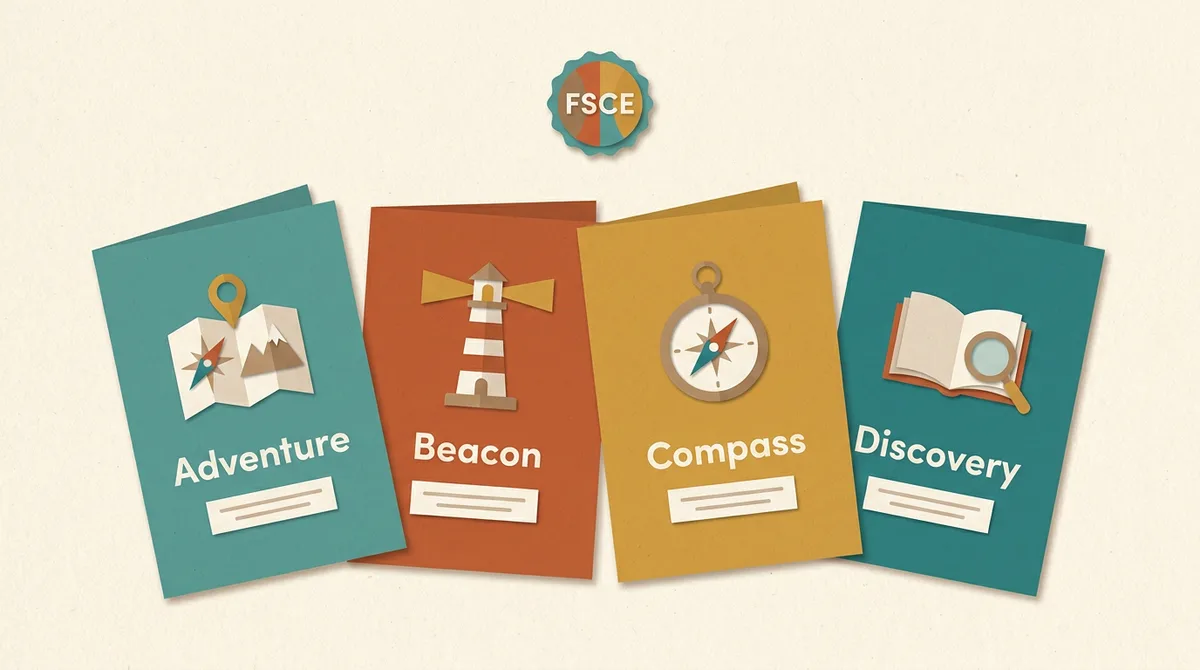
FSCE is a test provider, not one entrance-test specification used by every school. Its official parent page tells families to read the target school’s admissions guidance because specifications differ.
This guide uses the children’s and parents’ familiarisation documents linked from Chelmsford County High School’s 2027-entry page as a detailed example. The documents carry a 2026 copyright date. Their four-paper structure and answer rules describe that example, not every FSCE school or future entry year.
Start with your own school’s current guide. Check its subjects, paper structure, answer materials and entry year before using any practice pack. Use the grammar school directory to find the school’s admissions information. Sharing a provider does not always mean sharing a test or score.
What FSCE actually is, and what it is not
FSCE stands for Future Stories Community Enterprise Limited. It was incorporated on 1 April 2022, company number 14018895, and is registered at Reading School, Erleigh Road, Reading RG1 5LW under SIC code 85600 (educational support services), with an active status on the Companies House register. That registered address matters: this is not a commercial test publisher selling into schools from the outside. FSCE describes its work as "bespoke and accessible 11+ and In-Year tests, written by Grammar Schools, for Grammar Schools".
FSCE draws on the Key Stage 2 curriculum taught up to the end of Year 5. The school’s specification determines which content and answer formats apply. For example, Trafford’s announced test for 2028 entry will draw on KS2 English and mathematics; CCHS’s linked guide describes a wider range of curriculum subjects.
The CCHS example: four named papers
The children’s guide linked from CCHS’s 2027-entry page states that there are four different papers, "which might be sat in any order":
- Adventure Paper: any of the listed subjects, answered with multiple choice answer options
- Beacon Paper: any of the listed subjects, answered with short written answers
- Compass Paper: any of the listed subjects, answered with multiple choice answer options
- Discovery Paper: "a paper which will require a Creative Response"
Each paper has its own question booklet and its own separate answer sheet, and the booklets are branded by entry year, for example "Adventure Paper 2026 Entry" (CCHS Information for Children, copyright 2026).
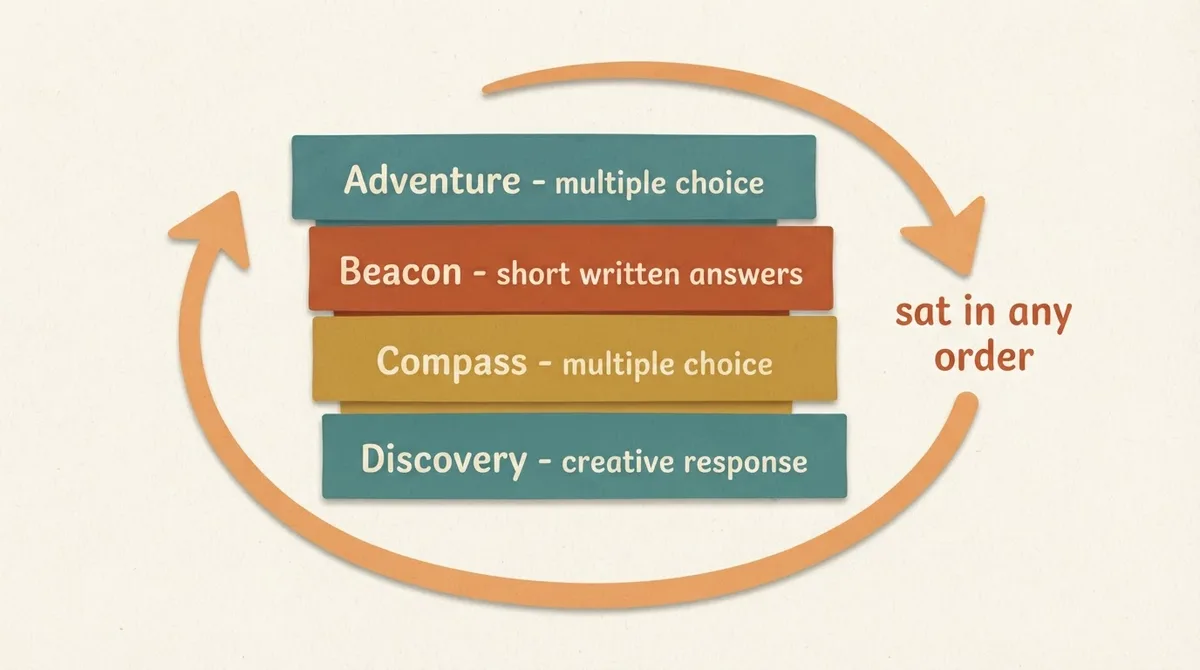
Read that carefully, because it changes how you prepare. The papers are named after the answer format, not the subject. A child cannot walk in thinking "maths first, then English". Adventure, Beacon and Compass can each draw on any listed subject, and the order is not fixed. The single most useful piece of familiarisation you can do is making sure your child is unbothered by that: the paper in front of them tells them how to answer, not what topic to expect.
The eleven subjects listed in the CCHS guide
The CCHS guide lists eleven Key Stage 2 subjects its test may include: Art and Design, Computing, Design and Technology, English, Geography, History, Languages, Maths, Music, Physical Education and Science. The guide stresses this "shouldn't be anything new or extra to what you have already been taught up until the end of Year 5 only".
That list looks alarming until you read the reassurances that sit alongside it in the parent guide. On Music: "A child will not be disadvantaged if they do not play a musical instrument." On PE: "This is not a test of practical sporting ability." On maths: no calculators. In other words, these are curriculum-literacy questions, not specialist auditions.
A fair worked example of the flavour (our own, not from any paper): a Compass section might give a short recipe with quantities for four people, then ask a multiple choice question about scaling it for ten, a second about which unit of measurement is sensible for the flour, and a third about which stage of the method must come first. That is maths, design and technology, and reading comprehension, all inside one everyday context. Preparing for that is not eleven separate revision projects. It is broad reading, general knowledge conversation, and secure Year 5 curriculum basics.
Audio instructions and answer rules in this example
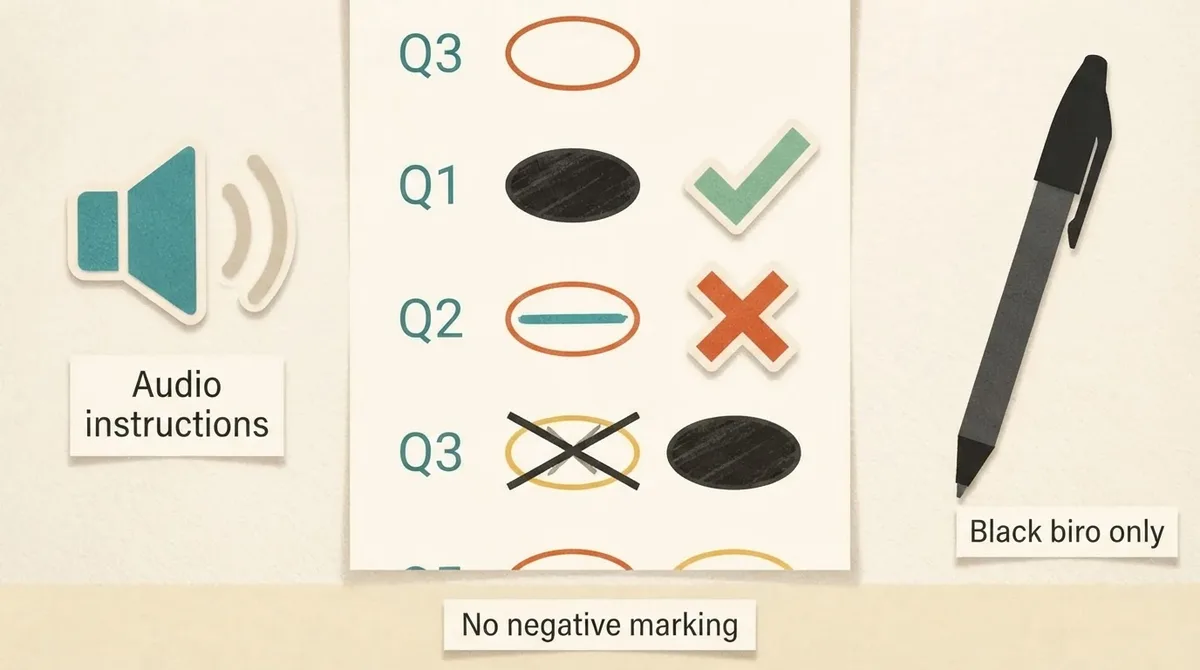
According to the CCHS children’s guide, instructions are not read out by an invigilator: they come from a voice recording. The recording tells candidates when they may open the question booklet, which page to turn to, the section and page number, how to answer, an example question, how much time is allowed for that section, when to start, and it gives warnings towards the end of each section. FSCE links to a sample of the audio so children can hear it in advance, which is worth doing once.
For this CCHS example, the answer rules are:
- Answers go on separate answer sheets "using a black biro or ballpoint pen", not pencil.
- For multiple choice, one oval must be fully shaded. A horizontal or vertical line through the oval is not accepted.
- To change an answer, cross through the incorrect oval and shade the correct one.
- There is no negative marking: "You will NOT lose any marks for incorrect answers!"
In this guide, the papers are also section-locked. Within a section a candidate may not look at any other section, may not go back to answer or correct questions from an earlier section, and may not look ahead at future sections. The last question in each section is followed by an instruction not to go beyond that point until the recording says so.
Three practical consequences. First, because there is no negative marking, every single oval should be shaded before a section closes, even the guesses. Second, because sections lock, the usual advice to "skip it and come back at the end" only applies within the current section. Third, biro is unforgiving, so shading technique is worth ten minutes of practice at the kitchen table. Trace Learn's paper tests help children rehearse the transcription habits that stop them losing marks they had already earned.
The Discovery response in the CCHS example
For the creative response, candidates may plan in the question booklet, but "ONLY the answer sheet will be marked", and it is written by hand. The answer sheet is double sided and carries the instruction: "There is no additional paper, so please keep your creative writing task to two sides only." It is anonymised for marking, headed "Please do not write name on this sheet", with the child's name and username pre-printed instead.
That single constraint should shape all your writing practice. Two sides, by hand, is a real and unusually tight limit. A child with a sprawling five-paragraph habit will run out of paper mid-scene. The drill that helps most is deliberately structural: plan in three or four beats, open in the middle of the action rather than with a slow scene-setting paragraph, and land the ending before the second side runs out. Practise on paper of a comparable size so the feeling of the space is familiar, then review the result against the target school's own published criteria.
Which details must you check at the school?
Do not assume one FSCE-wide paper count, duration, subject weighting or qualifying score. A familiarisation example shows formats and instructions; it does not establish all the contents of the test your child will sit.
Read the school’s current guide and determined admissions policy. Where the school publishes timings or qualification rules, use those for the named entry year. Where it does not, leave the detail unknown rather than borrowing a figure from another FSCE school.
Why an older guide cannot establish the current format
An older guide hosted by CCHS describes three papers, while its currently linked guide describes four named papers. That comparison demonstrates a change between those documents. It does not show that every FSCE school adopted the same new format.
Decision 1: should you buy "FSCE past papers"?
Treat any material sold as an FSCE past paper or authorised practice paper with care. FSCE's own answer is unambiguous: "There are NO past papers and NO practice papers that have been authorised by FSCE", because "the test format/content changes from year to year, so any material would be immediately out of date". The format is changed deliberately "so that no tutor, parent or company can claim to have any knowledge about what the FSCE entrance test will be like". Both guides carry the line: "This guide is the only genuine resource produced for the FSCE Ltd Entrance Test. There is no charge for this Familiarisation Guide."
So a £20 "FSCE-style practice test" is generic 11 plus practice with a label on it. It may still be useful as general exam practice, but buy it knowing that, not believing you have bought the exam. Our guide to free 11 plus practice papers explains how to distinguish official familiarisation material from provider-branded approximations. The better spend of the same hour is reading the official guide's subject-by-subject "what we are looking for" notes with your child, then working on secure Year 5 curriculum knowledge and timed answer-sheet technique.
Decision 2: keep drilling reasoning, or switch to curriculum work?
The most useful evidence here comes from the consortia adopting FSCE, not from commentary. Trafford has stated explicitly that from the test sat in September 2027 the content moves away from "verbal, non-verbal and mathematical reasoning" to "the Key Stage 2 English and mathematics national curriculum programmes of study up to the end of Year 5". That is a first-party statement that reasoning is being dropped, not a prediction.
Choose practice from the subjects and tasks your target school specifies. Do not drop or add a question family solely because the provider is FSCE. If they are also sitting a GL Assessment area test or an independent school test, keep reasoning in the mix, because those boards still use it. Formats vary considerably by region, so start from our 11 plus exam explained overview, and see the full GL, CEM and ISEB comparison rather than assuming one area's format travels.
Decision 3: when to start, now that testing is moving to Year 5
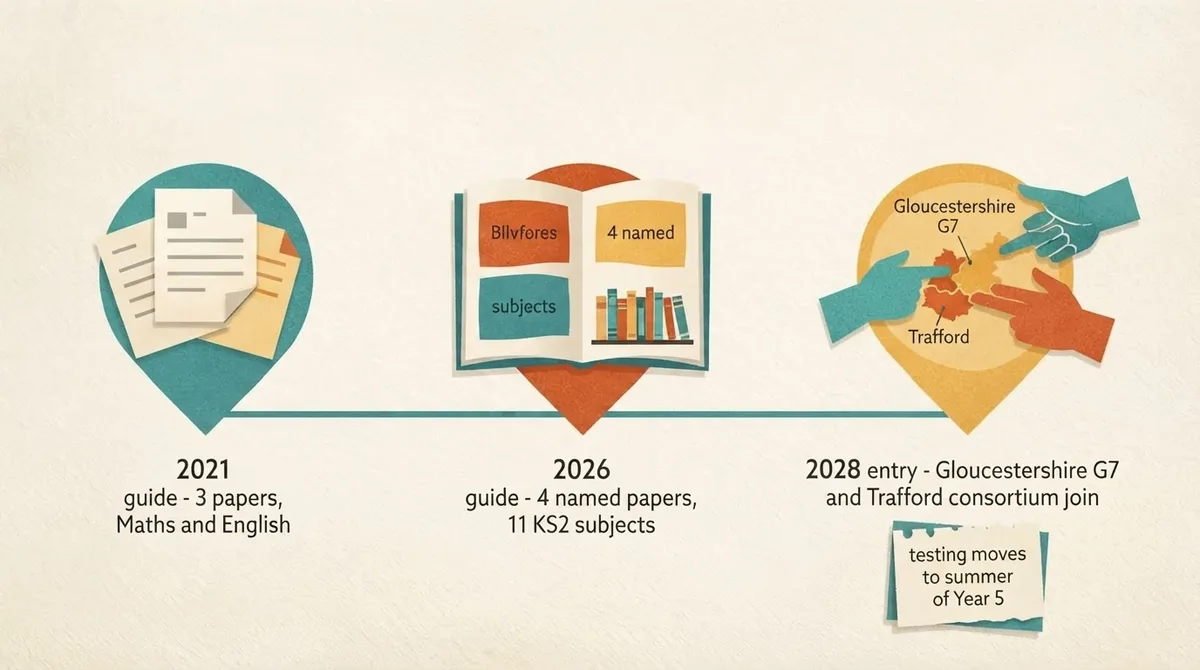
Two confirmed expansions change the preparation calendar:
- The seven Gloucestershire Grammar Schools (G7) appointed FSCE as admissions test provider for Year 7 entry from 2028 following a competitive tender, and moved the test from September of Year 6 to the latter part of the summer term of Year 5, effective summer 2027 (Pate's Grammar School announcement). Sir Thomas Rich's confirms GL Assessment remains the provider for 2027 entry, with that test on 12 September 2026.
- The Trafford Grammar School Consortium (Altrincham Grammar School for Boys, Altrincham Grammar School for Girls, Sale, Stretford and Urmston) announced on 14 July 2026 that FSCE becomes its admissions test provider from 2028 entry, tested in September of Year 6, moving to the latter part of the Summer Term of Year 5 from 2029 entry.
For the Gloucestershire change, the test moves earlier by roughly one school term. A Gloucestershire child entering in September 2028 now sits the test around June or July of Year 5, not September of Year 6, which pulls the real preparation window back into Year 4 and the first half of Year 5. If you were planning a "big summer before Year 6", that summer falls after the Gloucestershire test. Trafford’s first FSCE sitting for 2028 entry remains in September 2027. Check your own school's published admissions arrangements for the exact date each cycle, because these are the details most likely to move.
What to do next
A practical starting plan:
- Download the current parent and child familiarisation guides from your school’s admissions page. Read the child version together.
- Listen to sample audio instructions if the school provides them.
- Use the pen, answer-sheet method and correction rules specified in that guide.
- Practise a short handwritten response if the school includes one, using its stated space and timing.
- Keep school learning, reading and ordinary problem-solving central. Use the school’s subject scope rather than assuming all FSCE tests assess eleven subjects.
Our exam plan can help you organise a schedule around a target date. Recheck that date and the test specification on the school’s official site before committing to the plan.
Topics
- fsce
- 11 plus
- exam boards
- grammar schools
- parent guide