
The Birmingham and West Midlands 11 Plus Explained
A dated, source-linked guide to the eight grammar schools in Birmingham and Sutton Coldfield: the two-stage application, the 205 and 224 scores, and why catchment often matters more than the test result.
 Elspeth Marlow
- 15 min read
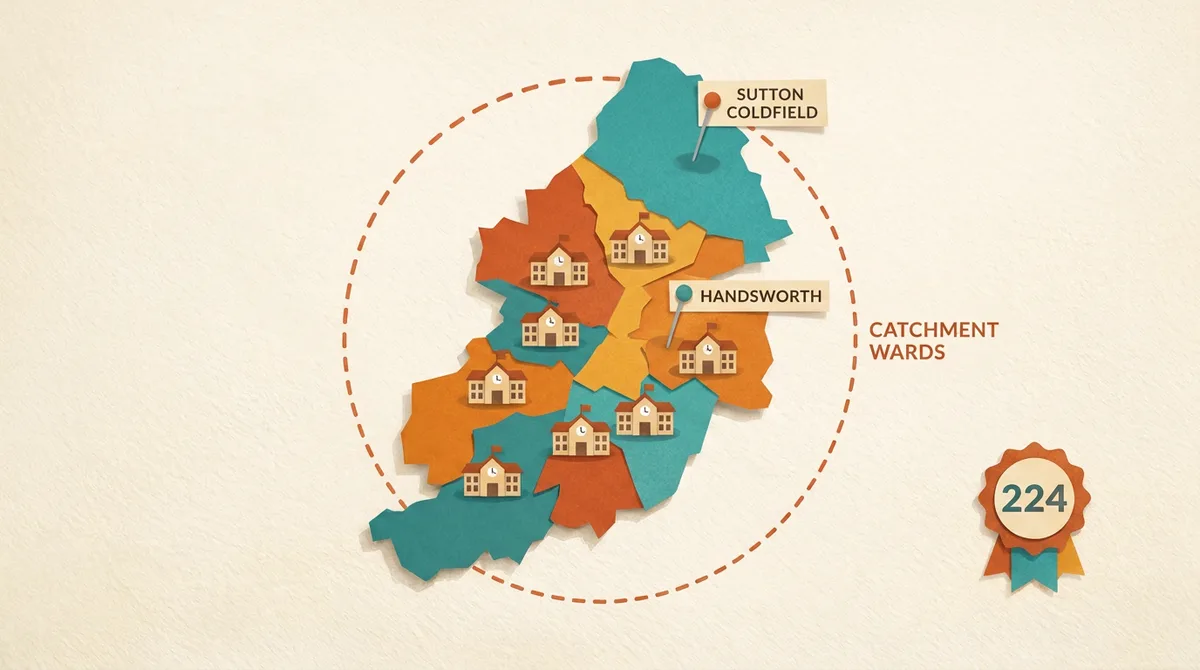
If you have spent an evening trying to work out how many grammar schools there are in Birmingham, you are not doing it wrong. The search results genuinely disagree. One page says eight, another fourteen, another fifteen, another nineteen. The council's own site splits the answer across two thin pages, one listing schools and one explaining the test, and never quite joins them up. Meanwhile the single most useful document in the whole system, the trust's table of last year's cut-off scores and distances, sits online as a wall of numbers with almost no explanation attached.
This guide fixes that. It counts the schools properly, explains why other sites arrive at different numbers, and then does the thing almost no page-1 result does: it explains that in Birmingham the test score is only half the decision. Catchment ward, pupil premium status and the straight-line distance from your front door to the school's front gates decide the rest. Children with scores in the 250s have missed out on places that children in the 220s were offered, and that is not a scandal or an error. It is exactly how the published admissions policies are written.
The other thing this guide does is state plainly the trap that costs Birmingham families a place every single year: registering your child for the entrance test is not applying for a school place. They are two separate forms, submitted to two different organisations, four months apart. Everything below is dated to the September 2027 entry cycle (children born between 1 September 2015 and 31 August 2016) and linked to the official source, so you can check any of it yourself.
How many grammar schools are there in Birmingham, and why does every site give a different number?
Eight. There are eight selective grammar schools in Birmingham and Sutton Coldfield that share a single entrance test and a single registration process. They are:
- King Edward VI Aston School (boys)
- King Edward VI Camp Hill School for Boys
- King Edward VI Camp Hill School for Girls
- King Edward VI Five Ways School (co-educational)
- King Edward VI Handsworth Grammar School (boys)
- King Edward VI Handsworth School for Girls
- Bishop Vesey's Grammar School, Sutton Coldfield (boys)
- Sutton Coldfield Grammar School for Girls
The first six belong to the King Edward VI Academy Trust Birmingham. The last two, Bishop Vesey's and Sutton Coldfield Girls, sit outside the trust but use the same test. As the Foundation puts it, "each school has its own admissions policy", and that sentence turns out to matter enormously, as you will see below.
So where do the other numbers come from? Almost always from the wider partnership. The eight Birmingham schools are one of three groupings inside the West Midlands Grammar Schools partnership, which covers nineteen schools in total. The other two groupings are the Shropshire, Wolverhampton and Walsall consortium (Haberdashers' Adams, Newport Girls' High, Queen Mary's Grammar, Queen Mary's High and Wolverhampton Girls' High) and the Warwickshire consortium (Alcester Grammar, Ashlawn, King Edward VI Stratford-upon-Avon, Lawrence Sheriff, Rugby High and Stratford Girls' Grammar). Nineteen is therefore the correct answer to a different question: how many schools use the West Midlands entrance test.
Sites quoting fourteen or fifteen are usually blending the Birmingham eight with a handful of Warwickshire or Black Country schools, or quietly folding in the fee-paying King Edward's School and King Edward VI High School for Girls on Edgbaston Park Road. Those two are independent schools within the same historic Foundation. They are not grammar schools, they charge fees, and they run their own admissions. If a directory lists them alongside Five Ways without flagging the difference, treat the rest of that page with caution.
One registration covers you for schools across the partnership, so a family in south Birmingham can name a Warwickshire school as well, and if you are still working out which selective areas are realistically within reach, our guide to grammar schools by area and the test each one uses maps the regions and their entrance tests. But the eight above are the ones most Birmingham parents mean, and they are the ones whose catchment rules are discussed here.
What are the two stages parents keep mixing up?
This is the section to forward to a friend.
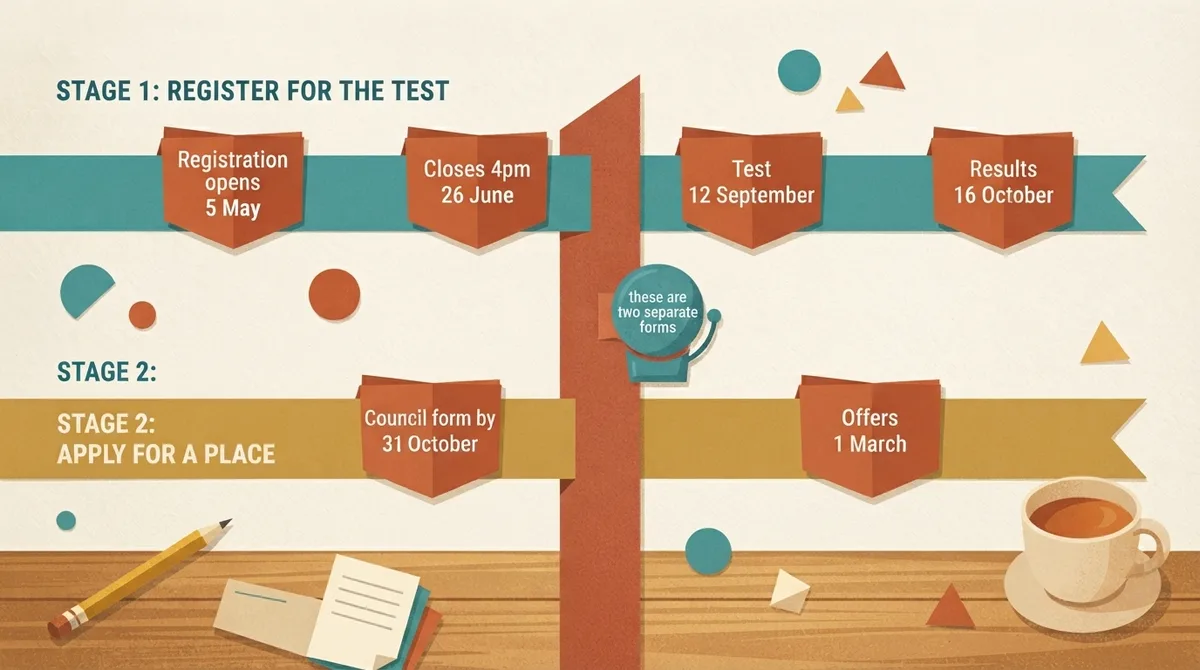
Stage one is registering for the test. You do this directly with the West Midlands Grammar Schools consortium, online, in the summer before your child starts Year 6. It gets your child a named seat in a test hall on a Saturday morning in September, and nothing else. It does not express any preference for any school. It does not go to your council.
Stage two is applying for a school place. You do this on your home local authority's Common Application Form, the same form every family in England uses for secondary transfer, naming the grammar schools you want in preference order. If you live in Birmingham you apply to Birmingham City Council; if you live in Solihull, Sandwell, Walsall or Dudley you apply to your own council, even though the schools are in Birmingham. The deadline is 31 October.
Miss stage one and your child cannot sit the test. Miss stage two and your child can score 260, be top of every list, and still receive no offer, because as far as the admissions system is concerned nobody asked for a place. The test result on its own is not an application.
The sequencing is deliberately helpful, and worth noticing: results are released in mid-October, a fortnight before the council deadline. You get to see your child's actual standardised score before you commit to a preference order. Very few areas of England give parents that.
What are the key dates for September 2027 entry?
For children born between 1 September 2015 and 31 August 2016:
- Tuesday 5 May 2026: registration for the entrance test opens
- Friday 12 June 2026: deadline for requests relating to a disability or additional need (access arrangements need evidence, so start this early)
- Friday 26 June 2026, 4pm: registration closes. This is a hard cut-off, not a guideline
- Saturday 12 September 2026: the entrance test
- Friday 16 October 2026: results issued to parents
- Saturday 31 October 2026: local authority preference form deadline
- Monday 1 March 2027: National Offer Day
Between registering and sitting, the consortium says your allocated test centre will post details of the test and the arrangements for the day to your home address in September. If nothing arrives by early September, chase it rather than assuming.
For reference, the equivalent 2026-entry cycle ran to the same shape: results by Friday 17 October 2025, preferences due 31 October 2025, offers on 2 March 2026. The pattern is stable enough to plan a full year of preparation around.
What is actually in the West Midlands Grammar Schools Entrance Test?
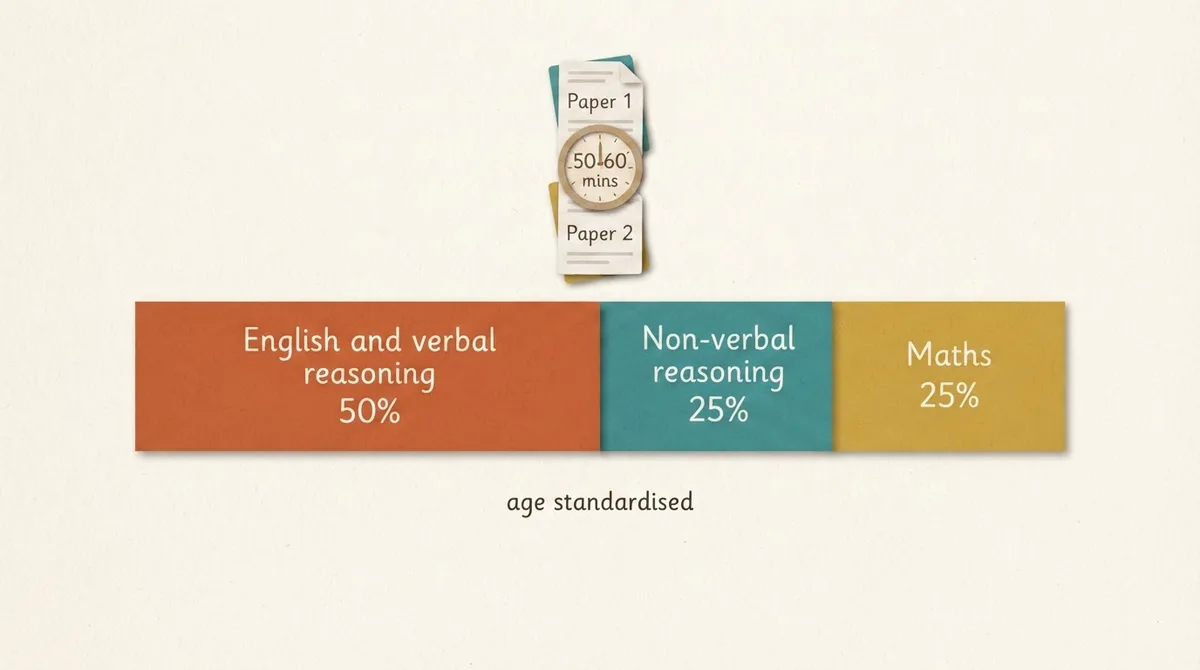
Two papers. Each is approximately 50 to 60 minutes long, including the time spent on instructions and example questions, so the actual working time is shorter than the headline number. Between them the papers cover English comprehension, verbal reasoning, mathematics and non-verbal or spatial reasoning. Every question is multiple choice and children record answers on a separate answer sheet.
Three details change how you should prepare.
The weighting is published and it is lopsided. The test is weighted 50% for English and verbal reasoning, 25% for non-verbal reasoning and 25% for mathematics. Half the marks sit in one family of skills. Most families instinctively split revision time evenly across four subjects, or lean towards maths because it feels most measurable. In Birmingham that is a misallocation. If your child is a confident mathematician and a hesitant reader, the maths practice is buying you a quarter of the paper while the reading gap costs you half of it.
Scores are age standardised. Section scores are adjusted for age so that, in the consortium's words, younger children are not disadvantaged compared with children in the same cohort who could be almost a year older. An August-born child is not competing on raw marks against a September-born child. This is standard practice nationally but it is worth understanding properly, because it also means you cannot convert a raw practice-paper mark into a predicted standardised score at home.
Instructions and timings come from an audio CD. The test instructions, example questions, practice questions and timings are all delivered via audio. Children cannot set their own pace through a section or go back when they feel like it. A child who has only ever practised silently, at their own speed, at the kitchen table, meets an unfamiliar constraint on the day. Practising to an externally imposed clock is a real and specific preparation task, not a detail.
The Foundation moved from CEM to GL Assessment as its entrance test provider, which is useful context when you are choosing practice materials. If you are unsure what that distinction means for question style, our comparison of GL, CEM and ISEB explains it, and our non-verbal reasoning question type guide covers the quarter of the paper families most often neglect.
What do the 205 and 224 scores actually mean?
For 2026 entry, across all eight schools, the qualifying score was 205 and the priority score was 224.
These are not two versions of a pass mark. They do different jobs.
The qualifying score is the threshold for being considered grammar-school suitable at all. Score below it and you are not in the running, wherever you live. Score at or above it and you are eligible to be ranked.
The priority score is a higher bar used inside the oversubscription rules. At the King Edward VI schools, in-catchment children who are not eligible for pupil premium need the priority score, not just the qualifying score, to sit in the in-catchment priority category.
Neither is a guaranteed pass mark, and this is where the results and offers table becomes essential reading. The real cut-off at each school is whatever score the last offered child in each category happened to have, and it moves every year with the size and strength of the cohort. Answer sheets are scanned and marked by computer, and the Foundation states plainly that it does not re-mark them, so there is no appeal route through the marking itself.
Why can a lower score inside catchment beat a higher score outside it?
This is the Birmingham differentiator, and it is genuinely unlike Kent or Buckinghamshire, where a qualifying score plus distance usually settles matters. If you have read our Kent Test guide and assumed the West Midlands works similarly, it does not.
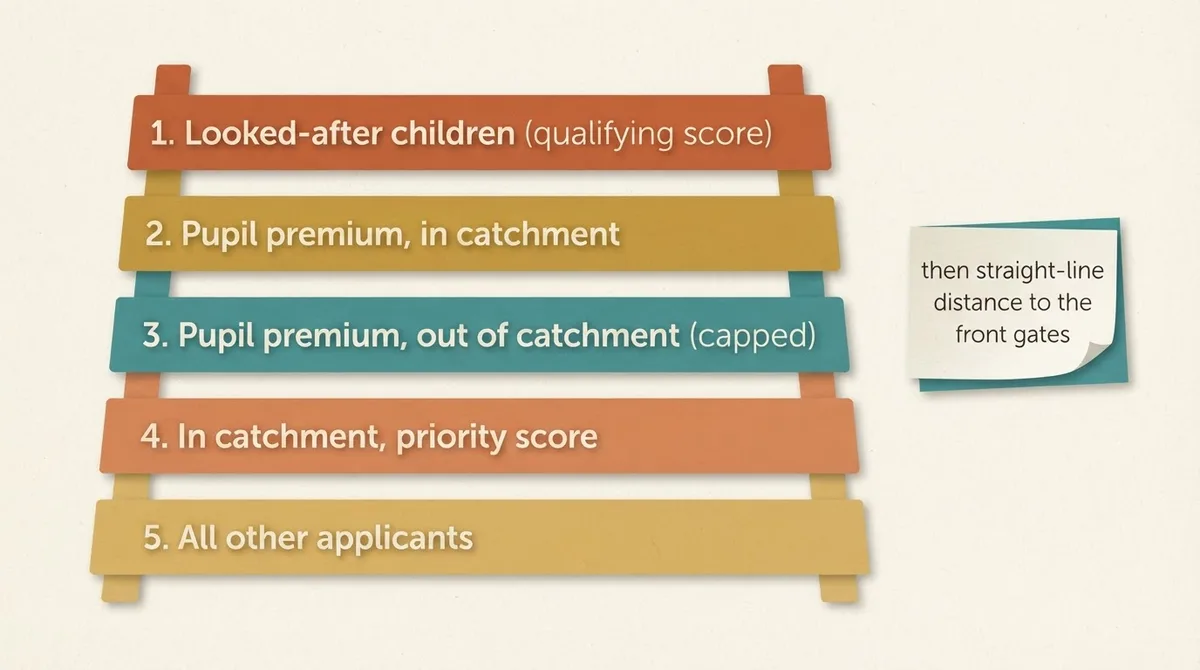
The six King Edward VI trust schools operate a catchment area defined by named electoral wards across Birmingham, Sandwell and Solihull, roughly forty of them. King Edward VI Handsworth School for Girls publishes its ranking order in full, and it is representative of the trust:
- Looked-after and previously looked-after children achieving the qualifying score
- Pupil premium children living within catchment
- Pupil premium children living outside catchment, capped at 48 places in total across categories two and three
- Non-pupil-premium children within catchment achieving the priority score
- All other children achieving the qualifying score
Read category four and category five next to each other. An in-catchment child on 224 is ranked above an out-of-catchment child on 254, because they are in a higher category, and categories are exhausted in order before the next one is touched.
The 2026-entry data shows exactly this. For "all other applicants", the last offered scores were 255 at Camp Hill Girls, 254 at Camp Hill Boys, 229 at Bishop Vesey's, 227 at Sutton Coldfield Girls, 219 at Handsworth Girls, 217 at Aston and 216 at Handsworth Grammar Boys. At King Edward VI Five Ways, no March offers at all were made in that category. Meanwhile every pupil premium applicant living inside catchment was offered a place in March at every King Edward VI grammar school, while out-of-catchment pupil premium applicants received no March offers at Camp Hill Boys, Camp Hill Girls or Handsworth Girls. Catchment, not score, was the binding constraint.
Where applicants cannot be separated within a category, the tie-break is a straight-line measurement between the home address and a point decided by the school, its front gates, using Ordnance Survey coordinates, with random selection if children are still inseparable. Check your ward against the Handsworth Girls admissions policy and the equivalent page for each school you are considering. Do not assume a nearby postcode is in catchment. Ward boundaries do not follow intuition.
Do the Sutton Coldfield schools work the same way?
No, and this is the contrast that catches families out. Sutton Coldfield Grammar School for Girls operates no catchment area at all. When oversubscribed it prioritises looked-after and previously looked-after children, then pupil premium students, then simply those who live closest to the school. Bishop Vesey's similarly does not run the trust catchment model.
Same test, same registration, same results letter, opposite geography rules. A family living outside the King Edward VI wards but reasonably close to Sutton Coldfield may find the two Sutton schools are a far more realistic prospect than a trust school with a shorter drive. A family deep inside catchment in Handsworth has the opposite calculation. Work out your position under both models before you rank anything.
What happens after results, and how should you rank preferences?
An equal preference system applies. Schools do not know or care where they sit on your list while deciding whether you qualify; the ranking is used only at the end, to decide which qualifying offer you receive. Where a child qualifies for more than one school, the system offers a place at the school ranked highest on the preference form.
Two consequences follow. First, there is no tactical advantage in demoting your genuine first choice to look modest. Second, a child achieving the qualifying score or above is automatically placed on the waiting list for any school listed higher than the one offered, so listing an ambitious school first costs you nothing and keeps a waiting-list position alive. Movement after National Offer Day is normal, particularly where families hold offers at more than one school in the partnership.
One practical point on pupil premium: eligible pupil premium pupils in Years 4 and 5 at King Edward VI Handsworth Grammar School's feeder pathway are offered free access to an online preparation platform, and the Foundation issues login credentials for its GL-content familiarisation tool to disadvantaged candidates who register for the test. If your child is pupil premium eligible, claim that access. It is free, it is official, and a surprising number of eligible families never take it up. For context on intake size, Handsworth Grammar states that the number of intended admissions each year is 150 at age 11.
How should a Birmingham family actually prepare?
Work backwards from the format rather than from a generic 11+ syllabus.
- Weight the timetable 50/25/25. Half your practice on English comprehension and verbal reasoning, a quarter on non-verbal reasoning, a quarter on maths. Adjust for your child's weaknesses, but start from the published weighting rather than an even split. Our revision timetable guide has a workable structure for this.
- Practise multiple choice specifically. Transferring answers to a separate sheet is a skill with its own failure mode, namely the slipped row. Ten minutes of deliberate practice removes a risk that has nothing to do with ability.
- Practise to an external clock. Because timings are delivered by audio, your child should be used to a section starting and stopping without their permission.
- Sit full papers under timed conditions from spring of Year 5. Not to chase a score, but to build stamina for two papers in one morning.
- Do your catchment homework in parallel. Confirm your ward, read each school's policy, and be honest about what the previous year's category cut-offs imply for your position.
If you want practice matched to this format rather than to a generic national paper, our free 11 plus practice papers cover the four skill areas, and Trace Learn's mock tests run timed multiple-choice papers with age-standardised style reporting so you can see progress by section rather than as one blurred total. That section-level view is what tells you whether the 50% of the paper that matters most is actually improving.
The short version
Eight grammar schools in Birmingham and Sutton Coldfield, inside a nineteen-school West Midlands partnership. One test in September, two papers, multiple choice, weighted half to English and verbal reasoning. Register by 4pm on 26 June with the consortium, then name your schools on your council's form by 31 October. A score of 205 gets you considered and 224 unlocks in-catchment priority at the King Edward VI schools, but which ward you live in can matter more than either number, and the two Sutton Coldfield schools ignore catchment entirely.
Admissions arrangements are reviewed annually and vary between schools even within the same city, so confirm the current year's policy on each school's own admissions page before you rank anything. Then get the preparation weighted correctly, and start early enough that timed papers are routine rather than an event. When you are ready to work to a proper schedule, create a free account and build the plan around the dates above.
Topics
- birmingham
- 11 plus
- grammar schools
- west midlands
- admissions
- catchment