
Printable Non Verbal Reasoning Worksheets for the 11 Plus
A segmented set of non verbal reasoning worksheets covering all twelve question families at easy, medium and hard, plus the marking routine, weekly volume and timing advice that turns printed sheets into progress.
 Elspeth Marlow
- 13 min read
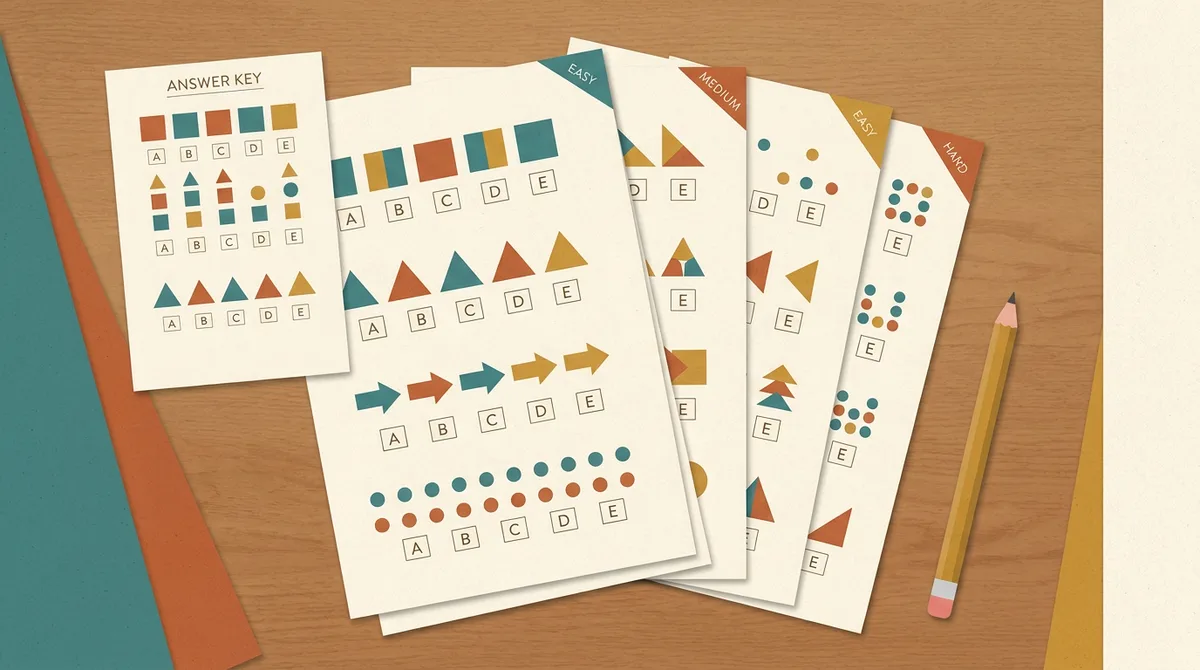
Most parents arrive at non verbal reasoning the same way. Your child is fine at maths, reasonable at English, and then a practice booklet lands on the kitchen table with a page of squares, arrows and dots, and nobody in the house has any idea what the rule is meant to be. The instinct is to print more sheets. That instinct is half right: volume genuinely helps in non verbal reasoning more than in any other 11+ paper, because almost every question is a variation on a small number of transformations that become obvious once you have seen them forty times.
The half that is wrong is thinking any old sheets will do. A random mixed pack teaches a child to guess in twelve different ways at once. What works is one question family at a time, at a difficulty that produces roughly eight correct out of ten, marked properly, with the wrong ones revisited a week later. That is the whole method, and it is why this page is organised as a library first and a guide second.
Below is the full worksheet set: every non verbal reasoning question family, at three difficulty bands, each one a printable sheet with a separate answer key. No email address, no sign-up wall to see what is inside. After the library, the part nobody else writes down: how many sheets a week, how to mark them, when to start the stopwatch, and how to know your child is ready to move up a band.
Start here: the worksheet library
The set is built the way the exam is built, one question family per sheet rather than a mixed jumble. Each sheet is short by design, twenty to twenty-five questions, printable on two sides of A4, with the answer key kept on a separate page so your child cannot read ahead and so you can mark without reprinting.
Every family below exists at three levels:
- Easy introduces the transformation with two elements changing at most, large clear shapes, and obvious distractors.
- Medium is closest to real 11+ standard: two or three attributes changing at once, plausible near-miss options.
- Hard stacks transformations, uses smaller detail differences, and includes the deliberately awkward options that separate the top of the cohort.
Each worksheet is generated fresh from Trace Learn's printable paper library, which means a child who works through a sheet twice is not simply memorising positions. That is the practical difference between a generated library and a tutor's folder of seven fixed PDFs: when your daughter needs a fourth matrices sheet at medium because matrices are her weak spot, a fourth matrices sheet exists.
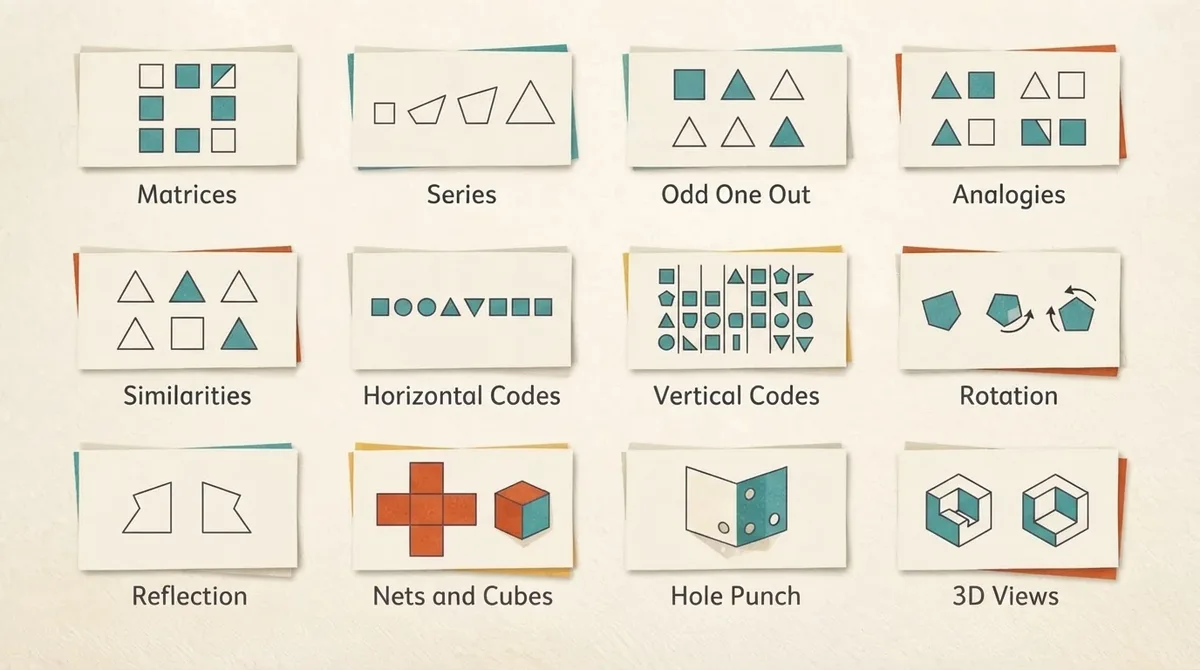
The twelve question families, and what each worksheet drills
- Matrices. A grid with one cell missing. The worksheet drills reading across rows and down columns separately before combining the two rules.
- Series and sequences. A row of figures progressing by a rule. Drills counting the step size rather than eyeballing the shape.
- Odd one out. Four or five figures, one of which breaks a shared property. Drills naming the shared property out loud before choosing.
- Analogies. A is to B as C is to what. Drills describing the A-to-B change in words first.
- Similarities. Which figure belongs with a given group. The mirror image of odd one out, and worth practising separately because children conflate the two.
- Horizontal codes. Figures labelled with two-letter codes; work out which letter encodes which feature.
- Vertical codes. The same logic stacked, which trips up children who learned the horizontal version by position rather than by principle.
- Rotation. Which option is the given figure turned by 90, 180 or 270 degrees. Drills the physical habit of turning the page.
- Reflection. Mirror lines vertical, horizontal and diagonal, plus the classic near-miss where a rotated figure is offered instead.
- Nets and cubes. Fold the flat net into a solid and check which faces meet.
- Hole punch. Fold, punch, unfold. Drills counting holes by symmetry rather than guessing.
- 3D views. Plan and elevation views of a block arrangement, including hidden cubes.
If you want the underlying method for each of these rather than the drill, our pillar guide walks through every non verbal reasoning question type with worked examples. Print a worksheet, then read the matching section together when your child gets stuck.
Which worksheets match your area's test
This is where most worksheet pages give you a CEM versus GL split that no longer describes reality. The honest answer is that non verbal reasoning appears in different places, under different names, with different timings, depending on where you live. A few first-party examples:
- Buckinghamshire does not have a standalone non verbal paper at all. Buckinghamshire Council's guide to the secondary transfer test describes two multiple-choice papers, one testing verbal skills and one testing "mathematics and non-verbal skills including spatial reasoning", each about 45 minutes long (60 minutes including introduction and examples). Children also sit a practice test in September, two papers of about 40 minutes each, using the real test's instructions. Rotation, reflection, nets and 3D views matter most here.
- Medway commissions its own papers. Medway Council sets a 45-minute reasoning paper split into 20 minutes of spatial and non verbal reasoning and 25 minutes of verbal reasoning, with the spatial and non verbal portion divided into four separately timed sections. Short, sharply timed worksheets are exactly the right rehearsal for that structure.
- Warwickshire runs a shared test with the Birmingham, Walsall, Wolverhampton and Shropshire grammar schools. Warwickshire County Council describes four sections, English, verbal reasoning, non verbal reasoning and mathematics, in multiple-choice format, with each of the two tests taking around 60 minutes including spoken instructions. The council also notes the difficulty "may go beyond the levels that children are expected to be achieving by the end of Key Stage 2", which is a fair argument for spending time in the hard band.
- Bexley does not use GL Assessment. Bexley Council says the selection test covers verbal ability and English comprehension, numerical reasoning and non verbal reasoning across two booklets of roughly 50 minutes each, with papers provided by Quest Assessments, and points families to Quest for familiarisation materials.
The practical upshot: check your own council's admissions page for this year before you decide how much non verbal work to do, then weight the worksheet families accordingly. Our overview of non-verbal reasoning format, timing and marks has more on how the section is scored where it exists as its own paper. Formats change between cycles, so treat the council page as the authority and this list as a starting point.
It is also worth printing the publisher's own free familiarisation material alongside the worksheets. GL Assessment publishes free PDFs across six areas including non verbal reasoning, and draws a useful distinction: familiarisation papers give "general familiarity with test styles", while practice papers are for "comprehensive preparation". Worksheets are neither. They sit underneath both, building the individual skills that a paper then tests together.
Milestone one: the first sheet, untimed
Do not start with a mixed paper. Print one easy sheet from a single family, ideally series or odd one out because both are intuitive, and sit next to your child while she does it. No timer, no comment, no help unless she asks. You are watching for one thing: does she have a method, or is she pattern-matching by feel? A child with a method points at things and mutters. A child guessing goes quiet and fast.
That first sheet sets your baseline. If she scores above roughly 90 per cent on easy, skip straight to medium for that family. If she is under 60 per cent, stay on easy and slow down rather than adding volume.
Choosing easy, medium or hard, and when to move up
Use a simple rule: the right band is the one where your child gets about eight out of ten right and can explain the two she missed once you talk them through. That is high enough to keep her willing and low enough that she is learning.
Move her up a band when she has scored 90 per cent or better on two consecutive sheets in the same family and finished both comfortably inside the time you would expect. Move her back down when a sheet produces more than four errors of the same type, or when she stops working and starts guessing. It is completely normal for a child to sit on hard for rotation and reflection while still needing medium for codes. Band by family, not by child.
How many worksheets to set each week
For a child starting a year out, two sheets a week is enough, roughly 20 to 30 minutes of non verbal reasoning in total. In the final term, three to four sheets a week works, but only if one of them is a re-do of previously wrong questions rather than new material.
More than four short sheets a week produces diminishing returns quickly. Non verbal reasoning improvement comes from recognising transformations, and recognition consolidates between sessions rather than during them. Three sessions of fifteen minutes across a week beats one session of forty-five, and it is far easier to sustain from September to January without an argument.
Spread the families rather than blocking them: matrices on Monday, rotation on Wednesday, a mixed re-do sheet on Saturday. Interleaving feels harder in the moment and produces better retention than doing five matrices sheets back to back.
How to mark a worksheet so your child actually learns from it
This is the step that gets skipped, and it is worth more than the extra sheet you would have printed instead.
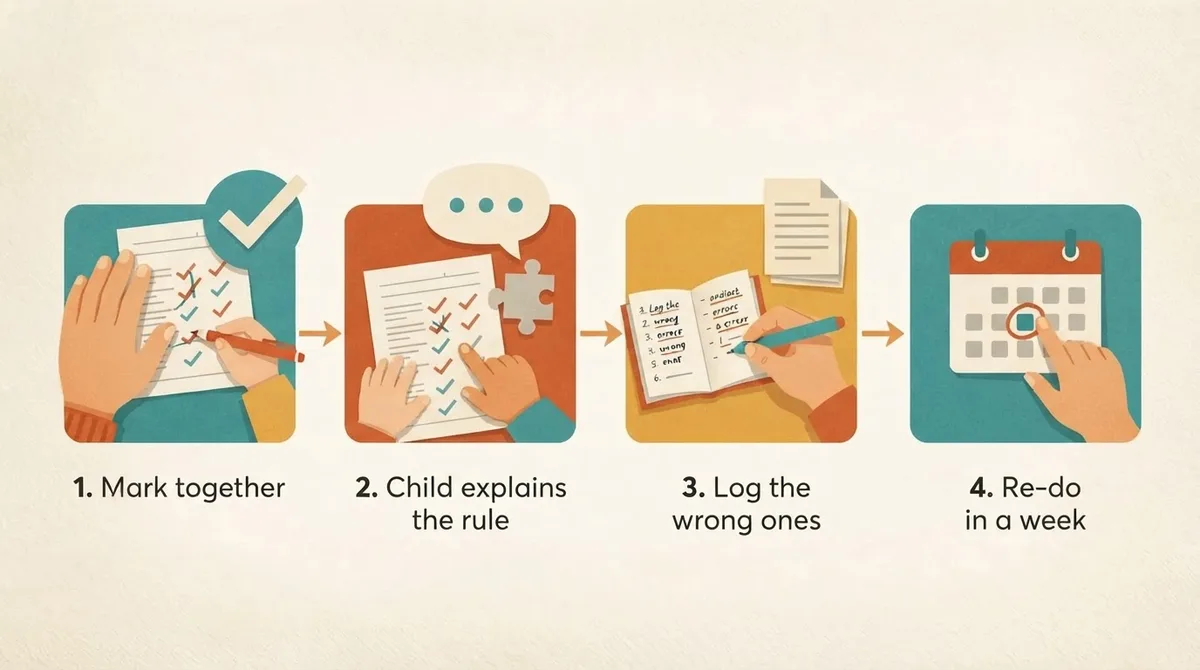
- Mark it together, immediately. Sitting side by side with the answer key, within a few minutes of finishing. Marking it alone that evening and handing back a score teaches nothing.
- Ask her to explain the rule on the ones she got right. Genuinely. Perhaps one in five correct answers turns out to be a lucky guess, and you want to find those now rather than in January.
- On the wrong ones, do not explain first. Ask what she thought was happening. The wrong rule she describes is the actual thing to fix, and it is usually one of a handful: counting sides but ignoring shading, spotting rotation but missing that it was a reflection, or reading a matrix across but not down.
- Write the missed question numbers and the family on the top of the sheet, then put it in a folder.
- Re-do the wrong ones a week later, on a fresh copy of the same sheet type. A question your child can solve a week later is a rule she owns. One she solves only in the ten minutes after you explained it is still yours, not hers.
Keep a rough tally by family across a term. Three sheets in, the pattern is normally unmistakable: most children are fine on series and odd one out and lose the majority of their marks in two specific families, usually codes and nets or 3D views. That is where the next month of worksheets should go.
When to start the timer, and what timings to use
Give it at least three or four weeks untimed. A child who is timed before the method is automatic learns to rush, which in non verbal reasoning means learning to guess.
When you do start, anchor the timings in what the real papers allow rather than an invented number. Medway gives 20 minutes for the whole spatial and non verbal section, split into four separately timed sections, which works out at roughly five minutes per short block. Buckinghamshire's papers run about 45 minutes for a combined maths and non verbal paper. Bexley's booklets are about 50 minutes each covering three areas. Whichever way you cut it, the per-question allowance is under a minute, and often closer to 30 to 40 seconds.
So: a 20 to 25 question worksheet should take 10 to 15 minutes at exam pace. Start by setting a generous 18 minutes and let her beat it, then tighten by two minutes a week until she is at 12. Never introduce a tighter timer and a harder difficulty band in the same week. GL Assessment makes the case for timed work plainly, noting that a timed paper "gives children valuable experience of managing their time effectively" and that a good score "can also boost a child's confidence and reduce their anxiety". Both halves of that matter, which is why timing comes after competence, not before it.
A six-week non verbal reasoning worksheet plan
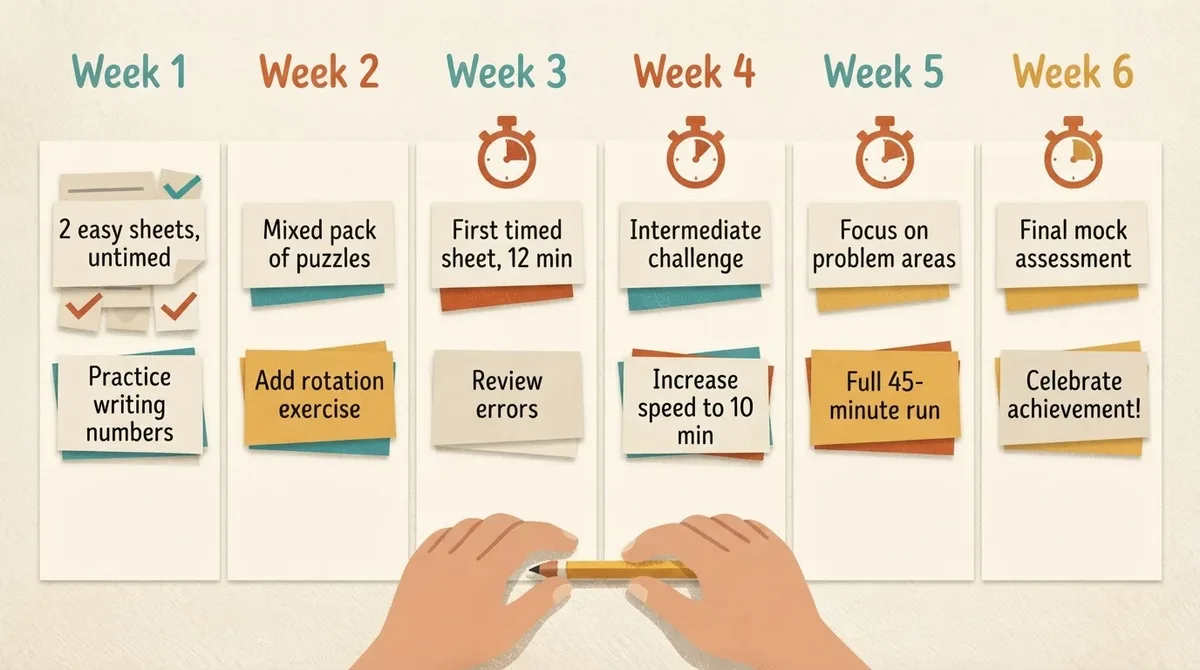
- Week 1. Two easy sheets, untimed: series and odd one out. Mark together, establish the routine.
- Week 2. Two easy sheets: matrices and analogies. Add the folder for wrong questions.
- Week 3. Move any family at 90 per cent up to medium. Introduce rotation and reflection. First timed sheet at 18 minutes.
- Week 4. Codes, horizontal and vertical, at whatever band fits. Re-do week 1's wrong questions. Timer at 16 minutes.
- Week 5. Nets, cubes, hole punch and 3D views, the spatial cluster, at easy or medium. Timer at 14 minutes.
- Week 6. One mixed sheet at medium under 12 minutes, then a full-length practice paper at your area's real timing. Review the tally by family and choose the two families for the next cycle.
Repeat the cycle with the bands raised. Most children need two or three passes through it, which is why starting in Year 5 rather than the September of Year 6 makes such a difference.
Verbal reasoning worksheets and the rest of the 11+
Almost every area that tests non verbal reasoning also tests verbal reasoning, and the two behave differently. Non verbal improves with pattern exposure; verbal improves with vocabulary and with drilling a smaller set of well-defined question types. If you are building a weekly rota, one non verbal sheet and one verbal sheet is a sensible pairing, with maths and English comprehension carrying the rest of the week. Our guide to verbal reasoning question types covers the equivalent families on that side, and the same marking routine applies without modification.
A short list of the questions parents ask most:
Do worksheets replace practice papers? No. Worksheets build individual skills; a full paper tests stamina, timing and switching between question types under pressure. Use worksheets weekly and a full paper monthly.
Is it cheating to re-use a worksheet? Not if the questions are freshly generated rather than identical. Re-doing the same twenty questions from memory is the one thing that genuinely wastes an evening.
My child hates them. Cut the volume before you cut the difficulty. Ten minutes three times a week, marked properly, beats a resented forty-minute Sunday session by a distance.
When should we start? Give yourself two or three cycles of the six-week plan above, which points to the spring or summer of Year 5 for a September or autumn test. If you are later than that, keep the routine and just narrow the families to the two your child loses most marks on.
Topics
- non verbal reasoning
- worksheets
- 11 plus
- practice papers
- parent guide