
How to Add Structure to Home Education Without Recreating School
The law does not require a timetable, set hours or marked work, but it does reward evidence of progress. Here is a four-part system (goals, rhythm, review, evidence) that keeps home education defensible without turning your house into a classroom.
 Elspeth Marlow
- 15 min read
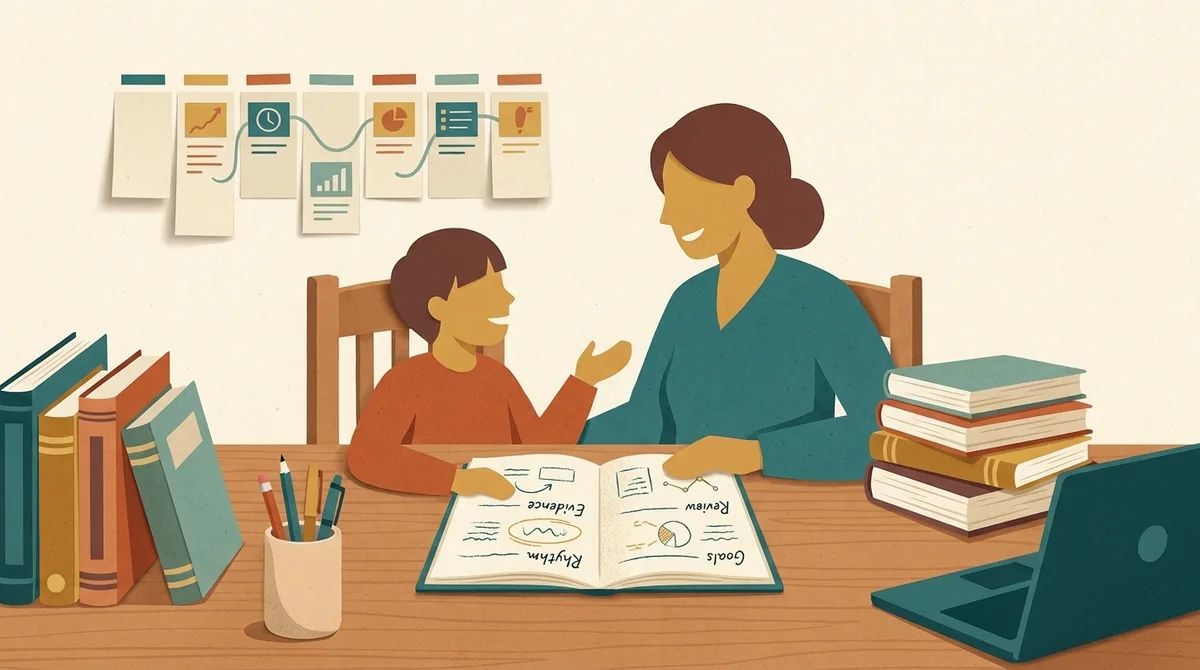
There were an estimated 126,000 children in elective home education in England on the autumn 2025 census date, up from 111,700 the year before, and the most commonly reported primary reason was mental health at 16% (Department for Education statistics). A large share of those families did not plan this. They arrived mid-term, after a hard year, often with a child who is not currently able to sit at a desk for five hours. If that is you, the last thing you need is a plan that assumes a fresh start in September and a compliant nine-year-old.
Most advice asks you to pick a label: structured, semi-structured or autonomous. That is a useful conversation to have once. It is useless on a Tuesday in November when you cannot remember whether you did any maths last week and the council has emailed. Choosing a philosophy is not the same as having a system.
What follows is a system: goals, rhythm, review, evidence. Each works on paper before it works on any device. Nothing here requires you to buy anything, and the order genuinely matters.
Week one: the question that unlocks everything
Before you design anything, read two paragraphs. Section 7 of the Education Act 1996 requires a parent to cause their child to receive "efficient full-time education suitable to his age, ability and aptitude, and to any special educational needs he may have, either by regular attendance at school or otherwise" (legislation.gov.uk). That is the whole duty. Efficient, full-time, suitable.
The official guidance distinguishes a suitable education from a school timetable. The Department for Education's guidance for parents states at paragraphs 2.8 and 2.11 that home-educating parents are not required to have a timetable, to set hours during which education takes place, or to observe school hours, days or terms, and that there is no legal requirement to hold teaching qualifications, teach the National Curriculum, make detailed lesson plans in advance, give formal lessons, mark your child's work, formally assess progress, or match school-based age-specific standards (EHE guidance for parents). Paragraph 2.7 adds that there is no legal definition of full-time, and that home education does not have to mirror the roughly five hours a day, 190 days a year that school children receive.
Hold that against the 32.5-hour week expected of mainstream schools (GOV.UK). That figure is engineered for one adult and thirty children, with registration, transitions, assemblies and the constant overhead of moving a crowd. Copying a school timetable fails not because you lack discipline, but because you have removed the only problem the timetable was built to solve.
So the first question is: what is structure actually for, if the law does not require it? Paragraph 2.12 answers it. It is likely to be "much easier for you to show that the education provided is suitable if attention has been paid to the breadth of the curriculum and its content, and the concepts of progress and assessment in relation to your child's ability." Paragraph 2.9 adds that you should at least be able to quantify and demonstrate the amount of time for which your child is being educated.
Structure is not a legal duty. It is the thing that makes your education defensible to an outsider and survivable for you. Those are two excellent reasons, and neither requires bells.
Weeks two to three: write the one-page plan
Goals come first, because a rhythm without goals is just a habit. Take one sheet of A4 and write four things.
- Three anchors for the year. Not subjects. Outcomes. "Reads a chapter book independently and willingly." "Can handle written multiplication and division and explain which one a word problem needs." "Finishes one thing she started." Three is the limit, because you will actually remember three.
- Breadth, named. The areas you intend to touch across a term: literacy, numeracy, science, humanities, arts, physical, practical life, and something the child chose. This answers paragraph 2.12's "breadth of the curriculum" without adopting the National Curriculum, which you do not have to follow (gov.uk/home-education).
- The minimum standard you are aiming at. Paragraph 2.10a expects education to enable the child, when grown up, to function as an independent citizen in the UK, and 2.10c notes that local authorities may use minimum expectations for literacy and numeracy when assessing suitability. Write one line each on what reading and number should look like by July.
- Social contact. Paragraph 2.10e is explicit that education may not be deemed suitable if it leads to excessive isolation from peers. Name the actual things: Tuesday forest group, swimming, cousins on Sundays. Councils notice this section; parents forget it.
Revisit the page three times a year. If you are also preparing for selective entry, the same one-page discipline underpins a longer arc, and our year-by-year 11+ preparation plan shows what that looks like when there is a fixed test date at the end of it.
Weeks two to six: build a rhythm, not a timetable
A timetable says 10:15 to 11:00, maths. A rhythm says: mornings we do the two things that need a fresh brain, afternoons are for the long project, and one day a week we are out. Rhythms survive a late night, a migraine and a burst pipe. Timetables do not, and every collapsed timetable teaches a child that plans are things adults abandon.
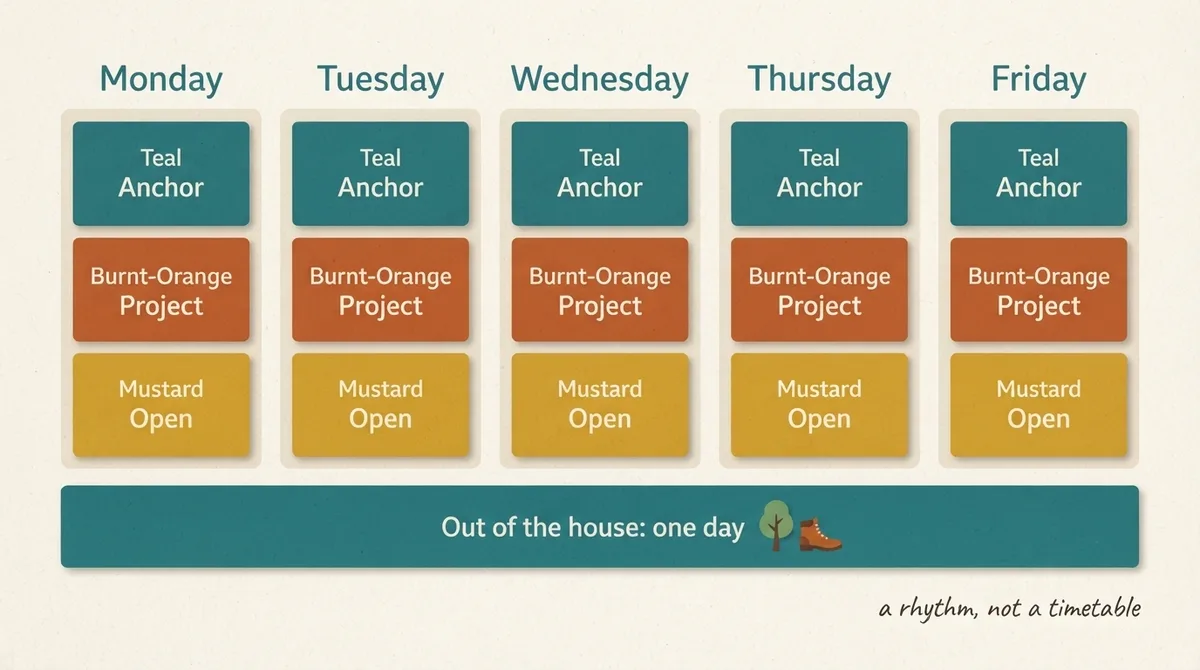
Build the week from three block types. Anchors are the short, near-daily, non-negotiable things (reading, number, handwriting or typing). Projects are the long, absorbing, cross-subject things. Open is genuinely unallocated. Then shape it to the child.
- Early primary (5 to 7). Two anchors of 15 to 20 minutes before lunch: reading together and something numerical, often with objects rather than a worksheet. One 45-minute project block three days a week. Everything else is play, outdoors and being read aloud to. Ninety minutes of formal work a day is comfortably full-time education for a six-year-old.
- Upper primary (8 to 11). Three morning anchors of 25 to 30 minutes (reading or comprehension, maths, writing), an hour-long afternoon project on three days running a four-to-six-week topic, one day out, and a weekly "hard thing" slot for whatever the child avoids.
- Secondary (11 to 16). Move from your week to their week. Give the teenager the term's outcomes and let them plan Monday morning on a whiteboard, with you checking Friday. Two or three exam subjects get standing daily slots; everything else rotates. Add an afternoon of paid work, volunteering or a course, because at this age independence is the curriculum.
- A child recovering from school. For the first weeks, one anchor only: fifteen minutes of reading aloud, at any time, sitting anywhere. Add nothing until that has been comfortable for a fortnight. Log the trips, the documentaries, the cooking, the conversations. This is deschooling, and it is not lost time. It is also the phase most likely to coincide with a council enquiry, which is exactly why the log matters.
A useful test: if you cannot describe your week in three sentences to a grandparent, it is too complicated to hold. The same logic that makes short, frequent sessions beat marathon ones applies here, and we set out the evidence in why short sessions beat cramming.
From week six: the review cadence
This is the part missing from most guides, and the part that actually keeps a home education on the rails. Three loops, at three speeds.
The weekly ten-minute reset. Friday afternoon or Sunday night, alone or with the child. What did we actually do; what did we say we would do and skip; what is one thing that is clearly easier than it was six weeks ago; what is next week's single change. One paragraph in a notebook. Repeated 38 times, that is a learning log, and a learning log is evidence.
The half-termly one-page review. Every six or seven weeks, sit with your plan. Score each anchor as moving, stalled or dropped. File two or three dated pieces of work per area. Then ask the harder question: is anything on this page here because I want it, rather than because the child needs it? Adjust the plan, not the child.
The annual report. Once a year, write 400 to 600 words describing approach, breadth, progress, social contact and next year's aims. Write it whether or not anyone asks, because guidance paragraph 5.5 notes that once satisfied, a local authority will normally update its information periodically, "often being an annual review". Writing it in advance turns a stressful request into a copy-and-paste.
The cadence is neutral; the philosophy is yours. An autonomous, child-led family runs the same three loops and simply describes interests followed rather than topics covered.
Term one onwards: measuring progress without a test centre
You are under no legal obligation to formally assess progress. But paragraph 2.12 tells you that engaging with the concept makes life easier, and honestly, you want to know. Three honest ways.
Compare the child to themselves. Keep the same piece of work from September and repeat the task in February. Ask a child to re-read a passage they struggled with in the autumn. This is the most persuasive form of evidence, because it is unfakeable and specific.
Watch the transfer, not the score. A child has learned fractions when they halve a recipe without being told to, and punctuation when it appears in a birthday card rather than a worksheet. Note these moments in the weekly paragraph with a date. They are worth more than a mark out of twenty.
Use a standardised measure sparingly, and read it correctly. A GL Assessment Standard Age Score has a mean of 100 for any age group and a standard deviation of 15 points, and approximately two-thirds of pupils score between 85 and 115 (GL Assessment). A National Percentile Rank of 70 means the pupil did as well as or better than 70% of same-age peers, with 50 being average. Stanines group scores into nine bands precisely to discourage over-interpreting small differences.
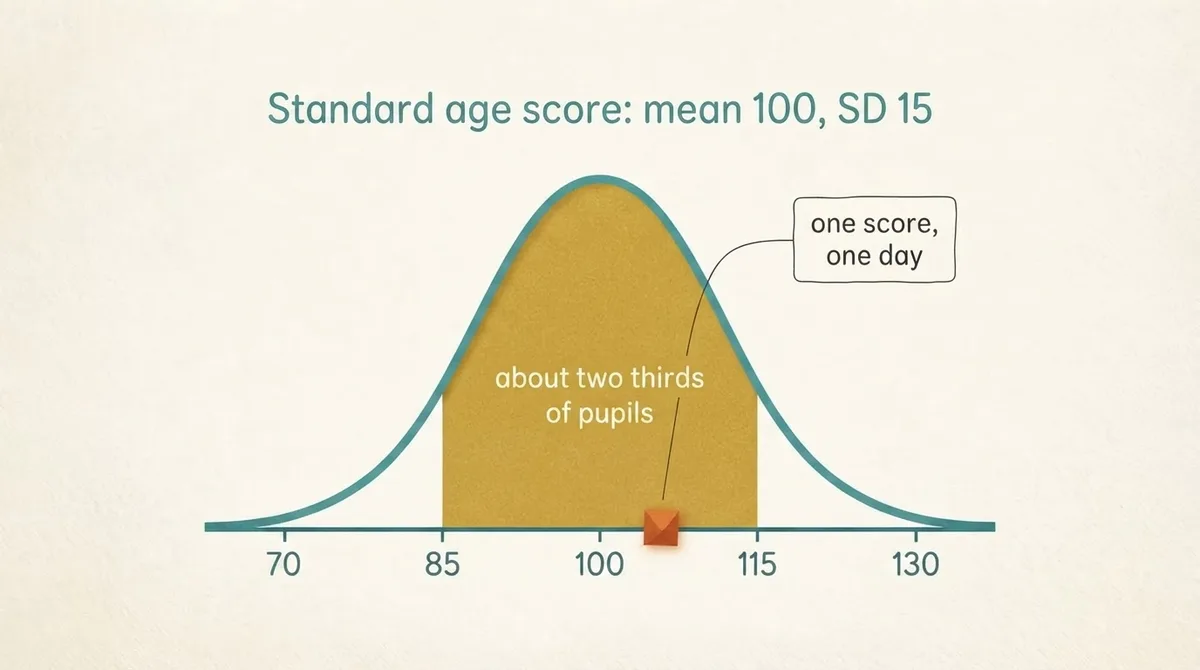
Worked example. Your ten-year-old scores 108 in October and 103 in June, and you panic. You should not. Both sit inside the middle two-thirds, both are above the age average, and five points is well within the noise of one child, one morning, one room. What is worth acting on is a consistent direction across three sittings, or a subject where the score contradicts what you see daily. Use progress tracking to look for a stable pattern rather than reacting to one result.
Building the evidence file before anyone asks
Councils that publish guidance tend to list the same four evidence formats, and knowing them removes most of the anxiety.
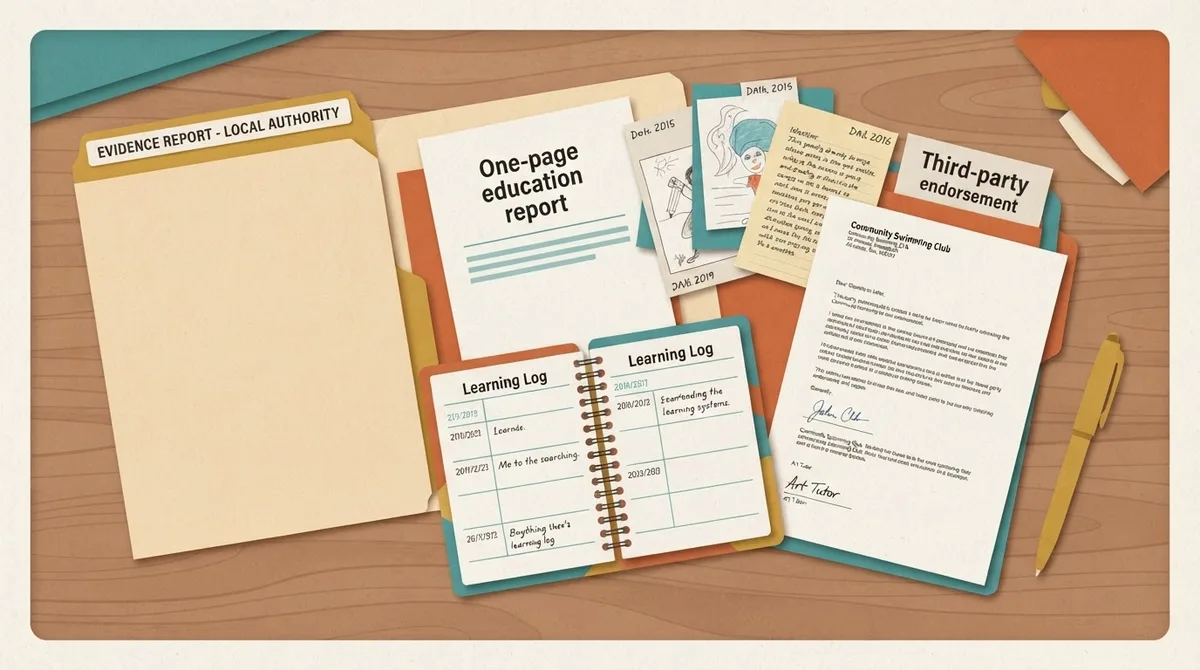
- A short written report. Your own account of the education, and often the only document needed.
- Dated samples of work. Six to twelve pieces per term, spread across areas, with the date visible. Photographs of models, gardens and cakes count.
- A learning log or journal. Your weekly paragraphs, in order.
- Third-party endorsement. A line from a swimming coach, music teacher, club leader, tutor or online course provider.
A one-page report can be deliberately unremarkable, and that is the point.
Education report: Maya, age 9, autumn term 2026. Maya has been home educated since May 2026. Our approach is project-based with daily short sessions in reading, writing and mathematics. This term: read four chapter books, two independently; wrote a four-page illustrated guide to Roman roads following a visit to Chedworth villa; worked through short division and equivalent fractions, currently secure with two-digit divisors; ran a six-week weather project including daily rainfall recording and a bar chart of the results; weekly swimming lesson (level 5) and Thursday forest school group with eight other children. Structured work averages around three hours a day, four to five days a week, plus reading and practical activity. Next term: written multiplication of decimals, a local history project, and starting recorder. Samples of dated work and a weekly log are available on request.
That is 140 words and it addresses breadth, progress, time, social contact and next steps. Assemble the folder each half term and you will never write it under pressure.
What learning software can and cannot do
Software is good at three jobs. It organises, sequencing topics so you are not deciding at 8am what to teach. It diagnoses, finding where a gap actually is: many a "can't do long division" turns out to be a shaky six times table. And it reports, keeping a dated record so a term of work becomes something you attach to an email rather than reconstruct from memory. That last one is underrated, and it is what a progress tracking view is for.
It cannot replace the relationship, and an anxious child needs a person, not a dashboard. It cannot do practical or outdoor learning, often where home education has its real advantage. It cannot substitute for specialist SEND assessment and support. And no edtech company likes writing this down: app activity is not proof of a suitable education. A local authority judges the education, not your usage statistics. Use the software's record as one dated sample among several, alongside the writing, the models and the club letters. If you are weighing tools against tutoring or doing it yourself, use the disclosed framework in how to choose an 11 plus learning platform.
When the letter arrives: enquiries, the 15-day notice and the register
The Children's Wellbeing and Schools Act became law on 29 April 2026, and every local authority now holds a register of children in their community who are not in school. More families will be asked, sooner, to describe what they are doing.
A local authority "has no formal powers or duty to monitor the provision of education at home", but it does have a section 436A duty to identify children not receiving a suitable education, and it is entitled to make informal enquiries. Parents "are under no legal obligation to respond", and need not agree to a meeting or produce specific evidence. But the guidance is equally clear that if you do not respond, the authority "is entitled to conclude from the absence of any response that it appears that your child is not receiving a suitable education" (paragraphs 5.1 to 5.5).
If the authority considers it has insufficient information, it must serve a notice under section 437(1) requiring you to satisfy it, and you will have at least 15 days to respond (paragraph 5.6). Fifteen days is comfortable if you have a folder and brutal if you are starting from nothing. That is the moment your weekly paragraphs stop being admin and become the thing that protects your family. Beyond that sit school attendance orders, the council's formal route if it believes a child is not receiving suitable education. Worth knowing: paragraph 5.26 confirms "Ofsted has no role in the oversight of education received by individual children who are educated at home."
Two practical points on cost and SEND. Parents "must be prepared to assume full financial responsibility for the child's education, including bearing the cost of any public examinations (which would have to be entered via an external examinations centre)", with any local authority help being discretionary (paragraph 3.6). And if your child has an EHC plan and the home education is suitable, the authority has no duty to arrange special educational provision, though it keeps checking suitability (paragraph 5.21); a parent already home educating can still request a statutory assessment of SEN (paragraph 5.24). Separately, if your child attends a special school, you need the council's permission to educate them at home.
When the structure stops working
It will, at least twice a year. Diagnose before you redesign.
If the child has stalled, the usual causes are difficulty (the step was too big, so go back three steps and rebuild), boredom (the work is beneath them and they are protesting correctly), or fear (the subject carries a school memory). Only the first is a curriculum problem.
If the plan has stalled, look for the block nobody has touched in a month and delete it rather than feeling guilty about it. A rhythm with four things you do beats one with nine things you don't.
If you have stalled, which is the most common case and the least discussed, take the signs seriously: dreading mornings, arguing daily, measuring the week by what you failed to do. The fixes are unglamorous. Drop to anchors only for a fortnight. Outsource one subject to a class, a co-op or a course. Swap one day a week with another family. Take a week off entirely, and note in your log that you did, because school children get thirteen weeks and nobody calls it a failure. Building a study plan around a sustainable weekly shape rather than an aspirational one is the whole argument of short daily 11 plus practice, and it applies just as much here.
One last reframe. These four parts are not a burden taken on in place of school. They are considerably less work than 32.5 hours, and they produce something school rarely gives a parent: a dated, honest, specific account of how one particular child is actually getting on. If you want a tool to carry the organising and record-keeping while you keep the judgement, you can start free, but the paper version works, and the paper version is the one that matters.
Topics
- home education
- structure
- progress
- planning
- record keeping