
Boys, Writing and the 11 Plus: What the Evidence Does and Does Not Show
The official data confirms a real boys-girls writing gap, then explains almost nothing about your own child. Here is what the numbers say, whether the writing task even counts where you are applying, and a diagnostic that routes to three different fixes.
 Elspeth Marlow
- 14 min read
Most parents who search for this have just watched it happen. Forty minutes set aside, a title on the page, a sharpened pencil, and an eleven-year-old boy who has written six words and rubbed out four of them. He can narrate a video game plot with three factions and a betrayal in it, so it is not that his head is empty. It just will not come out through a pencil.
Two questions follow. Is this a boy thing? And what do I do on Monday? National attainment figures show a group-level difference: yes, there is a real, measured, national pattern, and it is bigger in writing than in any other subject. The second has an answer too, but it is not the one the first question implies. Knowing your child sits in a demographic group with a lower average tells you nothing about what is actually stopping him, and acting on the group average is how families end up buying prompt lists about zombies and football when the real problem is that he can only write eleven words a minute.
This guide does three things in order. It puts the official numbers on the table with sources. It asks whether the writing task is even assessed where you are applying, because in some of the biggest selective areas it is not. Then it replaces the gender question with a diagnostic that separates three genuinely different problems, all of which look identical from the other side of the kitchen table.
What the national data actually shows
The Department for Education's key stage 2 attainment release for 2024/25 is the cleanest national picture of eleven-year-olds in England, and it is unambiguous on one point. Writing is where the sexes diverge most: the release states that "the biggest attainment gap between boys and girls remains in writing teacher assessment at 12 percentage points". At the higher standard the pattern repeats in miniature, with "10% of boys and 16% of girls" assessed as working at greater depth, a six point gap unchanged from 2024.
Compare that with reading, where 72% of boys and 78% of girls met the expected standard, a six point gap. Writing is roughly double it. Across all pupils, 72% met the expected standard in writing and 62% met it in reading, writing and maths combined (DfE key stage 2 attainment, 2024/25).
Attitudes point the same way. The National Literacy Trust surveyed 125,375 UK children and young people and found that in 2025 only 26.6% of eight to eighteen year olds enjoyed writing in their free time and 10.4% wrote something daily. Split by sex, 34.9% of girls enjoyed writing against 21.1% of boys, and 14.1% of girls wrote daily against 9.1% of boys (National Literacy Trust, June 2026). Worth holding onto: enjoyment has fallen 20.2 percentage points since 2010 across all children, girls included. This is not only a boys story.
So the pattern you think you are seeing is real at national scale. You are not imagining it, and you are not being unfair to your son by noticing it.
Why a 12 point gap tells you almost nothing about your son
Now the part the folklore leaves out. In the same DfE release, girls led at the expected standard in every subject "except for maths where boys performed slightly better (1 percentage point difference)". And a 12 point gap in writing means that roughly two thirds of boys nationally do meet the expected standard. The gap is a statement about half a million children. It has close to no predictive power over one child.
There are two further reasons to discount it in your own house. First, selection draws from the upper tail. Population averages are least informative exactly where you are standing, because the boys sitting a grammar or independent 11+ are not a random sample of boys. Second, teacher assessment in writing is the most judgement-heavy of the key stage 2 measures, which is one reason it behaves differently from the externally marked reading and maths tests.
The practical cost of using "he's a boy" as a diagnosis is that it is unfalsifiable and it licenses lower expectations. It also routes you to the wrong shop. If you decide the problem is boyish disengagement, you buy prompt lists about explosions and football. If the actual problem is that his handwriting is not automatic, those prompts change nothing, because he will freeze on a story about a zombie apocalypse exactly as reliably as on one about a lost dog.
Treat the national gap as a reason to look harder at your child's writing, never as an explanation of it.
First decision: does the writing task even count where you are applying?
Before any technique, settle this. It reallocates family effort more than any tip in this article, and no comparable guide asks it.
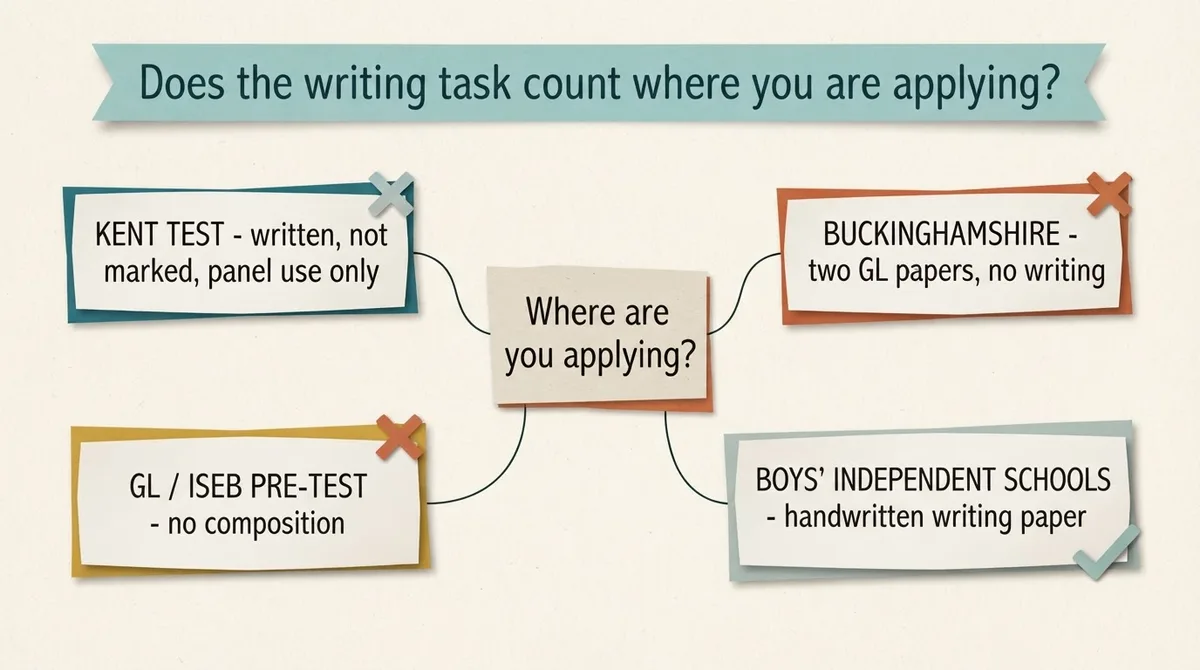
- Kent. There is a writing exercise, and it is not marked. The Kent Test allows 40 minutes including 10 minutes of planning, and the piece is retained so that a local headteacher panel may use it during the headteacher assessment stage, which applies to borderline cases. So it matters, conditionally, and not through a mark. If Kent is your route, open the current school and test evidence in the Trace Learn grammar-school directory and weight preparation towards the marked papers.
- Buckinghamshire. The Secondary Transfer Test is two GL papers of about an hour each covering verbal, non-verbal and mathematical skills. There is no writing paper at all. Families sometimes spend a whole summer on creative writing for a test that never asks for a sentence, so check the current arrangements in the grammar-school directory.
- GL English papers generally. GL's own English materials describe comprehension, capital letters and punctuation, spotting spelling mistakes, and word choice and grammar. That is language accuracy, not composition. A child can be weak at inventing stories and strong at a GL English paper.
- ISEB Common Pre-Test. Four online adaptive assessments covering maths, English (reading comprehension and grammar), verbal and non-verbal reasoning. No writing element.
- Boys' independent schools. Here composition is frequently tested outright, by hand, under time. Haberdashers' Boys' School lists a 20 minute handwritten creative writing paper alongside Maths and NVR (45 minutes), English and VR (40 minutes) and a 20 minute Creative Comprehension (Habs admissions process). Merchant Taylors' sets three 45 minute written papers: English, Maths and a General Paper.
The honest summary: a family aiming at a GL grammar route in a non-writing county and a family aiming at a competitive boys' day school should not be doing the same preparation. Consortium and county arrangements also change between cycles, so verify on the admissions page for your specific schools this year rather than on any blog, including this one. If maths is carrying more of your weighting than you assumed, our 11+ maths topics and question types guide sets out what that side of the paper covers.
Second decision: which of the three problems is it?
The national curriculum defines writing as two dimensions: transcription (spelling and handwriting) and composition ("articulating ideas and structuring them in speech and writing"), and states plainly that "spoken language underpins the development of reading and writing" (national curriculum for English). The DfE's Writing Framework, published in July 2025, adds the mechanism: "Writing places significant demands on pupils' working memory", and automatic handwriting and spelling "free up their working memory for composition" (Writing Framework summary).
That gives three failure points, not one.
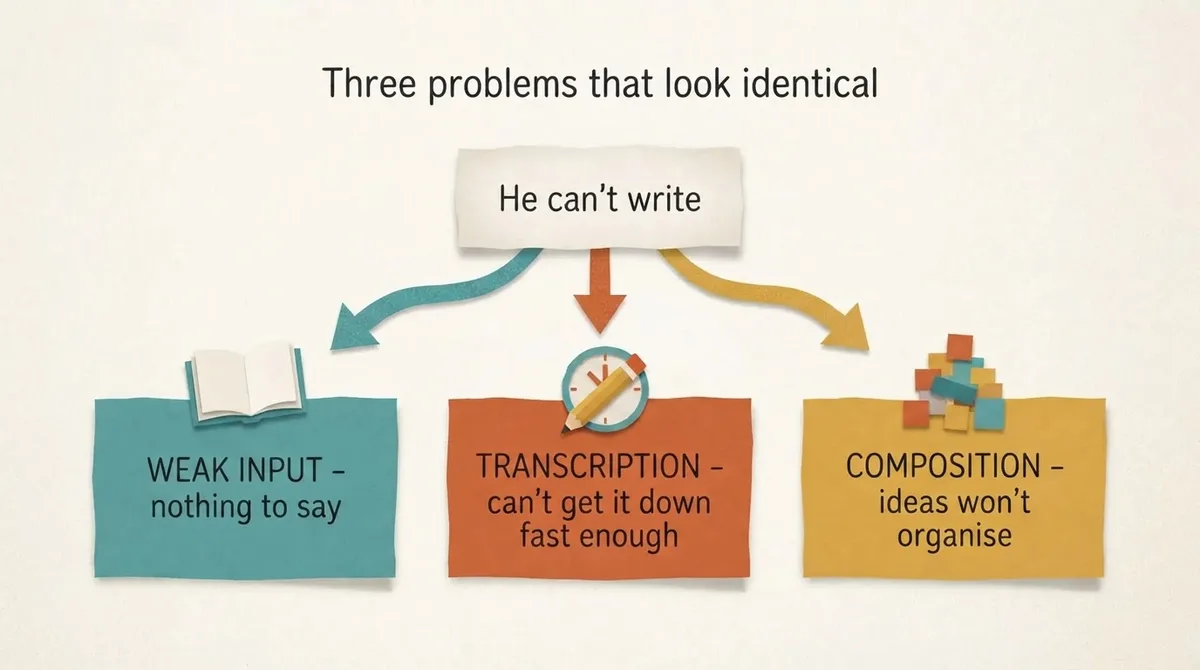
A ten minute diagnostic. Do all three in one sitting, in this order.
- Talk test (3 minutes). Give him a title, say "The Last Train", and ask him to tell you what happens. No writing. If he produces a shaped account with a beginning, a turn and an ending, ideas are not the problem.
- Copy test (3 minutes). Ask him to copy a short printed paragraph in his normal handwriting for exactly 3 minutes, then count the words. Year 5 and 6 pupils are expected to "write legibly, fluently and with increasing speed" so that "problems with forming letters do not get in the way of their writing down what they want to say". Under roughly 15 words per minute copying, or visible effort in forming letters, points hard at transcription.
- Write test (4 minutes). Same title as step 1, now on paper, 4 minutes. Compare the writing with what he said aloud.
Read the pattern:
- Told a good story, copied fast, wrote a good opening: he is fine. Practise timing and finish.
- Told a good story, copied slowly: transcription bottleneck. The story exists; the pipe is too narrow.
- Told a good story, copied fast, but wrote something shapeless: composition weakness. He can generate but not structure.
- Could not tell a story at all: weak input. He has no stock of narrative patterns to draw on, which is a reading problem before it is a writing one.
Route one: the transcription bottleneck
This is the most commonly missed and the most fixable. A child whose letter formation is not automatic is spending working memory on the pencil that a fluent writer spends on the plot. From the outside it looks exactly like a lack of imagination.
What to do, in ten minute doses:
- Measure, then track. Record the 3 minute copy score fortnightly. Movement from 12 to 18 words per minute over a term is a bigger win than any adjective list.
- Fix joins, not letters. Most slow eleven-year-olds are slow on a handful of joins and on capitals. Isolate the two or three that break down and drill only those.
- Reduce erasing. Teach a single ruled line through an error. Rubbers cost minutes and momentum in a 20 to 30 minute paper.
- Attack spelling in the words he actually uses. Take his last piece, pull the six misspellings, and work only those. Keep a short personal list and revisit it through retrieval rather than copying a generic list.
If transcription is genuinely painful rather than just untrained, that is a signal to seek assessment rather than more practice. The Writing Framework's own line is that "it is important to identify the pupils who need additional support with writing as early as possible".
Route two: talk first, write second
The single highest-leverage move for a child who freezes appears on no competing 11+ page, and it comes straight from DfE guidance: "Pupils should compose orally while they are developing their transcription skills. This can still be valuable even when they can transcribe fluently."
In practice, before he writes each paragraph he says it aloud, in full sentences, as it will appear on the page. Not a summary of it. The actual sentences.
A worked example. Title: "The Locked Room". He says: "The handle turned but the door did not move. Dust hung in the light from the window. On the table there was a cup of tea, still warm." Then he writes it. The blank page problem disappears, because he is no longer inventing and transcribing at the same time; he is transcribing something that already exists.
This is also the cheapest intervention available. It costs no materials, works in a car, and can be done in ninety seconds per paragraph. Build towards independence by fading it: aloud to you, then muttered under his breath, then silently rehearsed. Muttering in an exam hall is not viable, but silent rehearsal of the next sentence is a habit that survives into the test.
Route three: composition, plans and sentence craft
If ideas exist and the pencil moves but the piece is shapeless, work on structure and on a small repertoire of moves.
A five minute plan. Four boxes, four to six words each: opening image, the change, the complication, the last line. Write the last line first. Knowing the ending is what stops an eleven-year-old writing a story that runs out of road at the bell.
A small repertoire beats adjective stuffing. The strongest 11+ scripts are controlled, not the most fantastical. Teach four moves and expect them once each, not everywhere:
- A short sentence after a long one, for impact. ("He waited. Nothing came.")
- One precise sensory detail rather than three vague ones. "The corridor smelled of wet plaster" beats "the scary, dark, creepy corridor".
- Dialogue that does a job: reveals a relationship or turns the plot, never small talk.
- A deliberate echo: an image from the opening returned to in the final line.
Match form to task. The national curriculum asks pupils to identify "the audience for and purpose of the writing, selecting the appropriate form". A diary entry, a persuasive letter and a story continuation are marked against different expectations. Use the target school's own task guidance and familiarisation material, then practise the full written experience with paper tests.
Feedback and a weekly habit that does not collapse
Most home writing routines die the same way: a timed paper every Sunday, heavily corrected in red, until the child associates writing with a bad hour and dread does the rest. Given that writing enjoyment nationally has fallen more than twenty points in fifteen years, manufacturing more of that is an expensive mistake.
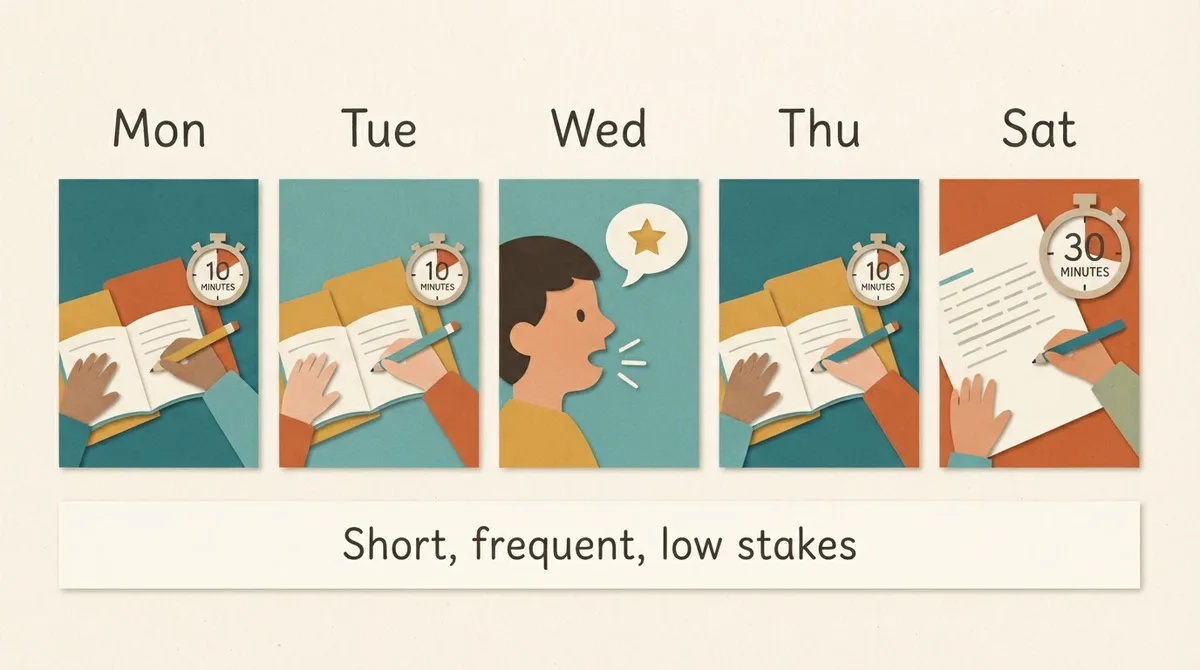
A routine that survives a term:
- Three 10 minute bursts on weekdays: openings only, or one paragraph, never a whole piece.
- One talk-only day: plan and narrate a story, write nothing.
- One longer piece at the weekend, timed to the real paper only in the final two months.
Feedback rule: two things, aimed at the next piece. Name one thing that worked, precisely ("the short sentence after the long one landed"), and one thing to do differently next time ("write your last line before you start"). Do not correct this piece line by line. Correcting a finished piece improves a piece; a forward instruction improves a writer. Keep a simple record of what you asked for and whether it appeared, which is the same logic behind progress tracking: you are looking for a trend, not a score.
Exam day, access arrangements and the stereotypes to avoid
On the day, three things matter more than flair. Spend the planning time (Kent formally allocates 10 of its 40 minutes). Finish the piece, because an unfinished story loses more than a slightly plainer one. Leave two minutes to reread for missing full stops and dropped word endings, which is where most easy marks go.
If handwriting, spelling or processing speed is a diagnosed difficulty, access arrangements exist and are applied for well in advance, with evidence, through the admissions authority rather than on the day. Our guide to 11+ access arrangements for SEND sets out the evidence and deadlines. Extra time granted for a genuine need is not an advantage; it is the removal of an irrelevant obstacle.
Finally, the stereotypes. Do not narrow his reading or his prompts to explosions, sport and battles on the theory that boys need boy-shaped material; the effect is to shrink the range of forms he can write, and range is what markers reward. Do not tell him, or let anyone tell him, that boys are bad at writing, because it is both false for around two thirds of them and a ready-made excuse. Do not treat neat handwriting as a girls' concern when it is a working memory concern. And do not let a national average become a ceiling: the gap describes a population, and you are teaching one child, whose actual bottleneck you can now name.
If you want structured practice around the rest of the paper while you work on writing at home, Trace Learn covers the reasoning and English question types that most selective routes do mark.
Topics
- creative writing
- 11 plus english
- reluctant writers
- handwriting
- parents