
Practice Papers and Mock Tests
Bond and CGP 11 Plus Books Compared
A neutral, non-retail comparison of Bond 11 plus and CGP 11 plus books: question-style fidelity, answer quality, cost per question, and where each brand is genuinely weak.
 Elspeth Marlow
- 14 min read
Search for Bond or CGP 11+ books and most of the prominent pages are publishers or retailers. That is useful for seeing what is in the latest edition, but less useful for deciding which range fits a particular child and local test.
This article is that missing comparison. Trace Learn is a digital 11+ platform, so we are not neutral about everything, but we sell no books and take no affiliate money from either publisher, which means we can say plainly where Bond is weak and where CGP is weak. Both lose at least one category outright below.
One warning first. The most expensive mistake parents make is not choosing the wrong brand. It is buying a full set of books before checking which test their child actually sits.
The short answer, before the detail
If your child sits a GL Assessment paper test and you are in the exam year, CGP makes the format easy to identify because its GL range says so on the cover. Bond also sells revised Assessment Practice books for GL and other admissions tests, plus separate multiple-choice test-paper packs, so the brand name alone no longer settles the question. If you are starting more than a year out, or your child needs to climb gently through difficulty levels, Bond's long age-graded ladder remains its clearest advantage. Many families use Bond early and a format-specific pack from either publisher late.
What neither brand can give you is a score that means anything. We will come back to that, because it is the single largest gap in the paper format and it has nothing to do with which publisher you pick.
Myth one: "Bond or CGP" is the first decision
Reality: the board is the first decision, and the brand is roughly the fourth.
Bond's own explainer is unusually candid. It states that "there is no single national 11+ exam", that "GL Assessment is the most widely used provider for grammar school entrance tests" and that "It is a paper test". It describes Cambridge Select Insight, formerly CEM, as "a digital entrance assessment used by some selective independent schools", and ISEB Common Pre-Tests as "an online assessment" (bond11plus.co.uk). Most comparison content online still frames this as "GL versus CEM", as though CEM were a live grammar-school option you might be preparing for. For the great majority of state grammar applicants, the practical question is GL or the school's own paper.
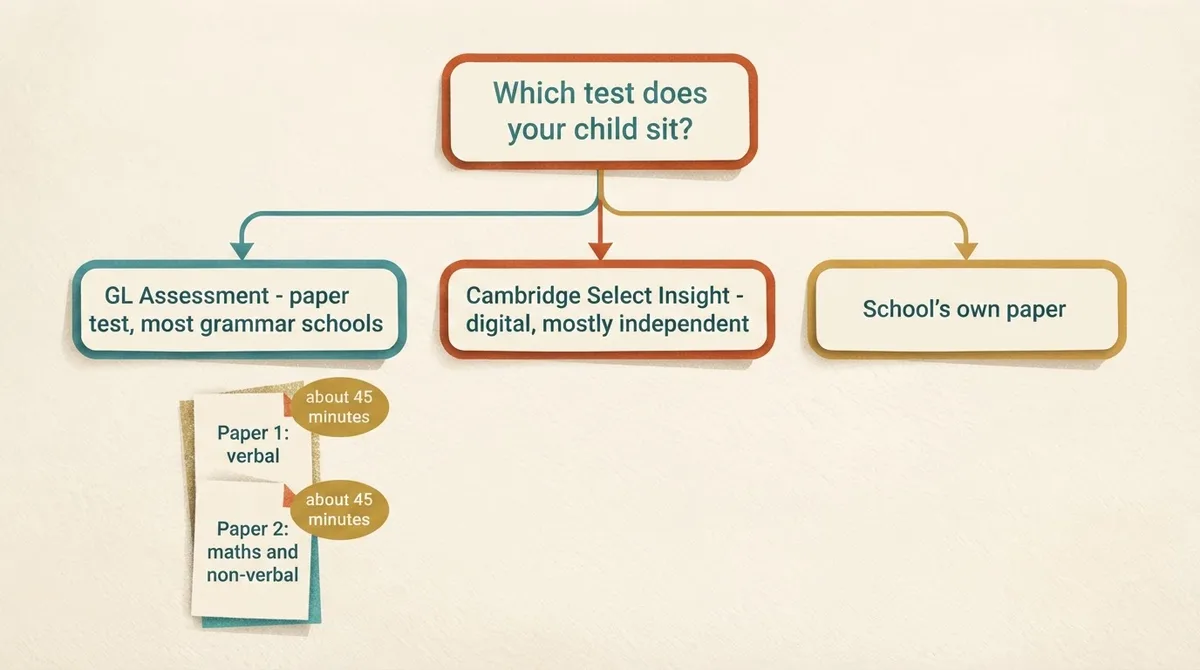
GL Assessment itself warns that "11+ tests vary from area to area" and that "The exact timings for, and number of questions in, your local 11+ test may differ from those in our familiarisation and practice materials", advising parents to check their admissions authority's website (gl-assessment.co.uk). If the publisher of the actual test says that, a workbook cannot promise otherwise.
So before you spend anything, find your local authority or target school's admissions page and write down which subjects are tested, how long each paper is, and whether answers go on a separate sheet. Our guide to the 11 plus exam and how it works walks through how to find that for your area. Then, and only then, choose books.
Myth two: the two ranges are the same product in different covers
Reality: they are built on different organising principles, and it shows in the catalogue.
Bond, an Oxford University Press imprint, organises by age and ability across English, Maths, Verbal Reasoning and Non-verbal Reasoning. Its Assessment series spans ages 5 to 13 for English and maths and ages 5 to 12 for reasoning, and includes titles pitched above the exam year. The Bond structure assumes you might arrive early and climb.
CGP organises by board and narrow age band, and says so on the cover: "11+ GL 10-Minute Tests: English, Ages 8-9", "11+ GL English Practice Book and Assessment Tests, Ages 10-11" (cgpbooks.co.uk). The GL branding is not decoration, it is the product promise: these questions are written to that board's style. Bond's current Assessment Practice descriptions also name GL explicitly, so it is more accurate to call CGP easier to navigate by format than to call Bond board-agnostic.
The consequence is simple. Bond gives you range and progression; CGP gives you targeting. Two years out and unsure of the destination, range is worth more. Eight months out in a GL county, targeting is worth more.
One structural difference catches people out. Bond's ages are ability-shaped as much as chronological, so a strong Year 4 child often works comfortably in a 9-10 book and a struggling Year 5 child may need to drop a band. Buying strictly by school year, in either range, is how families end up with a shelf of books that are all slightly wrong.
Myth three: any decent practice book prepares a child for any question type
Reality: you can grade fidelity against a published syllabus, and the brands score differently.
Take Buckinghamshire, which publishes exactly what its GL-produced Secondary Transfer Test contains. Children sit two multiple-choice papers. One assesses "verbal skills including comprehension, technical English and verbal reasoning". The other covers "mathematics and non-verbal skills including spatial reasoning". "Each paper is about 45 minutes long (60 minutes including the introduction and examples)" (buckinghamshire.gov.uk). That gives us four things to grade a book against.
Multiple choice throughout. Do not assume every book from either publisher uses the format your child will meet. CGP's GL Assessment Tests provide printable multiple-choice answer sheets. Bond sells both standard and multiple-choice test-paper packs, while its broader skill-building books are not all test simulations. Read the product title and sample pages, not just the logo. A child who has only ever written answers in a box will lose time learning to eliminate options and use a separate answer sheet under pressure.
Separate answer sheets. Buckinghamshire runs a shorter, unmarked practice test beforehand specifically to familiarise children with question types, test style and "using separate answer sheets". Both publishers supply answer sheets with the appropriate paper packs, but neither trains the specific failure mode, which is a child slipping a row and mis-marking every subsequent answer. That is a drill you have to invent yourself.
Spatial reasoning. This is the gap most parents miss. Buckinghamshire's second paper explicitly includes spatial reasoning, which is not the same thing as standard non-verbal reasoning. Cube nets, 3D rotation, folding and hole punches behave differently from matrices and sequences. Neither publisher's brand name proves that the particular title in your basket covers every subtype. If your test names spatial reasoning, check the contents page before you buy.
Technical English. The phrase covers grammar, punctuation, spelling and vocabulary as testable knowledge rather than as writing craft. Both ranges cover these skills, but the presentation differs. Bond uses a measured workbook style and CGP uses the compressed, informal revision-guide voice familiar from its other ranges. Which suits your child is genuinely a matter of temperament, so compare sample pages with the child who will actually use them.
Myth four: an answer key is an answer
Reality: what a book does when a child is wrong matters more than what it does when they are right, and edition dates matter here.
A bare key tells you the answer was C. It does not tell you why the child chose B, which is the information a parent actually needs. CGP's Practice Book and Assessment Tests include detailed answers. Bond's older catalogue is variable, but its revised Assessment Practice books and current 10 Minute Tests with Answer Support now advertise full explanations too. Check the exact ISBN if buying second-hand, because an older cover can mean an older answer section.
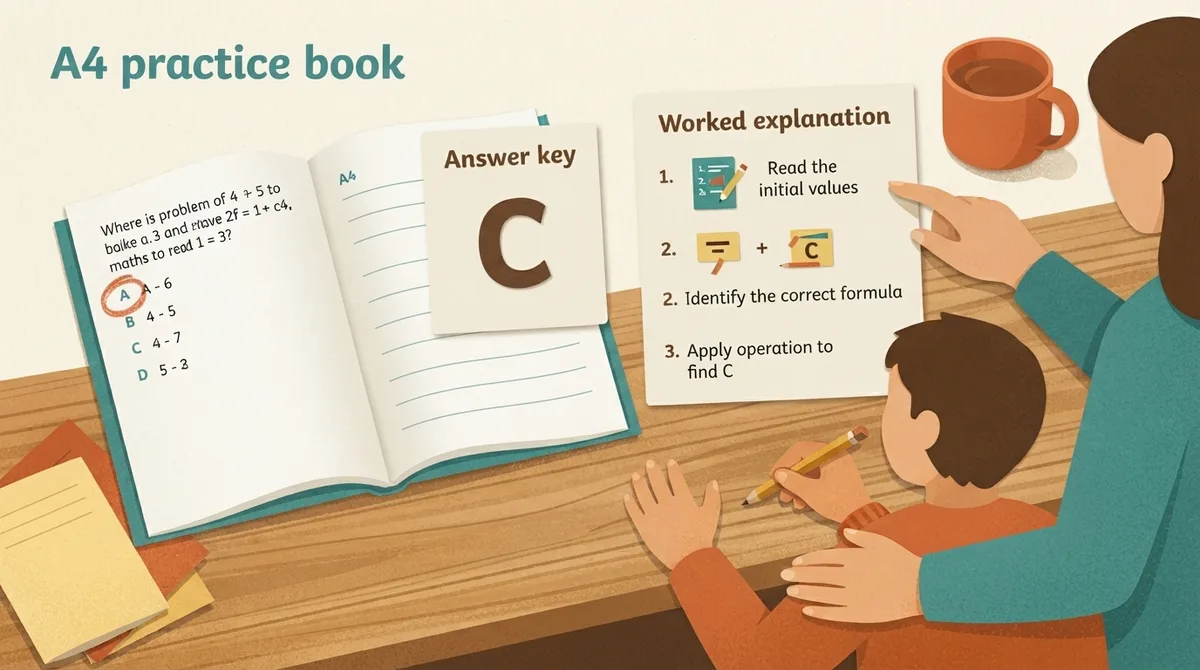
This matters most in the two subjects with no National Curriculum equivalent. GL Assessment warns that children "may not have encountered these types of questions before", particularly verbal and non-verbal reasoning. A parent who has never sat a verbal reasoning paper cannot reconstruct the method from a letter. If you are not planning to tutor, weight answer quality heavily and buy a current edition that explicitly promises worked or fully explained answers.
Bond's parent-facing material, including its Parent's Guide, book selector and reading lists, is particularly developed. CGP also publishes a free parent guide and printable answer sheets. The useful distinction is therefore not "Bond guides parents, CGP explains answers". It is whether the exact edition supplies the explanation and format support your family needs.
Myth five: the cheaper cover price means the cheaper preparation plan
Reality: the number of suitable books you need matters more than a single cover price.
Bond currently lists many individual Assessment Practice and 10 Minute Tests titles at £7.99, and its four-subject Assessment Practice Book 1 bundle for ages 10-11 at £32 (bond11plus.co.uk). CGP prices vary by title, bundle and retailer, so compare the current four-subject basket rather than a single book against a bundle.
Now do the real sum. Bond's model makes it tempting to buy several books across several age bands. Eight £7.99 books cost £63.92 before any full-length paper packs. CGP's age-banded catalogue can also multiply quickly if you buy 10-minute tests, practice books, stretch books and paper packs together. Start with one diagnostic book or free sample, then buy only the weakest subjects and the final format-matched papers.
Bond can be good value when you want an age-graded path, while CGP makes a targeted GL basket straightforward. Either can become expensive if you buy the catalogue rather than the gaps. Before either, work through the free material: our roundup of free 11 plus practice papers with answers covers what genuinely exists, including GL's own familiarisation PDFs, and it is more than most parents expect.
Where each brand loses outright
Bond loses on catalogue clarity. Its breadth is useful, but a parent can easily confuse skill-building Assessment Practice, 10 Minute Tests, standard test papers and multiple-choice test papers. Current revised titles have improved answer support and several name GL explicitly, but you still need to inspect the exact product rather than treating every Bond cover as a mock exam.
CGP loses on breadth at the youngest end. Its 11+ range starts later than Bond's long assessment ladder, so families looking for gentle Year 1 or Year 2 skill-building have fewer steps to choose from. Its cheerful, compressed house voice also divides opinion: some children find it approachable, while others need a calmer page.
A note on reviews, since parents will find them. Separate comments about a publisher's online subscription, delivery or account handling from reviews of a specific printed title. They are different products, and a review of one is weak evidence about the other.
What neither brand can do
Books cannot standardise, and this limitation of the format is bigger than everything above. Buckinghamshire is explicit: GL Assessment marks the papers, the marks are then standardised, and "A child's 'standardised score' will be between 60 and 170". Standardisation "takes into account each child's age in years and months on the date they take the test", which "makes sure that all children are placed on an equal footing and that no child is unfairly advantaged or disadvantaged because of their age". In that county, a score of 121 or above qualifies for grammar school, and roughly 37% of children are expected to reach it (buckinghamshire.gov.uk).
Now consider what "32 out of 40" in the back of a Bond or CGP book tells you against that. Nothing about where your child sits in a cohort. No age adjustment, so a July-born child is measured on exactly the same raw scale as a child ten months older, which is precisely the distortion the real test corrects for. And no way of knowing whether 32 out of 40 on that particular book corresponds to anything near a qualifying score.
This is why timed practice with reporting is a genuinely different activity from working through a book, and why many families do both. Trace Learn's mock tests use common GL-style formats and show subject and topic breakdowns that a printed page cannot calculate for you. Books build method. Timed digital practice reveals pacing and patterns of weakness. Neither replaces the other.
A 12-week schedule for a Bond or CGP set
This works with either brand: three to four sessions a week, none longer than 40 minutes.
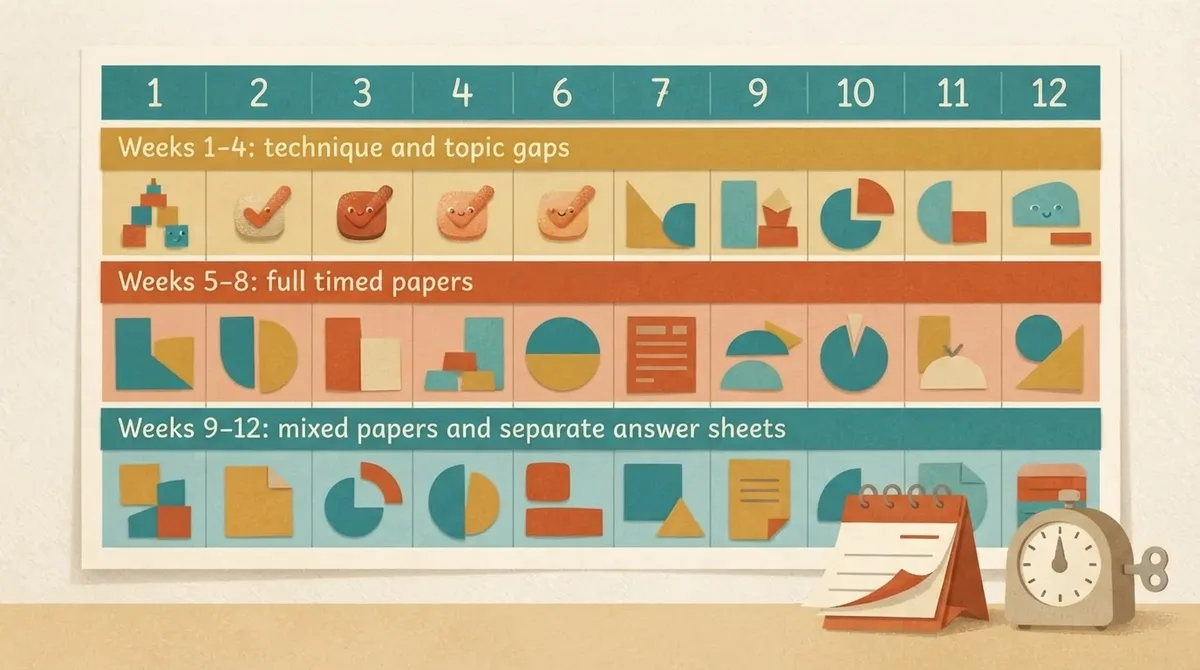
- Weeks 1 to 2, diagnose. Untimed short tests in all four subjects. You are looking for topic gaps, not scores. Log every wrong answer by type, not by mark.
- Weeks 3 to 5, method. Weakest two subjects only, untimed, with the explanation read aloud after every error. This is where CGP's worked answers earn their price.
- Weeks 6 to 8, introduce the clock. Ten-minute tests at full pace. Accuracy at speed beats completion; let questions go unanswered rather than let panic set in.
- Weeks 9 to 10, full papers. One 45-minute paper per week per subject group, at a table, no interruptions, answers on a separate sheet if your test uses one.
- Weeks 11 to 12, mixed and rested. Alternate a full timed paper with a light review session. Reduce volume in the final week rather than increasing it.
If you have longer than 12 weeks, do not stretch this plan thin. Use the extra months on reading, vocabulary and mental arithmetic, then run the 12 weeks as written. Our year by year preparation plan sets out what belongs in each earlier stage.
So which should you buy?
Buy CGP if your child sits a GL paper test, you are inside a year of the exam, and you want the board and age band stated prominently. Choose a current Practice Book and Assessment Tests title when detailed answers matter, and still check that its included question types match your local test.
Buy Bond if you are more than a year out, your child needs to climb through ability bands, or you want the broader parent-facing scaffolding. For final GL preparation, choose one of Bond's current GL-suitable, multiple-choice products rather than assuming a general assessment book reproduces test day. Use Bond's book selector or a sample before you order.
Buy both, in sequence, if you have the runway. Bond to build, CGP to sharpen. Then, whichever you choose, get the child sitting timed papers under something resembling real conditions, because a book score is not a standardised score and never will be.
Frequently asked questions
Are CGP books good for 11+?
Yes, with a condition. CGP's GL range is labelled clearly and its Practice Book and Assessment Tests titles include detailed answers, so it is a sensible candidate if your area uses GL. It is a weaker choice at the youngest end of preparation, and no national book can guarantee an exact match because local timings and question mixes differ.
Is Bond harder than CGP?
Not systematically. Difficulty varies by product, age band and whether the task is standard-answer or multiple choice. Bond also publishes above the exam year, so a Bond 11+ to 12+ book can feel harder than a CGP Ages 10-11 book by design. Compare equivalent ages and formats before drawing a conclusion.
Which books are best for 11 Plus?
The best book is the one written for your child's test, at your child's current level, with answers you can explain. That is a different book for a Year 4 child in an area with school-set papers than for a Year 6 child sitting a GL test in eight weeks. Check the admissions page first.
Can I just use free PDFs?
You can get a long way. GL Assessment publishes 10 hours of free familiarisation materials as downloadable PDFs across all four subjects (gl-assessment.co.uk), your council may publish a familiarisation booklet, and both Bond and CGP offer free samples. What free material rarely gives you is volume at consistent difficulty or reliable answer explanations. We do not link to pirated papers, and neither should anyone else.
Do book scores predict a pass mark?
No. Real 11+ marks are standardised and age-adjusted against a cohort. A raw mark from a workbook has no cohort behind it and applies no age adjustment, so it cannot be compared to a qualifying score such as Buckinghamshire's 121. Use book scores to track improvement in a single child over time, and nothing more. Formats, thresholds and subjects vary considerably by area, so always confirm the detail with your own admissions authority.
Topics
- bond 11 plus
- cgp 11 plus
- practice papers
- gl assessment
- 11 plus resources