
11 Plus Tutors, Apps and Self Study: Costs and How to Choose
Verified 2026 tutor and app prices, free council and GL Assessment familiarisation materials, and three fully costed 12-month budgets so you can choose a route on evidence rather than anxiety.
 Elspeth Marlow
- 15 min read
Search for an 11 plus tutor and you will get a page of people who sell tutoring. That is not a conspiracy, it is just how a commercial search result works. But it produces a strange gap: the two questions parents most often ask before they commit, how much does an 11 plus tutor cost and should I get one at all, are the two questions the ranking pages are least able to answer honestly. A tutoring agency that publishes an hourly rate risks losing the enquiry, and one that says "your child may not need this" is arguing itself out of a job.
Compare like-for-like costs and check the date attached to each price. Below are real prices checked against the marketplaces' own live listings and pricing pages on 27 August 2026, the free official preparation route that several councils and GL Assessment already fund, and three fully costed twelve-month budgets with the arithmetic shown. No success-rate claims, no guarantees, and no pretending that the most expensive route is automatically the best one.
The conclusion, stated up front so you can stop reading if it settles the matter: the right route depends on the child, not the budget. A confident Year 5 child who already works independently may need nothing more than free familiarisation material and a parent with a calendar. A child who has never seen a non-verbal reasoning question and loses heart when stuck may get more from six weeks of good tutoring than from a year of any subscription. Spending 1,800 pounds because everyone in the class is doing it is not a strategy; a year by year 11 plus preparation plan is.
Myth: "everyone charges roughly the same, so shop on quality"
Rates for 11 plus tuition in 2026 vary by roughly a factor of eight, and the spread is not a quality signal in any reliable sense.
On MyTutor, 11-Plus tutors are advertised "from 26 pounds per hour", and the live profiles on that listing run up to about 85 pounds per hour, with a free introductory video meeting offered before you book. Tutor Hunt advertises Eleven Plus lessons "from 15 pounds per hour" while its actual live profiles run from around 30 pounds to 123 pounds per hour, with the bulk clustering in a 45 to 65 pound band; it states that its tutors are enhanced DBS checked and ID verified. Tutorful listings sit broadly in the 34 to 60 pound range. GoStudent prices 50-minute classes rather than full hours, with its current 12-month examples ranging from 22.71 to 30.97 pounds per lesson depending on lesson frequency.
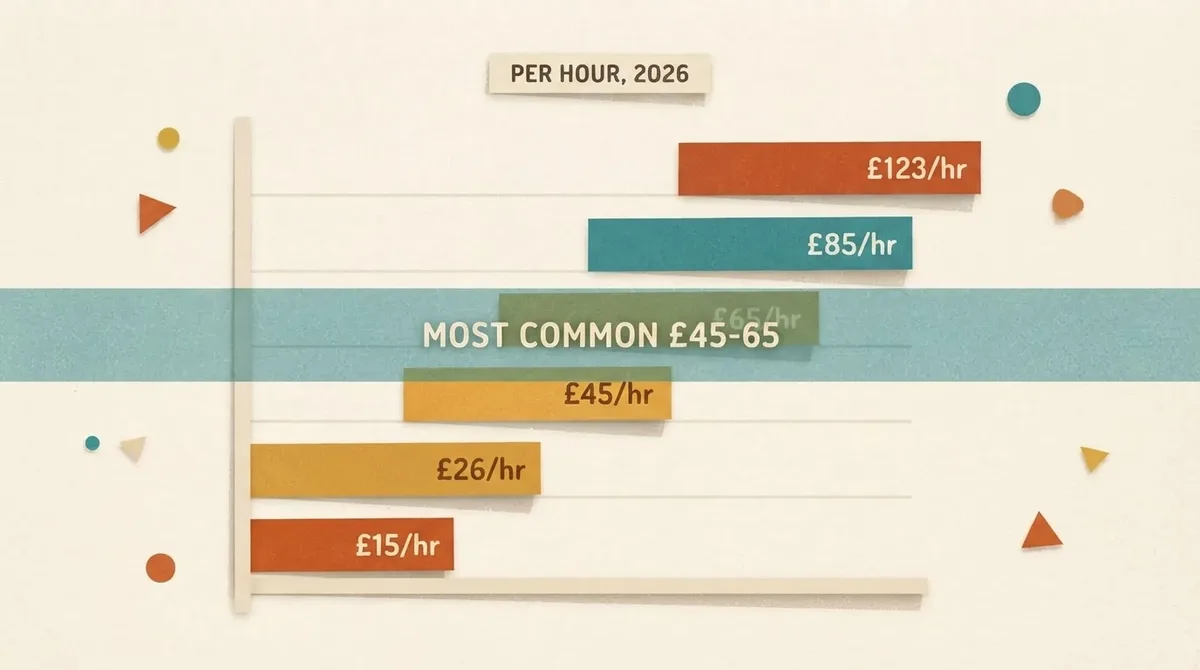
The reality behind that spread has four drivers, and only one of them is teaching quality.
- The "from" price is a floor, not an average. Every marketplace advertises its cheapest tutor. If you filter for someone with several years of 11 plus experience in your target area's format, expect to land in the middle of the band, not at the bottom.
- Region. London and the commuter belt price higher, and the demand data supports it: the Sutton Trust's Private Tutoring 2026 research found 45 per cent of secondary students in London had received private tutoring at some point, against 27 per cent in the rest of England and 24 per cent in Wales, and 33 per cent in urban areas against 19 per cent in rural ones.
- Format. Online tuition removes travel time and usually costs less than an in-home tutor covering the same hour. Small-group and centre formats cost less per session again, at the price of less individual attention.
- Tutor type. An undergraduate on a marketplace and an experienced ex-teacher who builds a bespoke plan are both "an 11 plus tutor" in search results. They are not the same product, and the price gap mostly reflects that.
One practical consequence: do not treat a 123 pound per hour profile as proof of superiority, and do not treat a 26 pound one as a bargain. Ask what happens between lessons, because that is where the difference usually lives.
Myth: "apps are the cheap option, tutors are the serious one"
App and centre pricing is public and easy to check, which is exactly why it is worth doing.
Atom Learning publishes three UK tiers for ages 7 to 11+: EMS at 39.99 pounds per month, or 31.99 pounds per month billed annually, which works out at 383.90 pounds a year; Exam Prep at 59.99 pounds per month, or 47.99 pounds monthly billed annually, at 575.90 pounds a year; and Exam Prep Plus, adding unlimited mock tests with instant marking and feedback, at 69.99 pounds per month, or 55.99 pounds billed annually, at 671.90 pounds a year.
Explore Learning, which offers online and in-centre tuition, publishes small-group 11 plus tuition at 22 pounds per session for two weekly sessions, from 190 pounds per month, and 18 pounds per session for three weekly sessions, from 240 pounds per month, with no joining fee and three mock exams included. It also lists one-to-one tuition from 42 pounds per session for a weekly session. Run the small-group monthly figures across a year and the route sits at roughly 2,280 to 2,880 pounds, which is above many one-to-one tutor budgets, not below them.
That is the point. "App" and "tutor" are not price tiers. A weekly online tutor at the marketplace floor can cost less than a premium centre package, and a top app tier can cost more than a term of fortnightly tuition. Compare the actual numbers for your actual plan.
Myth: "there is nothing decent for free"
This is the claim the commercial SERP most needs you to believe, and it is the one that falls apart fastest.
GL Assessment, which produces many of the 11 plus tests sat in England, publishes around ten hours of free familiarisation materials covering verbal reasoning, non-verbal reasoning, English and maths, as PDFs you print at home. GL notes they are "particularly useful for verbal reasoning and non-verbal reasoning tests as children may not have encountered these types of questions before". Full practice papers are a separate paid product, sold as printed booklets. Note too that GL states private tutors and other organisations may not host, copy or redistribute those materials without prior consent, so download them yourself from the official page rather than accepting a tutor's photocopies.
Councils go further in places. Warwickshire County Council provides children in Years 3 to 6 who are eligible for Pupil Premium with free Atom Home access through a partnership with Atom Learning. The programme is described as helping children get familiar with the question types they may see, make progress with the Key Stage 2 curriculum and build confidence. Eligibility includes pupils who have been eligible for free school meals at any point in the last six years. In plain terms: in that area, a family that qualifies can access a paid app tier at no cost.
Buckinghamshire runs its Secondary Transfer Test with no stated registration fee, automatically enters children at state-funded Buckinghamshire primary schools, and runs a shorter practice test, usually two days before the main test, so children learn what to expect. Redbridge points parents to GL's free resources directly.
The honest caveat comes from Redbridge itself, which warns that free materials "might not match the exact test your child will take", because question number, type or difficulty can vary. That is the real limit of the free route, and it is a gap-filling problem rather than a starting-point problem. Start free, find the gap, then spend on the gap. Our guide to free 11 plus practice papers covers what to do with the material once you have it.
Three fully costed twelve-month budgets
Assume a child starting in the September of Year 5 for a test in Year 6. All figures below use the verified prices above. Printing and stationery are estimated at 25 pounds and flagged as an estimate; everything else is a published price.
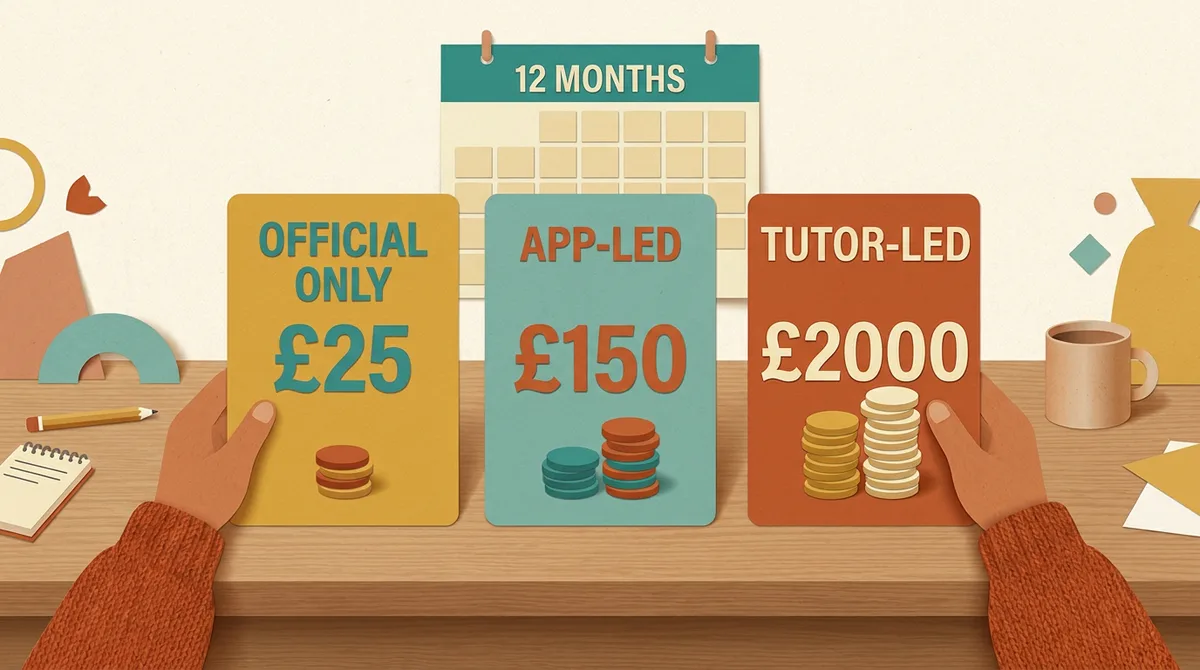
Route A: official only. Registration in the areas checked above carries no stated fee. GL familiarisation PDFs are free. Add printing at about 25 pounds, one set of printed practice booklets at roughly 30 to 40 pounds, and one paid mock at 25 to 40 pounds if you want a timed dress rehearsal. Twelve-month total: broadly under 110 pounds.
Route B: app-led with a parent running the timetable. Atom EMS billed annually is 383.90 pounds. Add the same 25 pounds of printing and one external mock at 30 pounds. Twelve-month total: about 440 pounds, or about 630 pounds if you step up to Exam Prep. A year of structured, marked practice for less than ten tutor hours at the mid-market rate.
Route C: tutor-led. One hour a week for 40 teaching weeks at 45 pounds per hour is 1,800 pounds. At the MyTutor floor of 26 pounds it is 1,040 pounds; at 65 pounds it is 2,600 pounds. Add materials at roughly 100 pounds and two mocks at 60 pounds and a mid-market tutor year lands near 1,960 pounds. At GoStudent's current example rates, one 50-minute class a week for 40 weeks gives a range of about 908 to 1,239 pounds. A twice-weekly Explore Learning small-group package runs 2,280 pounds or more across twelve months.
Route D, the one nobody sells: hybrid. Atom EMS annually at 383.90 pounds plus ten targeted tutor hours at 45 pounds, used as a six-to-ten week block on the single weakest area, is 834 pounds. That is under half a tutor year, and for many children it is the better-shaped spend, because the app supplies volume and marking while the tutor supplies diagnosis on the one thing volume will not fix.
The arithmetic that matters is the difference between Route B and Route C: roughly 1,500 pounds. Before committing that, it is worth asking what specifically the extra 1,500 pounds buys for your child. Sometimes the answer is clear and worth every penny. Sometimes it is accountability that a shared family calendar would provide free.
To run the same sums on a quote you have been given, enter it below. It starts at 40 teaching weeks to match the budgets above.
This part of the guide works out what a year of tuition costs from a quote. It works in your browser.
Matching your child's profile to a route
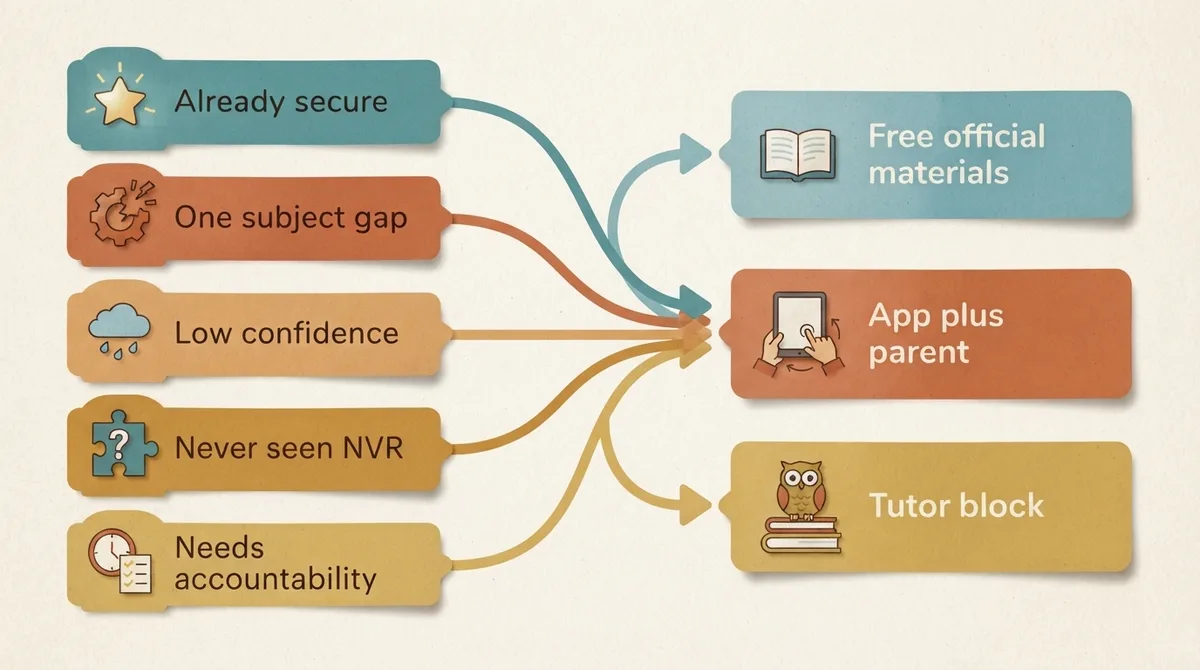
- Already secure across all four subjects, works independently. Free official materials plus timed practice. Add a mock or two in the final term. Reassess in three months rather than buying a year of anything.
- One specific subject gap, strong elsewhere. A short tutor block of six to ten hours aimed squarely at that gap, or an app used selectively. Do not buy weekly general tuition to fix a maths topic list.
- Low confidence, gives up when stuck. This is the strongest case for a human. A tutor who can read frustration in real time and adjust does something no software currently does well. Consider a fixed block, then review.
- Has never seen non-verbal reasoning. Start with the free GL familiarisation set, which is explicitly aimed at exactly this. Most children need exposure and method, not tuition. Our walkthrough of non-verbal reasoning question types covers the method side.
- Needs external accountability, and home sessions end in arguments. A tutor, a centre or a group class buys a fixed appointment and takes the parent out of the enforcement role. That is a legitimate thing to pay for, as long as you name it as what you are buying.
When a tutor genuinely beats an app, and when it does not
A tutor is worth the premium when the problem is diagnostic or emotional. Diagnostic: your child gets 60 per cent on a paper and neither of you can work out why, because the errors are scattered across topics and look random. A good tutor will find the pattern in one session. Emotional: your child has decided they are bad at maths, and no amount of correctly marked practice is going to shift a belief.
A tutor is also worth it when the local test format is unusual and you need someone who has actually prepared children for it, or when the timeline is short and you cannot afford a slow start.
A tutor is poor value when the real need is volume, marking and consistency. A weekly hour delivers 40 hours a year. An app delivers as much practice as a child will do, marks all of it instantly, and costs a quarter as much. Paying 1,800 pounds for something that a 400 pound subscription plus a parent with a calendar would achieve is the single most common overspend in 11 plus preparation. It is also worth being clear that tutoring access is not evenly distributed: the Sutton Trust reports 23 per cent of children in the worst-off households have had private tutoring, against 30 per cent in the best-off. A route that depends on 1,800 pounds should never be presented as the only route that works.
Before you buy anything at all, do one baseline: a timed paper under exam conditions. Sitting a full mock exam early tells you more about what to buy than any amount of comparison shopping. If you want a marked baseline without organising it yourself, our mock tests are built for exactly that.
How your local test changes the plan and the price
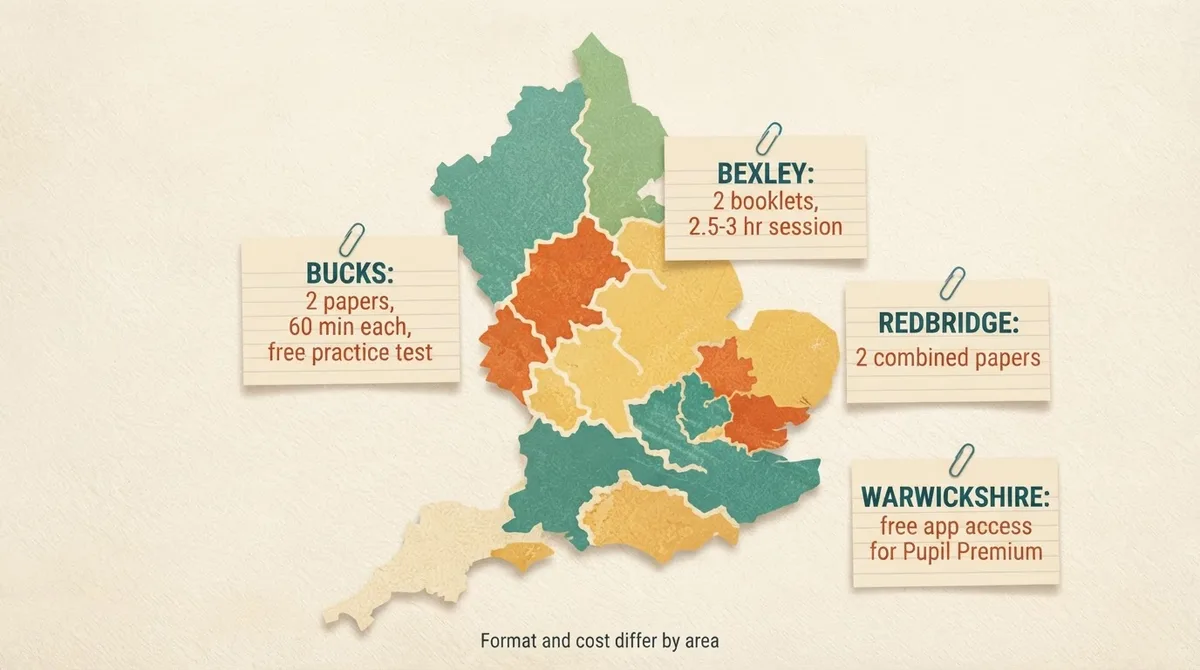
Formats differ by area, and the difference changes what you need to buy.
Buckinghamshire's Secondary Transfer Test measures verbal, non-verbal and mathematical skills, uses two papers of about 60 minutes each with a break between, is produced by GL Assessment, and includes that shorter practice test two days beforehand. Registration for 2026 opened on 1 May with a 3pm deadline on Tuesday 2 June, children at state-funded Buckinghamshire primaries are entered automatically, and the council states it will not normally accept late registrations without exceptional reasons. Because GL produces it and GL publishes free familiarisation, the free route covers more ground here than almost anywhere.
Bexley uses two separate booklets covering verbal ability and English comprehension, numerical reasoning and non-verbal reasoning. Each paper lasts about 50 minutes plus instruction time, and the council states each session runs from two and a half to three hours including instructions, both papers and a short break. Familiarisation is signposted to Quest Assessments rather than published by the council, so the free-material coverage is thinner and stamina practice matters more. Budget for stamina rehearsals, not just topic work.
Redbridge, for Ilford County High School for Boys and Woodford County High School for Girls, uses two combined papers, English and Verbal Reasoning, and Mathematics and Non-Verbal Reasoning. Registration for 2026 opened on 1 May and closed at 5pm on Monday 15 June, with the test on Friday 18 September 2026. The council points parents to GL's free resources but explicitly warns that free materials might not match the exact test.
So the gap-filling cost is area-specific. In a GL area, free plus a printed booklet may genuinely be enough. In a Bexley-style long session, the spend should go on timed full-length rehearsals. In a combined-paper area, it should go on switching between subjects within one paper. Check your own council's page before you spend, and if the timeline is what worries you, our year-by-year view of when to start 11 plus preparation sets out what belongs in each stage.
Questions to ask before you pay an 11 plus tutor
If you do go the tutoring route, these separate the professionals from the profiles.
- What is your hourly rate, and does it include planning, marking and any materials?
- Have you prepared children for my specific area's format, and what does that format involve?
- What will you set between lessons, and who marks it?
- How will you tell me whether this is working, and when would you tell me to stop?
- What is your notice period, and can we start with a fixed block rather than an open-ended weekly slot?
- Are you DBS checked, and can I see it?
Question four is the one that matters most, and the one that filters hardest. A tutor who cannot describe a scenario in which they would recommend stopping is selling a subscription rather than a service.
The honest conclusion
Start free. Download the official familiarisation material, check whether your council funds anything, and sit one timed paper. That costs almost nothing and produces the only information that should drive the decision.
Then spend against the gap that baseline reveals. If the gap is volume and consistency, an app year at under 400 pounds is the efficient answer. If it is diagnosis or confidence, buy tutor hours in a block and review honestly at the end. If it is neither, do not buy anything yet, and revisit in a term.
The most expensive route is not the safest one, and the cheapest is not automatically a compromise. If you would like structured practice, marking and a plan without committing to a tutor year, you can see what is included on our pricing page and decide from there.
Topics
- 11 plus tutor
- costs
- self study
- apps
- parents