
11 Plus Maths Questions with Worked Answers
Twenty-two original 11+ maths questions on the page, ordered easy to hard the way a real paper is, each with the full method and the fastest mental route. Plus the technique split nobody mentions: multiple-choice papers and written papers reward different tactics.
 Elspeth Marlow
- 15 min read
You searched for questions and Google handed you papers. Almost every page competing for this phrase is a directory of PDF download links: a table of school names, a column of years, and a promise that the answers are in there somewhere. That is useful when you want a full timed sitting on a Saturday morning. It is useless at nine o'clock on a Tuesday when your child has ten minutes before bed and you simply want to know what an 11+ maths question actually looks like.
So this page does the literal thing. Below are twenty-two original 11+ maths questions on the screen, no download required, arranged from straightforward to genuinely hard in the same shape a real paper takes. That ordering is not our invention: Bancroft's School describes Section A of its own entrance paper as "about thirty questions in increasing order of difficulty", with a later section reserved for "more difficult, non-standard problems" (Bancroft's 11+ maths paper). Every question here comes with the full method rather than a bare answer, and where a faster route exists in your head, we give that too. No board allows a calculator, and Buckinghamshire allows no scrap paper, ruler or protractor either, which turns the in-your-head route from a nice extra into a scored skill.
We have laid the questions out as a walkthrough of a single sitting, block by block, with the clock running the way it would in the hall. Work through it start to finish and your child meets the topics in the order a real paper serves them. Dip in at whichever block is currently causing trouble and it still works.
First, the ten-second question that changes everything: which paper is your child sitting?
11+ maths papers split into two incompatible species, and the difference matters more than any topic list. Nobody on the first page of results tells you this, which is why so much generic advice lands badly.
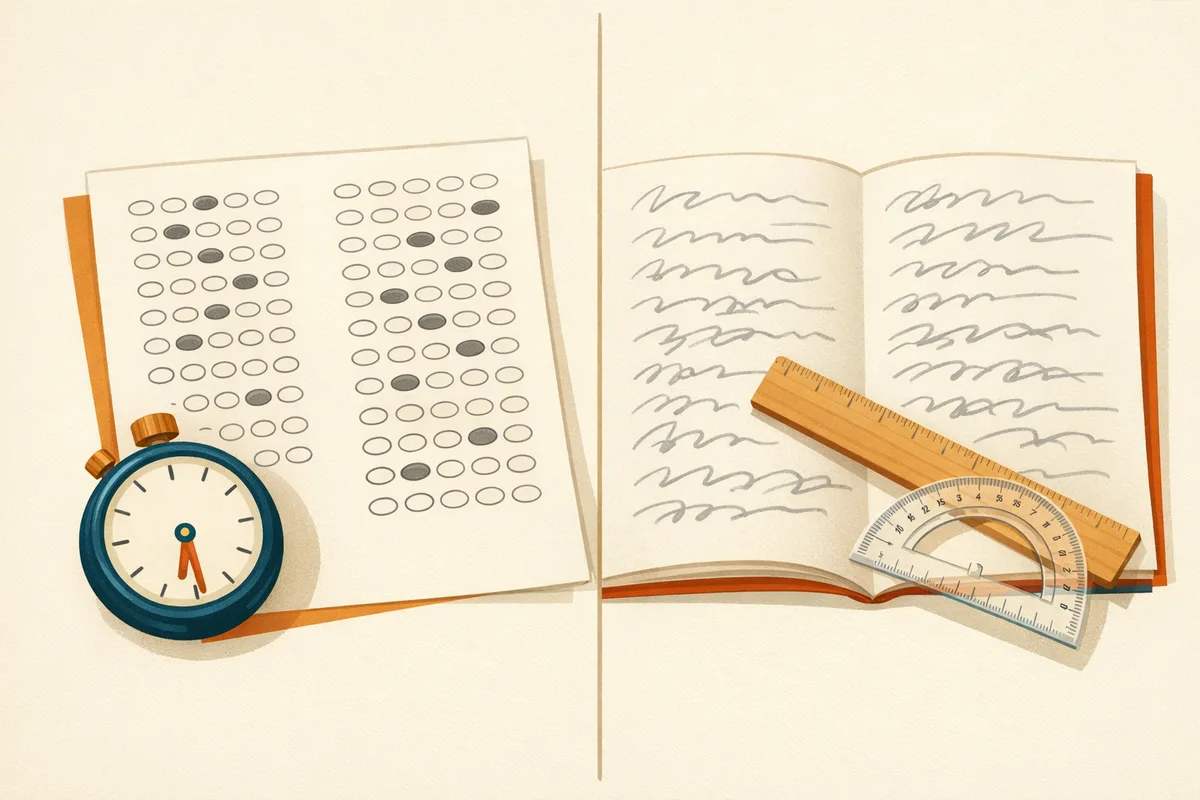
Species one: short, multiple-choice, computer-marked. The Buckinghamshire Secondary Transfer Test uses two booklets in which "All the questions are multiple-choice", with answer sheets that "will be marked by a computer", and the mathematics section runs to 25 minutes plus 5 minutes of practice (Buckinghamshire familiarisation booklet). The first Kent Test paper is similar: one hour combining English and maths, each section a 5 minute practice exercise followed by a 25 minute test on a separate computer-marked sheet (Kent County Council). Here there are no method marks. A wrong answer with beautiful working scores zero, and the options on the page are a tool you are allowed to exploit.
Species two: long, written, partially marked. The CSSE maths paper for 2022 entry in Essex allows 60 minutes for 60 marks across twelve pages, with individual questions carrying between 2 and 7 marks. Bancroft's runs 75 minutes across two sections. In these papers, working earns credit, so an abandoned half-solution can still bank marks. Note also what CSSE's rubric permits: candidates "may work the questions out in your head, or by writing on the white area around the question", with no answer booklet and no scrap paper.
Both species are built on the same statutory Key Stage 2 content: number and place value, the four operations, fractions and percentages, ratio and proportion, algebra, measurement, geometry and statistics, with pupils expected to be "fluent in written methods for all 4 operations" by the end of Year 6 (national curriculum programmes of study). If you want the full topic map before you start, our guide to every 11+ maths topic and question type sets it out. If you are still unsure which board your area uses, start with GL, CEM and ISEB compared.
Each worked answer below carries a note on which technique the question rewards.
Minutes 0 to 10: number, place value and the four operations
Real papers open gently. The first questions test whether the machinery is fluent, not whether your child can think laterally. Anything here that takes more than about thirty seconds is a warning light.
Question 1. Write four hundred and six thousand and ninety in figures. Answer: 406090. Build it column by column from the words: 406 thousands, then no hundreds, then 9 tens, then no units. The trap is writing 406,900 by sliding the ninety into the wrong column. Fast route: say the number aloud and count how many digits must follow "thousand", which is always three.
Question 2. What is 7000 minus 2486? Answer: 4514. Subtracting from a row of zeros is where careless marks vanish, so count up instead: 2486 to 2500 is 14, 2500 to 7000 is 4500, and 14 plus 4500 is 4514. Fast route: counting up beats borrowing every time when the top number is round.
Question 3. A crate holds 24 tins. A shop orders 17 crates. How many tins? Answer: 408. Long multiplication gives 24 times 10 equals 240 and 24 times 7 equals 168, totalling 408. Fast route: 17 times 24 is 17 times 25 minus 17, which is 425 minus 17, or 408. Format note: on a written paper, show the partition; the method is worth marks even if the arithmetic slips.
Question 4. What is the smallest whole number greater than 20 that leaves a remainder of 3 when divided by both 4 and 5? Answer: 23. Numbers leaving remainder 3 with both divisors are 3 more than a common multiple of 4 and 5, and the lowest common multiple is 20, so the sequence is 3, 23, 43. Format note: on a multiple-choice paper, test each option against both divisions rather than deriving anything.
Minutes 10 to 20: fractions, decimals and percentages
This is the block that separates candidates, largely because children who are fluent in one representation freeze when the question switches to another.
Question 5. What is three eighths of 240? Answer: 90. Divide by the denominator first, then multiply: 240 divided by 8 is 30, and 30 times 3 is 90. Doing it the other way round means multiplying 240 by 3 in your head for no benefit. Fast route: always divide before you multiply with fractions of amounts.
Question 6. Put these in ascending order: 0.7, three fifths, 65 per cent. Answer: three fifths, 65 per cent, 0.7. Convert everything to decimals: three fifths is 0.6, 65 per cent is 0.65, and 0.7 stays put. Fast route: decimals are the cheapest common currency, so translate into decimals rather than into fractions.
Question 7. A coat costs 80 pounds and is reduced by 15 per cent. What is the new price? Answer: 68 pounds. Ten per cent of 80 is 8 and 5 per cent is half of that, so the reduction is 12 pounds. Fast route: build every percentage from 10 per cent, 5 per cent and 1 per cent rather than reaching for a formula.
Question 8. Priya spends two fifths of her money, then one third of what is left. She has 24 pounds remaining. How much did she start with? Answer: 60 pounds. After spending two fifths she has three fifths left; spending a third of that leaves two thirds of three fifths, which is two fifths of the original. So two fifths equals 24 pounds, one fifth is 12, and the whole is 60. Format note: this is a classic multi-mark written-paper question, so write the fraction remaining at each stage.
Minutes 20 to 35: ratio, proportion and early algebra
Buckinghamshire's own booklet warns candidates that "You may find some of the mathematics questions more difficult than you are used to" because they test the ability to use existing knowledge on new problems. Ratio is where that usually bites.
Question 9. Share 45 pounds in the ratio 4 to 5. Answer: 20 pounds and 25 pounds. Add the parts to get 9, divide 45 by 9 to find one part is 5 pounds, then multiply out. Fast route: find the value of one part and everything else falls out instantly.
Question 10. Five identical pens cost 3 pounds 60. What do eight cost? Answer: 5 pounds 76. Unitary method: 3.60 divided by 5 is 0.72, and 0.72 times 8 is 5.76. Fast route: 72 times 8 is 576, so place the decimal point at the end rather than carrying it through the multiplication.
Question 11. If 3n plus 7 equals 34, what is n? Answer: 9. Subtract 7 from both sides to get 3n equals 27, then divide by 3. Fast route: on a multiple-choice paper, substitute the options straight into the equation, which is usually faster than rearranging.
Question 12. In a class the ratio of boys to girls is 3 to 4, and there are 6 more girls than boys. How many children are there altogether? Answer: 42. The difference between the ratio parts is 1, and that single part is worth 6 children, so the 7 total parts are worth 42. Format note: stating "1 part equals 6" is exactly the line a marker rewards.
Question 13. Two numbers have a sum of 31 and a difference of 7. Find them. Answer: 19 and 12. Add the sum and the difference to get 38, halve it for the larger number, then subtract 7. Fast route: the larger number is always half of the sum plus the difference, and this shortcut is worth memorising.
Minutes 35 to 45: measurement, money and time
These questions are rarely conceptually hard. They are hard because units change mid-question and because time does not run in tens.
Question 14. A film starts at 18:45 and lasts 1 hour 50 minutes. When does it end? Answer: 20:35. Add the hour first to reach 19:45, then add 15 minutes to reach 20:00, then the remaining 35 minutes. Fast route: never add 50 minutes directly; step to the next whole hour and carry the remainder.
Question 15. A jug holds 1.5 litres. How many 125 ml glasses can be filled from it? Answer: 12. Convert first: 1.5 litres is 1500 ml, and 1500 divided by 125 is 12. Fast route: eight 125s make 1000, so 1500 gives another four, totalling 12.
Question 16. A car travels 150 km in 2 hours 30 minutes. What is its average speed? Answer: 60 km per hour. Distance divided by time, with the time written as 2.5 hours rather than 2 hours 30. Format note: on multiple-choice papers, eliminate on units first; anything answered in km or in minutes is wrong before you calculate.
Minutes 45 to 55: geometry, shape, area and perimeter
Bancroft's expects candidates to bring "A ruler, pencil and protractor", while Buckinghamshire candidates may bring only two HB pencils and an eraser in a transparent case, with no mathematical instruments at all. Check your board before your child practises with a protractor in hand.
Question 17. A rectangle measures 9 cm by 4 cm. Find its perimeter and its area. Answer: perimeter 26 cm, area 36 cm squared. Perimeter is twice the sum of the sides, so 2 times 13; area is 9 times 4. Fast route: add length and width once, then double, rather than adding four numbers.
Question 18. Two angles sit on a straight line. One is 2x degrees and the other is x plus 30 degrees. Find x. Answer: 50. Angles on a straight line total 180, so 3x plus 30 equals 180, giving 3x equals 150. Format note: the fact that they sum to 180 is a stated reason and earns credit on a written paper.
Question 19. A 10 cm by 6 cm rectangle has a 4 cm by 3 cm rectangle cut away from one corner, leaving an L-shape. Find its area and perimeter. Answer: area 48 cm squared, perimeter 32 cm. Area is 60 minus 12. The perimeter is the surprise: cutting a corner notch removes two lengths and adds two identical ones, so the perimeter is unchanged at 32 cm. Fast route: for corner notches, perimeter stays the same as the original rectangle.
The last five minutes: statistics, averages and probability
Question 20. Find the mean of 7, 9, 12 and 4. Answer: 8. Total 32, divided by 4. Fast route: look for pairs that make round numbers, so 7 plus 9 is 16 and 12 plus 4 is 16.
Question 21. The mean of five numbers is 14. Four of them are 10, 12, 15 and 18. Find the fifth. Answer: 15. Work backwards from the total: five numbers with a mean of 14 sum to 70, the four given sum to 55, so the missing value is 15. Fast route: mean questions almost always reverse into total questions, and the total is the number to write down first.
Question 22. A bag holds 3 red, 5 blue and 4 green counters. What is the probability of drawing a green one? Answer: one third. Four green out of twelve counters, simplified. Format note: multiple-choice options often include the unsimplified 4 out of 12 alongside the simplified answer, so simplify before you look at the options.
The fast mental routes worth drilling separately
Several of the shortcuts above generalise, and drilling them in isolation for five minutes a day pays for itself across an entire paper:
- Multiply by 25 by multiplying by 100 and dividing by 4, and by 5 by halving then multiplying by 10.
- Subtract from round numbers by counting up rather than borrowing down.
- Build percentages from 10 per cent, 5 per cent and 1 per cent, never from formulas.
- With fractions of amounts, divide by the denominator before multiplying by the numerator.
- Multiply by 9 as "times 10, minus one lot", and by 11 as "times 10, plus one lot".
On multiple-choice papers, add three more habits. Estimate before you calculate and cross out anything wildly off. Eliminate on units, since a length answer given in square centimetres is a distractor. And back-solve, meaning substitute the options into the question, whenever solving forwards looks slower. On written papers, do the opposite: slow down enough to write one line per step, because a question worth 5 marks is not scored all or nothing.
What to do with the ones your child got wrong
The single most common mistake parents make at this point is re-teaching the question. Do not. Diagnose the topic behind it instead, then find three more questions of the same type. If Question 8 went wrong, the issue is fractions of a remaining amount, not that particular coat or that particular sum. If Question 19 went wrong, the issue is perimeter of compound shapes, which will reappear in a different disguise on the real paper.
Sort every wrong answer into one of three buckets before you decide what to do: a careless slip (the method was right, the arithmetic was not), a knowledge gap (the topic has not been taught properly), or a timing casualty (correct method, ran out of clock). Slips need short accuracy drills. Gaps need teaching. Timing casualties need timed practice, not more teaching.
That last category is the one static PDFs handle worst, and it is where Bancroft's own advice to parents is unusually blunt: children who will cope comfortably "should only need an experience of solving problems under timed conditions", and "excessive coaching for the paper can be counter-productive in the longer term". That is an argument for regular short timed sets with instant marking rather than for buying more workbooks. Trace Learn's timed mock tests are built for exactly that loop: a set of the same question type, on the clock, marked the moment it ends, with the topic breakdown that tells you which bucket the errors belong in.
Where the genuinely free official papers live
When your child is ready for a full sitting, go to the source rather than to an aggregator that wants your email address first. CSSE publishes past maths papers and mark schemes free of charge for 2021, 2022 and 2023 entry on its practice material page, noting that all its papers remain protected by copyright. Buckinghamshire and Kent both publish familiarisation material through their council sites, linked earlier in this article. Bancroft's sample paper is openly available too. Between them that is a genuine cross-section of both paper species, at no cost.
For a wider list of what is available by region and school, see our round-ups of free 11+ practice papers with answers and where to find genuine past papers. Formats and timings vary considerably by area and by individual school, so always confirm the details with the admissions page of the schools you are actually applying to before you build a practice routine around them.
The honest summary is this: twenty-two questions will not prepare a child for the 11+, and no page claiming otherwise deserves your trust. What they will do is show you, in about half an hour, exactly which topics are secure and which are not, so that whatever practice you do next is aimed at something real.
Topics
- 11 plus maths
- worked answers
- practice questions
- exam technique
- mental maths