
11 Plus Books, Papers and Online Practice: What Is Worth Buying
An independent look at the main 11+ book series, rated on difficulty against the real papers and on how well their answers actually explain anything. The right book depends on the test your child is sitting, and that is set locally.
 Elspeth Marlow
- 13 min read
Search for 11 plus books and you will get a shelf, not an answer. The first page is almost entirely publishers selling their own range, retailers listing everything at once, and tutoring companies recommending three books before recommending themselves. None of those pages is able to tell you that a particular series runs easier than the real paper, or that a particular book's answer section is just a column of letters with no working shown. They publish it, stock it, or earn from what comes next.
This article does the thing those pages structurally cannot. It starts from a fact that changes almost every buying decision and that hardly any of them lead with: the 11+ is set locally, not nationally, so the book that suits a child in Buckinghamshire may be close to useless for a child sitting the Bexley Selection Test or an independent school's online pre-test. Medway Council puts it more bluntly than any publisher would, stating that "Any test materials found online or in retailers, other than on the GL website are not official and are not supported or endorsed by GL or Medway Council" (Medway Council). That is an admissions authority telling parents the retail shelf is unofficial.
So below you will find: how to work out which test you are actually preparing for, the free official materials to exhaust before spending anything, an honest read on each major series including where it is too easy and where its answers teach nothing, a fit-to-need guide keyed to situations you will recognise, and a clear statement of what books do better than screens and what they plainly do worse. There is no best-buy badge at the end, and no affiliate framing anywhere.
Why can nobody on page one give you a straight answer?
Look at who ranks. Schofield and Sims, GL Assessment, Bond, CGP and Collins are all publishers presenting their own catalogue. A publisher cannot write "our Year 4 workbook is pitched well below a live grammar paper", even when it is true, because that sentence costs them a sale. Retail pages are worse: they sort by age band and price because that is all a shop can sort by.
The tutoring blogs that rank look more editorial, and some of them are genuinely useful summaries. But their commercial purpose is to establish that preparation is hard and then offer a tutor. That produces a predictable shape: three or four safe recommendations, no prices, no board-fit detail, no judgement about difficulty, and nothing that would put a parent off buying more.
What is missing is the only comparison that matters to a parent standing in a bookshop: does this series match the paper my child will sit, and if my child gets a question wrong, will the book explain why? Those two questions do more to determine value than the brand on the cover.
First, which test is your child actually sitting?
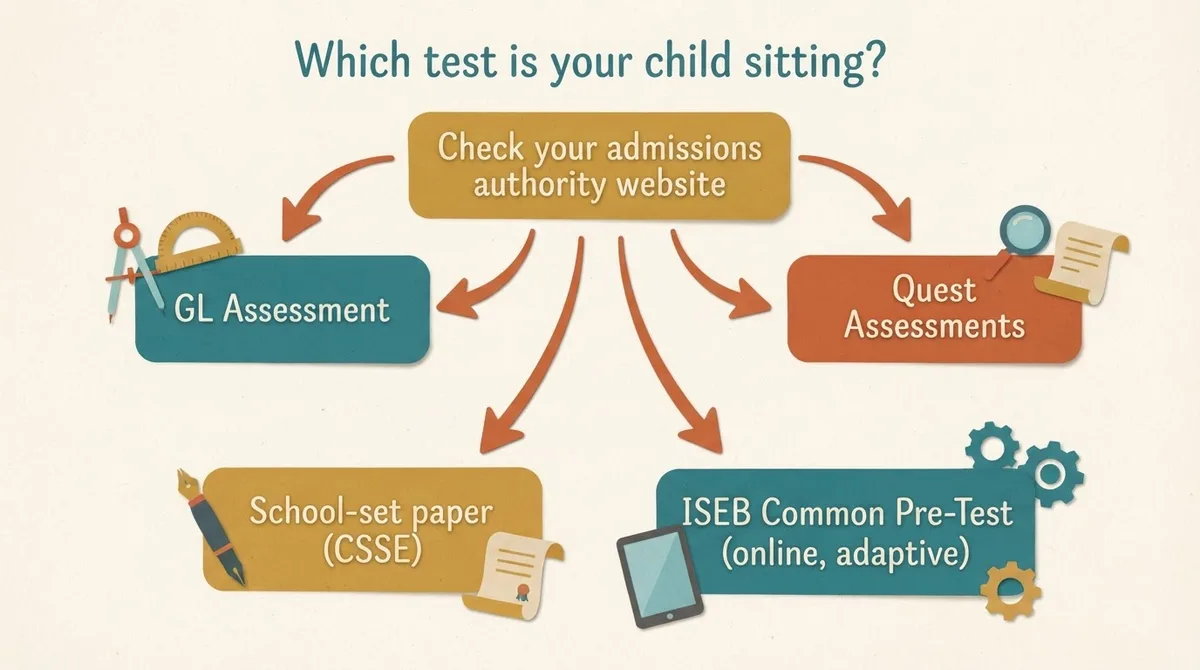
This is the step most parents skip, and skipping it is how families end up with a pile of books aimed at the wrong format. GL Assessment says so itself: "11+ tests vary from area to area. If you don't know what type of tests your admissions authority uses, you may find it helpful to check their website or contact them direct."
The variation is real and large:
- Medway uses GL Assessment, with three papers: English (30 minutes), Mathematics (50 minutes) and Reasoning (45 minutes, covering spatial, non-verbal and verbal reasoning).
- Buckinghamshire runs a Secondary Transfer Test of two multiple-choice papers of about 45 minutes each, one covering verbal skills including comprehension, technical English and verbal reasoning, the other covering mathematics and non-verbal skills including spatial reasoning (Buckinghamshire Council).
- Essex CSSE sets two papers, English (60 minutes plus 10 minutes additional reading time) and Mathematics (60 minutes), with no reasoning paper at all. From September 2024 entry onwards the English paper no longer contains Applied Reasoning questions (CSSE).
- Bexley does not use GL. "Quest Assessments is the Bexley Selection Test provider", covering verbal ability and English comprehension, numerical reasoning and non-verbal reasoning across two papers of about 50 minutes each.
- Independent schools often use the ISEB Common Pre-Tests, a series of four online, adaptive assessments in maths, English, verbal reasoning and non-verbal reasoning, which pupils applying to several schools only need to sit once.
If your area does not set a reasoning paper, every reasoning workbook you buy is enrichment rather than preparation. If your child sits an adaptive online test, paper practice will not rehearse the format at all. Our comparison of GL, CEM and ISEB formats goes further into what each board actually asks.
What can you use for free before you buy anything?
More than most parents realise, and it is all ungated.
GL Assessment publishes 10 hours of free familiarisation materials as downloadable PDFs you print at home, across six downloads covering verbal reasoning, non-verbal reasoning, English, maths, a combined non-verbal reasoning and maths paper, and verbal skills (GL free materials). GL also attaches an important caveat: "The exact timings for, and number of questions in, your local 11+ test may differ from those in our familiarisation and practice materials."
Buckinghamshire publishes its Secondary Transfer Test familiarisation booklet as a free PDF with information about what the test is like, advice about taking it and sample questions, and children at state-funded Buckinghamshire primary or partner schools get a hard copy automatically. Children normally sit a non-marked practice test first as well, though the council notes it is recommended rather than compulsory. CSSE publishes free downloadable familiarisation papers. Bexley points parents to familiarisation exercises plus a Pupil Information Booklet and a Parent Information Booklet on the Quest website.
Warwickshire County Council is the plainest of the lot. Announcing its move from CEM to GL Assessment, it said: "Whilst a full preparation guide with detail of the new tests will be available later this Spring, intensive coaching or tuition is not needed or encouraged" (Warwickshire County Council). ISEB takes a similar line, stating that additional preparation is not required for its pre-tests because they are based on the national curriculum.
None of this means preparation is pointless. It means the official free layer is the correct first purchase, at zero pounds, and you should only buy once you know what your child cannot yet do. Our roundup of free 11 plus practice papers with answers collects the reputable ungated sources in one place.
How do the main series actually compare?
A few honest generalisations, offered as a starting judgement rather than a verdict on every individual title.
Bond is the broadest and most systematic range. Bond's own shop lists individual practice books at £7.99 each, organised by age band from 7-8 up to 12-13, with multibuy discounts and a separate CEM Practice filter. Strengths: incremental difficulty, huge question volume, clean progression from assessment papers into timed papers. Weaknesses: the lower age bands are pitched well below a competitive grammar paper, and buying by age rather than by test can quietly waste a year. Answers are typically brief, often just the correct response with a short note.
CGP is the most readable for children, with cartoon framing, short explanations and workbooks that reduce resistance in a reluctant child. Difficulty in the standard range tends to sit slightly under a live selective paper, which is why CGP also sells harder tiers and an online subscription. Answer sections are generally better than Bond's for maths working, weaker for English comprehension, where reasoning is hardest to compress into a line.
Schofield and Sims is not really an 11+ series at all, and that is its strength. It is core skills practice: arithmetic fluency, spelling, grammar, comprehension. It is excellent for a Year 3 or Year 4 child who needs the underlying competence, and largely irrelevant six weeks before a test. Answers are usually a key rather than an explanation.
Collins sits between CGP and Bond in tone, with a decent practice paper range, though availability is patchy and titles regularly show as temporarily out of stock. Content quality is solid, but there is no compelling reason to choose it over Bond or CGP unless a specific title fills a gap.
GL's own practice papers are the closest you can get to the house style of a GL test, covering verbal reasoning, non-verbal reasoning, English and maths with three packs available per area, each book containing three question papers and answer sheets plus guidance for parents. One thing worth knowing before you buy: GL states that "The different numbers on the books are just for reference and do not indicate a difference in the level of difficulty between papers". Parents routinely assume Pack 1 is easier than Pack 3. It is not.
Answer quality is the thing to check in the shop
Open the back of the book before you buy. If a wrong answer produces only a letter, the book cannot teach a child anything without an adult who already understands the question type. That is fine for a parent confident in non-verbal reasoning and fatal for one who is not. Books that show working, or explain why the three wrong options are wrong, are worth substantially more per pound than books with a bare key, even at twice the price.
Which books fit which situation?
Match the purchase to where you actually are.
- Year 4, no idea which test yet. Buy nothing test-specific. Core skills only: arithmetic fluency, spelling and grammar, plus wide independent reading. Schofield and Sims territory. Spend the time identifying your admissions authority instead.
- Year 5, test confirmed as GL. One GL practice pack per assessed area, plus a Bond or CGP workbook for the weakest area. Print the GL free familiarisation PDFs first so the format is not new.
- Six weeks out, GL area. Stop buying workbooks. Full timed papers only, marked and reviewed, with a written list of every recurring error type. New books at this stage dilute attention.
- Child is strong but slow. Volume workbooks make this worse. Use short timed sets on a clock, roughly half the paper length, and count questions attempted rather than score. Our guidance on 11 plus maths papers covers pacing drills in more detail.
- Child is fast but careless. Buy books with worked solutions, not more question banks. The fix is a marking habit, not more exposure.
- Independent school ISEB pre-test. Paper books rehearse content but not format, because the real thing is online and adaptive. Use books for maths and English fundamentals, and rehearse the on-screen experience separately. ISEB itself sells a prep pack and endorses an adaptive online product, which tells you where it thinks the format practice needs to happen.
- Bexley, CSSE or another non-GL area. Start with the provider's own familiarisation materials. Generic GL-branded practice papers may misrepresent the format you will meet.
Where do books beat screens, and where do they lose?
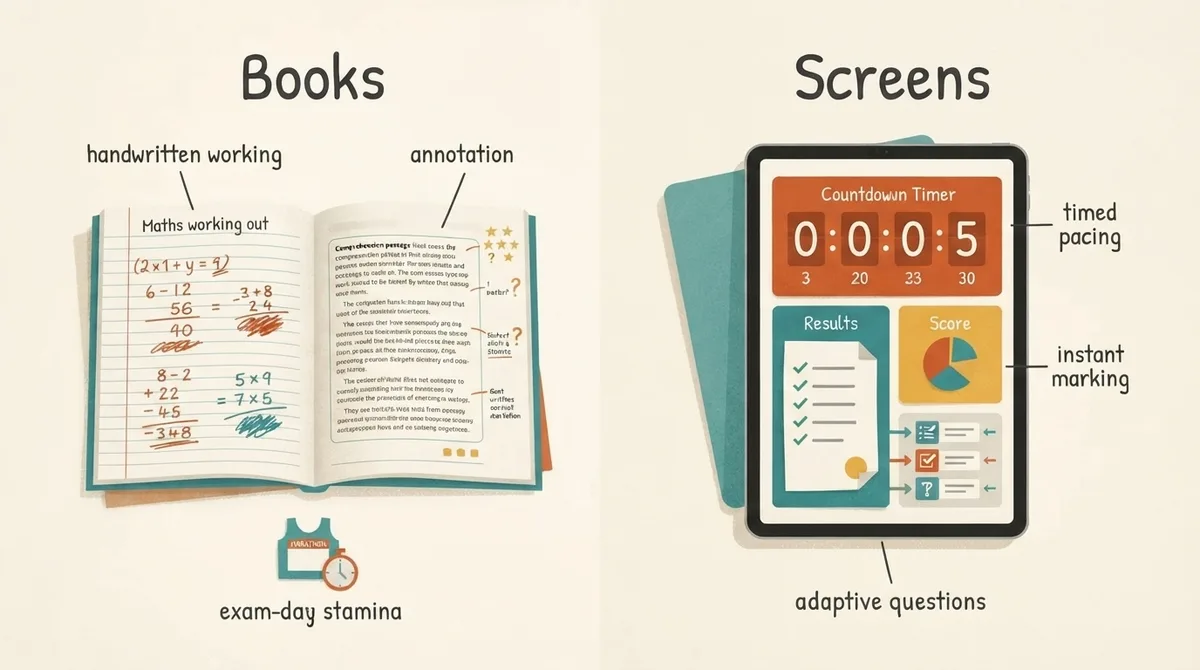
Books win on things that are physical. Handwritten maths working is where careless errors become visible to a parent, and a screen that only records a final answer hides the exact step that went wrong. Comprehension annotation, underlining evidence and margin notes, transfers directly to a paper exam. And stamina for a 50 or 60 minute paper is built by sitting a 50 or 60 minute paper on paper.
Screens win on things that are mechanical. Timed pacing is enforced rather than remembered. Marking is instant, which matters enormously when a parent cannot confidently mark non-verbal reasoning. Question selection can adapt to what a child keeps getting wrong instead of marching through a fixed sequence. That is precisely why ISEB's own pre-test is adaptive and online rather than a printed booklet.
The sensible arrangement is both, with each doing what it is good at: books for working, annotation and full paper rehearsal, screens for drilling weak question types and tracking whether accuracy is actually moving. If you want that second half handled automatically, our progress tracking shows accuracy and pace by question type rather than a single score.
What does a sensible shelf cost, and what should you skip?
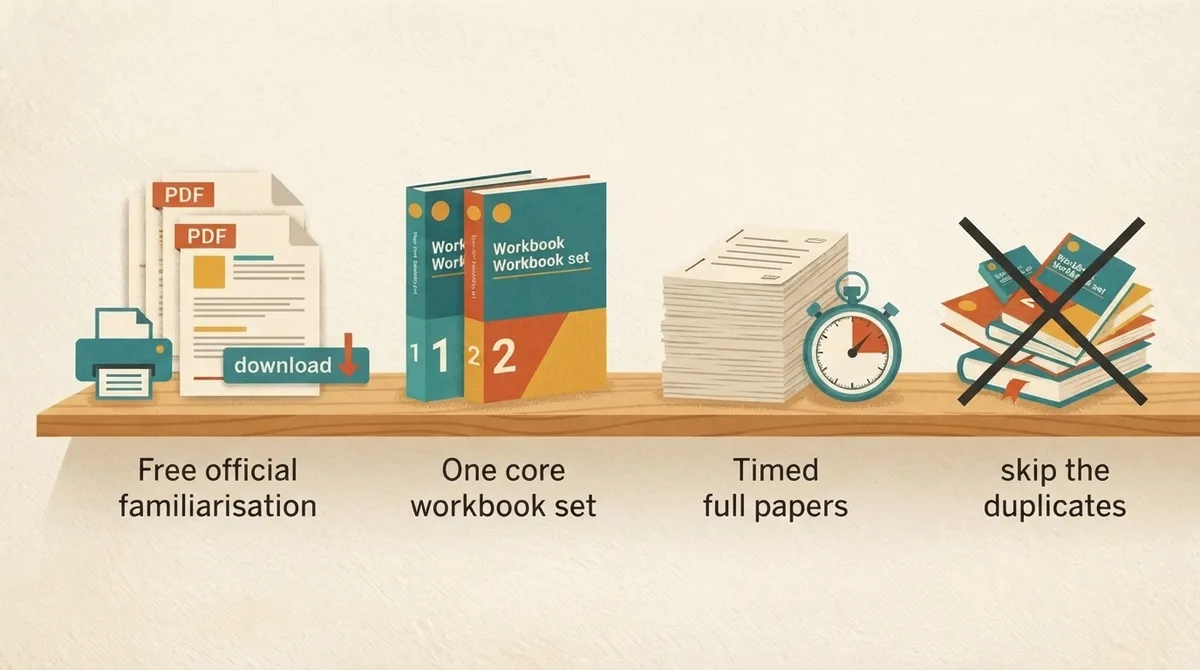
At Bond's listed £7.99 per practice book, a household can spend well over a hundred pounds without noticing. Most of that is duplication: three publishers asking the same verbal reasoning question types in three different fonts.
A proportionate shelf looks roughly like this: the free official familiarisation materials for your actual test, one core workbook for each assessed area, and one set of full-length timed papers for the final stretch. That is a modest outlay, and it covers everything the test requires.
What to skip: a second series covering ground the first already covers, anything bought purely because a child finished the last one, age-banded books that sit below the level of the real paper, and unofficial "past papers" of unclear origin. The route to genuine material is set out in our guide to 11 plus past papers.
Questions parents ask about 11 plus books
Which 11 plus books are best? There is no single best series, because there is no single test. Fit to your local format first, then choose on answer quality.
Are higher-numbered GL books harder? No. GL states the numbers on its books are for reference only and do not indicate difficulty.
When should we start buying? Later than most families do. Build core skills first, confirm the test, use the free official materials, then buy to fill identified gaps. Our year by year preparation plan sets out sensible timings.
Is a revision guide better than practice papers? They do different jobs. A guide teaches a method; papers test whether it holds under time pressure. Most children who plateau need papers and better marking, not another guide.
Do we need books at all? Not necessarily. Several admissions authorities discourage intensive coaching, ISEB says additional preparation is not required, and the free official materials cover familiarisation adequately for many children.
Where to start this week, for nothing
Do three things before you spend anything. Find your admissions authority's page and write down the exact papers, timings and subjects. Download the free familiarisation materials for that test, print them, and sit one under something close to real conditions. Then mark it and list the error types, not the score.
That list is your shopping list. If it says "cannot do fraction word problems", you need a maths workbook with worked solutions. If it says "ran out of time with eight questions unattempted", you need timed full papers, not a workbook at all. Buying before you have that list is how the pile of unused books gets built.
If you would rather have the marking and the error analysis done for you, Trace Learn's paper tests run full timed papers and return a breakdown by question type. Either way, work the free official route to the end first. It is the only material anyone can honestly call official.
Topics
- 11 plus books
- revision guides
- practice papers
- resources
- parents