
 Length 2:43
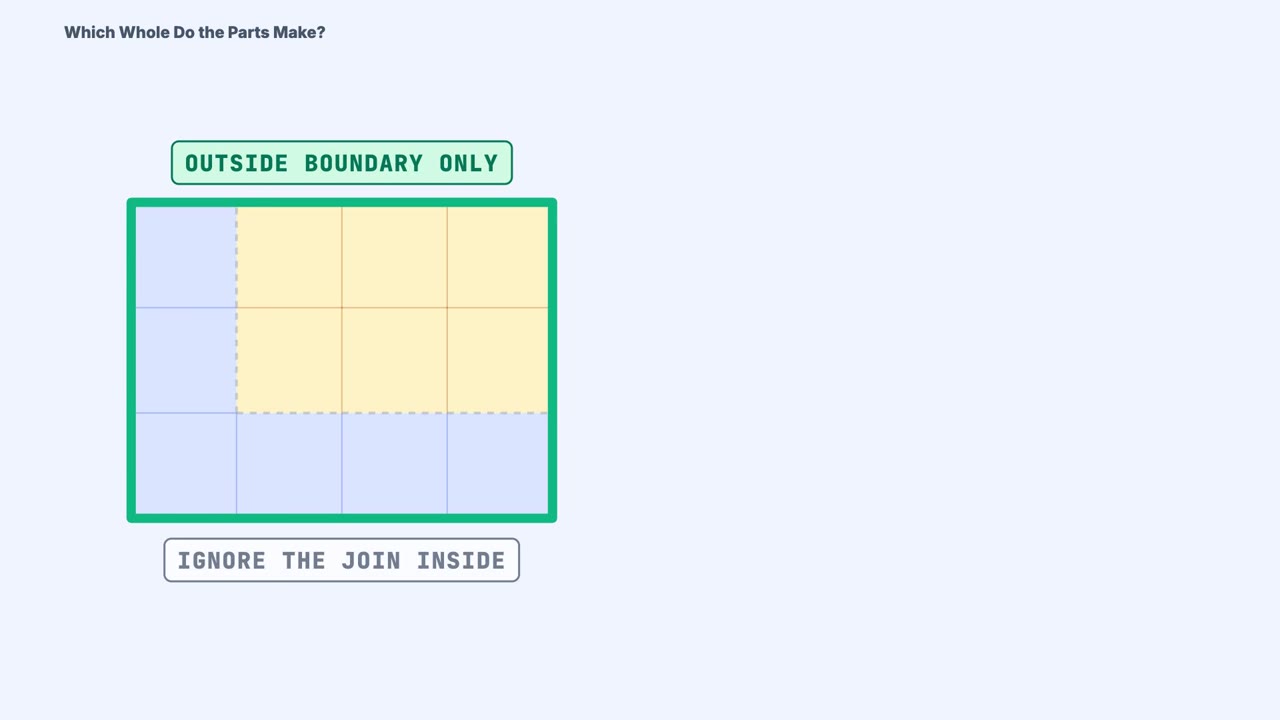
Which Whole Do the Parts Make?
Connect shape parts
11+ Non-verbal Reasoning · Spatial
A short worked example (2:33) for one 11+ non-verbal reasoning skill: Validate a cube net.
This video shows how to decide whether a flat arrangement of squares can fold into a closed cube. Watch an 11+ non-verbal reasoning question solved step by step.
Turn on captions with the CC button. The full transcript is below the video.
Every word of the video, to read along or to skim before watching.
A flat shape can look perfectly tidy, yet fold into a jumble. The secret is not counting six squares. It is tracking where every face lands.
Start with one square as the base. Imagine its four edge-neighbours lifting through right angles, like walls around a room. Keep the base still. Follow each shared edge. A face may turn again through another hinge, but it cannot twist, stretch, or pass through a face already there. Now check the landing places. A finished cube needs one base, four different side faces, and one opposite face. If two squares try to cover the same side, the net fails. If a gap remains, it fails too. Be careful: squares far apart on the flat net are not automatically opposite. Folding changes their relationship. Judge them only after the hinges turn. You can rehearse each fold with your finger, ninety degrees at a time, while watching for an overlap.
Let's work through an example. You are shown two arrangements, A and B, each made from six equal unmarked squares. In both, four squares form a straight horizontal row. Which arrangement can fold into a cube? In A, one extra square sits above the second square in the row. The other sits below that same second square. Hold the second square as the base. Fold its left, right, upper, and lower neighbours upwards. They become four DIFFERENT walls. The fourth square in the row is hinged to the right wall. Fold it once more... it closes across the top, opposite the base. Every cube position is filled exactly once. A works. In B, both extra squares sit above the row: one above the second square, and one above the third. Fold the four-square strip around. Then lift both upper flaps. They aim for the SAME top position and overlap. So B cannot make a cube. The answer is A.
Remember: choose a base, turn each hinge through a right angle, and check every landing place. One face per position, with no gaps or overlaps - cube solved!
Watch these next. The first ones teach the skills closest to this one.
Length 2:43Connect shape parts
 Length 2:32
Count cubes in a structure
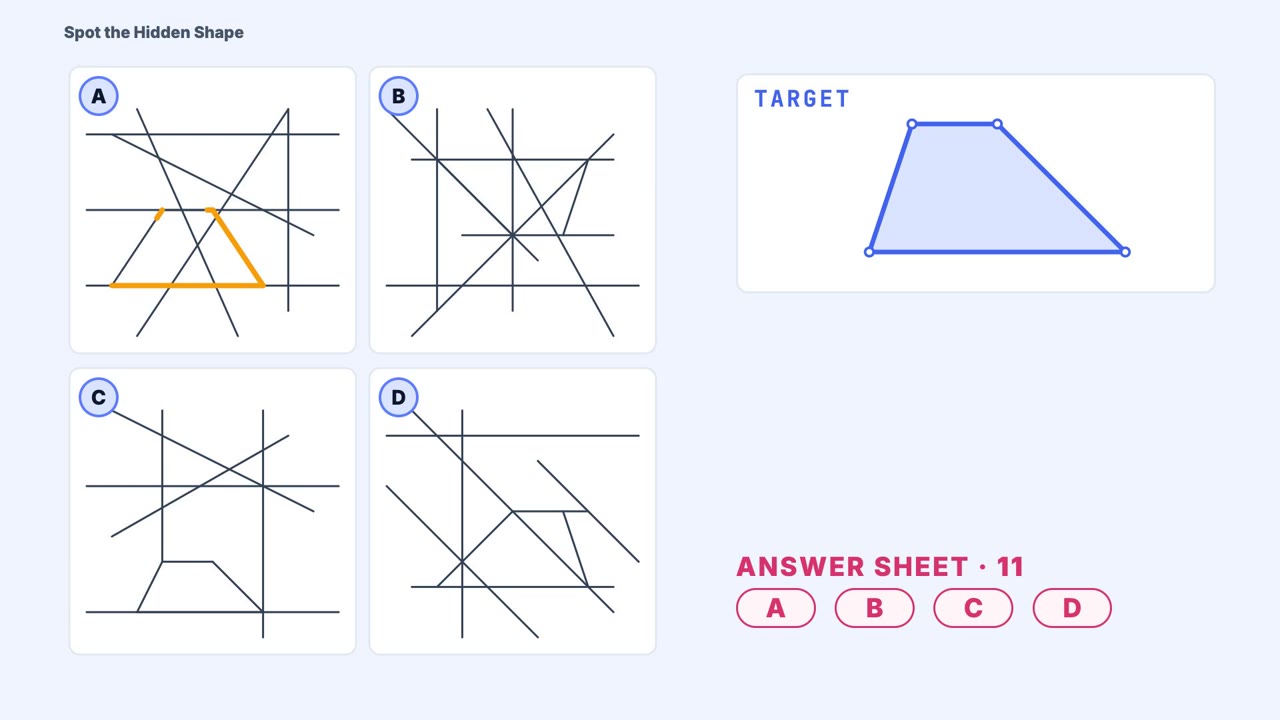 Length 2:37
Find an embedded shape
The free diagnostic checks maths, English and both kinds of reasoning, and shows what to practise next. No card is required.