
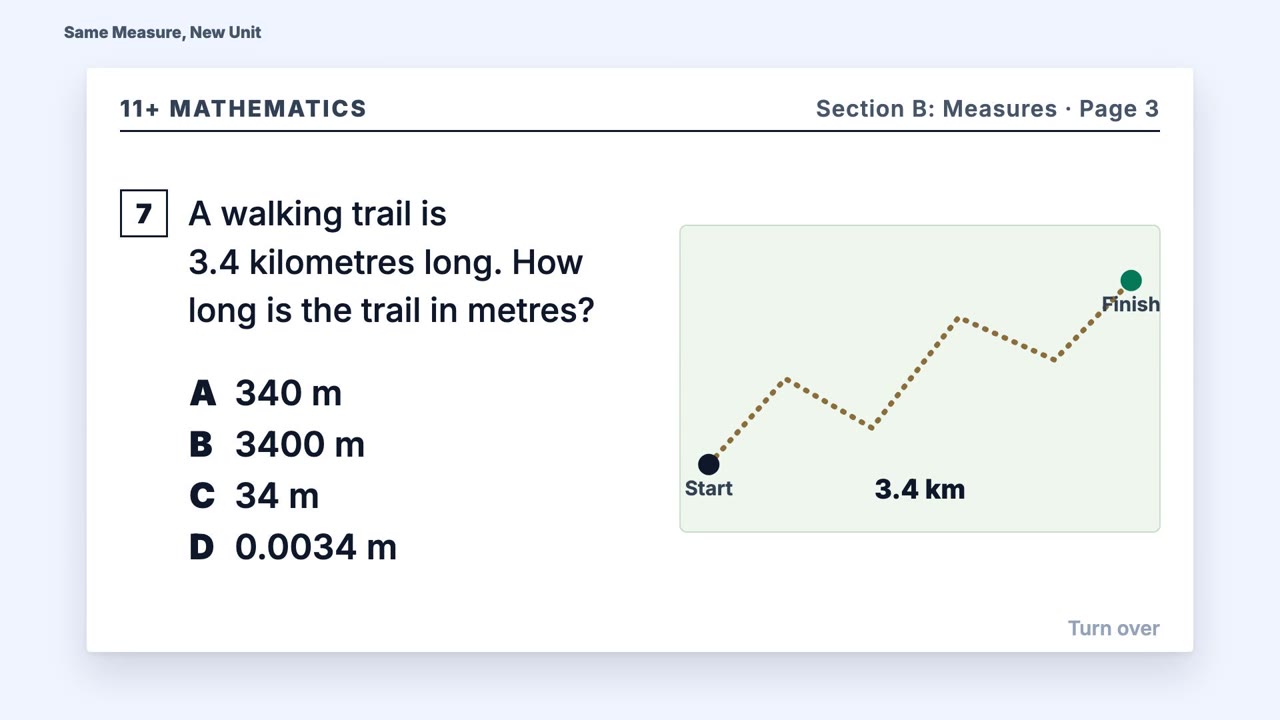
 Length 2:43
Same Measure, New Unit
Convert units
11+ Maths · Measure
A short worked example (2:39) for one 11+ maths skill: Calculate perimeter.
This video shows how to add the boundary lengths of a labelled shape to calculate its perimeter. Watch an 11+ maths question solved step by step.
Turn on captions with the CC button. The full transcript is below the video.
Every word of the video, to read along or to skim before watching.
A tiny ant walks around the edge of a shape. When it reaches its starting point, how far has it travelled? That journey is the perimeter... and one careful lap gives you the answer.
Perimeter means the total length of the OUTSIDE boundary. Watch the ant trace every side of a rectangle, turning at each corner. The glowing line forms one complete loop. Corners are turning points, not extra lengths to count. We measure that loop in length units, such as centimetres or metres. To calculate it, choose a corner and move in one direction. Write down each side length as it lights up. Keep going until you return to the start. Then add every recorded length. A tick appears on each counted side, so none is missed or counted twice. Do not multiply the side lengths just because several numbers are shown. Multiplying a rectangle's length by its width finds area, which covers the inside. Perimeter follows the EDGE, so addition is the safe method for an irregular shape. Picture a ribbon laid exactly around it.
Let's work through an example. An L-shaped card has six outside sides, labelled eight centimetres, three centimetres, four centimetres, two centimetres, four centimetres and five centimetres. What is its perimeter? First, place a bright dot on the top-left corner. We will trace clockwise. Across the top is eight. Down the short right side is three. Left along the notch is four. Down again is two. Across the bottom is four. Finally, up the left side is five... and the dot is back where it began. Now add the boundary lengths: eight plus three is eleven. Plus four is fifteen. Plus two is seventeen. Plus four is twenty-one. Plus five is twenty-six. The perimeter is twenty-six centimetres. Notice that we added SIX sides, including both sides of the notch.
Remember: perimeter is one full trip around the outside. Trace, tick, then add every side length once. Keep your units beside the answer, and you can conquer any labelled boundary with confidence!
Watch these next. The first ones teach the skills closest to this one.
Length 2:43Convert units
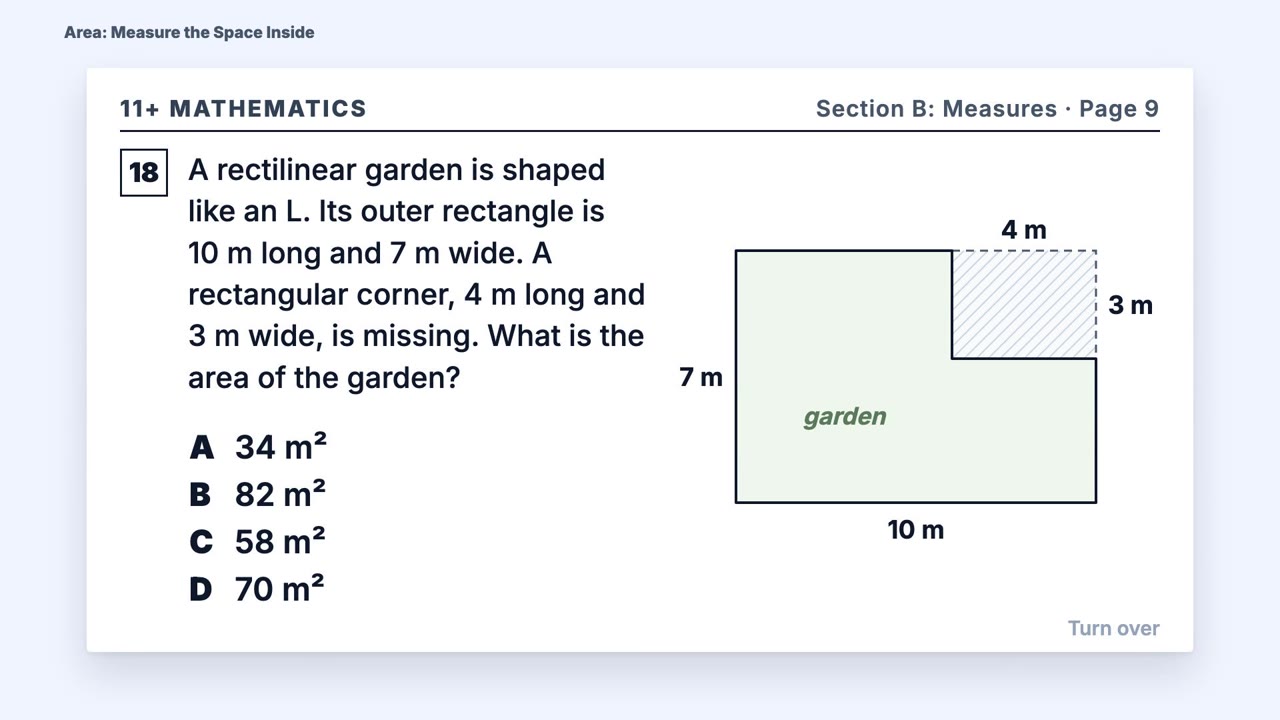 Length 2:45
Calculate area
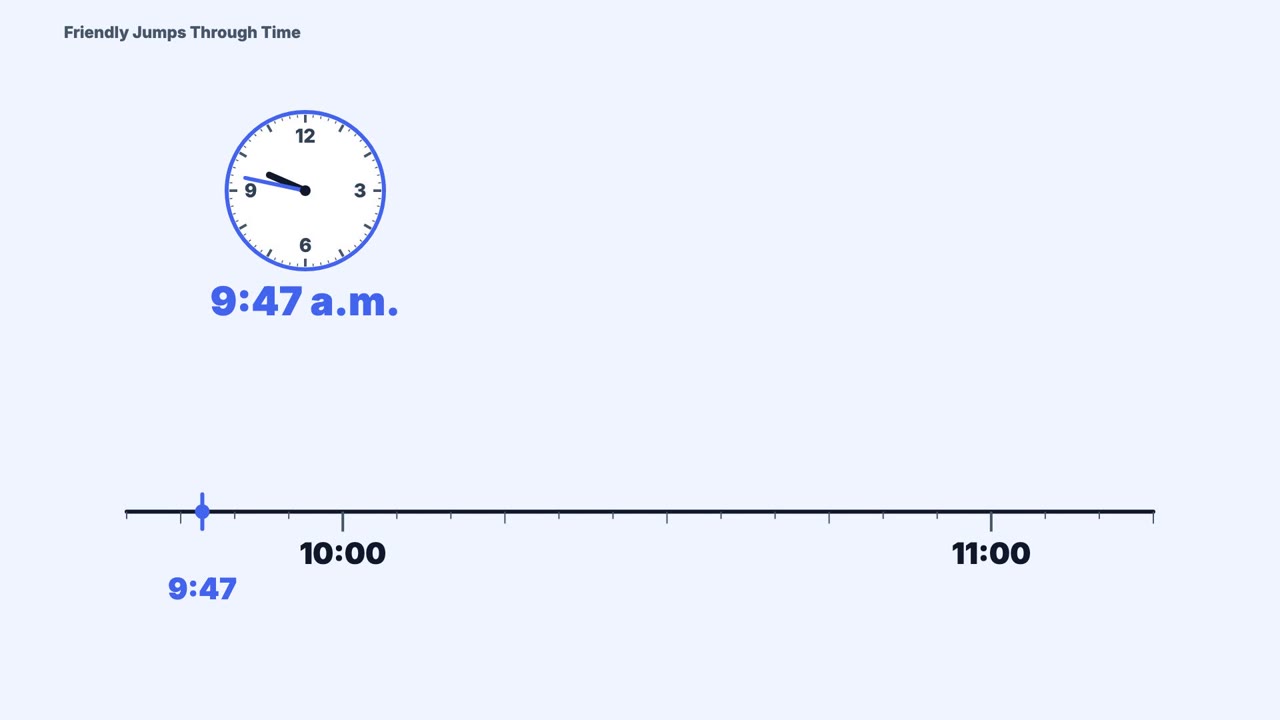 Length 2:34
Calculate a duration
The free diagnostic checks maths, English and both kinds of reasoning, and shows what to practise next. No card is required.