
What Grammar Schools Select For: Tests, Scores and Admission Rules
Grammar schools do not look for a type of child. They run a published, legally governed allocation procedure, and passing the test is usually only eligibility, not currency.
 Elspeth Marlow
- 13 min read

Ask the internet what grammar schools look for and you will be handed a personality profile: work ethic, curiosity, a passion for learning, extracurricular involvement. Some pages go further and coach parents through grammar school interviews and personal statements. In the English state system at 11+, those things are almost entirely fiction. No admission authority scores your child's hobbies, and the overwhelming majority of state grammar schools never meet your child before deciding whether to offer a place.
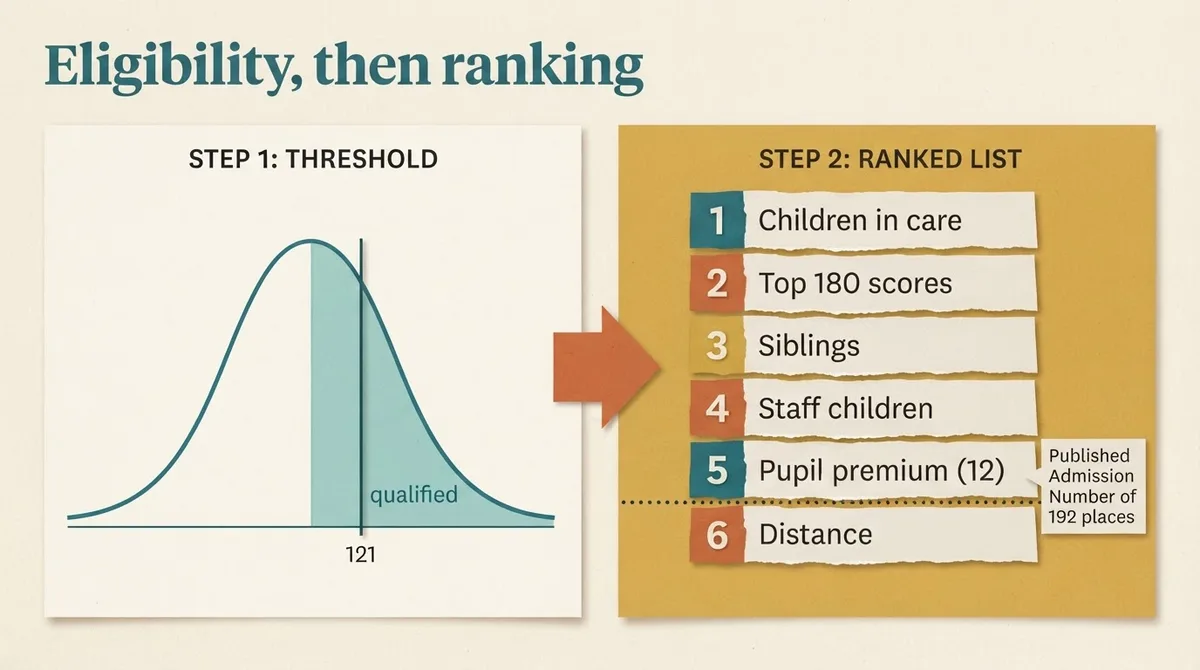
What actually happens is duller and far more useful to understand. A grammar school does not select a kind of child. It publishes a document called its admission arrangements, that document is legally constrained, and it operates as a two-stage machine: first a test threshold that decides whether your child is eligible at all, then a ranked list that decides who among the eligible children actually gets one of the finite places. Two children with identical test scores can get opposite outcomes, and in some counties the higher-scoring child can be the one who misses out.
This guide walks the process in the order a Year 5 and Year 6 family actually lives it, from registration to National Offer Day and beyond, and reads one real published policy line by line so you can see exactly where the decision is made. Rules vary sharply by area, so treat the examples as models to recognise rather than as your local rulebook.
The legal frame: who is allowed to select, and on what
Selection at 11 is not a school's private preference. Under section 104 of the School Standards and Framework Act 1998, a maintained school can only be designated a grammar school if the Secretary of State is satisfied it "had selective admission arrangements at the beginning of the 1997-98 school year", and the qualifying condition is that its arrangements "make provision for all (or substantially all) of its pupils to be selected by reference to general ability, with a view to admitting only pupils with high ability" (legislation.gov.uk). That phrase matters: the lawful basis is general ability, not character, not effort, not enrichment.
Everything else runs through the School Admissions Code 2021, statutory guidance that came into force on 1 September 2021 and is mandatory for headteachers, governing bodies, local authorities and academy trusts in England. Two consequences follow for parents. Every school must publish its arrangements, so the actual decision rule is a public document you can read today. And the Code fixes the top of the list: all state-funded schools must give highest priority to children who are in care or previously in care, a priority that sits above any test score (GOV.UK).
The same GOV.UK page lists what schools and councils are permitted to prioritise on: living close to the school, having a sibling already there, faith criteria, passing an entrance exam, attending a named feeder school, eligibility for the pupil premium or service pupil premium, and having a parent who has worked at the school for two years or more. Read that list again and notice what is absent. There is no line for motivation, no line for extracurriculars, no line for tutoring history.
Spring of Year 5: registration, and the first thing you must check
The first real milestone is registration, which typically opens in the spring or early summer of Year 5 and closes months before the test itself. Registering for the test is a separate action from applying for a school place, and missing the registration deadline usually removes the option entirely for that cycle. Our practical parent guide to the 11 plus shows where registration sits in the full application sequence.
At this point, do one piece of homework that most families skip. Download the admission arrangements PDF for each school you are seriously considering, and find the numbered oversubscription criteria. You are looking for one specific thing: does the school rank qualified children by score, or does it rank them by something else? That single answer changes what a sensible preparation and preference strategy looks like, and it is knowable eighteen months before the offer arrives.
Autumn of Year 6: the test, and how a raw mark becomes a score
Most areas test at the start of Year 6, usually in September, though a minority test later and formats differ. The subject mix is the familiar four: English, maths, verbal reasoning and non-verbal reasoning, in varying combinations. Delivery varies too, between paper booklets, multiple choice with a separate answer sheet, and online tests. Which combination applies to you depends entirely on your area; the Trace Learn grammar-school directory lets you filter the published school catalog by assessment provider and open each school's reviewed evidence.
The crucial mechanic is what happens after marking. Raw marks are converted into age-standardised scores. Buckinghamshire's Secondary Transfer Test, marked by GL Assessment, is a clear worked case: standardisation "balances the overall performance of children from one year to the next" and accounts for each candidate's age in years and months on the day of the test. Individual standardised scores run from 60 to 170, and the Secondary Transfer Test Score is a weighted composite of "50% of the standardised score for verbal skills, 25% of the standardised score for mathematical skills, 25% of the standardised score for non-verbal skills".
Two things follow. First, a September-born and an August-born child with the same raw mark do not end up with the same score, by design. Second, weighting means the papers are not equally valuable: in that model a point in the standardised verbal component contributes twice as much as a point in the standardised non-verbal component. Raw marks cannot be compared that way without each component’s conversion. The 11 plus exam explainer puts those scores back into the wider test and admissions journey.
Use the 11+ score calculator by area to check a reported result against its published method and qualification rule. A selective-test score is not automatically a national percentile, and qualification does not guarantee a school place.
October: the results letter tells you less than you think
Results usually arrive in October, before the national application deadline. The letter tells you whether your child reached the qualifying standard. Buckinghamshire's is explicit: "Children who achieve a standardised score of at least 121 are eligible to be considered for a Buckinghamshire grammar school place."
Note the verb. Eligible to be considered. The council states plainly that "Qualifying in the test does not guarantee that a child will be offered a grammar school place" because "There are always more applications for grammar schools than available places" (Buckinghamshire Council).
This also reframes the most common PAA question, "what percentage of children pass the 11+". There is no national pass rate because there is no national test. Buckinghamshire expects "about 37% of children will get an STTS of 121 or more". That figure is a locally set expectation tied to a locally chosen threshold and local cohort, not a fixed standard of ability. A different county with a different threshold produces a different number, and neither tells you much about your own child. The Trace Learn grammar-school directory keeps each published school's score policy attached to its own reviewed evidence.
The three allocation models, and why your area's model changes everything
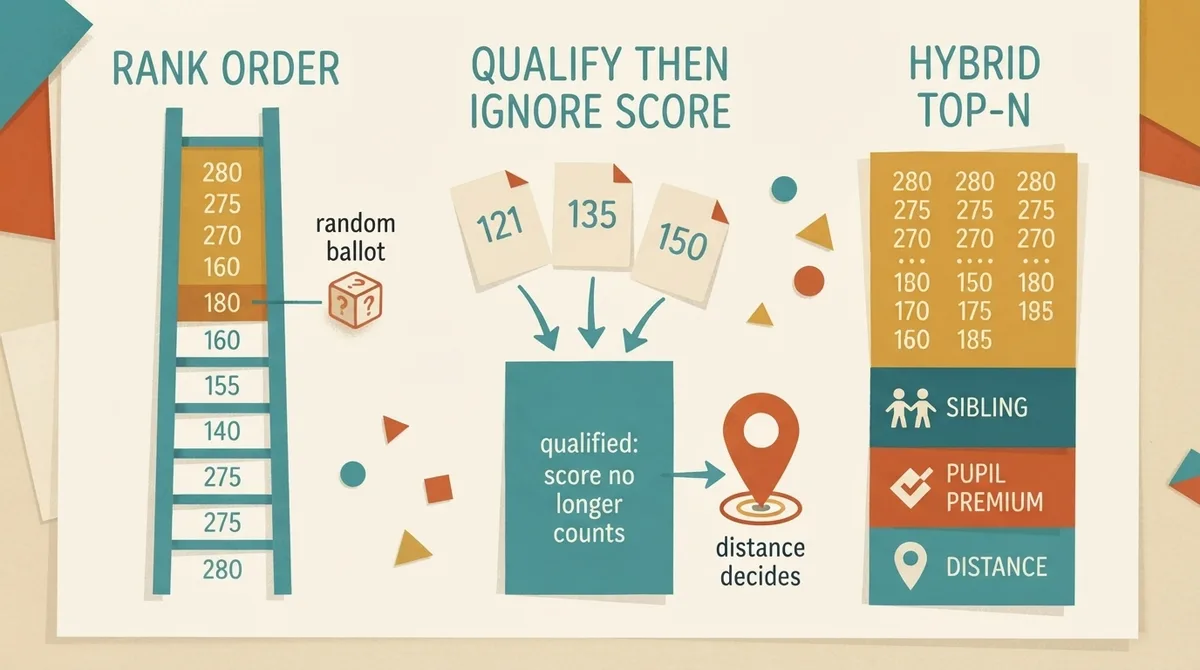
Qualification and allocation are separate decisions. Passing is usually eligibility, not currency. What your score is worth after qualifying depends on which of three models your target school runs.
1. Rank order, score is everything. Queen Elizabeth's School, Barnet, has 180 places and admits solely on entrance test results. Tests run over two days in September, answer sheets are marked electronically, and scores are standardised for candidate age. There is no catchment cushion and no sibling shortcut. Where applicants tie for the final place, "the applicant to whom the place will be offered will be determined by a random ballot" (QE Barnet). At the very margin, the deciding factor is chance, published in advance.
2. Qualify, then the score stops counting. Buckinghamshire is the exact inverse. Once a child qualifies, "their test score has no further role" and "Achieving a higher score does not give a child any more priority for a place". A child on 121 and a child on 150 enter the queue on identical terms, and the school's own admission rules (siblings, catchment, distance) decide between them. Every piece of advice built on chasing a bigger margin above the threshold is, in this model, simply wrong.
3. Hybrid: a guaranteed top band, then everyone else. The Bexley Selection Test assesses verbal ability and English comprehension, numerical reasoning and non-verbal reasoning, weighted 50/25/25, and "All children who take the test are ranked in order of their total age-standardised score". Only "The top 180 children with the highest total age-standardised scores are placed in one of the highest priority groups", and the council states that "Achieving the selective standard does not guarantee a grammar school place unless your child is among the top 180 highest scorers" (Bexley Council). Score buys you a great deal, but only up to a hard line; below it, other criteria take over.
One real policy, read line by line
Abstractions are easy to nod along to, so take Beths Grammar School in Bexley, which has a published admission number of 192 for Year 7. Its ranked criteria run in this order (Beths Grammar School):
- Children in local authority care.
- Students achieving one of the highest 180 scores in the selection tests.
- Siblings.
- Children of permanent staff.
- Up to 12 places for pupil premium and/or free school meals students.
- Proximity, by shortest radial distance.
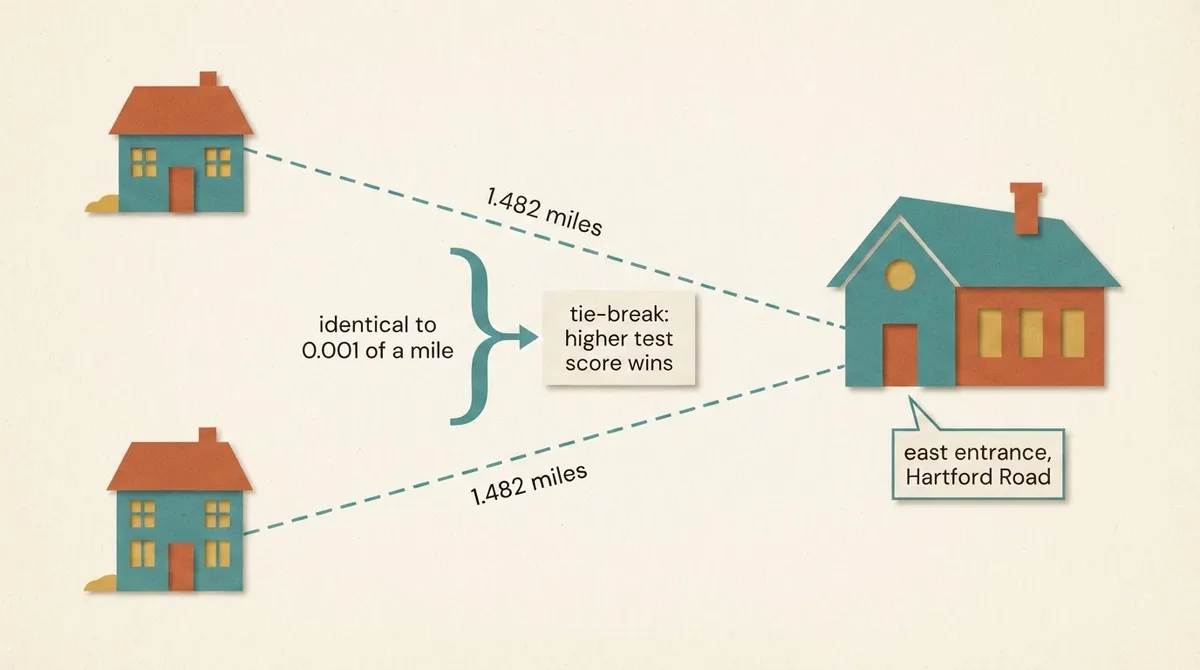
Read top down. A looked-after child is placed before the highest scorer in the borough, because the Code requires it. Then the top-180 band, which is where score does its work. Then relationships to the school. Then a capped equity band of up to 12 places. Only then does distance enter, and it is defined with forensic precision: the "Direct line distance between the applicant's home address to Beths Grammar School's east entrance on Hartford Road". Not the nearest gate, not road distance, one named entrance.
And the tie-break: "Where the distance is identical to 0.001 of a mile, the scores in the selection tests will be used as a tie-breaker with priority given to the higher score." So with 192 places and roughly 180 taken by scores, care status, siblings, staff children and the premium band, the residual pool competing on distance is small. Where two families in the same block of flats are separated by less than a thousandth of a mile, the test score returns as the decider.
Pupil premium and free school meals: the priority parents miss
Disadvantage priority is now real and specific, and it moves in the opposite direction to the tutoring arms race. Beths reserves up to 12 places. Buckinghamshire requires all its grammar schools to admit at least six unqualified children who are eligible for pupil premium, meaning children below the 121 threshold can still be admitted.
Sutton goes further into the test itself. Candidates registered as pupil premium at their primary school "are eligible to achieve up to 20% lower than the standardised pass mark" for the Selective Eligibility Test, and free school meals and pupil premium status also "form part of the over subscription criteria". Sutton's process is also a useful reminder that consortium areas can run two stages: a first stage of multiple-choice maths and English papers, then a second stage of maths and English papers that "will not include verbal or non-verbal reasoning, and are not multiple choice". The grammar-school directory separates each published school's route from its allocation rules.
If either status applies to your family, check the registration form for the tick box. It is frequently the single highest-value thing a parent does in the whole cycle, and it is free.
What is never assessed
To be blunt about the biggest myth on this subject: at 11+ in the English state grammar sector, there is no interview, no personal statement, no portfolio and no reference in the mainstream process. Nothing in any published criteria above scores a child's grit, curiosity or violin grade. (Partially selective and independent schools do sometimes interview; do not import their rules into a state grammar application.)
Tutoring history is likewise never a criterion, in either direction. No admission authority credits it and none penalises it. What the mechanics above do reward is unglamorous: reading the correct rulebook, hitting the registration deadline, weighting practice towards the papers your area weights most heavily, and building exam pace under real timing. Structured mock tests under proper conditions do more for a borderline score than any amount of enrichment narrative.
Late October to March: preferences, offers, and what happens if the answer is no
The common application form is normally due at the end of October, and offers land on National Offer Day in early March. Between those dates, nothing you do changes the outcome, because the ranking is mechanical. So the real work is in the preference list: name schools whose criteria you actually satisfy, and never leave a realistic place unnamed in the hope that a stretch school comes through.
If your child does not qualify, there are two distinct routes, and they are commonly confused. In Buckinghamshire, a Selection Review is "your opportunity to explain, in writing, why you think your child would be best suited to a grammar school even though they did not reach the qualifying score of 121". Panels consider school reports, headteacher summaries and exceptional medical or family circumstances. They explicitly do not consider samples of school work or extracurricular participation. If a review fails, an appeal panel "will be limited at first to considering whether the Selection Review was carried out in a 'fair, consistent and objective' manner".
Be realistic about odds. Buckinghamshire's published 2025 Year 7 outcomes: of qualified appeals, 7 succeeded and 98 did not; of unqualified appeals, 4 succeeded and 165 did not (Buckinghamshire Council). Roughly 7% and 2%. Appeal if you have genuine evidence, but plan around the waiting list and your other offers rather than around the panel. Our grammar-school appeals tool explains the evidence, stages and limitations.
The short answer
Grammar schools select for measured general ability at a single point in time, then allocate the resulting places by a published ranked list in which care status, siblings, disadvantage and geography can all outrank a strong score. "What do grammar schools look for" has no national answer, because the answer is written in your target school's admission arrangements. Read that document first, work out which of the three models it uses, and let it tell you what to prepare and where to apply. If you want the preparation itself sequenced against those milestones, our exam plan builds the schedule backwards from your area's test date.
Topics
- grammar schools
- admissions
- 11 plus
- oversubscription
- appeals