
Warwickshire 11 Plus and Grammar School Entry
A source-led guide to the Warwickshire 11+: the shared West Midlands test, the six grammar schools, the two separate deadlines and how places are really decided.
 Elspeth Marlow
- 12 min read

Most pages about the Warwickshire 11 plus describe a county exam sat by children in Rugby, Stratford and Alcester for a handful of local schools. That description is close enough to sound right and wrong enough to cost families places. The test your child sits in September is not owned by Warwickshire alone, registering for it is not the same as applying for a school, and there is no single county pass mark that anyone can quote you.
Those three points are the whole guide. Each of them is stated plainly in official council or partnership material, and each of them is either missing or blurred on the commercial pages that rank for this search. We have written this around the primary sources, named the exact documents Warwickshire publishes so you can read the current year's figures yourself, and deliberately not reprinted qualifying scores that circulate second hand and go stale within months.
One note on timing, because it changes what is useful to you. Registration for 2027 entry closed at 4pm on 30 June 2026, invitation letters went out in the week beginning 10 August 2026, and the test itself falls on 12 and 13 September 2026. If you are reading this in the run-up, the section on the papers and the section on the second deadline matter most. If you have only just discovered the process, skip to the part on missing the deadline, because there is a route and almost nobody writes it down.
Where does the Warwickshire 11 plus timeline actually sit for 2027 entry?
Warwickshire publishes a full schedule for the entrance test, and it is worth holding the whole shape in your head rather than the one date you are chasing.
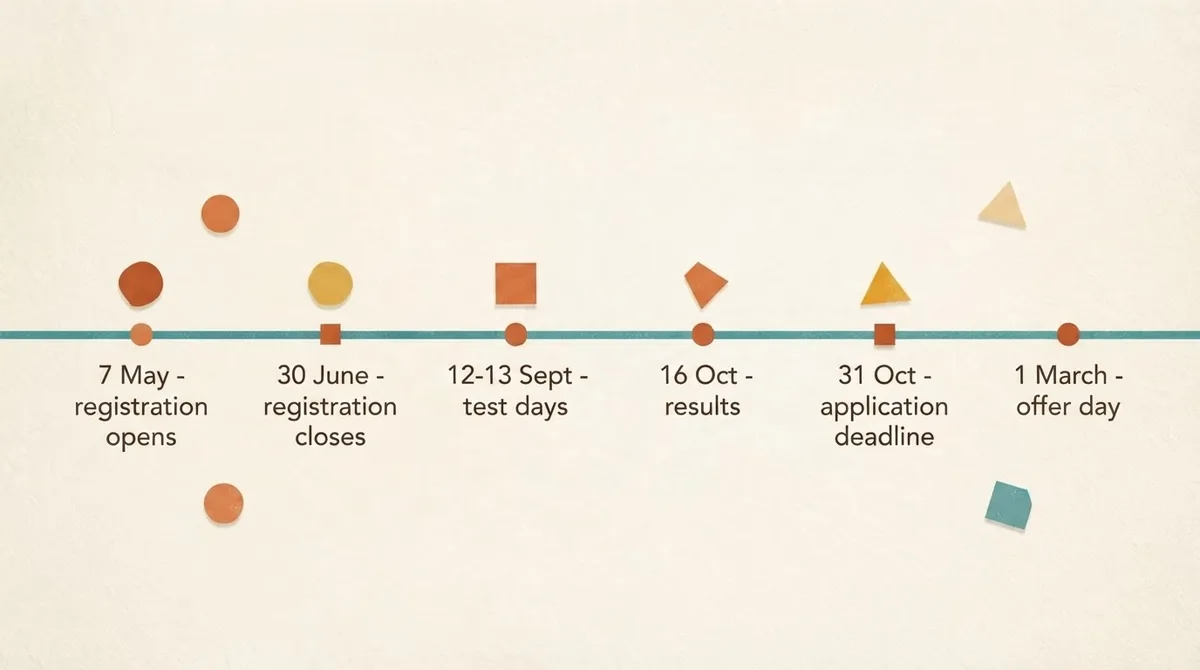
- Registration opened on 7 May 2026 and closed at 4pm on 30 June 2026, for children then in Year 5.
- 30 June 2026 was also the deadline for requesting access arrangements, not a later date.
- Access arrangement decision letters were issued in the week beginning 13 July 2026.
- Test invitation letters were issued in the week beginning 10 August 2026.
- The test is held on Saturday 12 and Sunday 13 September 2026. Children are allocated to one of the two days by the council, not by parental choice.
- Results appear on the Parent Portal on 16 October 2026.
- The secondary school application deadline, through your home local authority, is 31 October 2026.
- Proof of address is required by 31 December 2026, sent to [email protected], with one proof for the parent or carer and one for the child.
- National Offer Day is 1 March 2027.
All of that is set out on the county's own grammar schools and 11+ test pages. Two items on that list catch families every year: the proof of address requirement, which people assume is optional paperwork, and the 31 October application deadline, which we come back to below because it is the single highest-consequence step in the sequence.
Why is the Warwickshire 11 plus test not really a Warwickshire test?
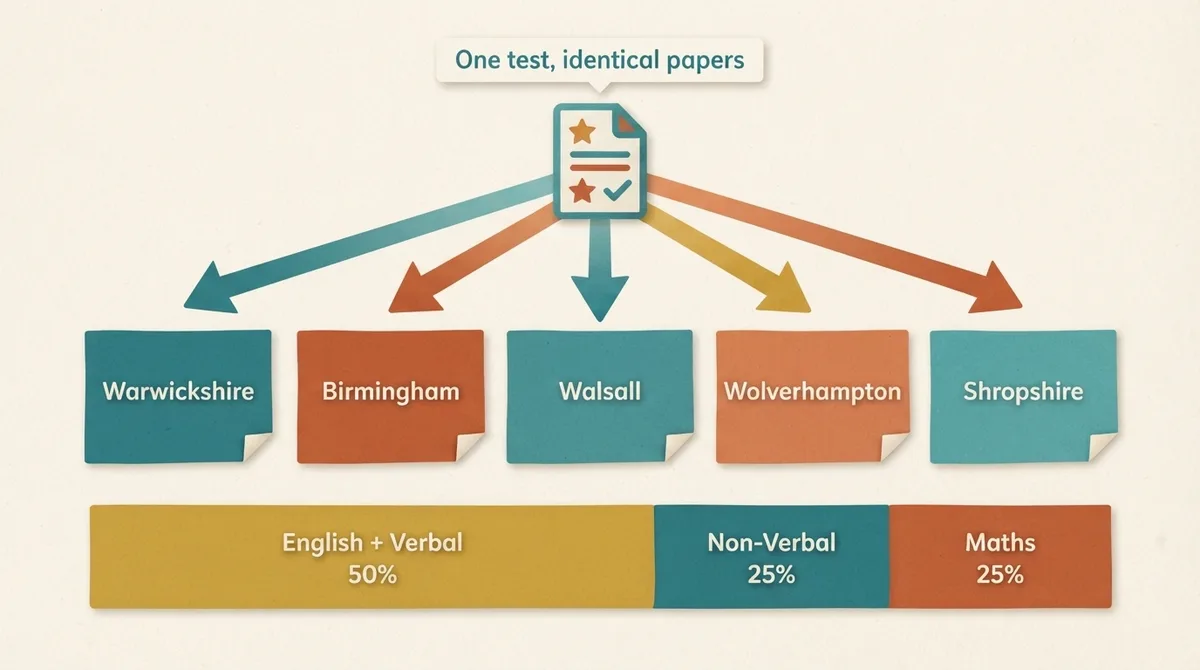
This is the fact that reframes everything else. Warwickshire County Council states that the test is administered collaboratively across Warwickshire, Birmingham, Walsall, Wolverhampton and Shropshire, using identical papers across all of those areas. It is not a county paper written for six local schools. It is a regional assessment run by a partnership, and Warwickshire is one member of it.
The partnership's own site, the West Midlands Grammar Schools entrance test page, confirms that the test is provided by GL Assessment and publishes the weighting used to build a candidate's result: 50 per cent for English and verbal reasoning combined, 25 per cent for non-verbal reasoning and 25 per cent for mathematics. Section scores are standardised for age, so that younger children in the cohort are not disadvantaged against older ones.
The practical consequence is the useful bit, and it is what no competing page says out loud. Your child sits one test, once, and the resulting score travels across the partnership. A family in Rugby, Coleshill or Kingsbury can therefore put Warwickshire schools and Birmingham schools on the same application without a second sitting, subject to each school's own admission arrangements. If your shortlist crosses the county boundary, read this alongside our guide to the Birmingham and West Midlands 11 plus, which covers the Birmingham side of the same partnership in detail.
Which grammar schools in Warwickshire use the test, and is it five or six?
You will see both numbers. Several well-known pages say five. The council and Rugby High School both say six, and the sixth is the interesting one.
- Rugby High School, Rugby. Girls, selective.
- Lawrence Sheriff School, Rugby. Boys, selective.
- Ashlawn School, Rugby. Mixed and partially selective. The council describes it as operating one selective class who follow a slightly different curriculum in Years 7 and 8. It is not a wholly selective school, which is why list-makers drop it, but 11+ scores are used for that selective cohort.
- King Edward VI School, Stratford-upon-Avon. Boys, selective.
- Stratford Girls' Grammar School, Stratford-upon-Avon. Girls, selective.
- Alcester Grammar School, Alcester. Mixed, selective.
All six are free to attend, and there is no charge for sitting the 11+ test itself. Allocation typically prioritises higher test scores together with residence inside a school's priority area, and every school publishes its own admission arrangements on its own website. The council's overview of grammar schools in Warwickshire is the reference point, but the binding document for any individual school is that school's own policy for the entry year you are applying for.
Why this matters beyond trivia: Ashlawn gives Rugby families a genuinely different shape of option, a partially selective mixed school in the same town as two single-sex grammars. If you have been told Rugby has "two grammar schools", you have been given an incomplete picture of what to name on your form. If you are still mapping the wider landscape, our national overview of grammar schools in the UK and their entrance tests shows how Warwickshire's arrangement compares with other selective areas, which differ considerably.
What is on the two papers, and how should each section be prepared?
Warwickshire describes an 11+ made up of two papers covering four sections: English, verbal reasoning, non-verbal reasoning and mathematics, all multiple choice. The council states that each of the two tests takes around 60 minutes to complete, including spoken instructions at the start and explanations of the practice items. Rugby High School describes the assessment as completed in approximately three hours including a break, which is the whole-morning figure parents should plan around rather than the per-paper figure.
The partnership adds detail the council page does not: sections are individually timed within each paper, and children record answers on a separate answer sheet rather than in the booklet. That answer sheet is worth rehearsing. Transferring answers under time pressure is a mechanical skill, and children who have never done it lose marks that have nothing to do with what they know.
Because the provider is confirmed as GL Assessment, GL-style preparation is genuinely appropriate here, which is not true in every selective area. A few section-specific notes:
- English. Comprehension-led and multiple choice. Practice extracting evidence for an answer you have to choose rather than write. Our 11 plus English guide covers the question types that recur in GL-style comprehension.
- Verbal reasoning. Combined with English into half the total weighting, which makes it the highest-leverage section in the whole test. Vocabulary breadth pays here more than technique.
- Non-verbal and spatial reasoning. A quarter of the total. Speed comes from recognising a small number of transformation families, not from cleverness on the day. See our breakdown of non-verbal reasoning in the 11 plus.
- Mathematics. A quarter of the total, multiple choice, so estimation and elimination are legitimate tools alongside full working.
A free Familiarisation Guide and other reference documents are published in Warwickshire's School Admissions Document Library, and the guide is described as covering the 11+ test used in Birmingham and Warwickshire, further confirmation that the two authorities share the paper. Full-length timed rehearsal under the real clock is the part families most often skip; if you want that structured, our mock tests run to realistic timings with section-level reporting.
Does registering for the test mean you have applied for a school?
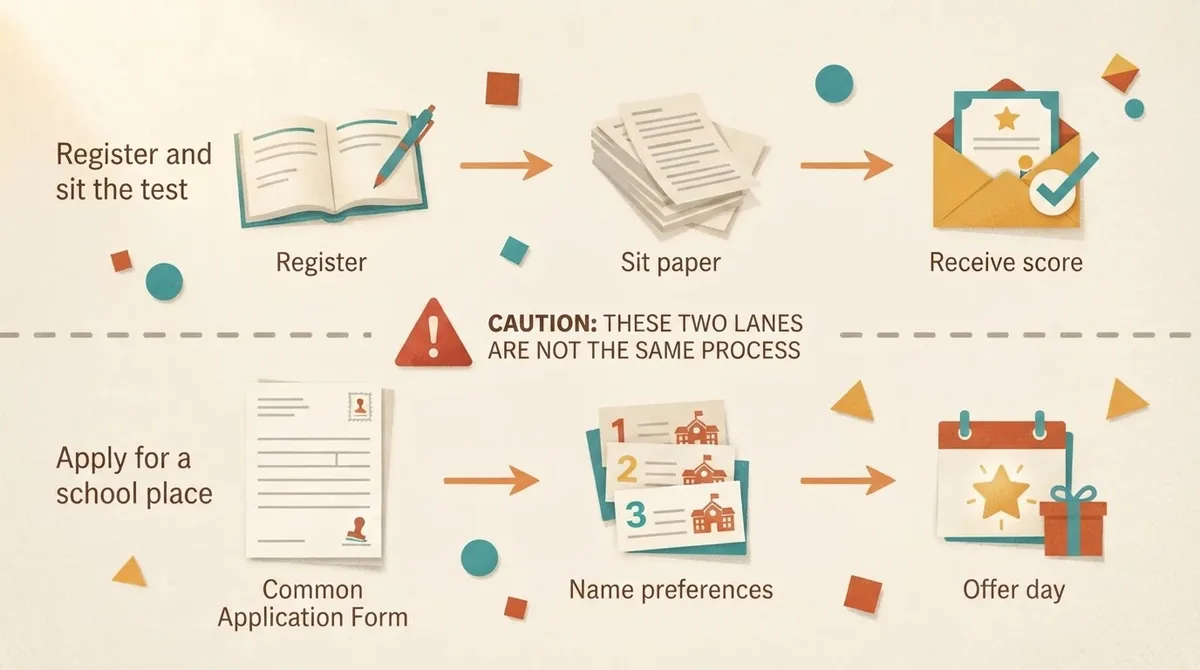
No, and this is the mistake that costs places. Warwickshire states it directly: taking the 11+ test is not the same as making an application for a grammar school, nor does it guarantee an offer of a place.
There are two processes and two deadlines. First, you register for the test with Warwickshire by 30 June while your child is in Year 5, through a Parent Portal account and an online form that triggers an automatic email confirmation. Second, you submit a secondary school application through your home local authority by 31 October in Year 6, naming the grammar schools you want as preferences on the common application form. Missing the first means no test. Missing the second means a strong score with nowhere to send it.
The council's page on applying to a Warwickshire grammar school also explains what happens if the second deadline slips. Late applications after 31 October are processed after initial offers have been made, with 11+ scores then determining position on waiting lists. That is a materially worse position than an on-time application, even with an identical score.
If there is no county pass mark, how are places decided?
There is no single Warwickshire pass mark, and any page quoting you one number for the county is describing something that does not exist. Places are allocated on comparative scoring, not against a fixed threshold.
Each of the six schools is its own admission authority and sets its own automatic qualifying score for the entry year. The council frames the requirement as meeting each school's minimum academic standard for that entry year. Those standards are then moderated through a Committee of Reference local review, and Warwickshire runs separate East and South committees whose minutes it publishes.
This is where you should go to primary documents rather than to any commercial guide, including this one. Warwickshire's School Admissions Document Library publishes, by name, the Entrance Test Familiarisation Guide, the 11+ Score Ranking spreadsheet, the 11+ Offer Day Online Leaflet, the special testing arrangements form, and the East and South Committee of Reference meeting minutes. Read the Score Ranking file for the most recent entry year and you will see the actual distribution rather than a figure someone scraped from a rival site three years ago.
We have chosen not to publish per-school qualifying numbers for exactly that reason. Those figures live in council spreadsheets that are reissued annually, and a number that is out of date is worse than no number, because parents plan around it.
How do access arrangements and support work?
Children with special educational needs or medical issues complete a specific testing arrangements form, emailed to [email protected], and the request must be in by the same 30 June deadline as registration itself. Decision letters follow in mid-July. The form and guidance sit in the document library named above.
Two other support points are worth knowing. Pupil Premium eligible families receive free access to Atom Learning's 11+ platform through Year 6, offered both by the council and directly by Rugby High School. And children currently in Year 7 or above follow a separate application process rather than the standard 11+ route, so in-year transfer enquiries should go to the council directly.
On the perennial question of whether a child can pass without tutoring: yes, plenty do. What separates outcomes is not paid tuition but familiarity with the format, honest section-level feedback and enough timed practice that the paper holds no surprises. That is a scheduling problem more than a spending one, and our progress tracking exists to make the weak sections visible early enough to act on.
What are the appeal dates, and what if you missed the deadline?
If your child is refused a place, you have a statutory right of appeal, and Warwickshire publishes the timetable. For 2026-27 Year 7 entry, offer day was Monday 2 March 2026, the appeal deadline was Friday 27 March 2026, and appeals lodged by then were heard by Monday 15 June 2026, with hearings starting Thursday 30 April 2026. Appeals are acknowledged within five school days of receipt, parents are notified at least ten school days before the hearing, supporting documents are due at least seven calendar days before the appeal, and decisions follow within five school days of the hearing. Appeals received after 22 June 2026 may not be heard before the September term, and no appeals were heard between Tuesday 20 July and Friday 18 September 2026. Check the current-year equivalents on the council's school admissions appeals pages before diarising anything, and read our guide to results day and appeals for what a hearing actually involves.
If you missed the 30 June registration deadline, no commercial page will tell you this plainly, so we will. Your child cannot sit the test for that entry year. What you can do is plan the following cycle properly: register in the window that opens in early May while your child is in Year 5, and use the intervening year for steady preparation rather than a summer scramble. If your child is already in Year 6 or beyond, contact Warwickshire about the separate in-year and Year 7-plus process, and check individual school policies for late assessment arrangements, which vary by school and are not guaranteed.
And if you are simply early, that is the best position to be in. Build the plan backwards from the September test date rather than forwards from today, which is what our exam plan is designed to do.
Two dates, two processes, six schools, one shared regional test. Get those four facts right and the rest of the Warwickshire 11+ is administration.
Entrance requirements, priority areas and qualifying standards are set by individual schools and change between entry years. Always confirm the current arrangements with Warwickshire County Council and with each school before relying on any summary, including this one.
Topics
- warwickshire
- 11 plus
- grammar schools
- gl assessment
- admissions