
Verbal Reasoning Questions and Answers by Type
A worked bank of 11+ verbal reasoning questions grouped by GL question family, where every answer comes with the method and a named explanation of the wrong answer children actually pick.
 Elspeth Marlow
- 13 min read
Search for verbal reasoning questions and most of what comes back is written for adults. Graduate psychometric publishers dominate the results with true, false and cannot-say passages, argument analysis and workplace comprehension. None of those formats appear in a GL Assessment 11+ verbal reasoning paper, so a Year 5 child working through them is practising a different exam entirely.
The 11+ pages have the opposite problem. They hand over questions and withhold the method: school pages that are nothing but PDF booklets and answer sheets, quiz sites that name dozens of question types and then return a right or wrong verdict with no working, publishers selling a paper. A parent can find out that their child got question 14 wrong. They cannot find out why.
This page is the missing half. Every question below carries the method and, more importantly, the wrong answer children actually reach, because in 11+ verbal reasoning the distractors are engineered. The same three or four mistakes cost the same marks in every household in the country, and naming them is worth more than another fifty untaught questions.
How to use this question bank
Work through one family at a time, not the whole page in one sitting. Give your child the question on its own, cover the answer, and let them commit to something in writing before you reveal anything.
When they are wrong, read the trap line out loud and ask them whether that is what they did. Most children recognise their own mistake instantly, and that recognition is what stops it repeating. When they are right, still read the method, because being right by guessing and being right by method look identical on an answer sheet and only one of them survives a timed paper.
If you are not yet sure which family is hurting, our verbal reasoning question types explainer defines each format first. This page is what you work through once you know.
What verbal reasoning means in the 11+
GL Assessment defines verbal reasoning as the ability to think logically about written information and then use that skill to solve problems, and states that most 11+ papers contain a verbal reasoning test because it has proved to be the best predictor of future academic potential (GL Assessment 11+ FAQs). In practice that means short, tightly constructed puzzles built from letters, words and simple logic, usually multiple-choice, usually answered at a pace of well under a minute each.
That is a different animal from adult verbal reasoning. A graduate test asks you to read a 150-word business passage and judge whether a statement is true, false or cannot be determined from it. An 11+ paper asks your child to crack a letter code, complete a letter series, find a hidden word or spot the odd one out. The word overlaps. The exam does not. If your child has been practising cannot-say passages, none of that time has landed on the paper they will sit.
GL also publishes free familiarisation material, including a verbal reasoning familiarisation paper, precisely because children may never have met these question types before (GL free materials). Do that first, then come back here for the method.
Which question types actually appear in your area's test
Before you drill anything, find out what is on the paper. GL confirms that 11+ tests vary from area to area and that local authorities or individual schools decide which subjects are tested and the balance of question types within them. Four real examples show how wide that variation runs.
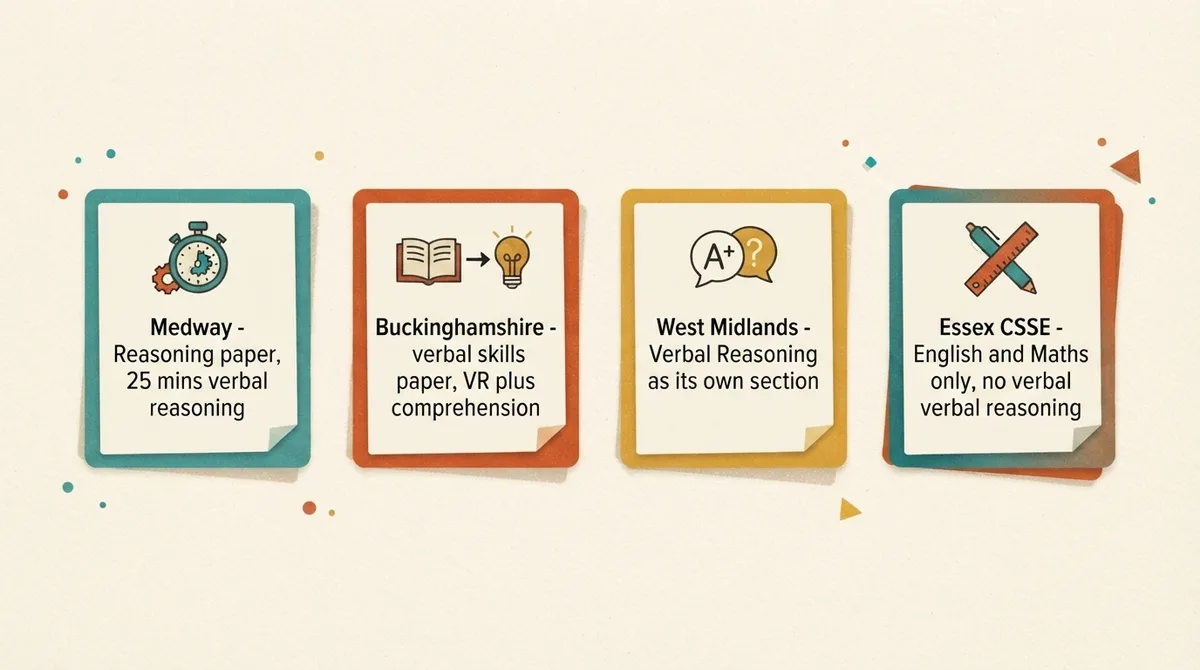
- If your child sits the Medway Test, verbal reasoning is a timed block inside a larger paper. The test is three papers (English, Mathematics and Reasoning), and the 45-minute Reasoning paper splits into 20 minutes of spatial and non-verbal reasoning and 25 minutes of verbal reasoning, with GL writing the tests specifically for Medway Council (Medway Council). Twenty-five minutes is a hard number you can divide, which is what the timings later in this article are built on.
- If your child sits the Buckinghamshire Secondary Transfer Test, verbal reasoning is folded into a verbal skills paper alongside comprehension and technical English. Every question is multiple-choice, each paper runs about 45 minutes (60 including introduction and examples), and answers go onto a separate answer sheet (Buckinghamshire Council). Practise the transcription, not just the reasoning.
- If your child sits the West Midlands Grammar Schools Entrance Tests, verbal reasoning is its own named section, sitting alongside English, Non-Verbal Reasoning and Mathematics, in a multiple-choice format across two tests of around 60 minutes each (Warwickshire County Council). Here the families below carry their full weight.
- If your child sits the CSSE Essex 11+, none of this is examined. CSSE is two papers, English and Mathematics, and from September 2024 entry the English paper no longer contains Applied Reasoning questions. Verbal reasoning drilling is optional enrichment, not preparation.
If you are unsure which board your area uses, start with our comparison of GL, CEM and ISEB, then confirm against your own council's admissions page, because arrangements change year to year.
Codes: letter codes and number codes
Codes reward one habit above all others: decode the example first, in writing, before looking at the question word.
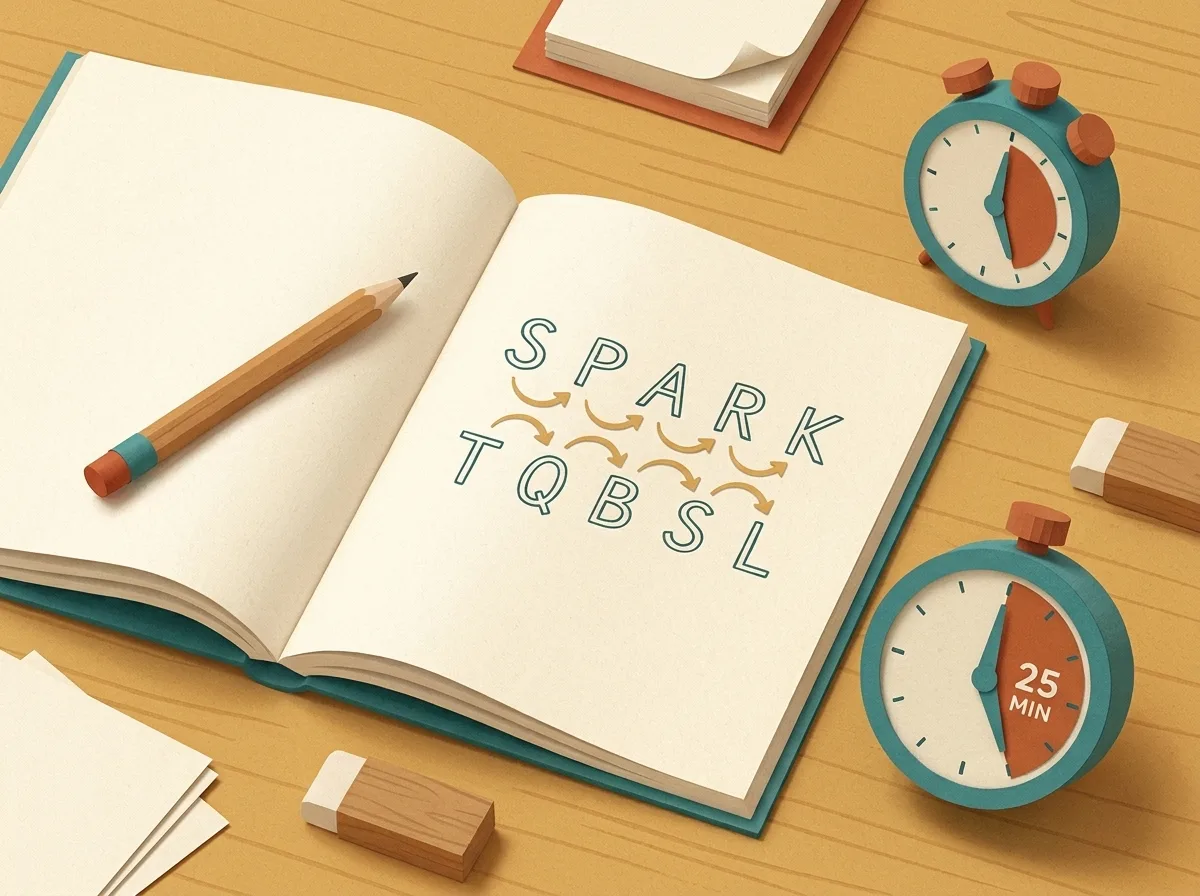
1. SPARK is written as TQBSL. Write BLAME in the same code. CMBNF. Every letter moves forward one place. Children who write AKZLD have spotted the shift of one but pushed it backwards; check direction on the example before touching the question.
2. MOUSE is written as NNVRF. Write TIGER in the same code. UHHDS. The shifts alternate: forward one, back one, forward one, back one, forward one. Children who write UJHFS applied forward one throughout, because they checked only the first letter of the example.
3. If CAT is written as DCW, write DOG in the same code. EQJ. The shift grows with position: plus one, plus two, plus three. Children who write EPH assumed a fixed shift again, the single most common code error at 11+.
4. BEND is 2537 and DENY is 7534. What is BENDY? 25374. Match letter to digit across both words first: B is 2, E is 5, N is 3, D is 7, Y is 4. Children who answer 25344 mapped D to 4 because D is the fourth letter of the alphabet, importing a rule the question never gave.
5. Using alphabet positions, DOG is 4 15 7. What is CAT? 3 1 20. Count A as 1. Children who write 2 0 19 started counting at zero, which is right in spirit and wrong on every mark.
Letter sequences, letter series and letters for numbers
In a sequence, each position moves independently. Write the movements above the letters as small numbers before you answer.
6. AZ, BY, CX, D?. DW. The first letter runs forwards and the second runs backwards. Children who write DY spotted the plus one in the first pair and never checked that the second letter was travelling the other way, which is the classic 11+ sequence trap.
7. CE, GI, KM, O?. OQ. Inside each pair the gap is two; between pairs the jump is four. Children who write OP applied the between-pairs step to the inside of the pair.
8. AB, DE, GH, JK, ?. MN. Each pair starts three letters after the last. Children who write KL simply continued the alphabet from the final letter shown.
9. ZA, YB, XC, ?. WD. Mirror pairs: one letter reversing, one advancing. Children who write WC moved only the first half of the pair.
10. If A = 2, B = 3, C = 4, D = 12 and E = 6, what is (D divided by B) plus A, given as a letter? E. Twelve divided by three is four, plus two is six, and six is E. Children who write 6 did every step correctly and lost the mark by answering with a number when the question asked for a letter.
11. If P = 5, Q = 2, R = 10 and S = 4, what is R divided by (Q times S), as a number? 1.25. Brackets first. Children who work left to right get 20, so make them circle the brackets before calculating.
Compound words, hidden words and word building
This family is where two options can both be real words. The winning habit is to test every option to the end rather than stopping at the first one that works.
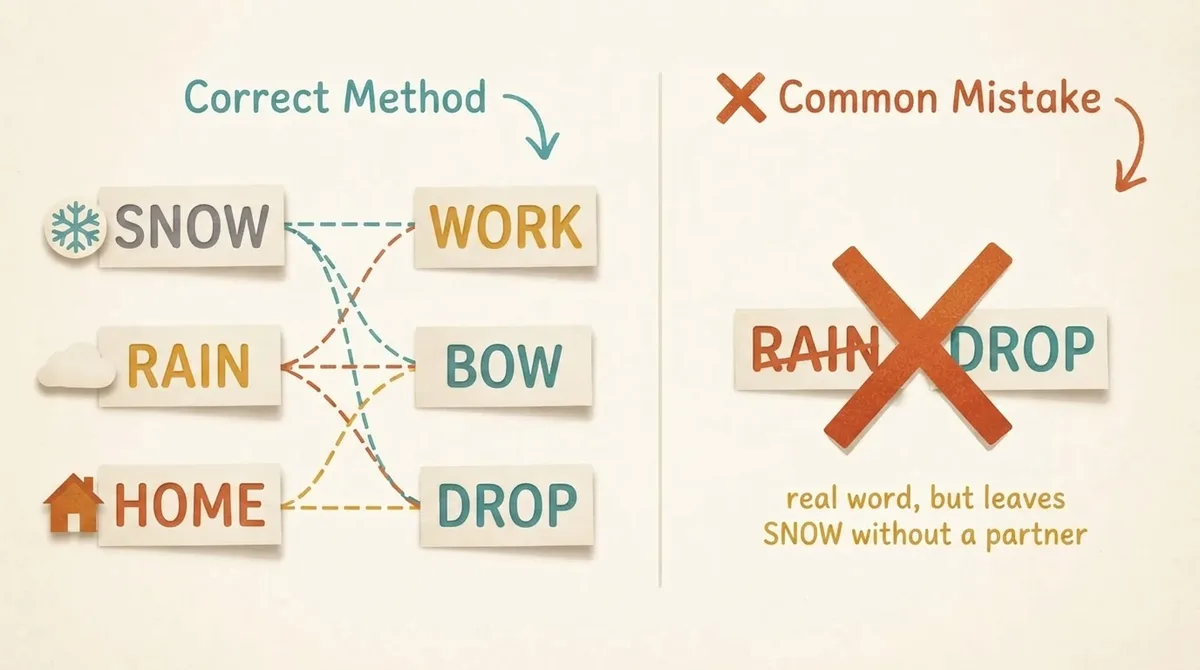
12. Pair each word on the left with one on the right so all three make compound words, using each word once: SNOW, RAIN, HOME with WORK, BOW, DROP. Snowdrop, rainbow, homework. Children pair raindrop first because it is a real word, then find snow has no partner. Solve the constrained word last, not first.
13. Which word goes in front of all three: ___ball, ___print, ___path? Foot. Hand works for two of the three, which is exactly why it is offered. Two out of three is always the trap in this format.
14. A four-letter word is hidden across the join of two words in this sentence: "We must open the gate." STOP, spanning must and open. Children hunt inside single words and offer OPEN or USTO; the hidden word almost always straddles a gap.
15. Move one letter from the first word to the second so both remain real words: CLAMP, HARM. Move the C: LAMP and CHARM. Children move the L, because CAMP is a real word, then never check that HARML is not. Both halves must survive.
16. Add the same letter to the front of each to make three new words: OUR, ATE, EDGE. H, giving hour, hate and hedge. Children test the first word only, find that many letters work with OUR, and commit before checking the third.
Word meaning: synonyms, antonyms, analogies and odd one out
Vocabulary questions are decided by relationship, not by association. Ask what the link is, in words, before choosing.
17. Choose one word from each group that is closest in meaning: (brief, lengthy, hasty) and (concise, wordy, rude). Brief and concise. Children who pick brief and hasty have chosen two words from the same bracket, which the instruction forbids even when the meaning feels close.
18. Which is most opposite in meaning to scarce: plentiful, cheap or hidden? Plentiful. Cheap is offered because scarce things are expensive, so the child answers by association rather than by opposition.
19. Book is to library as painting is to what? Gallery. The relationship is the place where the thing is kept. Children answer artist, which is a genuine relationship but not the one in the first pair.
20. Odd one out: sofa, stool, bench, cupboard, chair. Cupboard, the only one not for sitting on. Stool tempts children because it alone has no back, a real difference that is not the shared category.
21. Find the two odd ones out: violin, cello, trumpet, viola, flute. Trumpet and flute, the only non-strings. The trap is answering with one word when the question asked for two, and it is a mechanical loss, not a knowledge gap.
Logic, following instructions and reading information
These questions are short comprehension puzzles. The rule is to use only what is written on the page.
22. Amir is taller than Beth. Beth is taller than Cara. Dev is shorter than Cara. Who is shortest? Dev. Write the chain out top to bottom rather than holding it in your head; reversals of "taller than" cost more marks here than any other error.
23. Three children each chose one fruit and no two chose the same. Sam did not choose the apple. Priya chose the pear. Who chose the apple? Rani. Cross off as you go: Priya is fixed, Sam is excluded, one name remains.
24. Write the third letter of PLANET followed by the first letter of MOUSE. AM. Children write the letters in the order they read the words but miscount the position; touch each letter with the pencil while counting.
25. A club meets every third day, starting on Monday. On which day is the third meeting? Sunday. Monday, then Thursday, then Sunday. Children count the starting day as day one of the gap and land on Saturday.
26. "All of the pupils in Class 6 walk to school. Jo walks to school." Must Jo be in Class 6? No. The statement does not work backwards. Real-world plausibility is the trap: the answer must follow from the sentence alone.
The wrong answers children pick most often, and how long each type should take
Across every family above, four mistakes account for most lost marks: applying a rule in the wrong direction, applying a rule that was true for the first letter only, accepting the first real word without checking the rest, and answering in the wrong form (a number instead of a letter, one word instead of two).
For timing, use a real paper figure rather than an invented one. Medway allows 25 minutes for verbal reasoning inside its Reasoning paper. Divide that by a typical question count and roughly 30 to 40 seconds per question is the working budget. Within that, codes and sequences should take the longest, at around 45 seconds, because the decoding step is written down. Word meaning and odd one out should take 20 seconds or be flagged and left, since staring rarely rescues a vocabulary question. Logic sits in the middle at about 40 seconds.
Then add the mark nobody covers. Where questions are multiple-choice onto a separate answer sheet, as in Buckinghamshire, transcription is its own skill and its own risk. Practise filling the sheet, not just solving the question, and check every ten answers that the number on the sheet still matches the number in the booklet.
Mixed set under exam timing
Set a timer for five minutes and give these ten questions cold, with no type headings, because mixing formats is what the real paper does.
- FROG is coded GSPH. Code BIRD. (CJSE)
- BD, FH, JL, ?. (NP)
- Which word goes in front of both ___light and ___flower? (Sun)
- Opposite of ancient: modern, ruined or rare? (Modern)
- Hidden four-letter word: "They rose at dawn." (Seat, hiding across "rose at".)
- Odd one out: oak, pine, tulip, birch, willow. (Tulip)
- Finger is to hand as toe is to what? (Foot)
- If A = 3, B = 6, C = 2, what is B divided by A, as a letter? (C)
- Move one letter: SPACE and TAR to make two real words. (Move the S: PACE and STAR)
- Ravi is older than Mia. Mia is older than Leo. Who is youngest? (Leo)
Question 5 is deliberately left unresolved: it is the one to talk through together, because a hidden word question with no valid answer is exactly what a child needs practice at abandoning. Teach them to mark it, move on, and return if time allows.
When your child can work a set like this at pace, move to full papers under real conditions. Our free verbal reasoning practice test is the next step up, and timed mock tests put the same families under exam clock and answer-sheet pressure, which is where the remaining marks actually live.
Topics
- verbal reasoning
- 11 plus
- gl assessment
- practice questions
- exam technique