
Manchester and Trafford Grammar Schools and the 11 Plus
There are no state grammar schools in the City of Manchester: all seven sit in Trafford, and they run three different entrance tests. Here is which school uses which test, what is on each paper, and the deadlines that decide whether your child sits it at all.
 Elspeth Marlow
- 13 min read
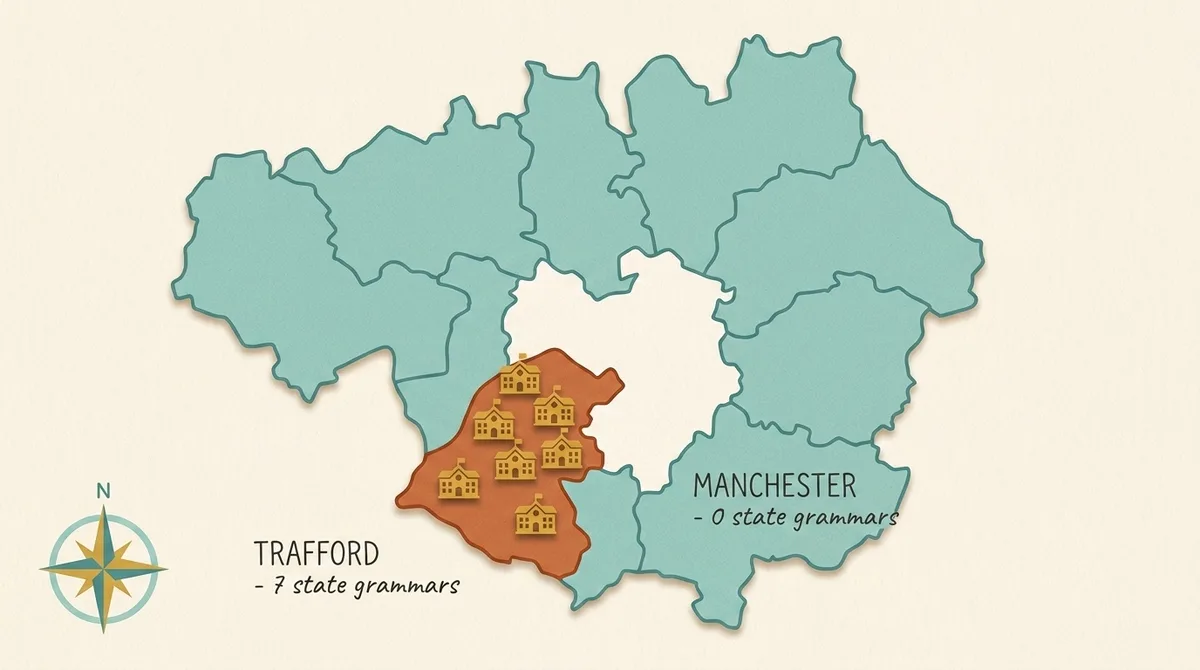
Most parents searching for grammar schools in Manchester are looking in the wrong local authority. The City of Manchester does not have a single state grammar school. Every state-funded selective school in Greater Manchester sits inside the neighbouring borough of Trafford, and the school whose name comes up first in almost every search, Manchester Grammar School, is an independent fee-paying school that has nothing to do with the 11+ process families are researching.
That correction moves your shortlist to Trafford and drops you into an admissions system more complicated than the usual listicle admits. The seven Trafford grammars do not share one entrance test. Five of them do, through the Trafford Consortium. The other two, Loreto Grammar School and St Ambrose College, each run their own exam on a different date with a different structure, so a child targeting one Consortium school and St Ambrose will sit two completely different papers in the same week.
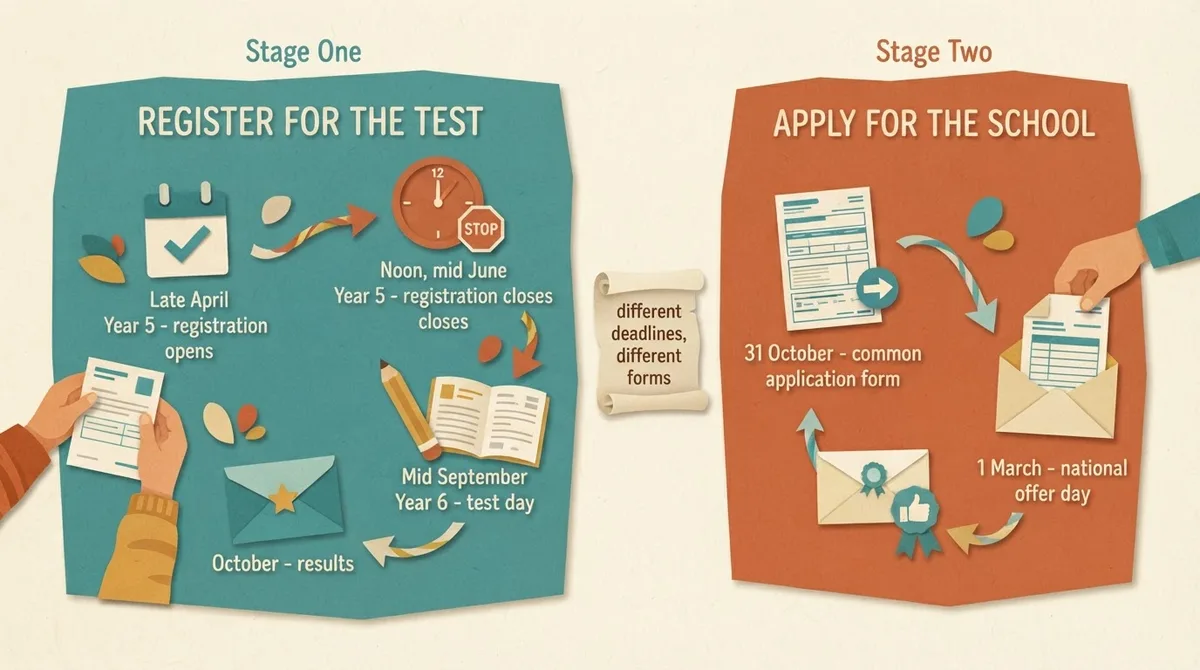
This guide walks it in order: which schools exist and where, which test each one uses, what is actually on each paper, and the two-stage timeline that starts in the April of Year 5. That timeline is where families lose places. Registering to sit the test is not the same as applying for a school, the registration deadline falls roughly four months before the application deadline, and missing it means your child cannot take the exam at all, however well prepared they are.
Start here: the schools are in Trafford, not Manchester
When selection was dismantled across most of England, some local authorities kept their grammar schools and others did not. Manchester City Council did not. Trafford did, and it remains one of a small number of fully selective English authorities, which is why a borough of its size holds seven grammar schools while the city next door holds none.
Practically, that means three things. Your child will sit a Trafford-run or Trafford-school-run entrance test, whichever Greater Manchester postcode you live in. You apply for a secondary place through your home local authority, so a Manchester family applies via Manchester City Council but names Trafford schools on the form. And you are competing against Trafford residents, who in several cases hold explicit priority in the oversubscription rules.
The seven state grammar schools at a glance
Here is the full list, with the detail that actually decides your shortlist rather than an A-level ranking. Every one of these is in the Trafford local authority.
- Altrincham Grammar School for Boys (AGSB). Boys. Trafford Consortium test. Distance and catchment rules apply after qualification.
- Altrincham Grammar School for Girls (AGGS). Girls. Trafford Consortium test.
- Sale Grammar School. Co-educational. Trafford Consortium test. Published admission number of 190 places.
- Stretford Grammar School. Co-educational. Trafford Consortium test. Qualifying standardised score of 334, admission number of 160 for September 2027, with priority postcodes M32, M33, M41, M17, M15, M16 and M21.
- Urmston Grammar School. Co-educational, despite being widely and wrongly described online as a girls' school. Trafford Consortium test.
- Loreto Grammar School. Girls, Catholic. Its own separate entrance exam on its own date, with faith criteria in its oversubscription rules.
- St Ambrose College. Boys, Catholic. Its own separate entrance exam, again with faith criteria.
Trafford Council confirms the split directly: the Consortium is made up of AGSB, AGGS, Sale, Stretford and Urmston, while Loreto and St Ambrose sit outside it and use a separate test (trafford.gov.uk). If a guide presents all seven as one block, it has not read the source.
Manchester Grammar School and the schools people mistake for grammars
Manchester Grammar School is not a grammar school in the 11+ sense that parents mean. The government's own register of schools classifies it as an "other independent school", inspected by the Independent Schools Inspectorate, covering ages 7 to 18 (get-information-schools.service.gov.uk). It charges fees, sets its own admissions assessment, and takes no part in the Trafford Consortium process. The word "grammar" in its name is historical, as it is at many independent schools founded centuries before state selection existed.
The same applies to the other well-known Manchester independents that surface in searches for free grammar schools: if the entrance process involves a registration fee and a termly invoice, you are looking at private admissions, not the 11+. Both routes are legitimate, but they run on different calendars with different tests. For the wider national picture of which areas are selective and what each uses, our guide to grammar schools near me maps the whole country.
Spring of Year 5: decide which test, or tests, your child will sit
This is the first real milestone, and it lands earlier than most families expect. By around Easter of Year 5 you want a working shortlist, because registration opens within weeks and the shortlist decides how many different exams your child is preparing for.
The helpful part of the Consortium arrangement is that one set of results can be considered by any of the five Consortium schools, as long as you select that option when you register for the test. You sit one exam and share the score.
The catch is the other two. Adding Loreto or St Ambrose to your list adds a genuinely separate exam, on a separate date, with its own registration form and its own deadline. That is a real decision about your child's autumn, not an administrative footnote.
Late April to mid June of Year 5: the deadline families actually miss
For September 2027 entry, Trafford Consortium registration opened at 12 noon on Thursday 23 April 2026 and closed at 12 noon on Friday 19 June 2026, with the entrance examination sat on Monday 14 September 2026 (agsb.co.uk). Registration closes in the June of Year 5, while your child is still two months short of starting Year 6, and roughly four months before the 31 October common application form that most parents assume is the deadline.
Trafford Council is explicit that a child must first pass the entrance test to be considered for a grammar place, and that parents must contact the preferred grammar school directly to register to sit it. The council does not do this for you: there is no automatic enrolment, no letter from your primary school, and no reminder.
Loreto's deadline sits later but is just as absolute: registration for its September 2027 entry exam closed at 1:00pm on 31 July 2026, with the school stating that no late applications are accepted (loretogrammar.co.uk). Loreto also publishes an eligibility window worth checking against your child's birthday: registration for the September 2026 tests was for candidates born between 1 September 2015 and 31 August 2016.
The practical takeaway is a diary entry, not a strategy. Put the April registration opening in your calendar in the spring of Year 5, and register early rather than at the deadline. Exact dates shift each year, so always confirm against the school's own admissions page for your entry year.
The lookup below shows the checked Trafford dates and registration link.
This part of the guide looks up which 11+ test your area uses. It works in your browser.
What is actually on the Trafford Consortium papers
This is the detail no page-one competitor publishes, and it is the thing that determines how your child should practise.
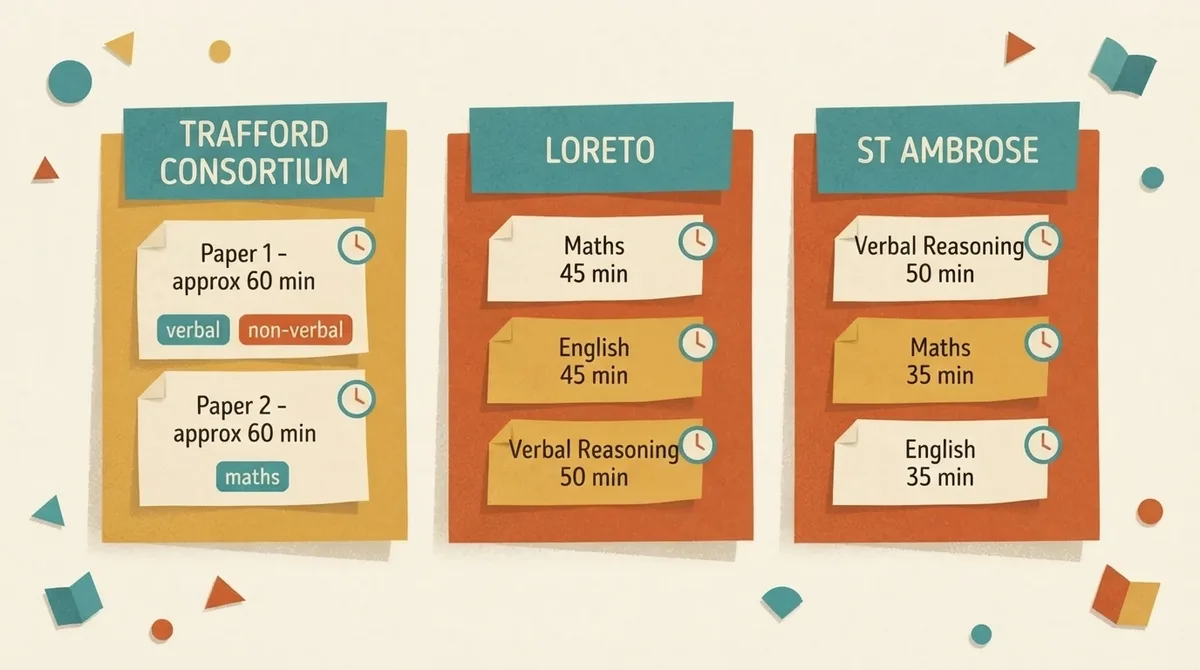
The Consortium entrance examination consists of two tests, each approximately one hour in length, containing questions that assess verbal ability, non-verbal ability and mathematics. The subject content is defined as follows:
- Verbal ability: word choice, vocabulary knowledge, word relationships and comprehension.
- Non-verbal ability: shape relationships, sequences, pattern identification, codes and spatial awareness.
- Mathematics: content typically taught through Year 5, covering number, measurement, geometry and statistics.
Because each paper mixes all three strands rather than isolating them, a child cannot mentally "finish" the verbal section and settle into maths; they switch modes repeatedly under time pressure. Practising three separate single-subject papers builds the knowledge but not that switching stamina, which is why full-length mixed papers matter more here than in single-subject regions. Our mock test practice is built to run those under real conditions, and if the maths list above looks daunting, note that it stops at Year 5 curriculum: this is a reasoning test, not an accelerated syllabus.
The non-verbal strand is usually the least familiar to primary-schooled children, since almost nothing in the national curriculum resembles it. If your child has never seen this question type, start with how non-verbal reasoning works in the 11 plus before timing anything.
Loreto and St Ambrose: the two separate tests
Both schools publish their own specifications, and neither resembles the Consortium format.
Loreto Grammar School sets three timed elements: Mathematics (45 minutes), English set by GL Assessment (45 minutes) and Verbal Reasoning set by GL Assessment (50 minutes). Its September 2027 entry exam fell on Friday 18 September 2026, four days after the Consortium test. There is no non-verbal reasoning element, and English is a discrete paper rather than a strand inside a mixed test.
St Ambrose College sets three multiple-choice assessments: Verbal Reasoning (50 minutes) administered by GL Assessment, plus Maths (35 minutes) and English (35 minutes) written by the school itself. The school states that no sample or past papers are available for its own maths and English papers (st-ambrosecollege.org.uk). The best preparation for those two is solid curriculum work plus general multiple-choice technique, not paper hunting.
Because the GL-set elements at both schools follow standard GL conventions, GL-style practice papers transfer well to the verbal reasoning and Loreto English components. Working through printable papers under the exact published timings, 50 minutes for verbal reasoning and 35 or 45 for the others, is the closest simulation available.
October of Year 6: results, and why passing does not get you a place
Results arrive in the autumn term, before the application deadline, which is the whole point of the September test date: you find out whether your child has qualified in time to build a sensible application.
Qualifying, though, is a threshold, not an offer. Stretford Grammar School requires a standardised score of 334 to qualify for consideration for a place (stretfordgrammar.com). Reaching 334 does not buy a place; it buys entry into the queue, and the queue is then ordered by the school's oversubscription criteria, not by score. Stretford's criteria run in this order:
- Looked after and previously looked after children.
- Children adopted from state care outside England.
- Catchment area residents receiving pupil or service premium.
- Applicants with siblings already in Years 7 to 11.
- Residents within priority postcodes M32, M33, M41, M17, M15 and M16 (within both Trafford and Manchester), and including M21.
- Non-catchment residents receiving pupil or service premium.
- All other applicants, ranked by distance to the school.
Distance is measured as a direct straight line from the child's permanent home to the school, using property coordinates from the Trafford Local Land and Property Gazetteer and Royal Mail data, with random allocation breaking ties.
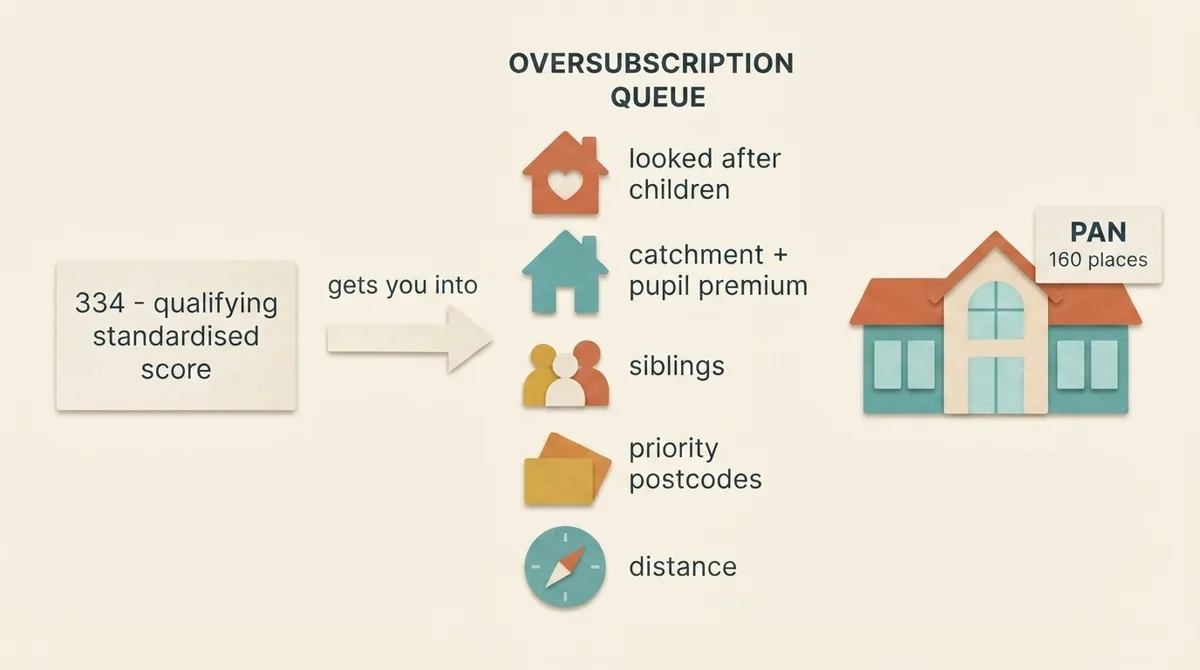
Crucially, although the five Consortium schools share one entrance test, each has its own separate oversubscription criteria and admission policy: the same score can produce an offer at one Consortium school and a refusal at another. For the wider context on how these thresholds are set and why they differ so much between authorities, see our explainer on 11 plus pass marks and qualifying scores.
By 31 October of Year 6: the common application form
This is the second stage, and it is entirely separate from the test registration you completed sixteen months earlier. You submit one common application form to your home local authority, listing your preferred schools in order. Manchester residents apply through Manchester City Council even when naming Trafford schools; Trafford residents apply through Trafford.
Two habits protect families here. First, name a realistic non-selective school somewhere on the form: preference lists are not a bargaining tactic, and an all-grammar list from a family living well outside every priority postcode is a real risk. Second, order the list by genuine preference rather than perceived chance, because a higher preference is only considered ahead of a lower one for the same child.
Offers arrive on national offer day the following March, and appeals and waiting lists run from there.
Building a shortlist that actually fits your postcode
Rankings are the least useful tool for this decision; work from geography and rules instead. Find your postcode in the published criteria first. A family in M32 or M41 has a materially stronger position at Stretford than a family the same driving distance away in a postcode outside that list, because that priority sits above the general distance category. Then weigh the admission numbers against how far you live from the gate, since Sale's 190 places and Stretford's 160 bite once distance ordering kicks in.
For Loreto and St Ambrose, faith criteria and parish evidence typically carry weight in their oversubscription rules, so read those policies in full rather than assuming the Trafford distance model applies. And if your child is sitting both a Consortium paper and one of the separate exams, plan for two exam experiences in one September. Our year-by-year preparation plan sets out what to cover when, and you can start a free plan to map the Trafford dates against your child's current level.
Frequently asked questions
How many grammar schools are there in Manchester? In the City of Manchester local authority, none. There are seven state grammar schools in Greater Manchester and all seven are in Trafford.
Is Manchester Grammar School a grammar school? Not in the state selective sense. It is an independent fee-paying school for ages 7 to 18, classified on the government register as an "other independent school" and inspected by the ISI. It does not use the Trafford Consortium test.
Can my child sit more than one test? Yes. One Consortium registration covers all five Consortium schools if you select that option, and Loreto and St Ambrose can be added on top, each with its own registration and date.
What score does my child need? It varies by school. Stretford publishes a qualifying standardised score of 334, but qualifying only places a child into the oversubscription queue. Check the current published policy for each school and entry year, as thresholds can change annually.
When do we register? For the Consortium, in the late April to mid June window of Year 5, closing at noon on the published date. Confirm dates on the school's own admissions pages and treat the deadline as final, because late registrations are not accepted.
Topics
- manchester
- trafford
- 11 plus
- grammar schools
- admissions