
Home Education in England: What Suitable Education Means
A precise, dated guide to what section 7 actually requires, what a local authority can and cannot make you do, and which parts of the Children's Wellbeing and Schools Act 2026 are genuinely in force.
 Elspeth Marlow
- 16 min read
Three questions drive almost every search about home education law: what does suitable actually mean, what can the council make me do, and have the rules just changed? The pages currently ranking answer the first vaguely, the second partially, and the third barely at all. One of the top ten results is a Facebook group post, which tells you how little authoritative material is written for parents rather than for officials.
Here is the definitional answer up front. A suitable education is one that is efficient, full-time, and appropriate to the child's age, ability and aptitude and to any special educational needs. None of those words is defined in statute. There is no minimum number of hours, no curriculum you must follow, and no qualification you must hold. Department for Education guidance says a suitable education must be age-appropriate, must enable the child to make progress according to their level of ability, and must take account of any specific aptitudes.
And the answer to the question parents are currently being given wrongly in forums: as at the reviewed date below, you do not need permission from your local authority to home educate in England, except in two narrow situations set out later. The children-not-in-school register and consent provisions in the Children's Wellbeing and Schools Act 2026 exist on the statute book but have not been commenced. The detail, with the commencement instruments, is in its own section.
What this page covers, when it was reviewed, and what it cannot do
Reviewed: 18 November 2026. Scope: England only. Wales, Scotland and Northern Ireland are compared in a later section, and the differences are substantive, not cosmetic.
This is legal information, not legal advice. It describes the general position; it cannot tell you whether your particular arrangement satisfies section 7, because that is a judgment about the whole of one child's education, made on the facts. No platform, curriculum, tutor or product can make a family legally compliant, and that includes Trace Learn. Practice papers and progress tracking can evidence part of a picture. They are not the picture.
For context on scale: DfE recorded 126,000 children in elective home education in England on the autumn 2025 census date, up about 14,300 year on year, and 175,900 children in EHE at some point during 2024/25. Of the 78,000 who started during that year, 49% came from academies and 23% from maintained schools. The most commonly recorded reasons were mental health (16%) and philosophical or preferential reasons (12%), with nearly 30% unknown or declined.
The duty sits on you, not on a school: section 7
Section 7 of the Education Act 1996 is the whole foundation. It requires the parent of every child of compulsory school age to "cause him to receive efficient full-time education suitable (a) to his age, ability and aptitude, and (b) to any special educational needs ... he may have, either by regular attendance at school or otherwise."
Read the last four words carefully. School is one way of discharging a duty that is already yours. Home education is not an exemption from a duty to send a child to school; it is an alternative method of performing the same duty. That is why there is no application process and no approval step.
What "efficient", "full-time" and "suitable" actually mean
DfE's elective home education guidance treats these as three separate tests, and so should you.
Efficient. Guidance interprets this as "education which achieves what it is intended to achieve". It is deliberately relative to your own aims. Crucially, efficient is not the same as suitable: you can deliver an unsuitable education very efficiently, and a suitable one very inefficiently.
Full-time. There is "no legal definition of 'full-time' in terms of education at home, or at school". Children at school typically have around five hours of tuition a day, 190 days a year across roughly 38 weeks, but guidance states plainly that "home education does not have to mirror this". Treat five hours a day as a comparator a council may reach for, not a standard you must hit. The real test is that education occupies a significant proportion of the child's life, and that you can quantify and demonstrate roughly how much time it takes.
Suitable. Not defined in statute. It must be age-appropriate, enable progress according to the child's ability, and reflect specific aptitudes. Guidance adds five further factors that do bear on suitability:
- An appropriate minimum standard, aimed at enabling the child as an adult to function as an independent citizen in the UK and beyond the community they were raised in.
- Education should not directly conflict with Fundamental British Values, though there is no requirement to teach them.
- Local authorities may apply minimum expectations for literacy and numeracy, while bearing in mind age, ability, aptitude and SEN.
- Provision may be unsuitable if delivered in circumstances that make it very difficult to work, such as very noisy premises.
- Provision may be unsuitable if it leads to excessive isolation from peers and so impedes social development.
The eleven things the law does not require you to do
Most overstatement of parental duty comes from reading the five factors above without their counterweight. DfE guidance is explicit that there is no legal requirement to:
- Hold any specific qualification.
- Have premises equipped to a particular standard.
- Aim for the child to gain any specific qualifications.
- Teach the National Curriculum.
- Provide a "broad and balanced" curriculum.
- Make detailed lesson plans in advance.
- Give formal lessons.
- Mark the child's work.
- Formally assess progress or set development objectives.
- Reproduce school-type peer group socialisation.
- Match school-based, age-specific standards.
Separately, you need no timetable, no set hours, and no observance of school terms or days. The one qualifier: you should be able to quantify and demonstrate the amount of time your child is being educated.
Withdrawing your child: a five-step playbook
- Check whether you are in one of the two consent situations. Local authority consent is required before a name is deleted only where the child attends a special school and the placement was arranged by the authority (a refusal can be referred to the Secretary of State), or where the child attends any school under a school attendance order, which the authority must revoke first. GOV.UK confirms no council permission is needed where a child attends a mainstream school, even with an EHC plan.
- Write to the head teacher. State that your child will no longer attend after a named date and will receive education otherwise than at school. Keep it to those elements plus your child's name, date of birth and class.
- Understand which rule is actually operating. DfE's 2019 parents' guidance (para 4.2) says a parent is "not obliged to inform the school". Regulation 9 of the School Attendance (Pupil Registration) (England) Regulations 2024 (SI 2024/208) makes the parent's written notice the ground that requires the proprietor to delete the name, once the named day has passed and no attendance order names the school. The guidance predates the regulations. In practice, written notice is now the operative mechanism, and sending it is what makes the deregistration clean.
- Expect acceptance, not negotiation. GOV.UK states "the school must accept if you're taking your child out completely." Schools may refuse part-time or flexi-schooling arrangements, which are discretionary.
- Never enrolled? Nothing to do. Where a child has never been registered at a school, guidance says the parent "is under no legal obligation to inform the local authority" or obtain consent, though DfE strongly recommends notifying.
What the council can and cannot make you do
A local authority "has no formal powers or duty to monitor the provision of education at home". It does have a duty under section 436A to establish, so far as possible, the identity of children not receiving suitable education, and to discharge it authorities "are entitled to make informal enquiries of parents".
You are under no legal obligation to respond, to agree to a meeting, or to produce evidence in a prescribed format. The section 175 Education Act 2002 safeguarding duty "does not entitle a local authority to insist on visiting a child's home, or seeing the child, simply for the purposes of monitoring". But silence has a cost: guidance says the authority is entitled to conclude from the absence of any response that it appears the child is not receiving a suitable education.
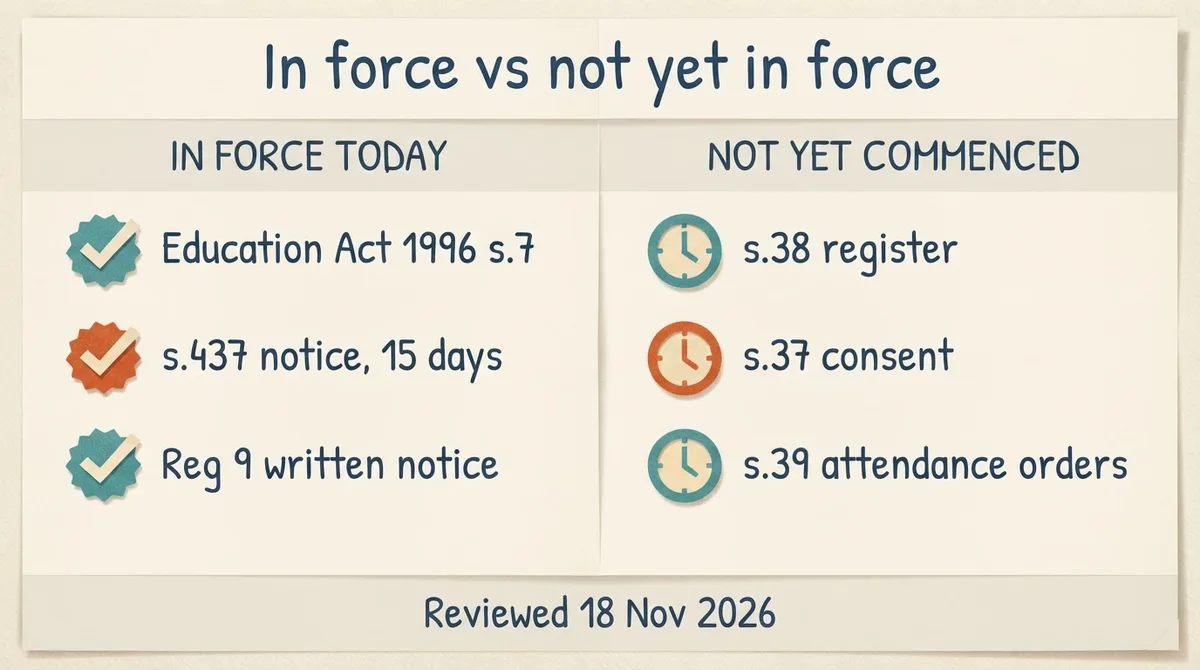
That conclusion triggers section 437 of the Education Act 1996. The authority must serve written notice requiring you to satisfy it, within a period that "shall not be less than 15 days beginning with the day on which the notice is served". If you do not satisfy it and it is expedient the child attend school, the authority must serve a school attendance order. Breaching an SAO is a criminal offence. You can seek revocation by producing evidence of satisfactory arrangements, and a refusal to revoke can be referred to the Secretary of State.
A proportionate reply: the evidence file
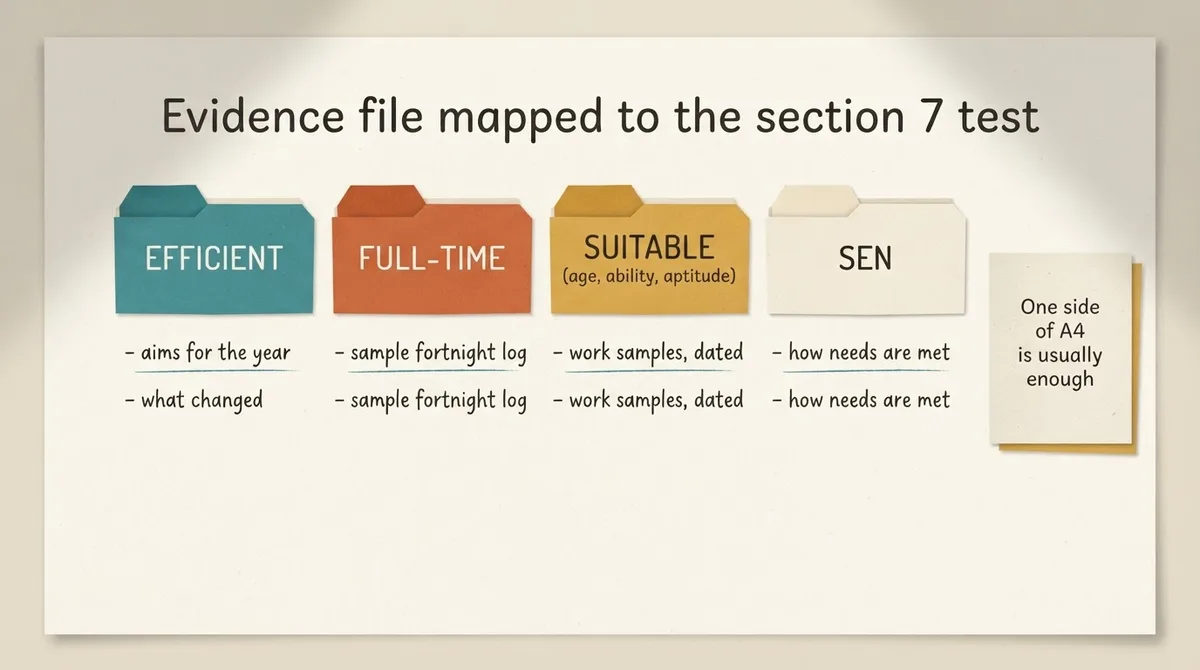
The practical gap this SERP leaves is what a good reply looks like. Answer the section 7 test, not an open-ended request. One side of A4 plus a small folder is usually enough.
Worked example, Year 6, maths and English. Aims for the year: secure written division and fractions; move from paragraph-level to structured multi-paragraph writing. Time: a typical fortnight log showing roughly 12 hours of core work, 4 hours of project work, 3 hours of group sessions. Evidence of progress: three dated pieces of the same writing task type from September, January and June, so improvement is visible without formal marking. Ability and aptitude: a note that the child reads well above age expectation and works below it in arithmetic fluency, and what you changed as a result. SEN: how each identified need is met, and by whom.
If your child is preparing for selective entry alongside home education, timed papers create the same dated trail. Our guides to preparing for the 11 plus year by year and the practical application sequence cover deadlines that home-educating families routinely miss, since no school will chase them for you. Formats vary considerably by area.
Illness, exclusion and SEN: when the state owes provision
This is the most consequential distinction on this page. If your child cannot attend school because of illness, exclusion or unmet needs, you may be entitled to provision rather than obliged to supply it yourself.
Section 19(1) of the Education Act 1996 requires every local authority in England to "make arrangements for the provision of suitable education at school or otherwise than at school for those children of compulsory school age who, by reason of illness, exclusion from school or otherwise, may not for any period receive suitable education unless such arrangements are made for them".
Separately, education otherwise than at school (EOTAS) under section 61 of the Children and Families Act 2014 allows an EHC plan to specify provision delivered outside school, with the local authority remaining responsible for arranging and funding the package. That is legally the opposite of elective home education, where you take on both.
Deregistering closes both doors. If a school suggests home education to avoid exclusion or to manage unmet SEN, DfE is clear that such pressure is unacceptable. Get advice before you write anything. If access arrangements rather than withdrawal are the real issue, our guide to 11 plus access arrangements for SEND explains the evidence thresholds assessment bodies apply.
Costs, exams and funding
There is no home education grant in England. Any help with exam entry, tuition or SEN-related costs is discretionary, varies by authority, and is not an entitlement. DfE confirms the 16 to 19 Bursary Fund is not payable where parents elect to home educate after 16, and home-educated children have no entitlement to work experience arranged by a school or authority.
Exams are the practical hurdle. Per JCQ, private candidates sit exams at an approved school or college without being enrolled there, which includes home-educated students. Candidates are responsible for making entries through the centre and paying the fees, and each centre sets its own fees and internal deadlines, which typically fall months before the public entry deadline. JCQ updates its list of centres accepting private candidates once a year in December or January, currently around 190 centres. Before committing to a subject, confirm with the centre whether it will accept and submit coursework or non-exam assessment on your behalf, because many will not, which quietly rules out several subjects.
What is changing, and what is not yet in force
The Children's Wellbeing and Schools Act 2026 (2026 c. 21) received Royal Assent on 29 April 2026. It creates a children-not-in-school register (section 38), a consent requirement for withdrawing certain children (s37), changes to school attendance orders (s39), information processing (s40) and new guidance (s41).
Section 38 inserts new sections 436B to 436G into the Education Act 1996: authorities must maintain a register of eligible children, register them within 15 days, and record specified information; parents must notify within 15 days, supply available information about the child's education, report changes within 15 days, and respond to authority requests at least annually.
None of that binds anyone yet. Section 78(1) commenced Part 1 and Part 2 provisions at Royal Assent only "so far as" they confer or relate to a power to make regulations. The two-month list in section 78(2) covers sections 5, 22, 31, 36, 51, 55, 56, 58, 59, Schedule 3 (other than paragraph 6), 60 and 61, and does not include sections 37 to 42. Commencement No. 2 (SI 2026/803, made 13 July 2026) commenced sections 1, 12, 16, 19, 20, 30 in part, 32, 11, 35, 65 to 69 and others across July to September 2026, and does not include sections 37 to 42. Commencement No. 3 (SI 2026/933) commenced only section 34, on allergy safety.
So, plainly: there is currently no national register duty and no general requirement to obtain consent to home educate in England. When commencement regulations arrive, expect the consent requirement to apply to defined groups, notification duties on parents, and statutory guidance following consultation. Watch for a Commencement No. 4 instrument naming sections 37 to 42.
England compared with Wales, Scotland and Northern Ireland
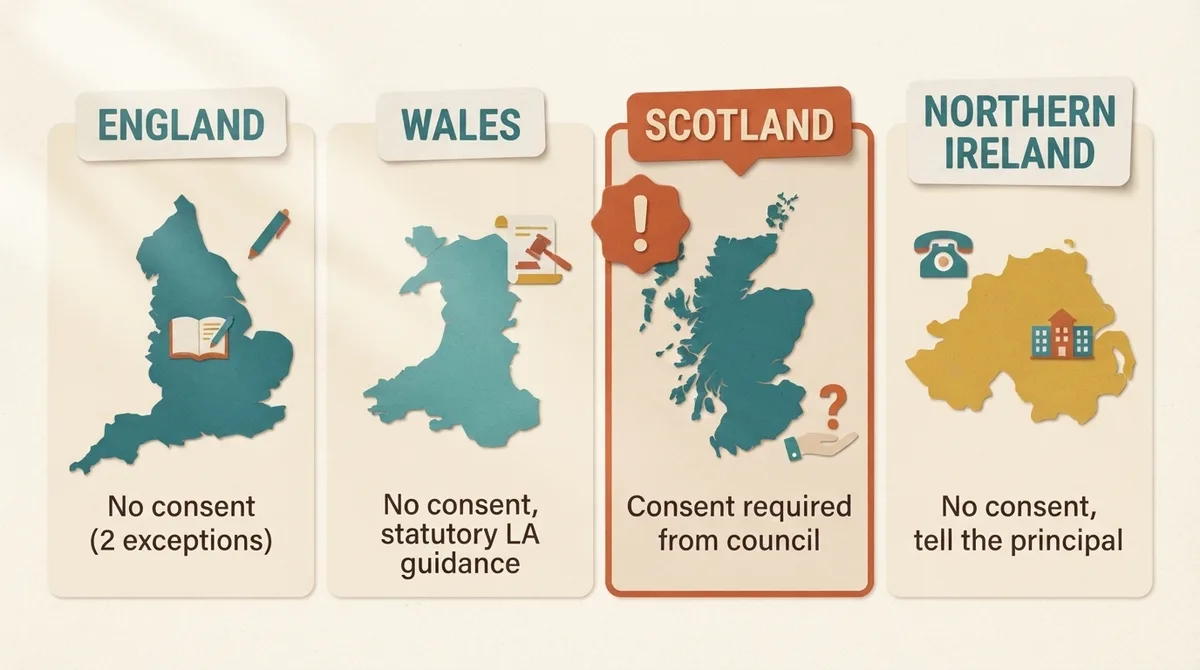
Most "UK homeschooling" pages are England-only. The differences matter.
- England. No consent, except special schools arranged by the authority and children under an attendance order. LA guidance is non-statutory.
- Wales. Section 7 applies (with additional learning needs substituted). Elective home education guidance for local authorities is statutory, published after a Welsh Government written statement in May 2023 and made under the section 436A duty; authorities must have regard to it, and it sets out an expectation that, to determine suitability, the authority should see and communicate with the child. The 2026 Act's children-not-in-school provisions extend to Wales by agreement but are not in force there; gov.wales states implementation "will be decided by the next Welsh Government", with secondary legislation and guidance still in development and subject to consultation.
- Scotland. The genuine outlier. Consent from the local authority is required to withdraw a child from a council-run school, and the council may refuse if it thinks the child will not get a suitable education. Consent is not needed where the child never attended a council school, attends an independent school, does not attend a council school in their local area, has not yet been enrolled, has finished primary but not started high school, or where the school has closed (mygov.scot).
- Northern Ireland. Parents must ensure efficient full-time education suitable to age, ability and aptitude and to any SEN, normally from age four to 16. No special permission is needed from a school or the Education Authority, but the principal must be told where the child was previously registered, so the child can be de-registered (nidirect).
Frequently asked questions
What are the new rules for homeschooling in the UK?
In England, none of the new rules is operative yet. The Children's Wellbeing and Schools Act 2026 creates a children-not-in-school register and a consent requirement for some withdrawals, but sections 37 to 42 sit outside both the section 78(2) two-month list and Commencement Nos. 2 and 3. Until commencement regulations are made, section 7 of the Education Act 1996 remains the operative law. Wales has agreed the provisions extend there but has not commenced them.
What is the best homeschool program in the UK?
There is no officially recommended or approved programme, and nothing about DfE guidance requires you to use one, since there is no duty to follow the National Curriculum or provide a broad and balanced curriculum. Judge any programme against the section 7 test: does it produce progress appropriate to your child's ability and aptitude, and can you demonstrate the time it occupies? Structured platforms help most with quantifiable evidence and with exam-shaped preparation. If selective entry is your goal, what the 11+ actually involves is worth reading before you buy anything; you can compare Trace Learn's options on our pricing page.
Do parents get money for homeschooling in the UK?
No. There is no home education grant or allowance in England. Local authority help with exam fees, tuition or SEN-related costs is discretionary and inconsistent. The 16 to 19 Bursary Fund is not payable where parents elect to home educate after 16. The exception is not funding for home education at all: where a child cannot attend school through illness or exclusion, section 19 obliges the authority to arrange suitable education, and an EHC plan may specify EOTAS provision the authority funds.
Can a school refuse homeschooling?
For a full withdrawal from a mainstream school, no. GOV.UK states the school must accept it, and regulation 9 of SI 2024/208 requires deletion from the admission register once your written notice takes effect. A school can refuse part-time or flexi-schooling, which is entirely at its discretion. Consent is required only for special schools arranged by the local authority and for children under a school attendance order.
Where to get independent advice
For a specific dispute, get individual advice rather than relying on any general page, including this one. Child Law Advice (childlawadvice.org.uk) covers deregistration and attendance orders in detail. IPSEA (ipsea.org.uk) is the place to go on EHC plans and EOTAS. If a local authority has acted unreasonably and you have exhausted its complaints process, the Local Government and Social Care Ombudsman can investigate.
If you are weighing home education against a selective route, keep the two decisions separate. Meeting section 7 is a legal question about the whole of your child's education. Preparing for a grammar school test is a narrow, dated, area-specific project, and Trace Learn's mock tests address only the second.
Topics
- home education
- education law
- england
- sen
- exams