
Which Grammar Schools Use the FSCE 11 Plus?
Compare school-specific FSCE entrance routes and announced future changes. Check the entry year, source links and whether schools share a sitting or require separate registration.
 Elspeth Marlow
- 12 min read
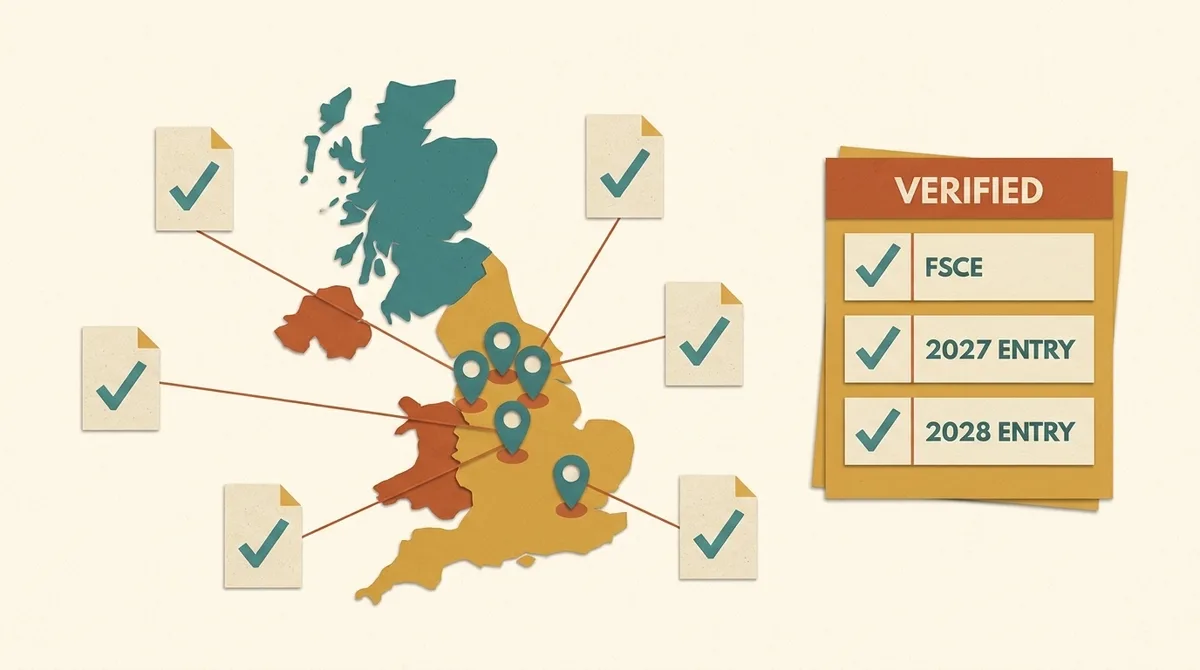
FSCE, or Future Stories Community Enterprise, writes entrance tests for a number of grammar schools. The provider name does not tell you which subjects your child will meet, how many papers there are, or whether one sitting covers several schools. Those details belong to the school and entry year.
Use the school links below to check the current admissions page and familiarisation materials. The dates in the first list are for tests sat in 2026 for September 2027 entry. Gloucestershire and Trafford have announced later changes, explained separately below.
FSCE directs parents to their target school’s admissions page for test content, format and free familiarisation guides. Its parent information also explains that specifications differ by school. Use a school’s current guidance before choosing practice materials.
Confirmed: schools using FSCE for September 2027 entry
These schools' own admissions pages name FSCE as the provider for tests sat in 2026 for entry in September 2027. The registration windows shown are for that cycle, now closed. They do not establish the dates for 2028 entry; wait for the school to publish those arrangements.
- Reading School, Berkshire. Boys. Registration 27 March to midnight 17 May 2026. Two sitting dates: catchment applicants Thursday 16 July 2026, out-of-catchment Friday 25 September 2026. Separate Sporting Aptitude Assessment Sunday 12 July 2026 for its 10% reserved places. 138 day places plus 12 weekly boarding places. Source: reading-school.co.uk.
- Chelmsford County High School for Girls, Essex. Test Thursday 3 September 2026. Registration 9am 13 April to 4pm 3 June 2026. 180 places. Content "tests application and knowledge and skills from KS2 subjects taught up to and including the Year 5 programme of study". Source: CCHS 2027-entry admissions.
- Queen Elizabeth Grammar School Penrith, Cumbria. Test Thursday 17 September 2026; registration deadline 12 July 2026. Source: QEGS admissions. Read the separate admissions policy for the allocation criteria.
- Ermysted's Grammar School, Skipton. Boys. Test Saturday 26 September 2026, registration closed noon 31 August 2026. Two papers only. Source: Ermysted’s Year 7 admissions.
- Skipton Girls' High School, North Yorkshire. Its own FSCE test was Saturday 26 September 2026, with registration closing at midnight on 19 August 2026. Source: Skipton Girls’ admissions page, which links the 2027-entry booklet. Do not assume a registration at Ermysted’s covers this school.
- The Crossley Heath School, Halifax. Applications 10am 20 March to 11pm 26 June 2026. Source: crossleyheath.org.uk.
- The North Halifax Grammar School. Shares the Halifax Grammar Schools FSCE test with Crossley Heath, but must be listed separately on your Common Application Form.
- Heckmondwike Grammar School, West Yorkshire. Registration opened 11 May 2026, applications due 22 June 2026, exam 14 September 2026, results mid-October, formal offer via the local authority in early March. Source: Heckmondwike entrance exam.
- Lancaster Girls' Grammar School. Test Saturday 26 September 2026, registration 1 June to 9 September 2026. Source: LGGS Year 7 admissions.
- Clitheroe Royal Grammar School, Lancashire. Test Saturday 26 September 2026, registration noon 1 June to noon 4 September 2026. 180 places, one sitting only, no resit. Source: Clitheroe’s 2027-entry admissions.
If you are working out which of these is realistically within reach, start with the Trace Learn grammar-school directory to compare the verified test route, catchment and admissions evidence for each published school. Our pillar guide to grammar schools near me then explains how distance tie-breaks and oversubscription criteria interact once the test score is in.
Myth: FSCE means one standard four-paper test
Chelmsford’s familiarisation guide describes four papers, but other schools publish different structures. Compare the documents for the same entry year.
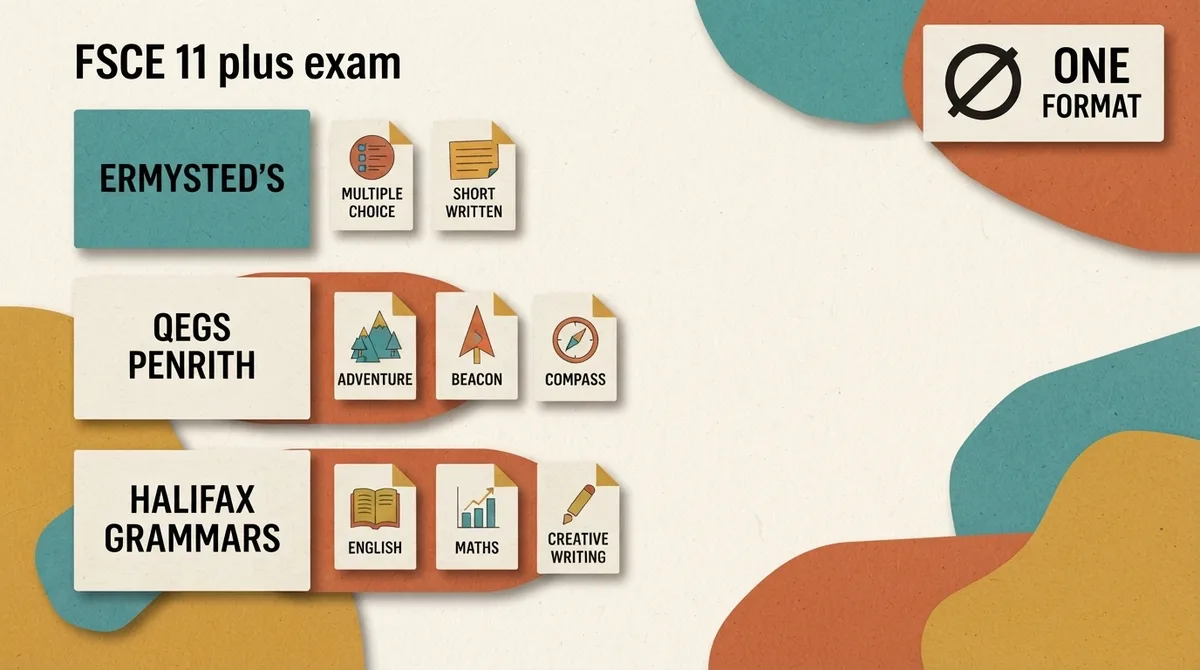
- Ermysted's describes exactly two papers: one of "English and mathematics questions with multiple choice answer options", and one of "English and mathematics questions where you respond with short written answers".
- Clitheroe Royal also describes two, "both of which are age weighted": Paper 1 multiple choice English and maths, Paper 2 short written answers, and explicitly no non-verbal reasoning.
- QEGS Penrith publishes three papers. Its September 2026 format notice gives approximate timings of one hour for Adventure, 40 minutes for Beacon and 35 minutes for Compass. This is more specific than the earlier parent FAQ’s general timing range. The FAQ describes content from several KS2 subjects and excludes non-verbal reasoning.
- Crossley Heath and North Halifax cover English, maths and creative writing, with everything except the creative writing marked by computer and all written elements sat on one day in September.
- Heckmondwike covers "application of knowledge and skills in English and maths, as well as exploring imaginative flair through creative writing".
- Lancaster Girls’ Grammar School says its September 2026 test assesses English and maths through multiple-choice and written responses. A broader FSCE familiarisation booklet does not change the school’s stated subjects.
The practical consequence: buying a generic "four-paper FSCE" practice pack for an Ermysted's candidate means practising a structure the child will not meet. Start with the tested subjects in the school’s current guidance. Secure KS2 English and maths are useful foundations, while schools such as QEGS and CCHS describe a wider range of curriculum subjects. Our FSCE 11 plus exam guide goes deeper on the question styles themselves.
Announced, but not using FSCE yet: the twelve
Twelve more schools have appointed FSCE but have not used it yet. Keep those future entry years separate from the present cycle when choosing practice materials.
Gloucestershire's G7: The Crypt School, Denmark Road High School, Marling School, Pate's Grammar School, Ribston Hall High School, Sir Thomas Rich's School and Stroud High School. They have appointed FSCE "for entry to Year 7 from 2028 onwards", and at the same time the test moves from September of Year 6 to "the latter part of the summer term of Year 5", taking effect "from summer 2027 for first entry into Year 7 in September 2028" (Pate’s joint G7 announcement).
Trafford's five: Altrincham Grammar School for Boys, Altrincham Grammar School for Girls, Sale Grammar School, Stretford Grammar School and Urmston Grammar.
The Gloucestershire and Trafford timing trap
The two areas change provider for the same entry year, but their first FSCE sitting dates differ.
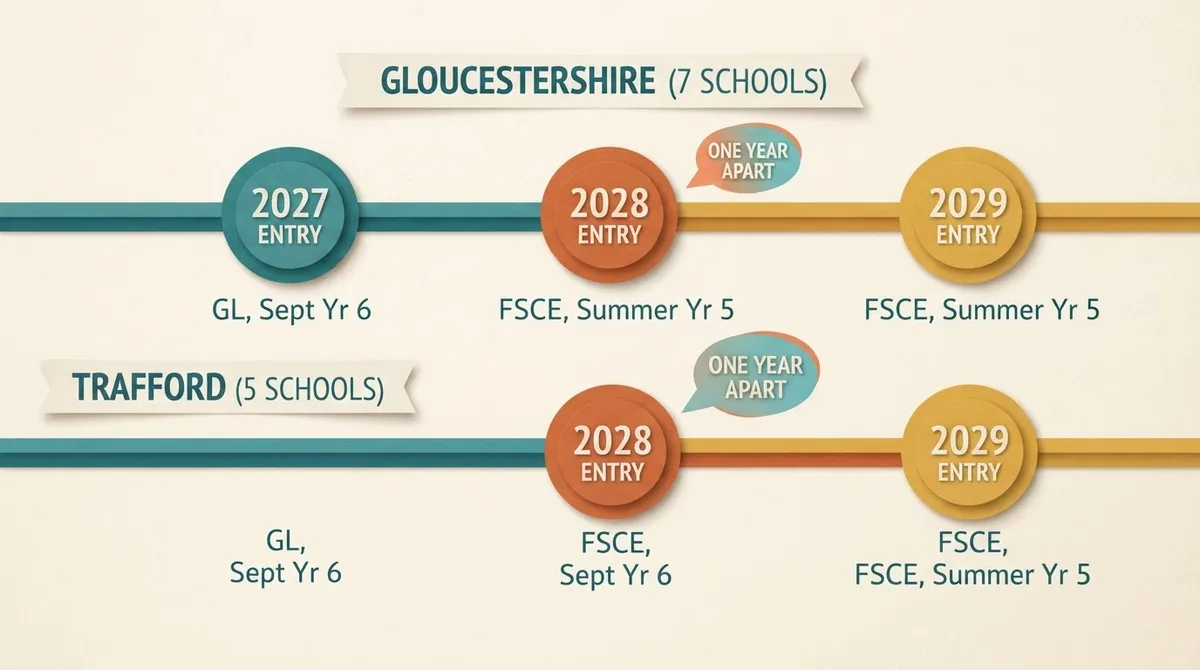
The Trafford consortium publishes a three-stage timetable: "For entry to Year 7 in 2027, the test provider will be GL and the admissions test will be held in September 2026"; "for entry to Year 7 in 2028, the test provider will be FSCE and the admissions test will be held in September of Year 6"; "for entry to Year 7 in 2029 onwards, the test provider will continue to be FSCE and the admissions test will be held in the latter part of the Summer Term of Year 5" (urmstongrammar.org.uk).
Work it through for two children both starting Year 5 in September 2026, both aiming at 2028 entry:
- The Gloucestershire child sits an FSCE test in the summer term of 2027, in Year 5. Preparation has to be complete roughly one school term earlier than the old September timetable.
- The Trafford child sits an FSCE test in September 2027, at the start of Year 6. Same provider and entry year, but a later sitting date that year.
And for 2027 entry, both areas are still on GL Assessment. Gloucestershire County Council's own page for that cycle states "The schools are planning for the Entrance Test to take place on Saturday 12 September 2026" with registration "open from noon, 18 May 2026 to noon, 26 June 2026", and never mentions FSCE at all. Trafford's new FSCE paper "will draw on the Key Stage 2 English and mathematics national curriculum programmes of study up to the end of Year 5", replacing the verbal, non-verbal and mathematical reasoning of the GL papers. Use the Trace Learn grammar-school directory to open each published school's reviewed route and admissions evidence.
Myth: Colyton Grammar School uses FSCE
For September 2027 entry, Colyton directs families to Quest Assessments. Colyton's own admissions page routes 11+ familiarisation to Quest Assessments and states that "our 11+ entrance test will include English, Maths and extended writing. It will NOT include verbal and non-verbal reasoning" (colytongrammar.com).
The Quest and Colyton parent guidance sets out three papers sat on the same day: English (40 minutes, 50 questions), Mathematics (40 minutes, 60 questions) and Writing (20 minutes, one prompt), with English and maths answered on OMR multiple-choice sheets. Assessment date Saturday 12 September 2026, registration portal open 31 March to 31 July 2026, results mid-October 2026, 160 Year 7 places.
The superficial similarity is what keeps the error alive: no non-verbal reasoning, a writing element, curriculum-based content. If your child is preparing for Colyton, prepare for Quest.
Which FSCE schools share a score, and which make you sit twice
"They all use FSCE" does not mean one test covers them all. Check whether the schools share a sitting and which separate registrations or application preferences you need.
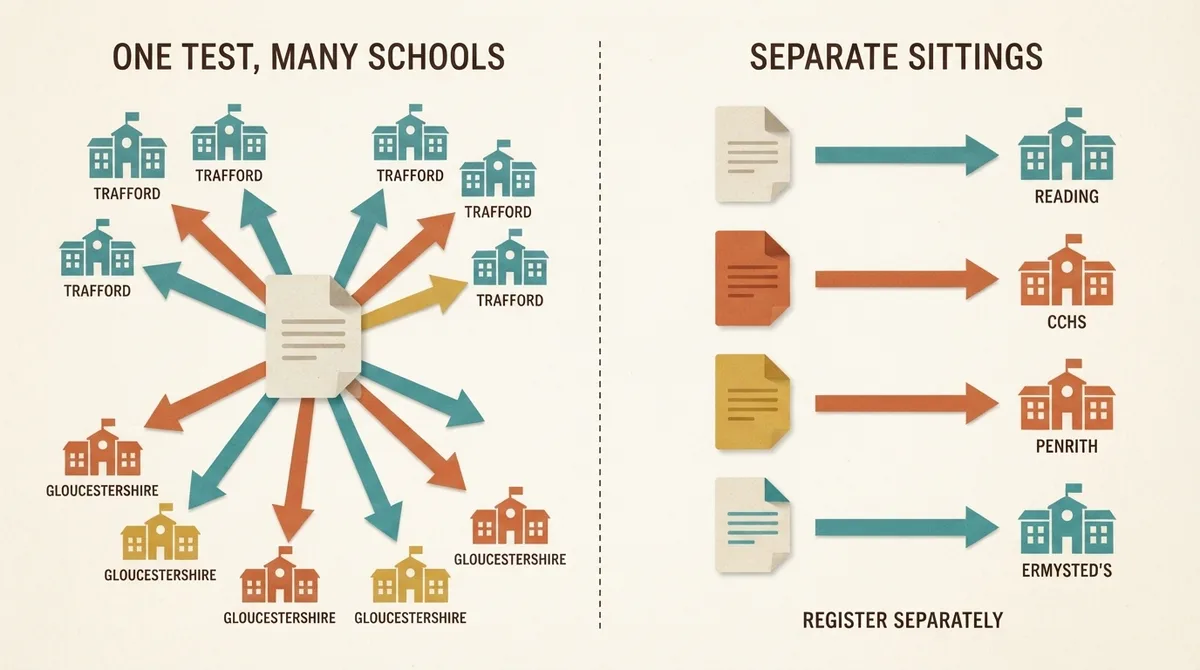
- One test, one score, several schools. Trafford "operates a shared testing process, enabling children to sit one test for entry to any of these schools" (from 2028 entry). Gloucestershire's G7 will likewise use one score across all seven from 2028.
- One test, but you still apply separately. Crossley Heath and North Halifax share a single Halifax Grammar Schools FSCE test. The child sits once, but both schools must be listed separately on the Common Application Form. Test registration does not replace the separate school preferences on the application. The coordinated process normally makes one school offer.
- Standalone sittings. Reading, CCHS, QEGS Penrith, Ermysted's, Skipton Girls', Lancaster Girls' and Clitheroe Royal each run their own FSCE test with its own registration. Sitting at one does not transfer to another. Note that Ermysted's, Lancaster Girls' and Clitheroe Royal all sat on Saturday 26 September 2026, so a family considering more than one of them needed to ask the schools about any timetable conflict and permitted arrangements.
Build your shortlist around that arithmetic before anything else, then plan backwards from the earliest sitting date. Trace Learn's exam plan works the same way: pick the target date, and the schedule fills in from there. If the overall sequence is still opaque, start with the practical parent guide to the 11 plus.
Myth: you can buy official FSCE practice papers
Reading School, the school FSCE is registered at, states it about as directly as a school can: "there are no commercially available practice test papers for the FSCE Ltd tests", and "the Entrance Test content changes each year therefore the Familiarisation Guide is NOT definitive".
That is worth quoting because listings selling "FSCE format past papers" rank alongside this page. Since the papers are curriculum-based, the honest preparation route is:
- Cover KS2 English and maths to the end of the Year 5 programme of study, since that is the stated ceiling for content at both FSCE and, in its own words, CCHS.
- Practise both answer modes: multiple choice on an OMR sheet, and short written answers where working and legibility count.
- Add creative writing only if the target school tests it (Heckmondwike, Crossley Heath, North Halifax, CCHS).
- Check each target school’s tested subjects before choosing reasoning practice. A provider name alone does not establish the content.
- Use the timings and breaks in the target school’s current familiarisation guidance; do not assume one duration for every FSCE test.
For example, a curriculum maths question might ask: “A class of 28 children collects 1,050 tokens. The teacher keeps 30 and shares the rest equally. How many tokens are left over?” Subtract first, then divide: 1,020 ÷ 28 gives 36 each with 12 left over. This is an original practice example, not a recalled or official FSCE question. Use the school’s free examples to learn its answer format.
How to verify a school yourself, and when to re-check
Check each school and entry year separately: Use this protocol:
- Open the school's own admissions page (search the school name plus "Year 7 admissions", and only trust a result on the school's own domain).
- Find the entry year explicitly stated on the page. A page headed "September 2027 entry" tells you nothing about 2028.
- Look for the provider named in full: "Future Stories Community Enterprise Ltd (FSCE)". If the page names GL Assessment, CEM or Quest, it is not an FSCE school for that year.
- Note the sitting date and the registration window, then diarise the window opening one month early.
- Re-check during Year 5, before the test registration window. For September 2027 entry, the dates above ran during 2026. Waiting until spring 2027 would miss the normal test cycle. For schools moving their test into Year 5, check the timetable earlier.
One page, one date, one entry year. If a source cannot give you all three, it cannot tell you which test your child is sitting.
If a summary disagrees with the school, use the school’s current policy and ask its admissions team to clarify the conflict. If you want to see how a child's coverage of the Year 5 curriculum is actually tracking against a target date, start a free account and use progress tracking rather than guessing from raw mock scores.
Re-check the school’s own current admissions page before registering. An announced change for a future entry year is not the format used by the present cohort.
Topics
- fsce
- 11 plus
- grammar schools
- admissions
- test providers