
The Buckinghamshire Secondary Transfer Test: A Parent Guide
A chronological guide to the Buckinghamshire 11+, from automatic entry and the withdrawal deadline through to results day, the Selection Review and the honest odds on appeal.
 Elspeth Marlow
- 14 min read

Most guides to the Buckinghamshire 11+ answer one question: what is on the test and how should my child prepare? That is the easy part, and it is well covered. The harder part, the part that trips up capable families every year, is the sequence of decisions and deadlines that sits around the test. Buckinghamshire Council publishes all of it, accurately and in detail, but across roughly ten separate pages. Registration lives in one place, the testing process in another, results, the Selection Review and two different appeal routes in three or four more. Nobody hands you the whole journey in order.
This guide does that. It walks through the Buckinghamshire Secondary Transfer Test chronologically, from the spring of Year 5 through to the appeal panels of the following summer, and links out to the council for every step where you actually have to do something. Where a date or a rule matters, we point you at the official page rather than paraphrasing it and hoping it stays true.
Three things in particular are worth reading even if you think you know the system: withdrawal from the test is an active step with its own deadline, not a matter of simply not attending; the late-October calendar puts the national application deadline one day after the Selection Review deadline, so you apply before you know the outcome; and the published success rates for unqualified appeals are low enough that they should shape your planning rather than sit at the back of your mind. We use the dates published for September 2027 entry throughout, but the shape of the year repeats.
Buckinghamshire's 11+ in one minute
Buckinghamshire is one of the few English areas that still operates fully selective secondary education across the whole county. Thirteen grammar schools admit on the basis of a single county-wide test, the Secondary Transfer Test, sat at the start of Year 6. There is no separate exam for each school and no consortium-by-consortium variation of the kind you find in Kent or London, so if you are still working out which area and test apply to your family, start with our guide to grammar schools near you and their entrance tests.
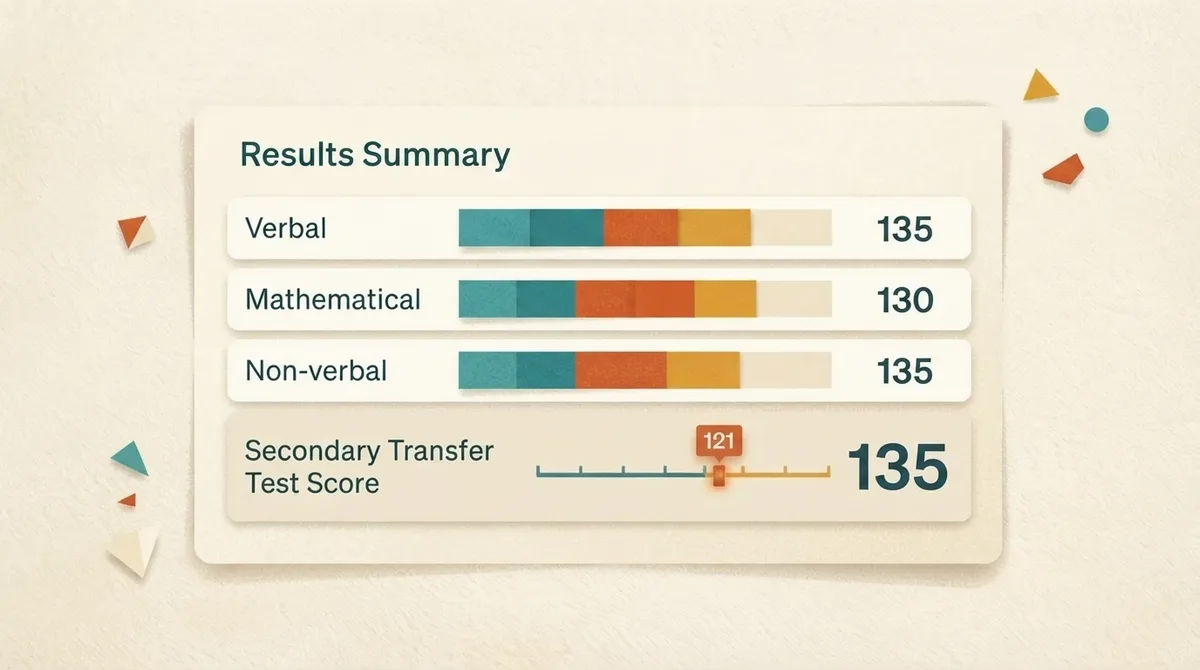
The test is produced by GL Assessment and commissioned by The Buckinghamshire Grammar Schools (TBGS), the company the thirteen schools set up to manage and administer transfer testing. Buckinghamshire Council administers the testing on TBGS's behalf under contract, which is why some information sits on the TBGS site and some on the council's. A child who scores at least 121 is considered qualified for a Buckinghamshire grammar school, according to the council's grammar schools and transfer testing page.
Qualifying is not the same as being offered a place. Qualification makes your child eligible to be considered under each school's oversubscription criteria, which typically weigh things such as siblings and distance. You still have to name the grammar schools on your secondary application in October, and a qualified child who does not list a grammar school will not be allocated one.
Spring of Year 5: your child is probably already entered
This is the single biggest structural difference between Buckinghamshire and most other selective areas, and it is where national guides tend to be vaguest. Children who attend a state-funded primary school in Buckinghamshire do not need to register. They are entered for the test automatically. No form, no fee, no action from you.
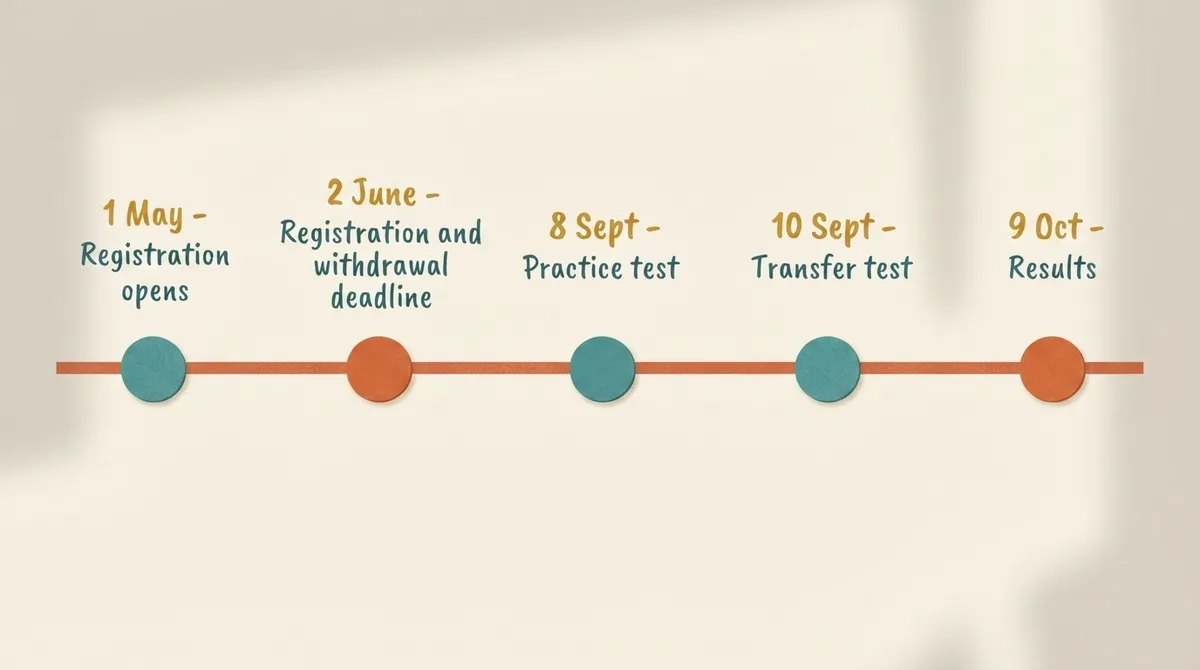
That is convenient if you want your child tested. It is a trap if you do not, because the corollary is that opting out is an active step with a deadline. The council sends parents an online withdrawal form to complete by 2 June. If you decide after that date, you have to contact the admissions team directly and tell them which school your child attends, as set out on the registration page.
If your plan is "we just won't turn up", you have misread the system. Automatic entry means the default is that your child sits the test with their year group. Withdrawal is a form with a date on it.
There is a good reason to be deliberate here rather than drifting. Some families are certain a grammar school is not the right setting and would rather their child not sit a formal test at all. Others prefer to leave the option open, on the reasoning that a child who is entered anyway loses nothing by attending. Both are defensible. What is not defensible is discovering in September that you have made the decision by accident.
Who must actively register
Automatic entry only covers Buckinghamshire state-funded primaries. If your child attends a Partner school, an independent school, or any school outside Buckinghamshire, you must register them yourself.
The detail that catches people out: state-funded schools in Milton Keynes are explicitly excluded from automatic Buckinghamshire registration. Milton Keynes is a separate local authority, and its schools are not Buckinghamshire schools for these purposes, however close they feel geographically. Families there must register in the same way as any other out-of-county applicant.
For September 2027 entry, registration opened at 10am on 1 May 2026 and closed at 3pm on Tuesday 2 June 2026. Late registration is not accepted without exceptional circumstances. There are two narrow exceptions worth knowing: families moving into Buckinghamshire by 18 June 2027 can qualify for late testing if they can evidence the house move, and children living abroad cannot be tested until they return to the UK. If either applies to you, contact the council early rather than assuming you will be accommodated.
Summer term of Year 5: the familiarisation Buckinghamshire gives you free
One of the more reassuring features of the Bucks system is rarely mentioned on commercial 11+ pages, which is a shame, because it is genuinely useful to a family weighing up whether to pay for tuition.
During the summer term of Year 5, official familiarisation resources are distributed to parents. The familiarisation booklet explains what the test is like, gives advice on sitting it and includes sample questions. Pupils at Buckinghamshire state-funded primaries and Partner schools receive a hard copy; out-of-county families can download it as a PDF from the council's testing process page. GL Assessment publishes additional free materials on its own website.
The underlying posture is facilitative rather than restrictive. The county's stated aim is that no child is disadvantaged simply because they have never seen the format before. That does not mean preparation is pointless, but it does mean the marginal value of paid tutoring is narrower than the marketing around the Bucks 11+ often implies. Format familiarity is provided. What you may still want to work on is underlying skill, pace and accuracy, which is a different thing from knowing what a matrices question looks like.
Early September of Year 6: the practice test, then the real thing
For September 2027 entry, the practice test is on 8 September 2026 and the Secondary Transfer Test itself is on 10 September 2026. Two days apart, both in school time, both at the start of Year 6.
The practice test is two shorter multiple-choice papers, each about 40 minutes, taken under test conditions. The papers are not marked and are not sent home. Parents sometimes find this frustrating, but the design intent is clear: the practice test exists to rehearse the experience, not to produce a score you can worry about for 48 hours. Your child gets to sit in the hall, hear the instructions, manage the answer sheet and feel the clock, before any of it counts.
The real test is two papers, all questions multiple-choice. One paper covers verbal skills including comprehension, technical English and verbal reasoning. The other covers mathematics and non-verbal skills including spatial reasoning. Each paper is about 45 minutes of working time, or roughly 60 minutes including the introduction and worked examples.
If your child is preparing, the most useful thing you can replicate at home is not another topic worksheet but the conditions: a full paper, timed, in one sitting, marked afterwards with the mistakes talked through. Our guide to 11 plus mock exams covers how to run those sensibly without turning every Saturday into an exam hall, and if you want the timing pressure built in, mock tests do the same job with automatic marking.
Worth saying plainly: formats differ by area. If you have read a guide written for Kent, Essex or a London consortium, do not assume the paper structure, timings or question mix carry over. Buckinghamshire is its own thing, and if you are still working out which board applies to you, our comparison of GL, CEM and ISEB is the place to start.
October: results day and the collision nobody warns you about
Results are released on 9 October 2026 for September 2027 entry.
The results report is more informative than a simple pass or fail. It gives your child's Secondary Transfer Test Score (STTS), individual section scores for verbal, mathematical and non-verbal reasoning, and their qualification status. Scores are age standardised, which means a child's raw marks are adjusted for their age in months at the time of testing, so an August-born child is not penalised for being nearly a year younger than a September-born classmate in the same year group. The section scores matter if you are considering a Selection Review, because they show where the score came from.
Now the part that deserves your full attention, because it appears almost nowhere else. Three dates land within three weeks of each other:
- 9 October: results released.
- 30 October: deadline to request a Selection Review.
- 31 October: national deadline to submit your secondary school application to your home local authority.
Read that order again. The application deadline falls one day after the review deadline, and reviews are not decided by then. So a parent whose child scored just under 121 has to submit their preference list, including any grammar schools, while the review is still undecided. The council sets this out on its results page.
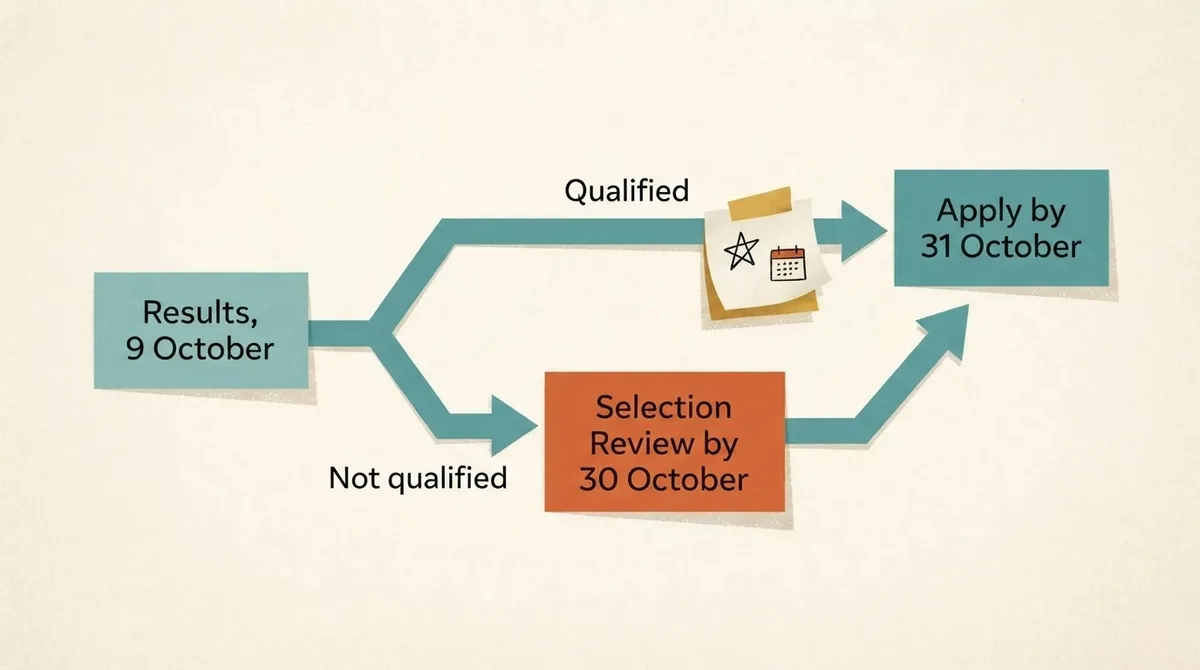
The practical consequence is simple and easy to get wrong. If you are pursuing a Selection Review, list the grammar schools you would want on your application anyway, alongside the non-selective schools you would be happy with. A successful review is worthless if the school was never named on the form. There is no mechanism that retrospectively adds a school you left off because you were waiting to hear.
The Selection Review: who it is for and what actually counts
A Selection Review is a written case arguing that your child would be best suited to a grammar school despite not reaching 121. If the panel agrees, the child is treated as qualified for admissions purposes.
The panel is three headteachers: two from grammar schools and one from a primary school. The evidence that counts is set out on the council's Selection Review page and includes a Headteacher's Summary Sheet, school reports, letters from teachers, and evidence of exceptional circumstances such as illness or bereavement close to the test date.
Just as important is what does not count. Samples of your child's school work are not considered. Neither is participation in extracurricular activities. Parents routinely assemble folders of both, and it is wasted effort. The panel is looking for corroborated academic evidence that the test score understates the child's attainment, not a portfolio.
On odds, the council's own guidance is that most successful reviews historically involved scores between 110 and 120. That is a useful calibration. If your child scored in that band and their school data genuinely points higher, a review is a reasonable thing to pursue. If the score sits well below that range, the honest reading is that a review is unlikely to change the outcome, and your energy is better spent on the rest of your preference list.
If the review does not succeed: appeals, and the real numbers
There are two appeal routes, and they behave very differently.
An unqualified appeal is for a child who did not qualify and whose Selection Review was unsuccessful. It is a two-stage test. Before the panel can consider the merits of your case at all, it must first decide whether the Selection Review was conducted in a fair, consistent and objective way. Only if it finds that it was not can it go on to consider the case further. In practice, panels historically find that nearly all Selection Reviews were fair, consistent and objective, which is why the first stage is where most unqualified appeals end.
The published outcome for 2025: 2% of unqualified grammar school appeals succeeded, compared with 7% of qualified appeals. Both figures are on the council's grammar school appeals page.
A qualified appeal is a different animal. It is for a child who qualified but was not offered a place at the school you wanted, usually because it was oversubscribed. Here academic evidence is not required at all; you are asked to give exceptional medical, social or educational reasons for wanting that particular school. Many parents prepare the wrong case because they assume every grammar appeal is about proving ability.
We publish these numbers because they should inform planning, not because they are encouraging. Appeal if you have a genuine case. Do not build your family's plan on a 2% route.
The thirteen Buckinghamshire grammar schools
All thirteen use the same Secondary Transfer Test and the same 121 threshold, but they differ in admission arrangements beyond qualification, so check each school's own criteria before ranking them.
- Aylesbury Grammar School (boys)
- Aylesbury High School (girls)
- Beaconsfield High School (girls)
- Burnham Grammar School (co-educational)
- Chesham Grammar School (co-educational)
- Dr Challoner's Grammar School (boys)
- Dr Challoner's High School (girls)
- John Hampden Grammar School (boys)
- Royal Grammar School (boys)
- The Royal Latin School (co-educational)
- Sir Henry Floyd Grammar School (co-educational)
- Sir William Borlase's Grammar School (co-educational)
- Wycombe High School (girls)
Key dates for September 2027 entry
- 1 May 2026, 10am: registration opens for children not automatically entered.
- 2 June 2026, 3pm: registration closes. Same date for the online withdrawal form.
- Summer term, Year 5: familiarisation booklet distributed.
- 8 September 2026: practice test, unmarked, not sent home.
- 10 September 2026: Secondary Transfer Test.
- 9 October 2026: results released.
- 30 October 2026: Selection Review deadline.
- 31 October 2026: national secondary application deadline.
- 18 June 2027: latest move-in date for late testing on relocation grounds.
Always confirm current-year dates on the council's grammar schools and transfer testing hub before acting on them.
What to do with all this
The Buckinghamshire system rewards parents who treat it as a sequence rather than an event. Decide in the spring of Year 5 whether your child is sitting the test, and if the answer is no, complete the withdrawal form by 2 June rather than letting the default carry you. Use the free familiarisation materials properly before deciding what, if anything, to pay for. Practise under timed conditions rather than accumulating worksheets, and use the year by year preparation plan if you want a structure that starts early and stays light.
Then, in October, plan for the collision. Assume the review outcome will not arrive before the application deadline, and build a preference list that works whichever way it lands. That single piece of foresight is worth more than any extra month of practice papers.
If you want to see where your child's accuracy and pace actually sit before making decisions about tutoring, you can start with a free account and work through a couple of timed papers.
Topics
- buckinghamshire
- 11 plus
- grammar schools
- admissions
- transfer test