
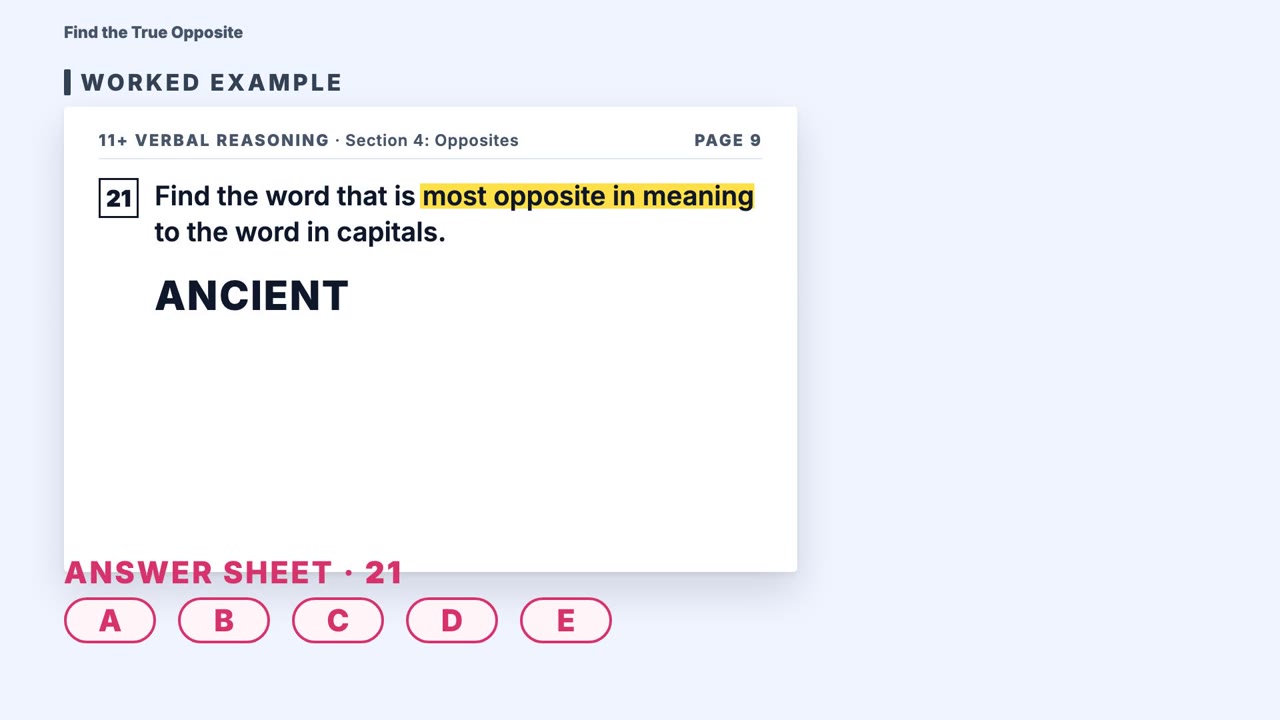
 Length 2:38
Find the True Opposite
Select opposite meaning
11+ Verbal Reasoning · Vocabulary
A short worked example (2:41) for one 11+ verbal reasoning skill: Select closest meaning.
This video shows how to choose the option with the closest meaning to a given word. Watch an 11+ verbal reasoning question solved step by step.
Turn on captions with the CC button. The full transcript is below the video.
Every word of the video, to read along or to skim before watching.
Two words can wear different coats, yet carry almost the same idea. Your challenge is to spot the closest pair... even when another option tries to distract you!
Start with the target word in the centre. Say its meaning in your own simple words. Then inspect every option, one at a time. You are looking for a synonym: a word with the same, or nearly the same, meaning. It does not need to sound alike. It needs to carry the same idea. Picture each option sliding into a meaning meter. Cross out an opposite first. Next, cross out words that are merely connected to the topic. A word can belong to the same situation without meaning the same thing. For example, "rain" and "umbrella" are connected, but they are not synonyms. Now compare the final two carefully. Ask, "Which word could replace the target most often without changing the main idea?" Choose the closest meaning, not a word that feels familiar, and not automatically the most dramatic word.
Let's work through an example. The target word is RELUCTANT. Choose the option closest in meaning. Option A, eager. Option B, unwilling. Option C, noisy. Option D, worried. Which option is correct? First, give reluctant a plain meaning. Someone reluctant does not really want to do something, and may hold back. The centre card now reads, "not willing or keen." Keep that meaning fixed while you test the choices. Option A, eager, means keen and ready, so it points the opposite way. Cross it out. Option C, noisy, describes sound, not willingness. Cross it out too. Option D, worried, can sometimes explain why somebody holds back, but it does not mean reluctant. A related idea is not enough. Option B, unwilling, matches "not willing." The two meanings overlap most closely. So the explicit answer is Option B, unwilling. Notice that we used the word's meaning, not a guessed story or an imagined sentence.
Find the plain meaning, remove opposites and merely related words, then choose the option with the strongest overlap. Trust your comparison... you've got this!
Watch these next. The first ones teach the skills closest to this one.
Length 2:38Select opposite meaning
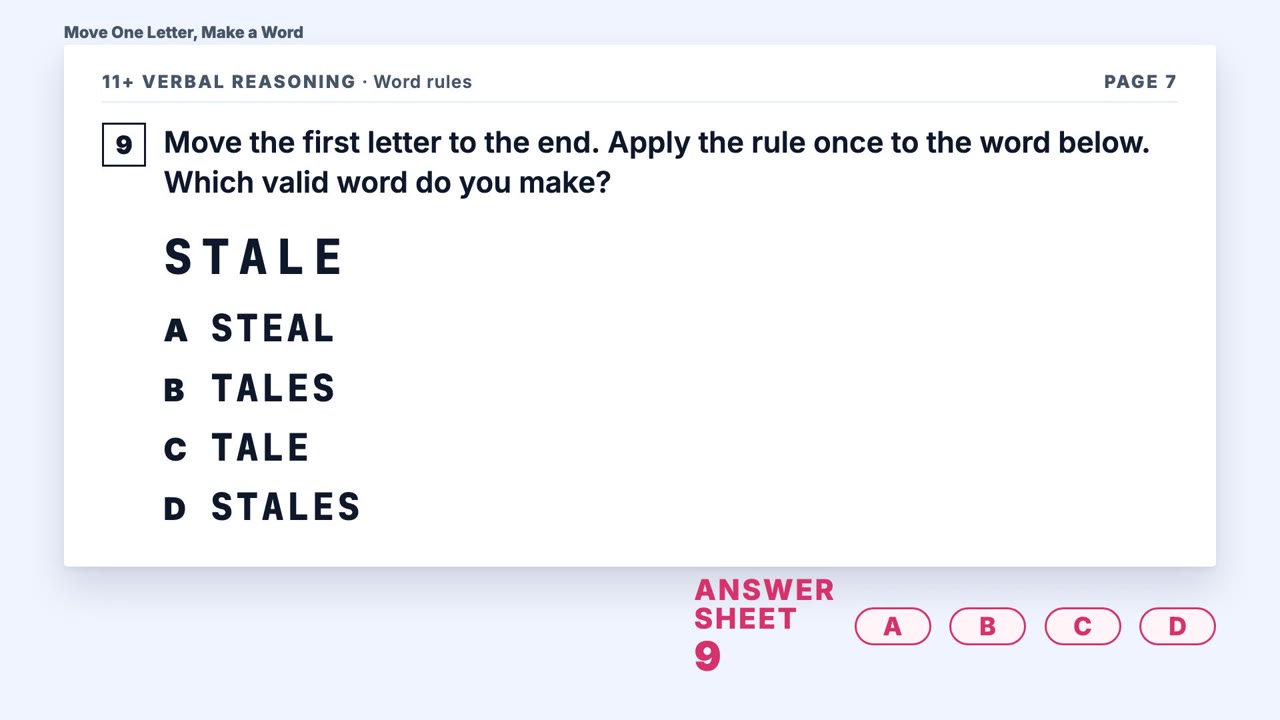 Length 2:29
Apply a word transformation rule
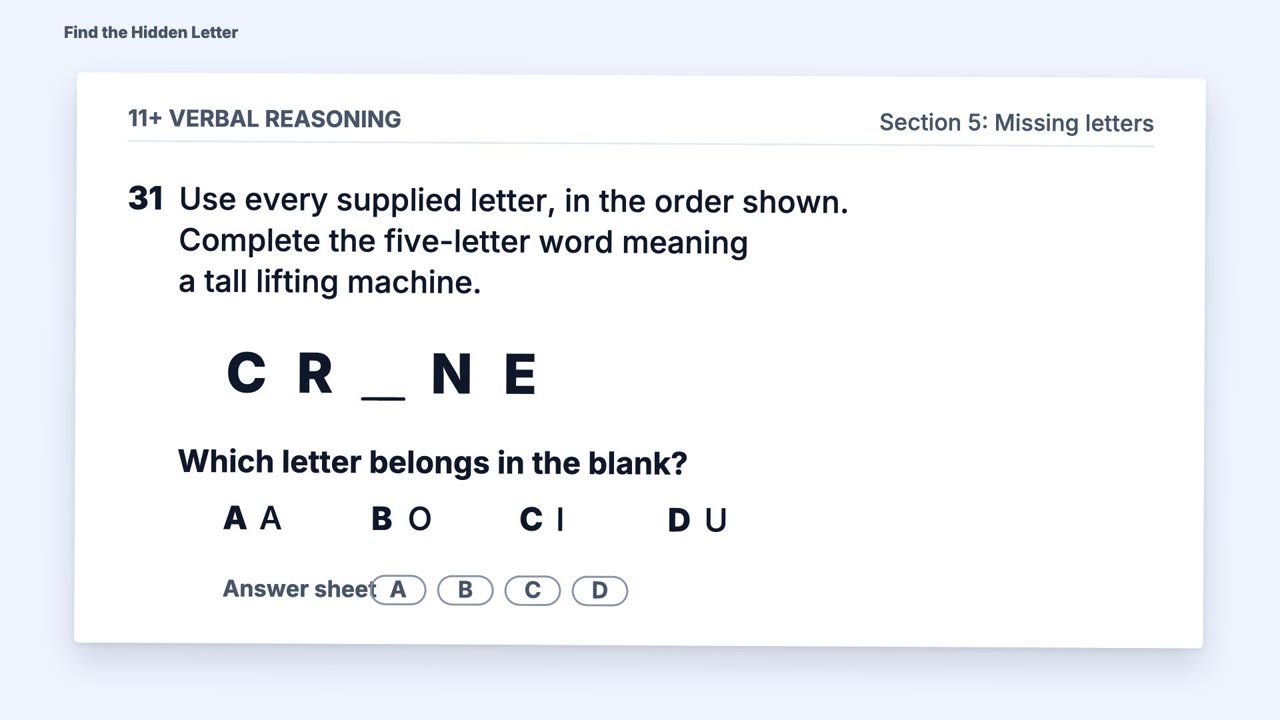 Length 2:25
Complete a word with a letter
The free diagnostic checks maths, English and both kinds of reasoning, and shows what to practise next. No card is required.