
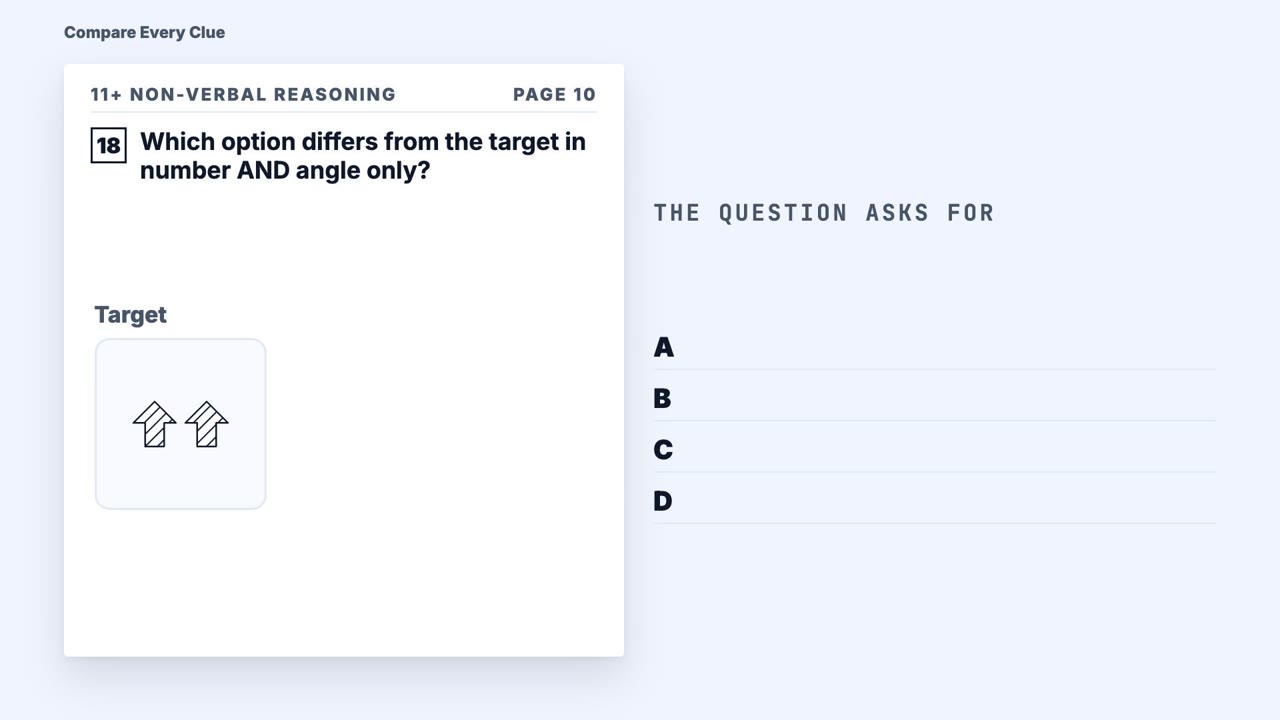
 Length 2:39
Compare Every Clue
Compare visual attributes
11+ Non-verbal Reasoning · Pattern
A short worked example (2:37) for one 11+ non-verbal reasoning skill: Identify a visual odd one out.
This video shows how to find the visual rule shared by a group of figures and choose the one that breaks it. Watch an 11+ non-verbal reasoning question solved step by step.
Turn on captions with the CC button. The full transcript is below the video.
Every word of the video, to read along or to skim before watching.
Four figures can look almost identical. Yet one tiny change can break the whole pattern. Can you spot the rebel before it gives itself away?
An odd-one-out question hides one rule shared by most figures. First, scan the same feature in every option. Count shapes. Compare shading. Check position and direction. Keep each comparison in matching order, so you compare like with like. Here, three cards appear. Each has two circles above one triangle, and exactly one circle is shaded. The details match, so they belong together. A fourth card has two shaded circles. That breaks the shared count rule, making it the odd one out. Do not choose the figure that simply looks busiest, darkest, or most unusual at first glance. That is the common trap. Test a precise rule across ALL the figures. Your rule should fit every non-answer, with just one clear exception.
Let's work through an example. Four square tiles each contain a two-by-two arrangement: one unshaded square and three circles, including one shaded circle. Option A has the square at the upper left and the shaded circle at the lower right. Option B has the square at the upper right and the shaded circle at the lower left. Option C has the square at the lower right and the shaded circle at the upper left. Option D has the square at the lower left and the shaded circle at the lower right. Which option is correct? Look at A. The square and shaded circle sit at opposite corners. B follows the same rule. So does C. Now inspect D... its special shapes sit side by side along the bottom row. They are not diagonally opposite. The arrangement may look equally neat, but neatness is not the test. D alone violates the shared position rule. So Option D is the odd one out.
Remember: compare one feature at a time, state the rule, then prove that three figures obey it and one does not. Trust the rule, not your first impression... and you will catch the odd one out!
Watch these next. The first ones teach the skills closest to this one.
Length 2:39Compare visual attributes
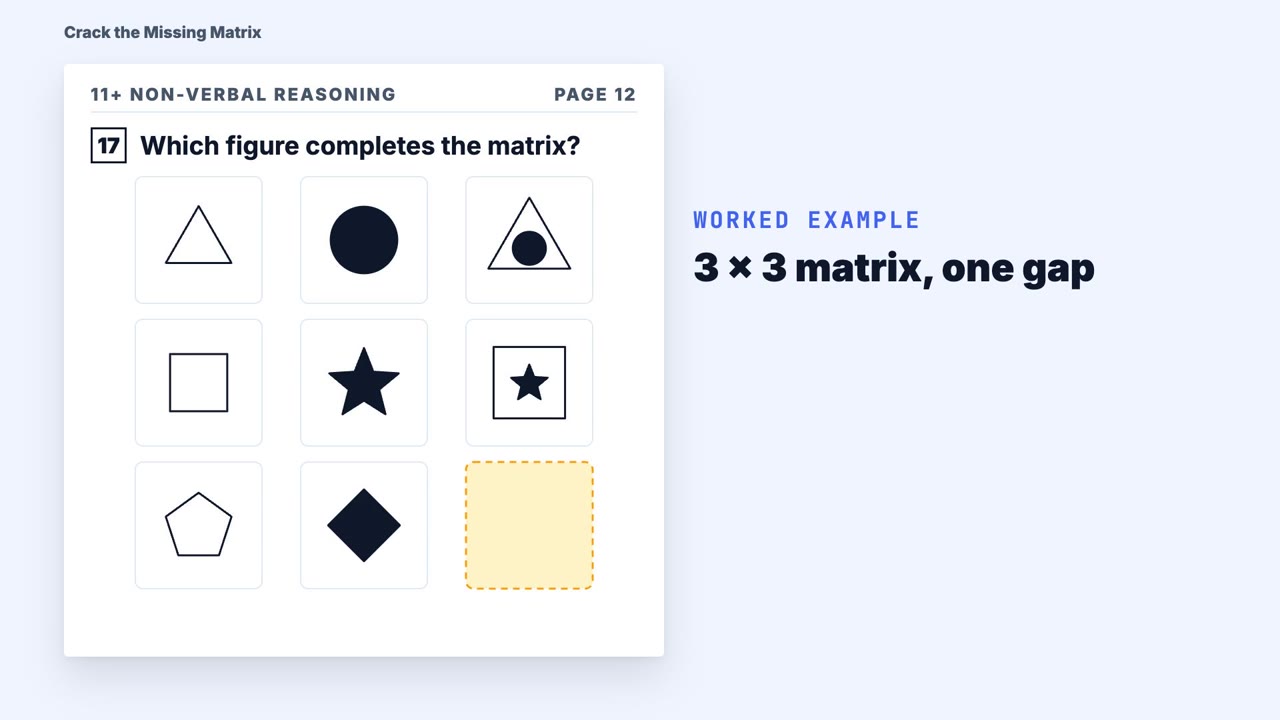 Length 2:35
Complete a visual matrix
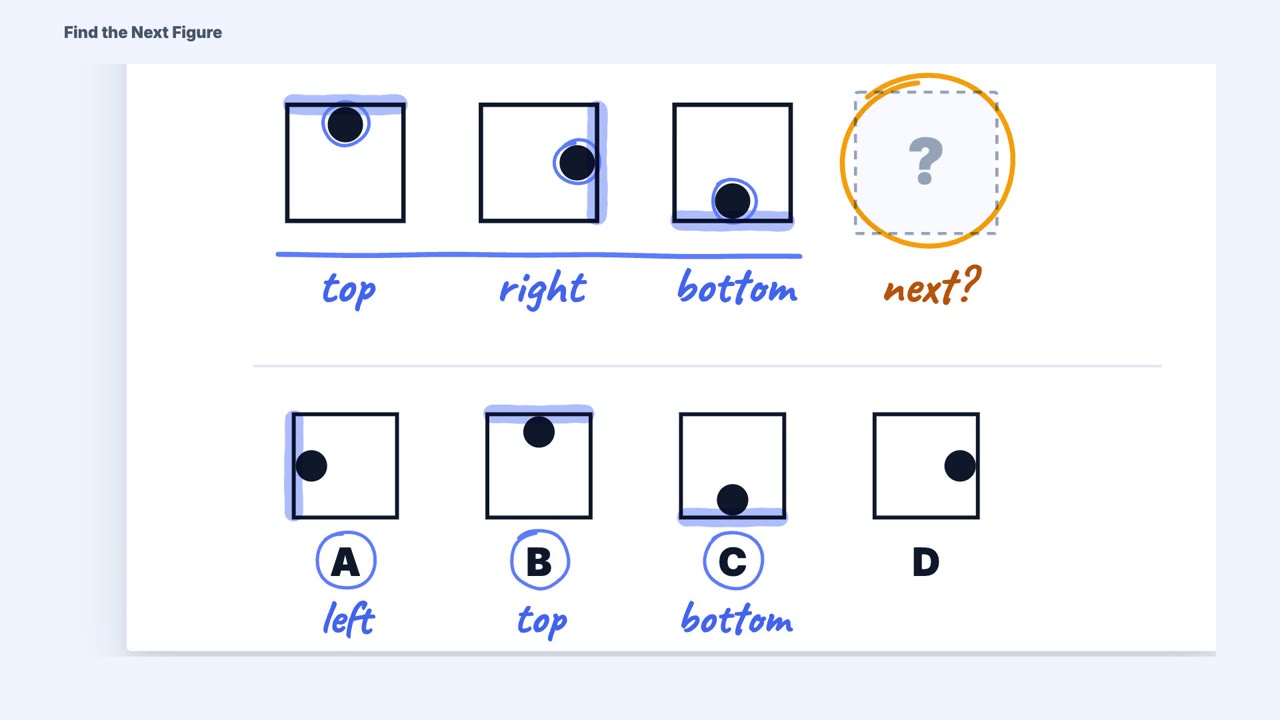 Length 2:32
Complete a visual series
The free diagnostic checks maths, English and both kinds of reasoning, and shows what to practise next. No card is required.