
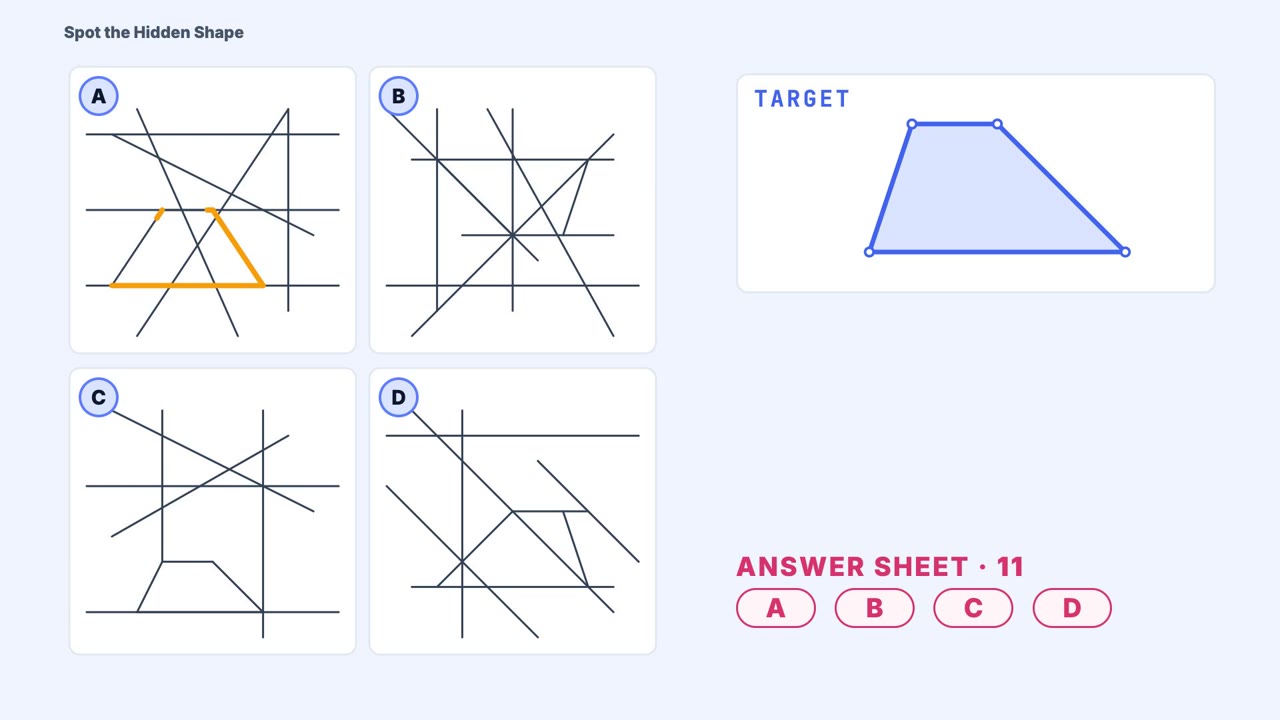
 Length 2:37
Spot the Hidden Shape
Find an embedded shape
11+ Non-verbal Reasoning · Spatial
A short worked example (2:32) for one 11+ non-verbal reasoning skill: Count cubes in a structure.
This video shows how to count all the cubes in a pictured structure, including hidden cubes that support others. Watch an 11+ non-verbal reasoning question solved step by step.
Turn on captions with the CC button. The full transcript is below the video.
Every word of the video, to read along or to skim before watching.
How many cubes can you see? Now here is the sneaky part... the correct total may be bigger, because some cubes are hidden underneath others. A tower cannot float. If a top cube is supported, another cube may be hiding directly below it. Let's learn to count what is there, not only what is visible.
First, split the structure into vertical columns. Your eyes see the top cube in each column, but each column can continue down behind cubes at the front. Trace every stack from its highest cube to the ground. Count one cube for every level it occupies. Next, count by layers. Mark the ground layer first. Any cube standing above needs a cube beneath it when the picture shows a solid, supported tower. Then mark the second layer, and finally the top layer. Do not count only the coloured faces you can see. A hidden cube has no visible face, yet it still belongs in the total. Check each upper cube and ask, what supports this cube?
Let's work through an example. A pictured structure has three cubes in the front row on the ground. Behind them, two cubes are visible on the second level, one behind the left cube and one behind the middle cube. One more cube sits on a third level above the left-hand stack. How many cubes are in the structure altogether? Start with the ground layer. The three front cubes are visible. The two second-level cubes each need support directly underneath, hidden behind the front row. That makes five cubes on the ground layer... three visible, plus two hidden. Now count the second layer. There are two visible cubes, and the third-level cube needs the left one beneath it, which is already counted. Add the single top cube. Five, plus two, plus one, equals EIGHT cubes altogether.
Remember: count columns down to the ground, or layers from bottom to top. Include every hidden support cube once. You can now see the cubes that the picture tries to hide!
Watch these next. The first ones teach the skills closest to this one.
Length 2:37Find an embedded shape
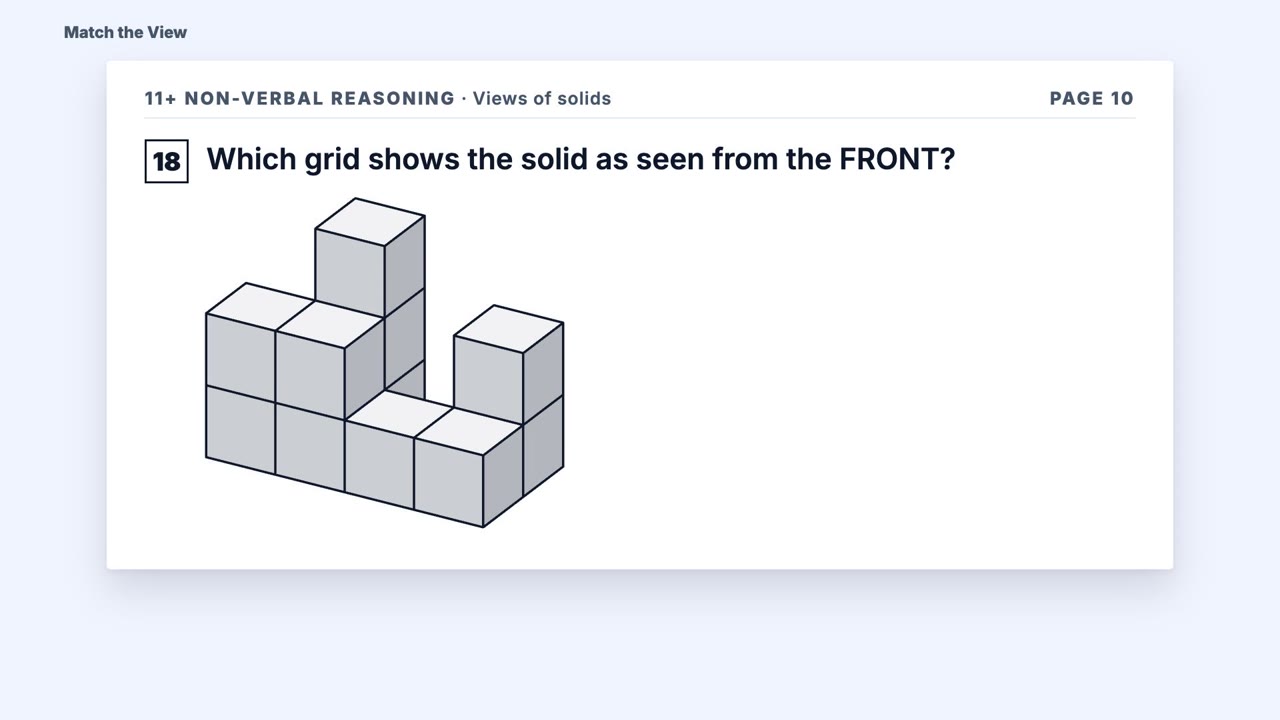 Length 2:34
Match a solid and its view
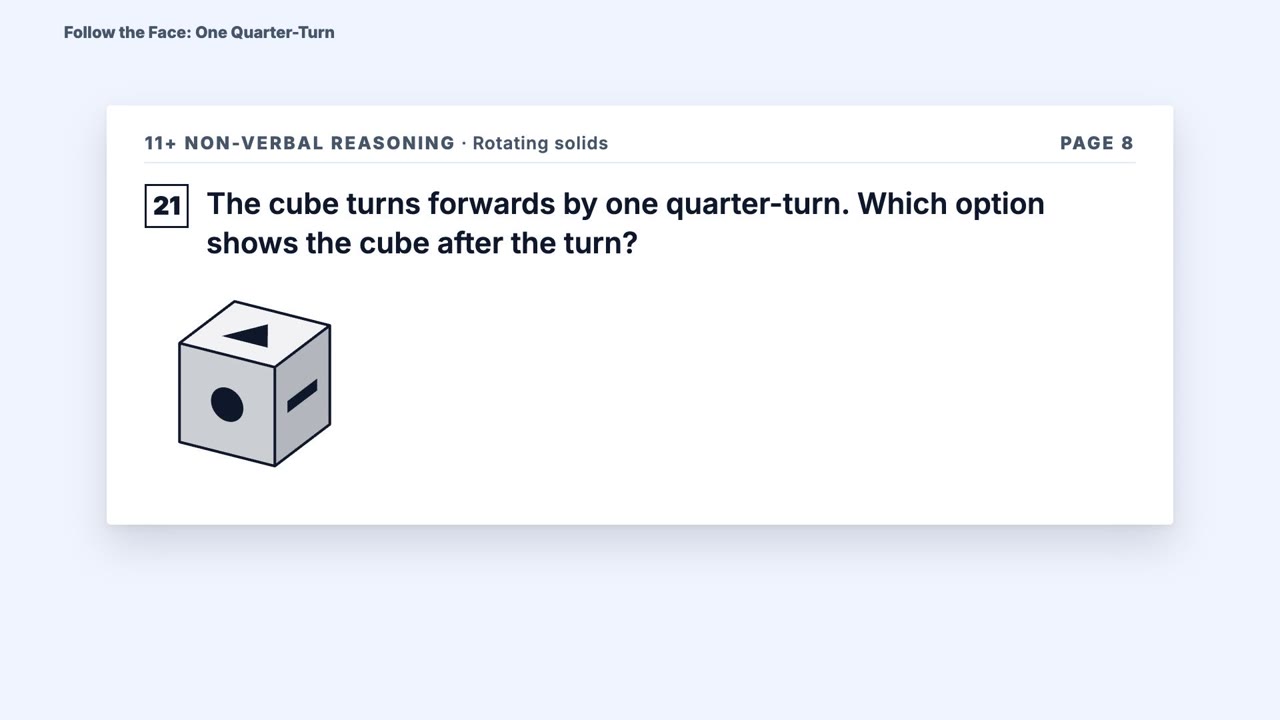 Length 2:30
Rotate a 3D solid mentally
The free diagnostic checks maths, English and both kinds of reasoning, and shows what to practise next. No card is required.