
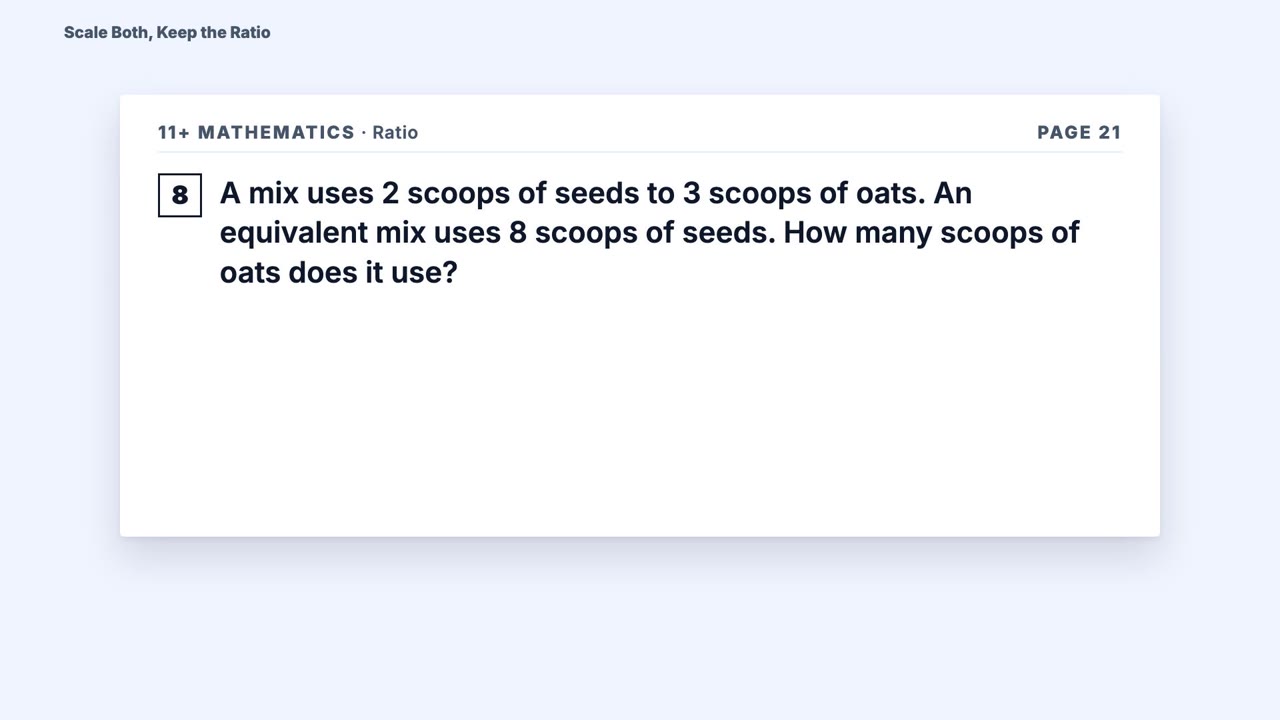
 Length 2:36
Scale Both, Keep the Ratio
Scale quantities in a ratio
11+ Maths · Problem
A short worked example (2:36) for one 11+ maths skill: Solve a multi-step problem.
This video shows how to choose and carry out a sequence of calculations to solve a word problem. Watch an 11+ maths question solved step by step.
Turn on captions with the CC button. The full transcript is below the video.
Every word of the video, to read along or to skim before watching.
A single question can hide more than one job. Spot the jobs in the right order, and a tangled story turns into a neat little trail. Miss the order... and even perfect arithmetic can lead you somewhere completely wrong.
First, picture the story. Ask, what is happening? Then find the final thing you must discover. Circle that task. Underline only the numbers and units that help you reach it. Next, build a step trail. Each box holds one small job. An arrow shows that one answer feeds the next job. Choose operations from the meaning: equal groups suggest multiplication; taking away suggests subtraction. Do not simply use the numbers from left to right, or add them because they are there. Read the relationships. After every step, label the answer, and ask, does this amount make sense in the story?
Let's work through an example. A school fair has six trays of eight apple cakes. During the morning, seventeen cakes are sold. How many apple cakes are left for the afternoon? The trays show equal groups, so our first job is multiplication. Six times eight equals forty-eight. We place forty-eight cakes in the first answer box. That tells us how many cakes there were before any were sold. Now that answer feeds the second job. Seventeen were sold, so we subtract. Forty-eight minus seventeen equals thirty-one. Watch the units stay the same: cakes. The answer is thirty-one apple cakes left for the afternoon. Check the trail. Six trays made forty-eight cakes, then selling some made the amount smaller. Thirty-one is below forty-eight, so it fits. Never trust an answer just because it looks tidy. Trace each step back to the story: six groups of eight, then seventeen taken away. That is how you prove both operations belong.
So remember: find the final task, build the step trail, follow the story's actions, and label each answer. One job feeds the next... and you can untangle any short multi-step problem with confidence.
Watch these next. The first ones teach the skills closest to this one.
Length 2:36Scale quantities in a ratio
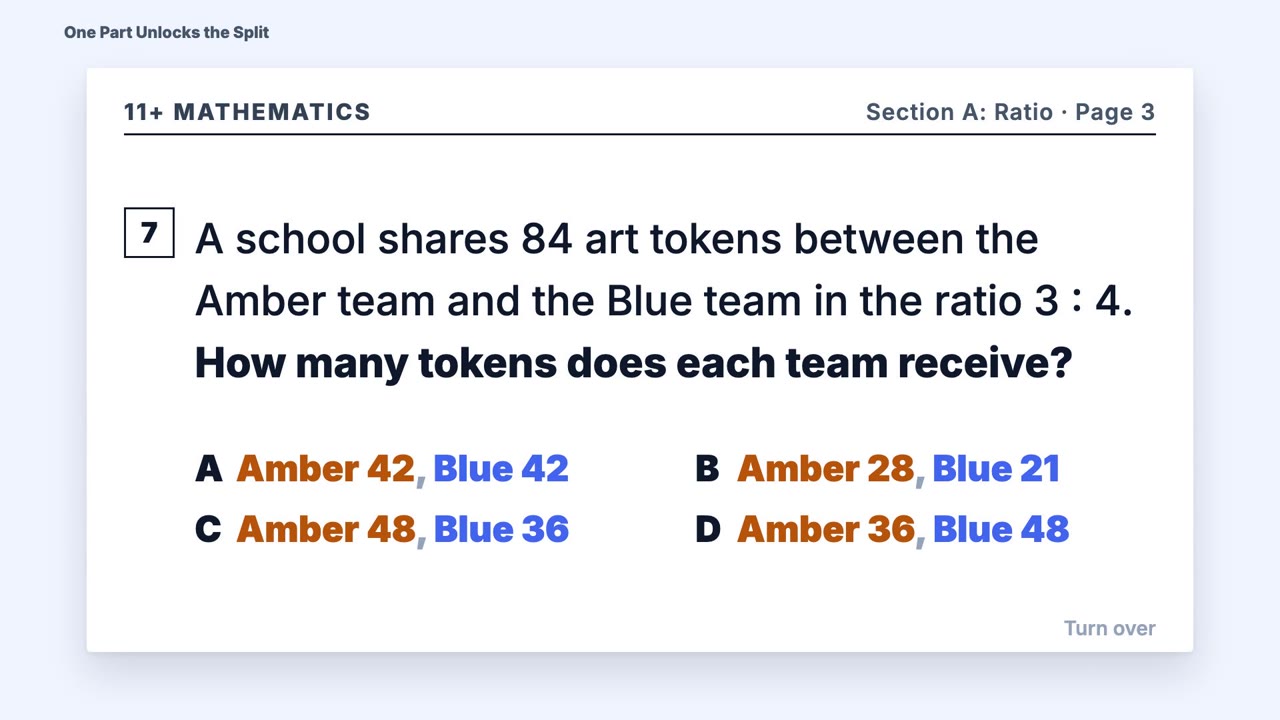 Length 2:38
Share a total in a ratio
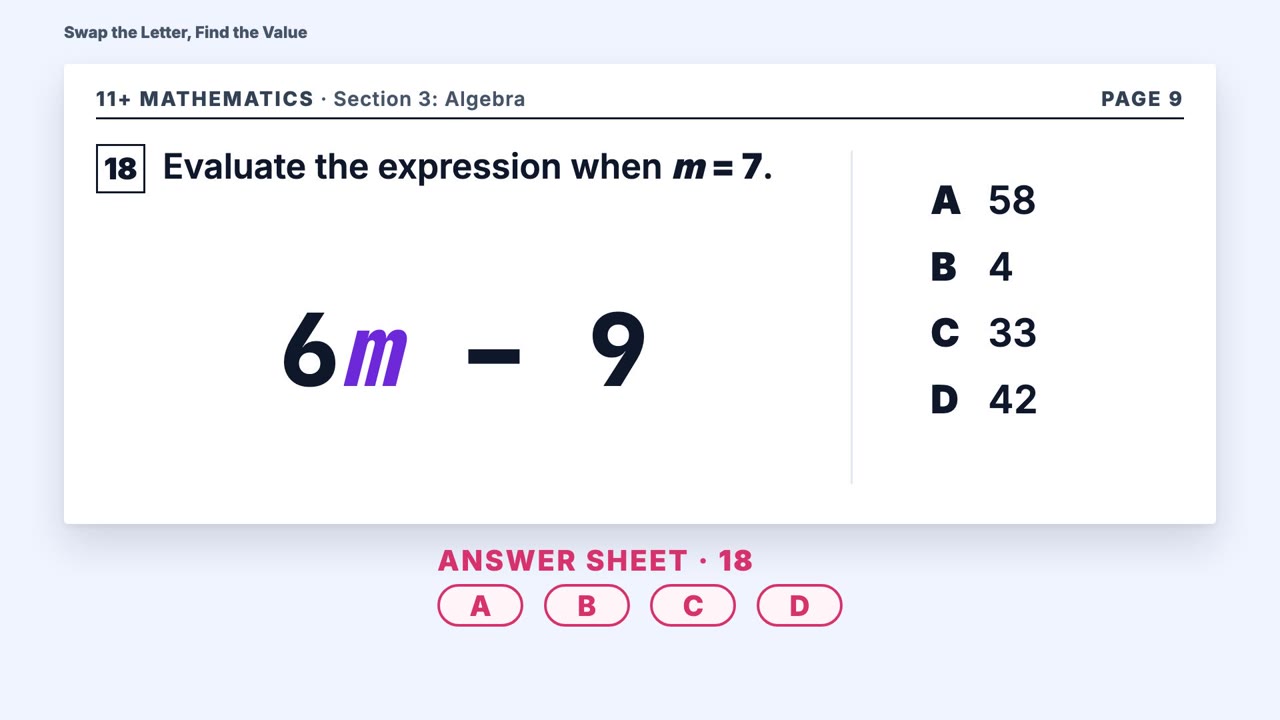 Length 2:29
Evaluate an algebraic expression
The free diagnostic checks maths, English and both kinds of reasoning, and shows what to practise next. No card is required.