
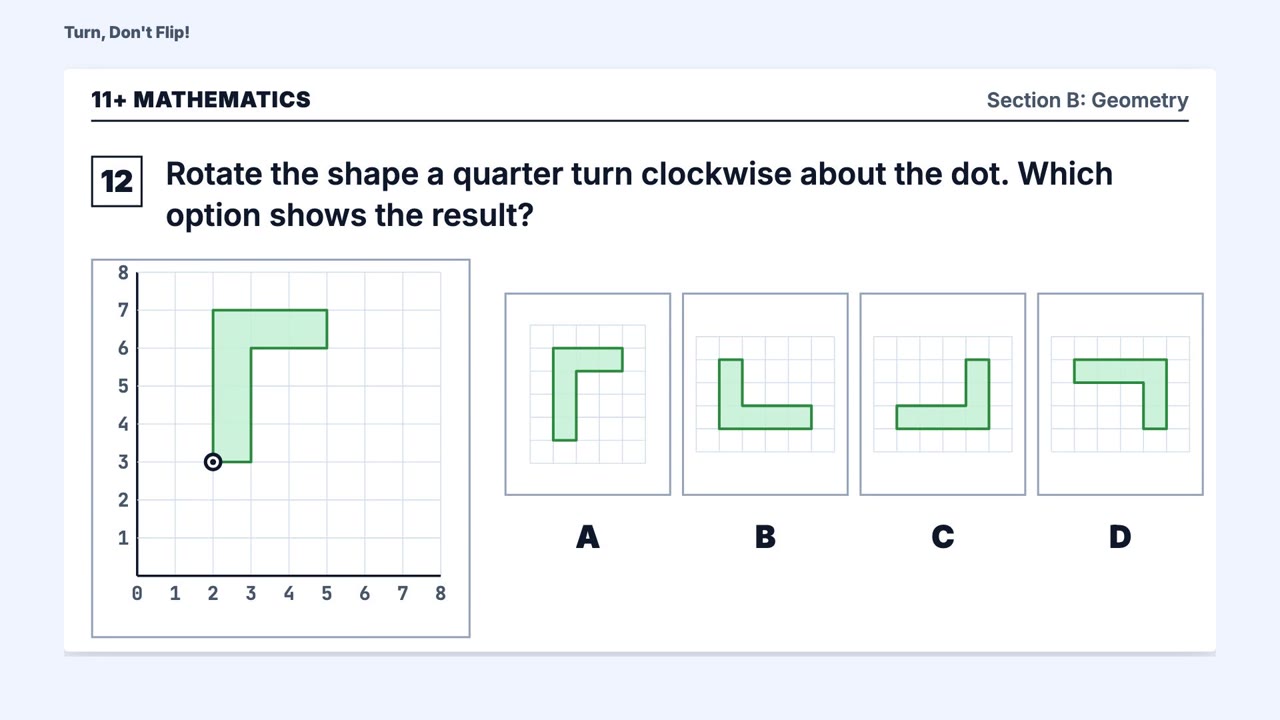
 Length 2:36
Turn, Don't Flip!
Rotate a shape
11+ Maths · Geometry
A short worked example (2:39) for one 11+ maths skill: Rotate a coordinate.
This video shows how to find a point’s new coordinates after a rotation about the origin. Watch an 11+ maths question solved step by step.
Turn on captions with the CC button. The full transcript is below the video.
Every word of the video, to read along or to skim before watching.
A dot can leap from one side of a grid to another without changing its distance from the centre. The secret is not a slide, and it is not a mirror... it is a TURN around the origin.
On a coordinate grid, the origin is where the axes cross: zero, zero. A rotation swings every point around that fixed centre. Picture a stiff arm joining the origin to the point. The arm turns, but its length stays exactly the same. For a quarter turn anticlockwise, the arm turns left through ninety degrees. Watch the point at three, one. After the turn, it lands at negative one, three. The old vertical distance becomes the new horizontal distance, on the opposite side. Always read coordinates across first, then up or down: horizontal, then vertical. A rotation is not a reflection. The point travels around the origin, and an arrow showing the turn keeps the shape's orientation moving with it.
Let's work through an example. Point A is at four, two. It is rotated ninety degrees anticlockwise about the origin. What are the coordinates of the image, A prime? First, plot A by moving four places right, then two places up. Join the origin to A with an imaginary arm. Now swing that arm anticlockwise through one quarter turn. Keep the arm the same length... no stretching, and no flipping. Track where the distances go. The two-place vertical distance becomes two places left of the vertical axis, so the new horizontal coordinate is negative two. The four-place horizontal distance becomes four places above the horizontal axis, so the new vertical coordinate is four. Read across, then up: negative two, four. So A prime is negative two, four. A matching quarter-turn arrow confirms the point has rotated left around the origin, rather than being mirrored across an axis.
Remember: keep the origin fixed, keep the distance unchanged, follow the stated direction and turn, then read horizontal before vertical. Do that, and every rotated coordinate has a clear landing place. You've got this!
Watch these next. The first ones teach the skills closest to this one.
Length 2:36Rotate a shape
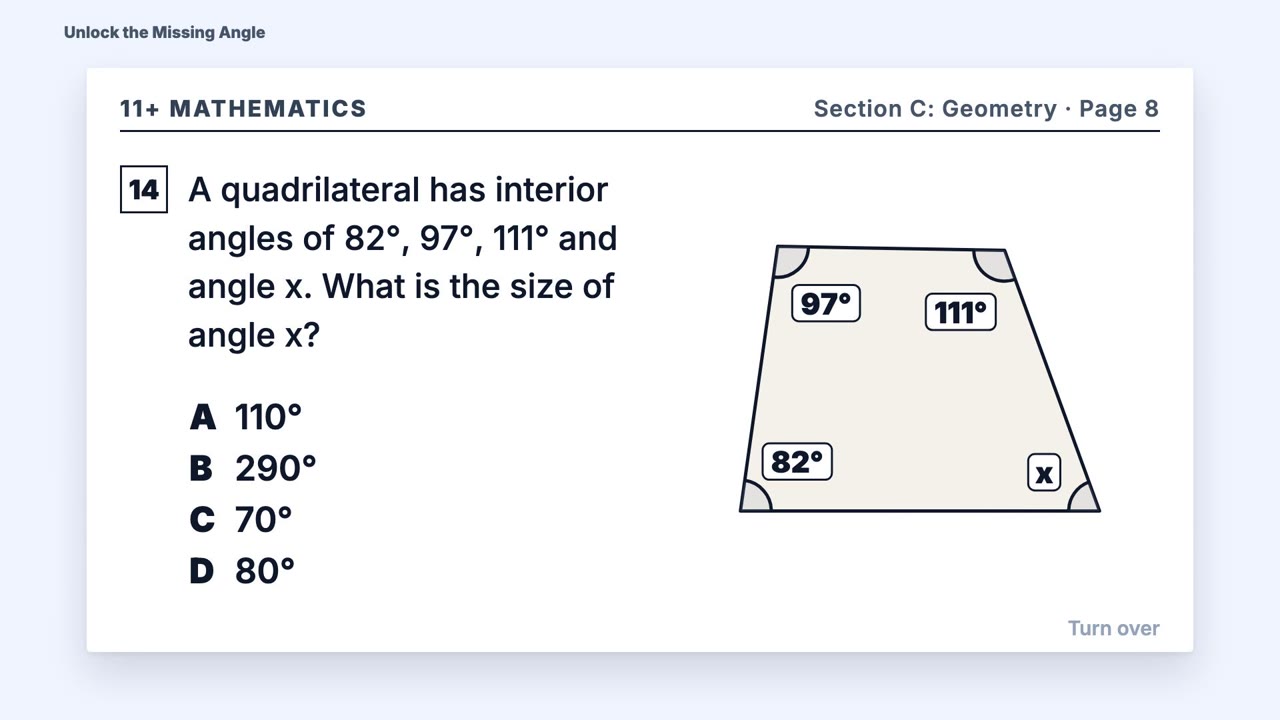 Length 2:41
Solve an angle relation
 Length 2:26
Track cube faces from a net
The free diagnostic checks maths, English and both kinds of reasoning, and shows what to practise next. No card is required.