
 Length 2:34
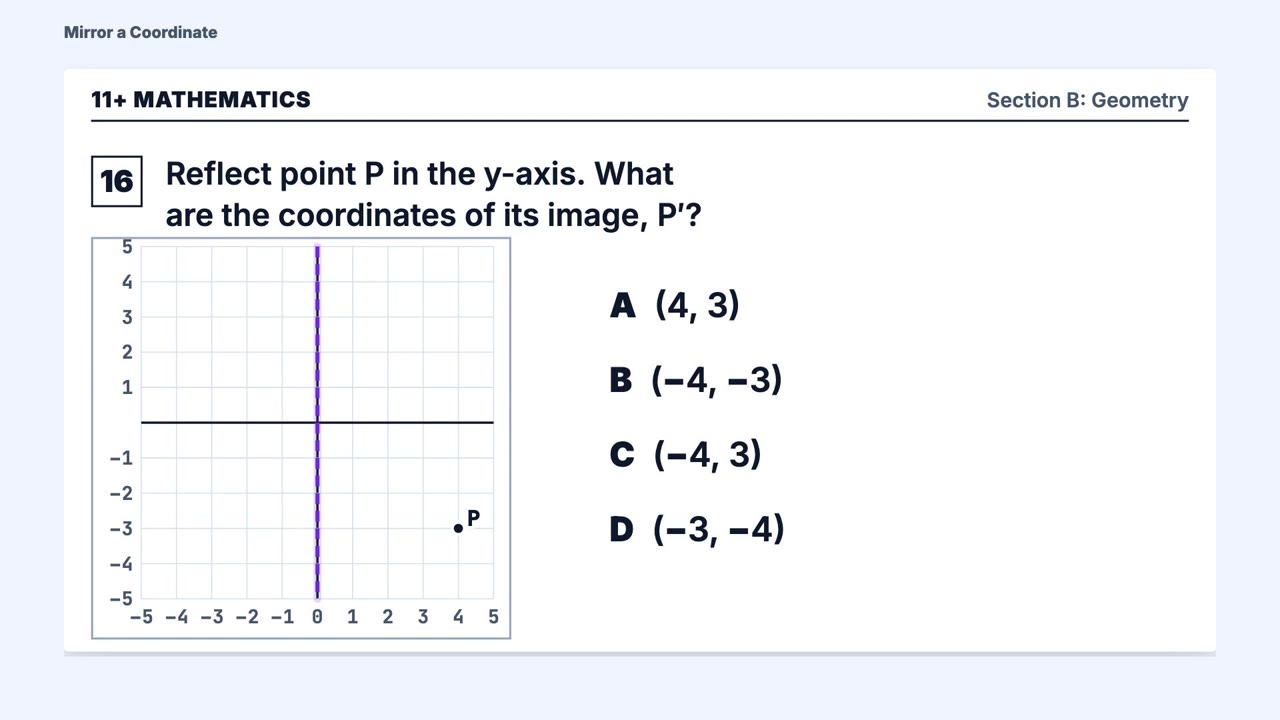
Mirror a Coordinate
Reflect a coordinate
11+ Maths · Geometry
A short worked example (2:44) for one 11+ maths skill: Preserve measure under a rigid transformation.
This video shows how to check why translations, rotations and reflections preserve a shape’s lengths and angles. Watch an 11+ maths question solved step by step.
Turn on captions with the CC button. The full transcript is below the video.
Every word of the video, to read along or to skim before watching.
Can a shape spin, slide, or flip, yet keep every measurement exactly the same? Watch this triangle move... It changes place and direction, but its side lengths and angles refuse to budge.
A translation slides every point by the same distance and in the same direction. See the three side labels travel with the triangle. They do not stretch or shrink. The angle arcs travel too. Each opening stays exactly as wide as before. A rotation turns a shape around a fixed point. A reflection flips it across a mirror line. All three moves are RIGID: matching side ticks and angle arcs keep their values. A turn may make the triangle face a new direction, but its clockwise order stays the same. Do not mirror it. Only reflection reverses handedness.
Let's work through an example. A right-angled triangle has sides of six centimetres, eight centimetres, and ten centimetres. Its other two angles are about thirty-seven degrees and fifty-three degrees. The triangle is rotated clockwise through ninety degrees. What are the side lengths and angles after the rotation? First, identify the transformation. The curved arrow shows a rotation, not a reflection. Do not mirror the triangle or reverse its arrangement. Track the marked right angle as the whole triangle turns clockwise. It lands in a new direction, still between the same two sides. Now carry the measures with the triangle. The six-centimetre side stays six centimetres. The eight-centimetre side stays eight centimetres. The ten-centimetre side stays ten centimetres. The right angle stays ninety degrees, while the other angles stay about thirty-seven degrees and fifty-three degrees. Nothing needs recalculating, because the move is rigid. So the answer is: side lengths six, eight, and ten centimetres; angles ninety, about thirty-seven, and about fifty-three degrees. Only the triangle's position and direction have changed.
Slides, turns, and flips can change where a shape sits, but never its lengths or angles. Carry every measurement with the shape, name the move carefully, and you have it!
Watch these next. The first ones teach the skills closest to this one.
Length 2:34Reflect a coordinate
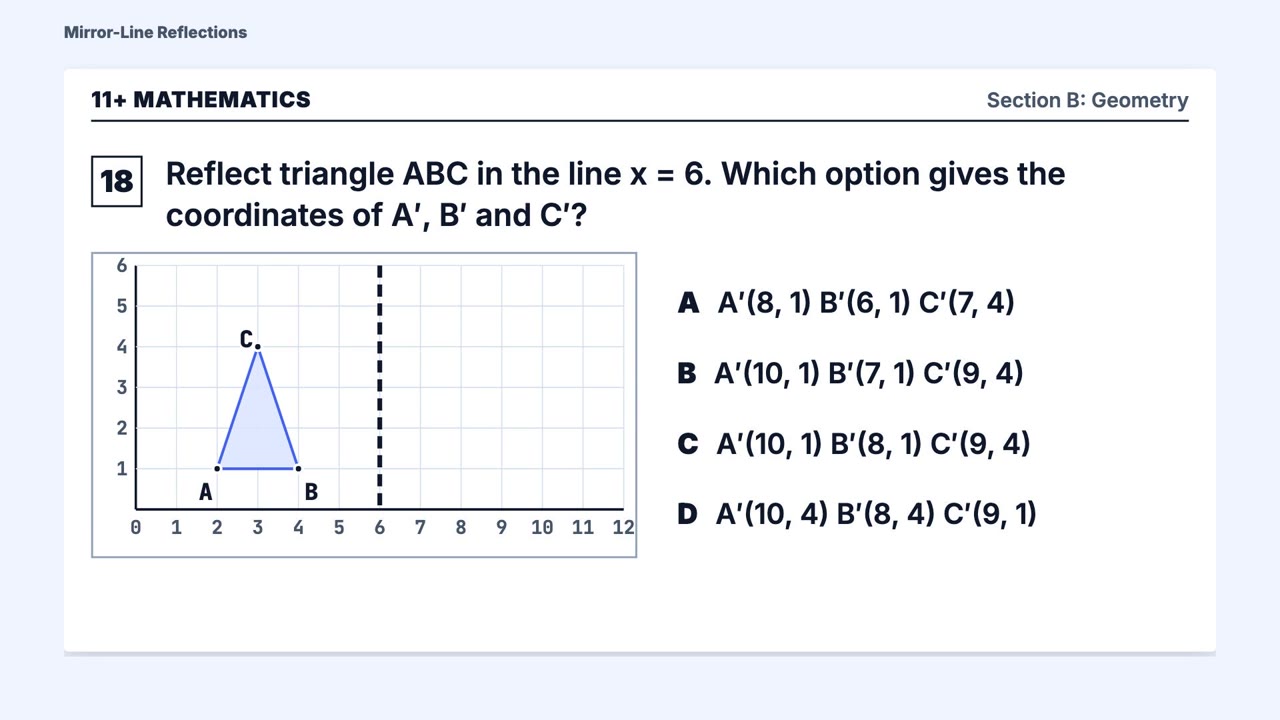 Length 2:34
Reflect a shape
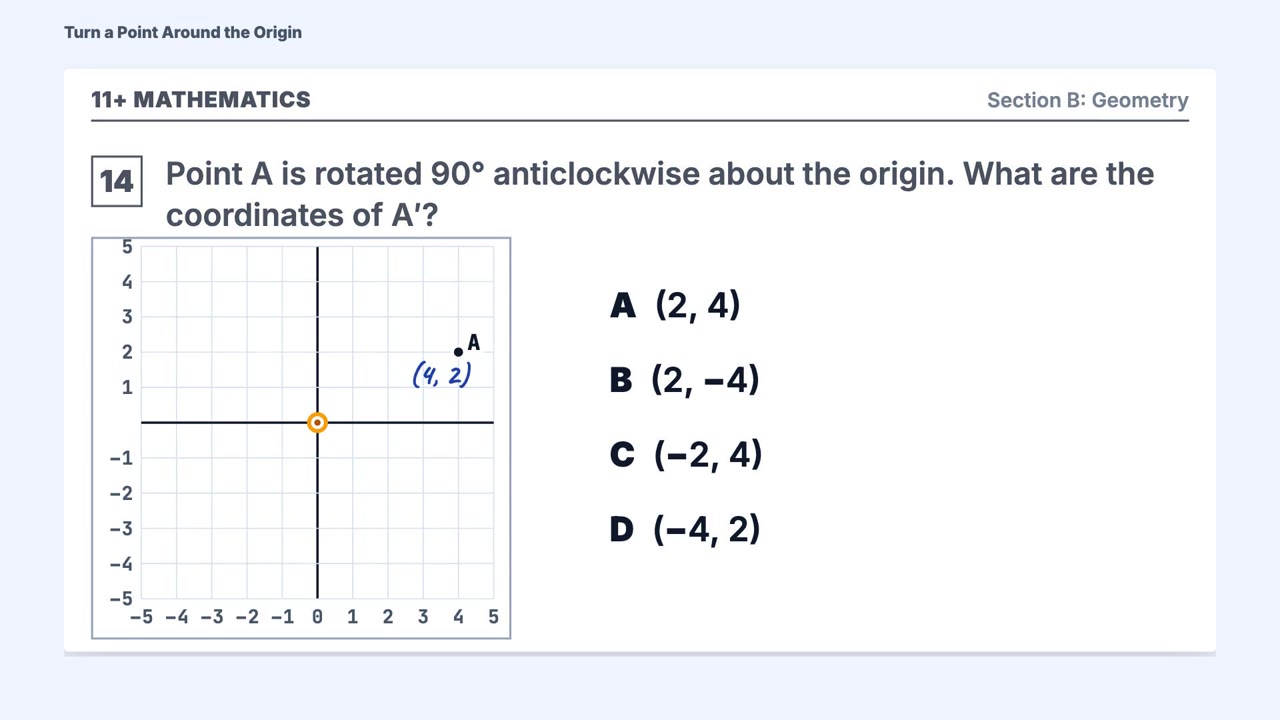 Length 2:39
Rotate a coordinate
The free diagnostic checks maths, English and both kinds of reasoning, and shows what to practise next. No card is required.