
 Length 2:31
Across, Then Up
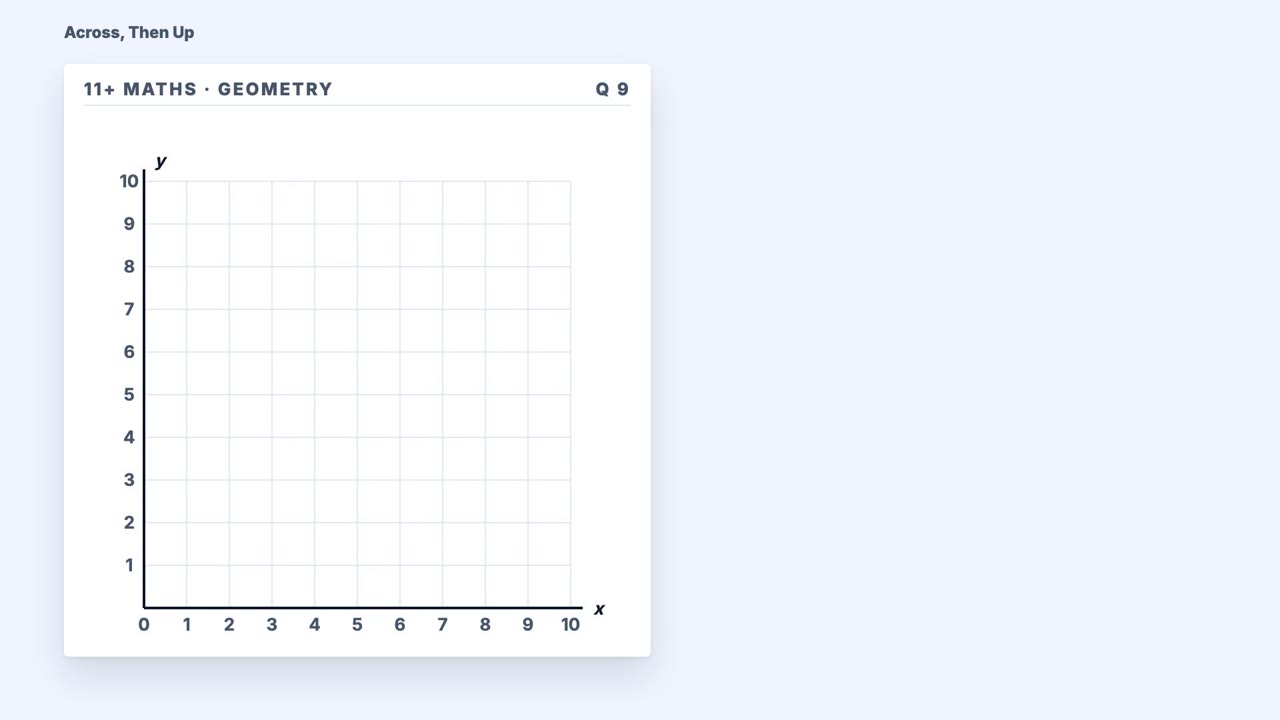
Plot or read a coordinate
11+ Maths · Geometry
A short worked example (2:48) for one 11+ maths skill: Identify a geometric transformation.
This video shows how to compare a shape and its image to identify the transformation that relates them. Watch an 11+ maths question solved step by step.
Turn on captions with the CC button. The full transcript is below the video.
Every word of the video, to read along or to skim before watching.
One triangle, three possible moves. It might slide, turn, or flip. Yet only ONE clue reveals the transformation... what happens to its position and its orientation. Let's become transformation detectives and spot that clue every time.
A translation is a slide. Every corner travels the same distance in the same direction, and the shape keeps facing exactly the same way. Follow one matching corner. Count across first, then up or down. Coordinates work in that order too: horizontal before vertical. A slide never turns and never makes a mirror image. A rotation is a turn around a fixed centre. Watch the little arrow painted on the shape: it turns with the shape. Name the angle and direction, such as a quarter turn clockwise. Do not mistake that new facing direction for a reflection. A turn preserves the shape; it does not mirror it. A reflection is a flip across a mirror line. Matching corners sit the same perpendicular distance from that line, on opposite sides. Orientation reverses, just like writing in a mirror. So ask three questions: same facing, turned, or mirrored? That separates the transformations.
Let's work through an example. On a square grid, triangle A has vertices at two, one; four, one; and two, three. Triangle B has vertices at five, three; seven, three; and five, five. Which single transformation maps triangle A onto triangle B? Give its full description. Start with the right-angled corner at two, one. To reach its matching corner at five, three, move three squares right and two squares up. Check another corner: four, one moves to seven, three. It is the same journey. Remember, read horizontal first, then vertical. All matching corners move three right and two up, while the triangle keeps its orientation. There is no turn and no mirror line. So the transformation is a TRANSLATION by three squares right and two squares up. In vector language, that is three, two.
Slide means translation, turn means rotation, and flip means reflection. Track one corner, check the orientation, and name the full movement. You've cracked it!
Watch these next. The first ones teach the skills closest to this one.
Length 2:31Plot or read a coordinate
 Length 2:44
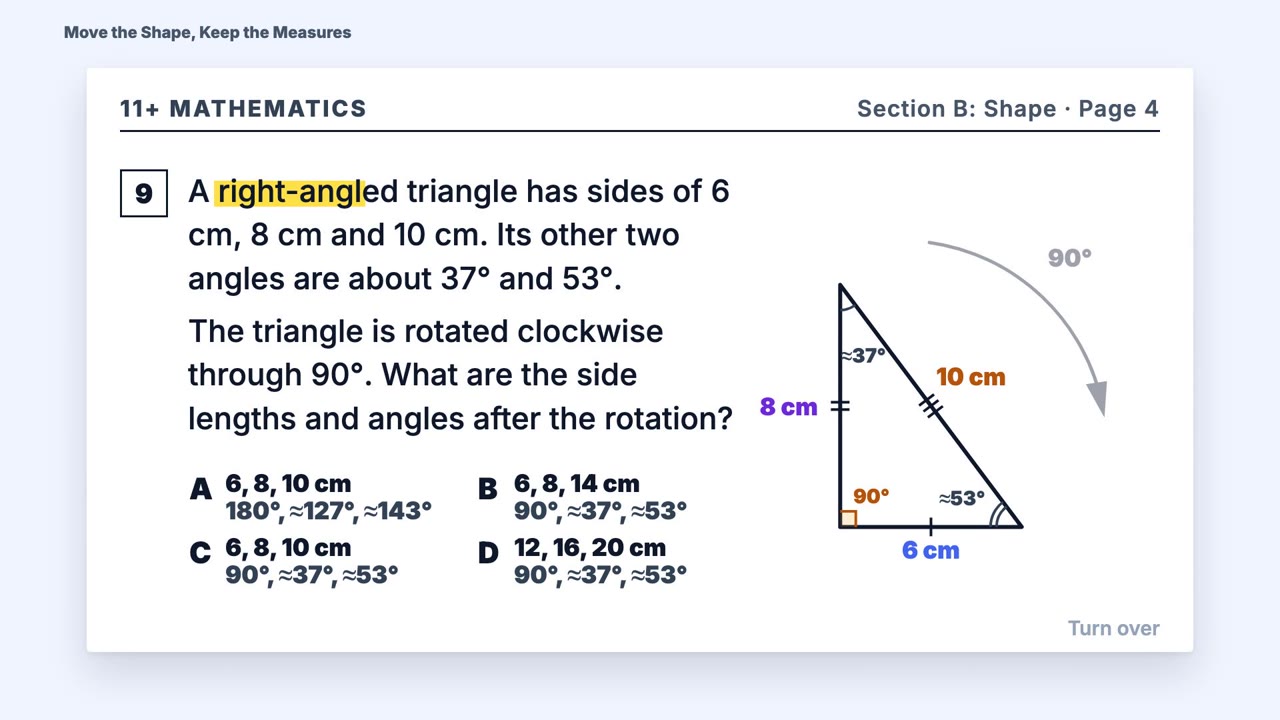
Preserve measure under a rigid transformation
 Length 2:34
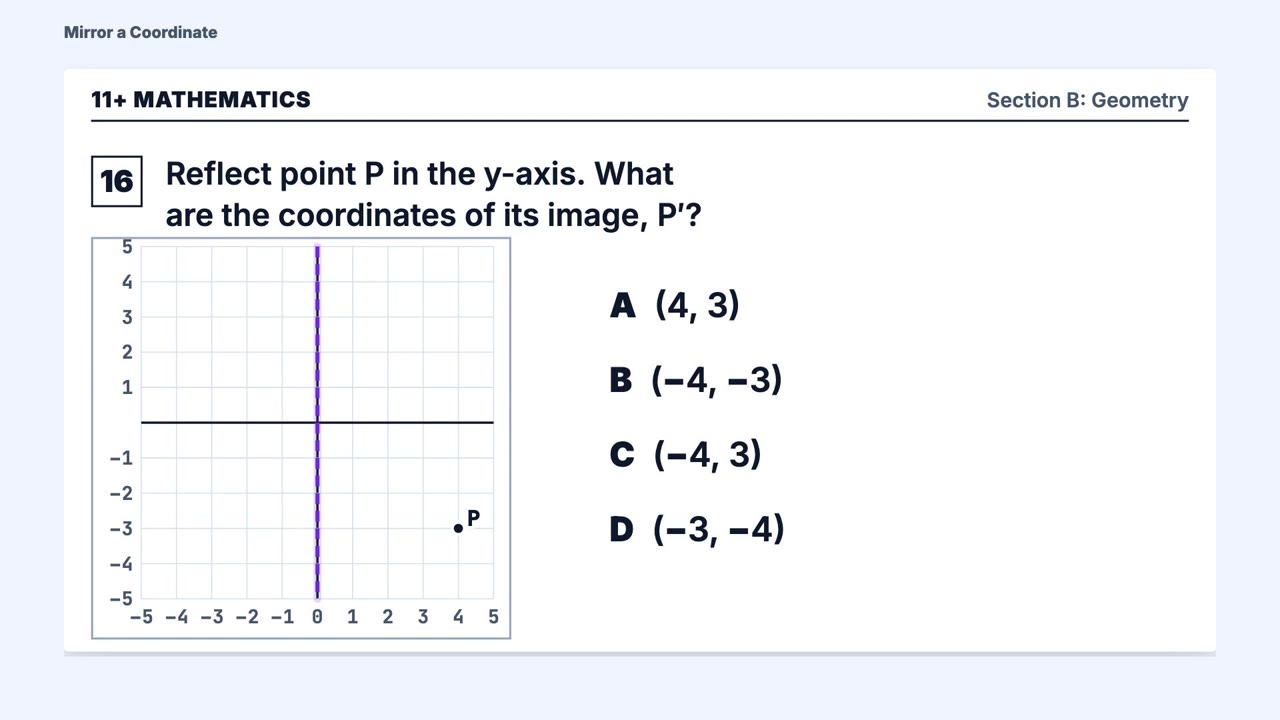
Reflect a coordinate
The free diagnostic checks maths, English and both kinds of reasoning, and shows what to practise next. No card is required.